AI virtual agents that resolve support conversations while your team sleeps
Deploy a virtual agent that answers using your own website content, operates around the clock in 36 languages, and hands off to humans only when genuine judgment is required. One snippet, no coding.
Watch a virtual agent work on your website
Enter your URL and see the AI virtual agent answer real visitor questions using your published content
A digital teammate that reads everything you publish and never clocks out
Traditional chatbots follow scripts. Virtual agents think. Asyntai crawls your website — product pages, pricing tables, help articles, policy documents — and builds a retrieval layer the AI queries in real time for every visitor conversation. The result is an agent that answers the way a well-briefed employee would: drawing on actual company information, staying within boundaries you define, and knowing when to bring in a colleague.
- Automatic content ingestionPoint the virtual agent at your URL and it crawls up to 50 pages of product listings, FAQs, shipping policies, and documentation — building its knowledge base without manual data entry.
- Private document uploadsSupplement public content with internal PDFs, warehouse procedures, escalation playbooks, or seasonal promotions that the virtual agent references alongside your website.
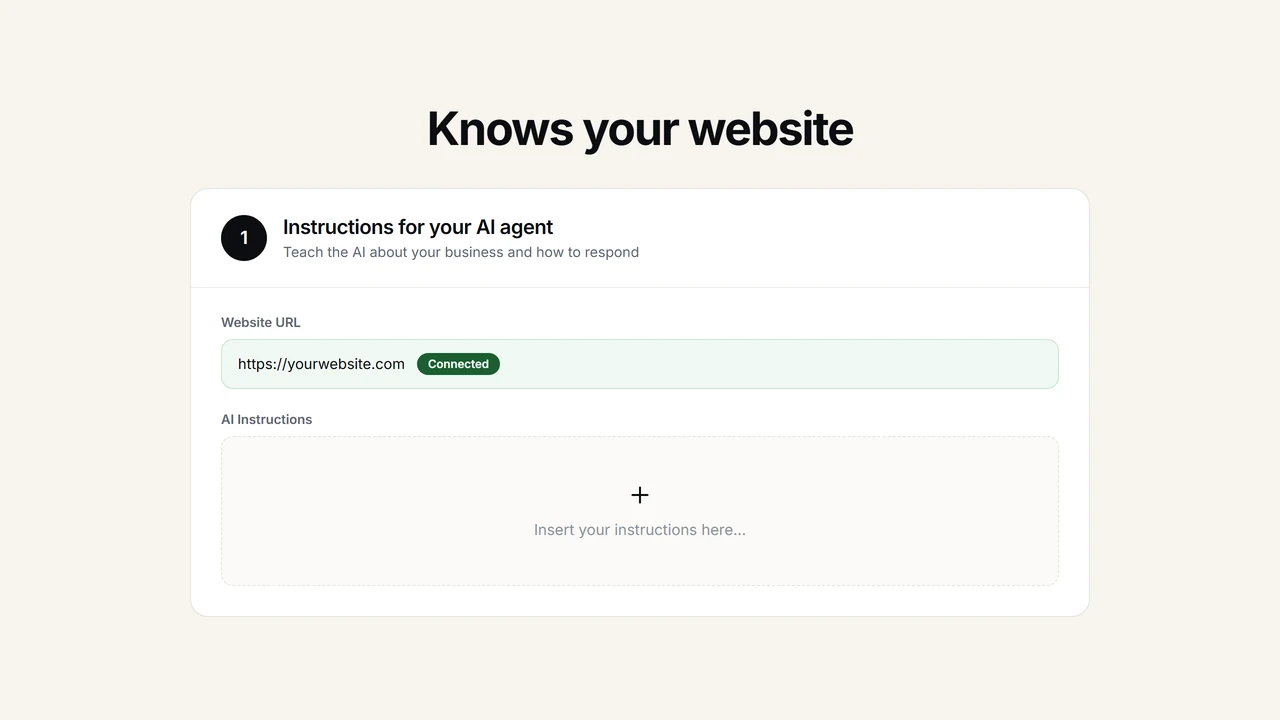
- Behavioral instructions in plain EnglishTell the agent how to greet visitors, when to escalate, what topics to avoid, and what tone to use. No programming syntax — just sentences describing the behavior you expect.
Virtual agents that act, not just reply
Answering questions is table stakes. On Standard ($139/month) and Pro ($449/month) plans, Custom Tools let your virtual agent call your own APIs mid-conversation — checking order status, looking up account details, verifying appointment availability, or initiating a return. The visitor gets a real answer drawn from live systems, not a redirect to another page.
- Live order and account lookupsConnect the virtual agent to your order management or CRM API and it retrieves real-time status, tracking numbers, or subscription details during the conversation.
- 36-language fluencyThe virtual agent detects each visitor's language automatically and responds accordingly — German, Japanese, Portuguese, Arabic, or any of 36 supported languages — using your content as the source of truth.
- Contextual escalation with full transcriptWhen the virtual agent reaches its limits, it collects the visitor's email and delivers the complete conversation to your dashboard and inbox so your team never starts cold.
- White-label brandingRemove Asyntai branding entirely on Pro (automatic) or Standard (email [email protected]) — visitors see your brand, not ours.
- User Context for personalizationPush logged-in visitor data via JavaScript so the virtual agent can reference their specific account tier, recent purchases, or membership status in its replies.
Deploy your virtual agent before lunch
No IT project. No vendor onboarding calls. One JavaScript snippet in your site header, one content crawl, a few behavioral rules typed in plain English, and your virtual agent is live — greeting visitors, resolving questions, and capturing leads you would have missed overnight.
- Create a free Asyntai account — no credit card — and copy the JavaScript snippet from your dashboard. Free plan: $0/month, 1 site, 50 messages.
- Paste the snippet into the
<head>of your website via your CMS, theme settings, or template file. The virtual agent appears immediately. - Enter your website URL for automatic content ingestion and upload any internal documents the agent should reference. Starter plan: $39/month, 2 sites, 800 messages.
- Write behavioral instructions covering tone, escalation triggers, and greeting style — then test with sample conversations. Standard: $139/month, 3 sites, 15,000 messages. Pro: $449/month, 20 sites, 50,000 messages.
<script src="https://asyntai.com/widget.js"
data-id="your-site-id" async>
</script>
# Virtual agent deployed — always on, every language.
AI Virtual Agents for Customer Support — FAQs
Questions teams ask before putting a virtual agent on the front line.
How is a virtual agent different from a regular chatbot?
A regular chatbot follows decision trees or keyword triggers — it can only handle scenarios someone explicitly programmed. A virtual agent uses a large language model to understand intent, retrieve relevant information from your content, and compose natural responses. It handles novel phrasings, multi-part questions, and topics that span multiple pages of your site without requiring predefined flows.
What content does the virtual agent use to answer questions?
It uses your own content. Asyntai crawls your publicly accessible website pages — product descriptions, pricing, FAQs, help articles, policy pages — and you can supplement that with uploaded PDFs or pasted text for internal information. The agent retrieves from this content in real time rather than generating answers from general knowledge, which keeps responses accurate and specific to your business.
Will the virtual agent make up answers if it does not know something?
No. The agent is grounded in your content through retrieval. When a question falls outside what your knowledge base covers, the agent acknowledges the gap honestly and offers to connect the visitor with your team. You can fine-tune this behavior through custom instructions — for example, requiring the agent to always escalate billing disputes or warranty claims.
Can it handle customers who speak different languages?
Yes — 36 languages. The virtual agent detects the visitor's language from their first message and responds in kind. A Spanish-speaking customer gets Spanish responses, a Korean-speaking customer gets Korean, even if your website content is entirely in English. There is no per-language setup or translation layer to manage.
What happens when the virtual agent cannot resolve a question?
It captures the visitor's name and email, preserves the full conversation transcript, and delivers everything to your Asyntai dashboard and support inbox. Your team picks up the thread with complete context — what the visitor asked, what the agent replied, and where the conversation reached its limit. No cold restarts.
Can the virtual agent perform actions like checking order status?
On Standard and Pro plans, Custom Tools let the agent call your APIs during a conversation. You define the endpoint, the parameters, and what data comes back. The agent can look up orders, check inventory, verify appointment slots, or pull account details — then weave that live data into its response naturally.
Does adding the virtual agent slow down my website?
No. The widget loads asynchronously after your page renders — it does not block the initial paint or affect Core Web Vitals. It behaves like any lightweight third-party script, similar to an analytics tag or a tracking pixel.
How much does a virtual agent cost?
The free plan covers 1 site and 50 messages per month at no cost. Starter is $39/month for 2 sites and 800 messages. Standard is $139/month for 3 sites and 15,000 messages. Pro is $449/month for 20 sites and 50,000 messages. Each AI response counts as one message, and you receive email warnings before approaching your cap.
Can I remove Asyntai branding from the virtual agent?
Yes. On Pro plans, white-labeling is automatic — visitors see only your brand. On Standard plans, white-labeling is available by request — email [email protected] and the team enables it for your account.
AI virtual agents for customer support — why the shift from chatbot to agent matters
Every business that serves customers online eventually hits the same wall. Support volume climbs. Hiring more agents eats into margins. Response times creep upward. Customers who waited three minutes last quarter now wait eight. The ones who do not wait simply leave — silently, permanently, taking their revenue and their referrals with them. The conventional response is to hire faster, train harder, schedule smarter. But staffing solutions scale linearly with demand, and customer expectations do not wait for your recruiting pipeline to catch up. AI virtual agents represent a fundamentally different architecture for support: a digital worker that handles conversations independently, drawing on your company's own published content, operating without shifts or breaks or language barriers.
The word "agent" carries weight that "chatbot" does not, and the distinction matters beyond marketing vocabulary. A chatbot is a responder — it waits for input and tries to match it against prepared answers. A virtual agent is an operator. It reads the visitor's message, understands the underlying intent even when the phrasing is ambiguous, searches across your entire content library for the most relevant information, composes a response that addresses the specific question, and decides whether it can resolve the issue or should bring in a human. That loop — perceive, reason, retrieve, respond, decide — is what separates an agent from a script. It is also what allows a single Asyntai installation to handle questions that would have required a six-person support team rotating through three time zones.
Content grounding is the mechanism that keeps virtual agents honest. An agent that generates responses from general knowledge will eventually hallucinate — confidently stating a return window your company does not offer, or quoting a shipping rate from a competitor's policy. Asyntai eliminates this failure mode by restricting the agent to retrieval. When a visitor asks about your return policy, the agent does not compose an answer from its general understanding of e-commerce returns. It searches the specific return policy page it crawled from your website, extracts the relevant details, and presents them in conversational language. If no relevant content exists in its knowledge base, it says so directly rather than improvising. The accuracy floor this creates is what makes virtual agents viable for real business conversations where a wrong answer costs more than no answer.
Deployment speed is where virtual agents diverge most sharply from the enterprise software they are often compared against. Traditional virtual agent platforms — the kind sold through multi-month procurement cycles — require intent mapping, dialog flow design, entity extraction configuration, integration middleware, and weeks of testing before a single conversation occurs. Asyntai collapses that timeline to an afternoon. You paste a JavaScript snippet into your website header. You provide your URL and the system crawls your pages. You type behavioral instructions in plain English — how to greet visitors, when to escalate, what subjects to avoid. You test a handful of conversations. You go live. The virtual agent starts working the same day you decide to try it, because the content it needs already exists on your website and the configuration it requires fits in a text field.
Language coverage reveals one of the quieter advantages of AI virtual agents over human support teams. Hiring a native Korean speaker, a native Portuguese speaker, and a native Arabic speaker to cover three customer segments requires three salaries, three onboarding cycles, and three schedule management headaches — and you are still uncovered in the remaining thirty-three languages your visitors might arrive in. An Asyntai virtual agent detects each visitor's language from their opening message and responds accordingly across all thirty-six supported languages. The content it retrieves may be written in English, but the response it delivers is in the visitor's language. For businesses with international traffic that outpaces their ability to staff multilingual teams, this capability alone justifies the cost of deployment.
The repetition problem in customer support is well-documented but rarely solved structurally. Studies across industries suggest that sixty to eighty percent of inbound support questions are variations of the same fifteen to twenty topics: shipping timelines, return procedures, pricing details, account access, feature availability, billing cycles. Each of those questions is answerable from content the business has already written and published. The structural waste is that a human agent reads the same question for the fortieth time that month, retrieves the same knowledge article, paraphrases the same answer, and sends it to the fortieth different customer — each time investing attention and salary on a task that produces identical output. A virtual agent absorbs that entire repetitive layer. It handles the fortieth instance exactly as accurately as the first, at three in the morning on a Sunday, in Thai, without fatigue or variation. Your human team inherits only the conversations that genuinely benefit from human creativity, empathy, or authority.
Custom Tools on Standard and Pro plans push virtual agents past the boundary of information delivery into actual task execution. A visitor asking "where is my order?" does not want to hear "please check your email for tracking information." They want a tracking number. With Custom Tools, the virtual agent calls your order management API mid-conversation, retrieves the shipment status, and presents it directly. A visitor asking "can I reschedule my appointment?" does not want a phone number to call. They want available time slots. The virtual agent queries your scheduling system and offers options. This capacity to act — not merely inform — is what earns the term "agent." The visitor's problem gets resolved inside the chat window, without navigating to another page, without waiting for a callback, without repeating information they already provided.
Escalation architecture determines whether a virtual agent builds trust or destroys it. A poorly designed handoff — "I cannot help you, please email [email protected]" — negates every positive interaction the agent had before that moment. The visitor feels dumped. They have to re-explain their situation from scratch. Whatever efficiency the agent provided is consumed by the friction of the transition. Asyntai designs escalation as a continuation, not a restart. The virtual agent collects the visitor's contact details, preserves the complete conversation, and delivers both to your dashboard and inbox in real time. When your team member opens the case, they see every question asked, every response given, and the exact point where the conversation exceeded the agent's scope. They respond as if they overheard the entire exchange — because they did.
Personalization through User Context transforms a competent virtual agent into one that feels uncannily attentive. On Standard and Pro plans, your website can push visitor-specific data into a JavaScript variable before the chat loads — account tier, recent purchase history, subscription renewal date, loyalty status, geographic region. The virtual agent incorporates that data naturally into its responses. A Pro-tier customer asking about advanced features gets confirmation and usage tips. A free-tier visitor asking about the same features learns they would need to upgrade, with a clear path to do so. A customer whose subscription renews next week gets proactive context about what to expect. None of this requires backend API integration beyond a few lines of JavaScript on your page — the data flows one way, from your site into the agent's conversation context.
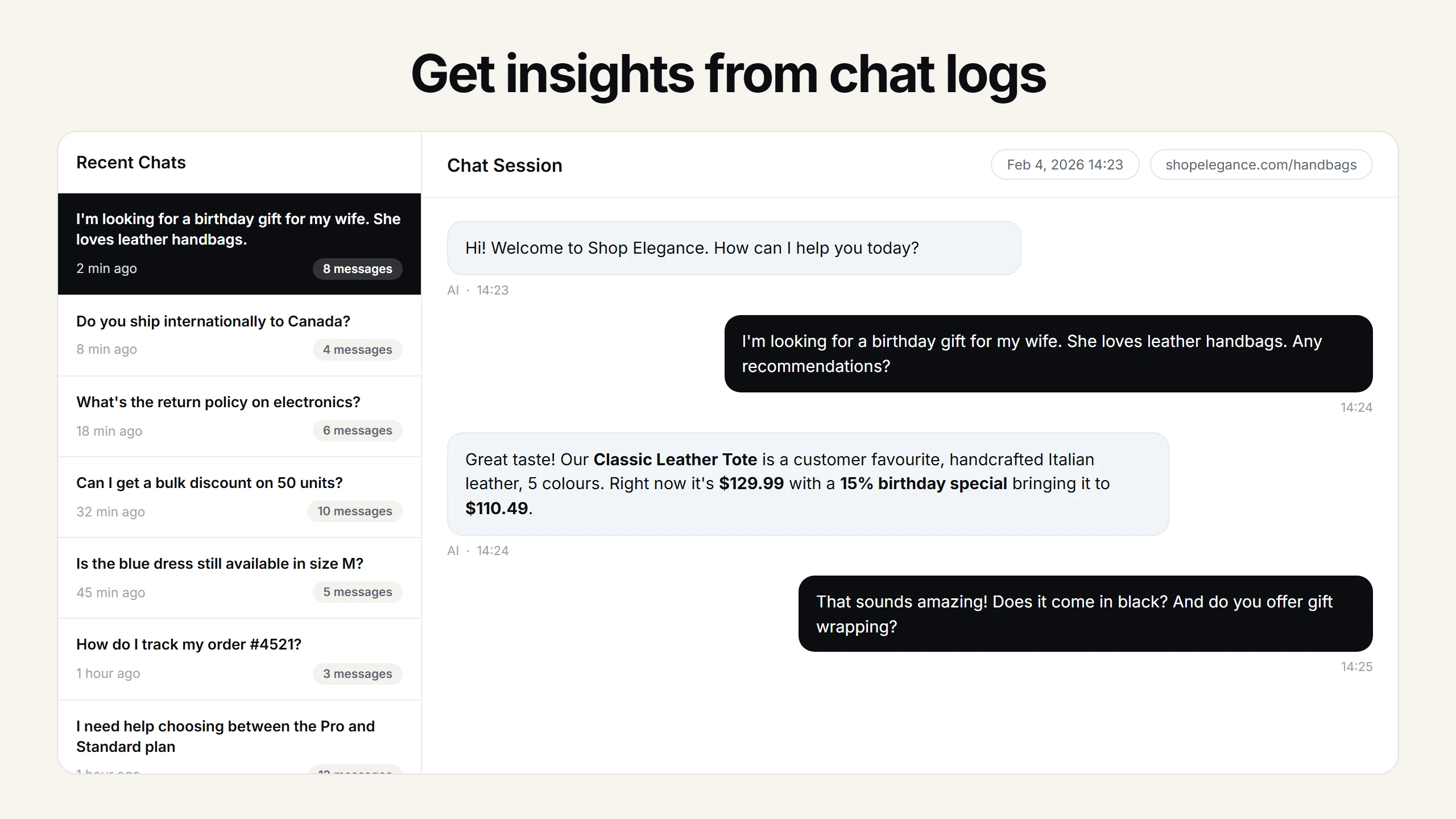
Analytics from virtual agent conversations reveal patterns that traditional support metrics obscure. When humans handle tickets, you measure response time and satisfaction scores — useful but surface-level. When a virtual agent handles thousands of conversations, you see the actual distribution of what customers care about. Which product page generates the most questions? Which policy confuses visitors? Which feature do people assume exists but does not? These patterns surface organically from conversation logs, turning your virtual agent into a continuous feedback mechanism for your website, your product team, and your marketing copy. Over months, the agent's conversation data becomes a prioritized improvement roadmap grounded in real visitor behavior rather than survey responses or support team anecdotes.
The overnight coverage argument is simple but powerful. Most businesses operate in a single time zone, yet their website serves visitors globally around the clock. A visitor from Sydney lands on your site at 2 AM your time, has a question about compatibility, finds no one available, and leaves. That interaction had commercial potential and zero support infrastructure to capture it. A virtual agent does not sleep, does not take holidays, and does not reduce capacity during flu season. It greets the Sydney visitor in English — or in whatever language they prefer — retrieves the compatibility information from your published specs, and resolves the question in forty seconds. If it cannot resolve, it captures their email so your team follows up during business hours. Either way, the visitor is acknowledged, engaged, and captured. The alternative — a "we'll get back to you" contact form — loses most of those visitors permanently.
Multi-site deployment matters for companies operating distinct brands, product lines, or regional storefronts. A retail group with a lifestyle brand and a technical equipment brand needs two virtual agents with entirely separate knowledge bases, tones, and escalation paths. An agency managing client websites needs each client's agent isolated from every other. Asyntai handles this through plan-based site limits: one site on Free, two on Starter, three on Standard, and twenty on Pro. Each site maintains its own crawled content, uploaded documents, behavioral instructions, and conversation archive. The virtual agent serving Brand A has no knowledge of Brand B's products, pricing, or policies.
Cost structure is where virtual agents deliver their most measurable impact. A human support agent costs between thirty-five thousand and seventy-five thousand dollars annually, handles one conversation at a time during scheduled hours, and requires training, management, and benefits. An Asyntai virtual agent starts at thirty-nine dollars per month for 800 messages, operates simultaneously across unlimited concurrent visitors, works every hour of every day, and requires no management beyond periodic content updates and instruction refinements. The per-conversation cost drops from double-digit dollars to single-digit cents. For businesses where the majority of support volume is content-answerable, this is not an incremental efficiency gain — it is a structural reduction in the cost of serving customers.
Starting with a virtual agent is deliberately low-commitment. The free plan gives you one site and 50 messages per month — enough to install the agent on a single property, test it with real visitor traffic, and evaluate whether the responses meet your standards. No contracts, no onboarding fees, no minimum commitments. If the agent performs, paid plans scale the message volume and site count to match your growth. If it does not, you remove a single script tag from your header and nothing changes. The risk is one afternoon of setup time. The upside is a support channel that operates continuously, accurately, and affordably — handling the repetitive majority so your human team can focus on the work that actually requires them.