AI search for ecommerce: let shoppers ask for what they want in their own words
An AI chatbot that reads your product catalog and answers natural-language questions — "do you have a blue dress under $50?" — so shoppers find what they need instead of bouncing from a broken search bar.
See how the AI handles real product questions
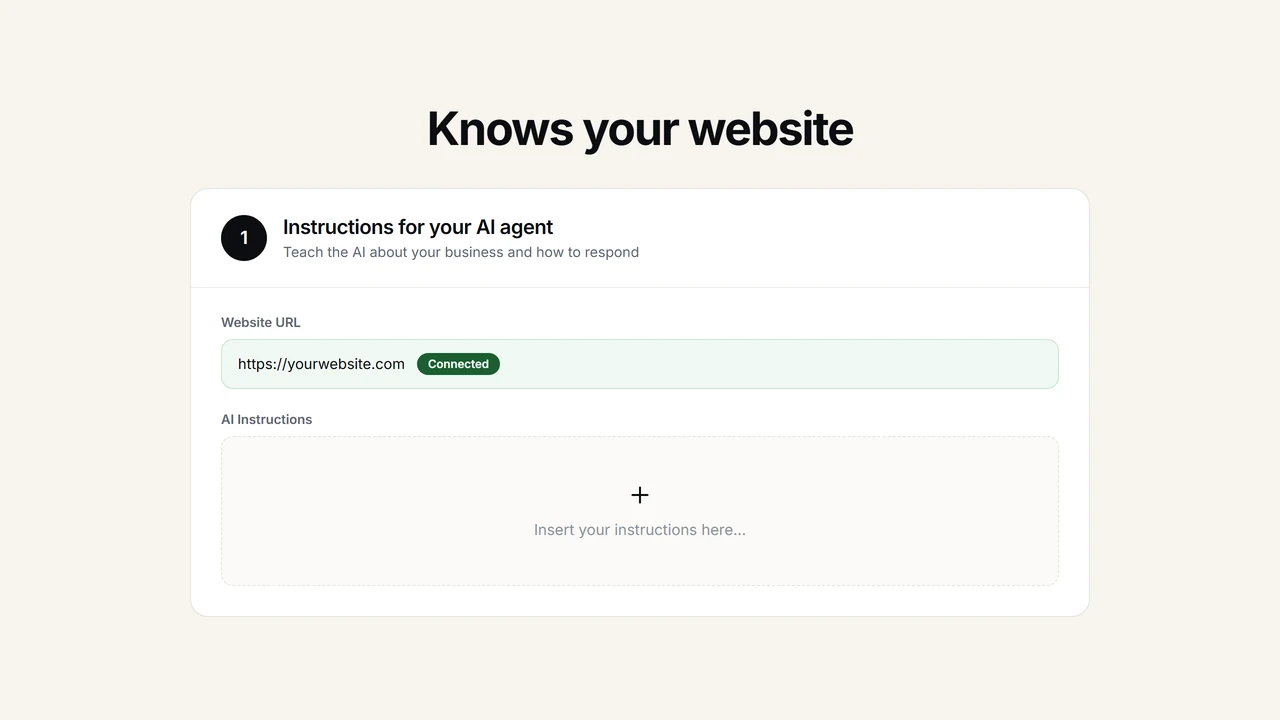
Paste your store URL below. The AI reads your product pages — names, descriptions, prices, specs, categories — and builds a working chatbot in seconds.
Your shoppers type real questions into search bars built for keywords — and get pages of irrelevant results
Ecommerce search has barely evolved in twenty years. A shopper types "red running shoes size 10 wide" and the search bar returns every product containing any of those words — red dresses, size 10 jeans, wide-brim hats — buried under which might be one relevant pair of shoes. A shopper types "gift for my mom who likes gardening" and gets zero results because no product is tagged with the word "mom." The search bar is a keyword matcher pretending to be a product discovery tool, and it fails every time a shopper phrases their query like a question instead of a database command. An AI chatbot replaces that broken interaction with a conversation. The shopper asks what they actually want, and the AI answers using the content on your product pages — descriptions, specifications, prices, availability, sizing guides, shipping policies. It works on every plan — Free gives you 50 messages per month to test, Starter at $39/month handles 800 messages, Standard at $139/month covers 15,000 messages across 3 sites, and Pro at $449/month scales to 50,000 messages and 20 sites.
- Natural language product discoveryShoppers ask questions the way they think — "do you have waterproof hiking boots under $100?" or "I need a gift for a 5-year-old who likes dinosaurs" — and the AI responds with matching products pulled from your catalog. No keywords required, no filters to configure, no zero-result dead ends. The chatbot understands intent, not just text strings, and responds with products that actually match what the shopper described.
- Answers built from your actual product pagesThe AI reads your product pages — titles, descriptions, specifications, materials, sizing charts, pricing — and uses that content to answer questions. When a shopper asks "is this jacket machine washable?" the answer comes from your product description, not a guess. You can also upload additional documents like buying guides, size charts, or care instructions to expand what the AI knows beyond your published pages. Up to 50 pages crawled automatically.
- Always on for shoppers in every time zoneYour best shoppers are not always browsing during your business hours. A customer in London shops your US-based store at 3 AM your time. A parent browses for school supplies at 11 PM after the kids are asleep. A last-minute gift buyer needs help at 6 AM Saturday. The chatbot answers product questions around the clock — no staffing, no shift schedules, no "chat offline" messages that send shoppers to a competitor.
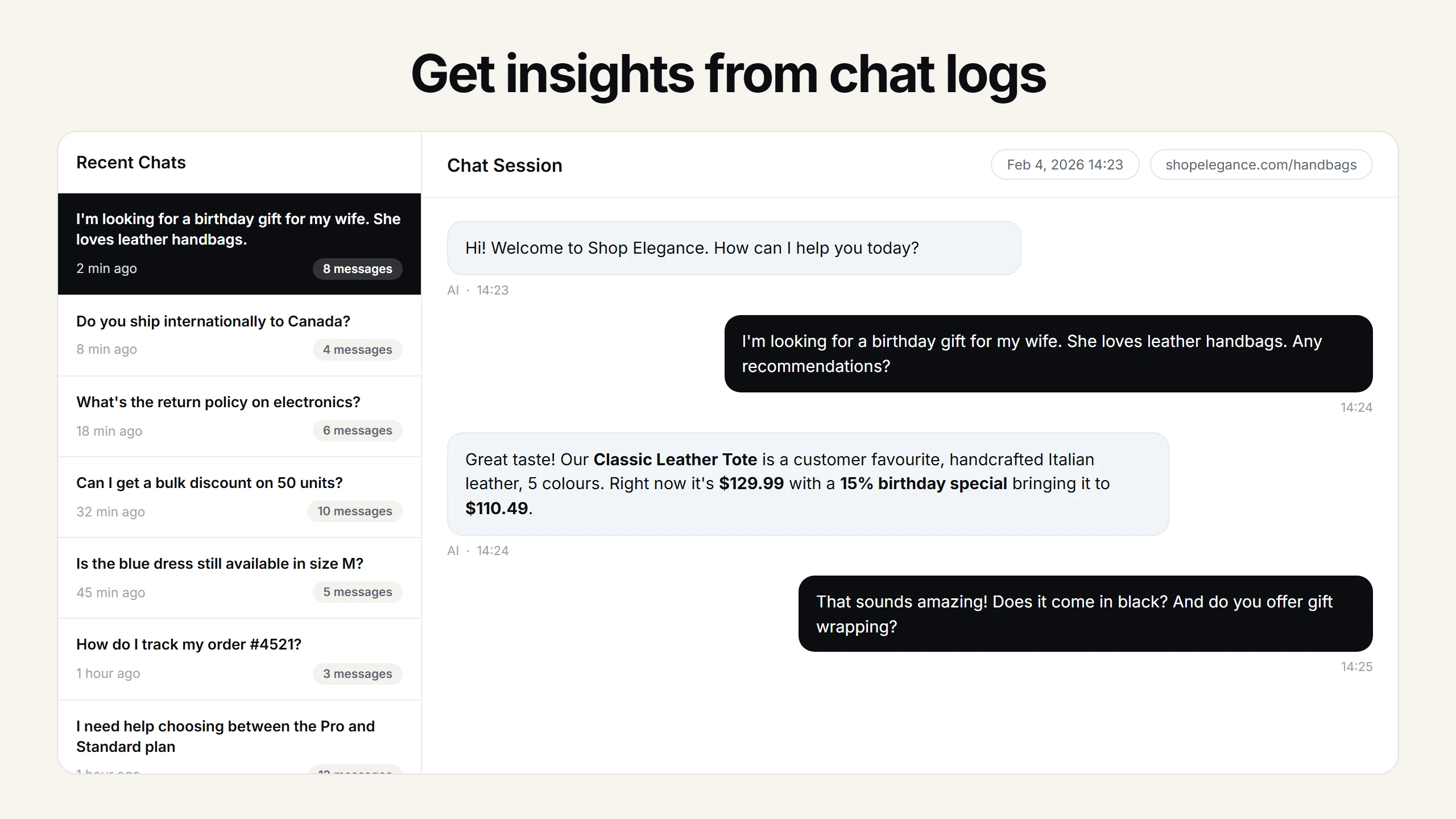
Connect your backend and let the AI check stock, prices, and order status in real time
Answering product questions from your catalog content covers most shopper inquiries. But some questions need live data — "is this available in medium?" or "when will this be back in stock?" With Custom Tools, available on Standard ($139/month) and Pro ($449/month) plans, the AI chatbot calls your store's API during a conversation, retrieves current inventory levels, pricing, and order data, and responds with real-time specifics. The shopper gets their answer without digging through your site; you reduce one more reason they might leave.
- Real-time stock and size availabilityA shopper asks "do you have this in size 8?" and the chatbot checks your inventory API and responds with current availability — not a cached page from yesterday. If the item is out of stock, the chatbot can suggest similar products or offer to notify them when it is back. Live inventory checks eliminate the frustration of adding an item to cart only to discover at checkout that it is unavailable.
- Current prices, discounts, and promotionsDuring a sale or promotion, your pricing changes constantly. A Custom Tool connected to your pricing engine ensures the chatbot always quotes the current price, including any active coupon codes, bundle discounts, or member pricing. "What is the price with the summer sale discount?" gets an accurate, up-to-the-minute answer — not a stale number from the last crawl.
- Order status and tracking lookupsReturning customers ask "where is my order?" more than any other question. Connect your order management system and the chatbot handles those lookups instantly — order confirmed, shipped, tracking number, estimated delivery date. The shopper gets their answer in seconds instead of waiting for an email reply or navigating your account portal.
- Product comparison assistanceShoppers choosing between two similar products — a $200 blender versus a $350 blender, a mid-weight jacket versus a heavyweight — can ask the chatbot to compare them. The AI pulls specifications, features, and pricing from both product pages and presents a clear side-by-side summary. The shopper makes a confident decision without toggling between browser tabs.
- Personalized suggestions based on contextWhen a shopper describes what they need — "I am training for a marathon in hot weather" — the chatbot recommends products that match from your catalog. It is not a recommendation engine powered by browsing history. It is a conversation where the shopper states their needs and the AI responds with relevant products from your actual inventory, using descriptions and specifications you have already written.
Get AI search running on your ecommerce store
No developer needed. Add your store URL, let the AI read your product pages, and paste one script tag. Fifteen minutes from signup to a working AI search chatbot.
- Sign up at asyntai.com/pricing — Free gives you 50 messages to test with your real catalog. Starter ($39/month) handles 800 messages. Standard ($139/month) and Pro ($449/month) add Custom Tools for live inventory and order lookups.
- Add your store URL. The AI reads your product pages — names, descriptions, prices, specifications, categories, sizing — and builds a knowledge base automatically. Up to 50 pages crawled.
- Upload any supplementary content — buying guides, size charts, care instructions, shipping policy documents — to give the AI more to work with beyond your product pages.
- Copy the embed script from your dashboard and add it to your store. Works on Shopify, WooCommerce, Magento, BigCommerce, Squarespace, and any platform that supports a script tag. The chatbot appears on your store immediately.
<script src="https://asyntai.com/widget.js"
data-id="your-site-id" async>
</script>
# One line of code. Shoppers ask, AI answers.
AI search for ecommerce — FAQs
Common questions from store owners evaluating AI-powered product search and discovery.
How does the AI know about my products?
When you add your store URL, the AI crawls your product pages — up to 50 pages — and reads titles, descriptions, prices, specifications, images alt text, sizing information, and any other content on those pages. It uses this information to answer shopper questions. You can also upload supplementary documents like buying guides, size charts, or FAQ pages to expand the knowledge base. The AI does not guess or generate information — it answers using content you have published.
Can the AI check if a product is in stock?
With Custom Tools on Standard ($139/month) and Pro ($449/month) plans, yes. You connect your inventory API as a Custom Tool, and the chatbot checks real-time stock levels during the conversation. Without Custom Tools, the chatbot answers based on what is published on your product pages — if the page says "in stock," that is what the chatbot reports. For stores with rapidly changing inventory, Custom Tools provide the live accuracy shoppers expect.
Does it replace my existing search bar?
It complements it. The chatbot appears as a widget on your store — shoppers who prefer a traditional search bar still have it. But shoppers who want to ask a question in natural language, describe what they are looking for, or get help choosing between products use the chatbot instead. Many stores find that the chatbot handles the queries their search bar fails at: multi-attribute searches, subjective questions ("what is good for sensitive skin?"), and comparison requests.
What if a shopper asks about a product we do not carry?
The chatbot only answers using your content. If a shopper asks about a product that is not in your catalog, the chatbot says it does not have information about that item rather than making something up. You can configure the chatbot's behavior through custom instructions — for example, suggest related products the shopper might be interested in, or invite them to contact your team for special orders. It never fabricates product information.
Does it work on mobile?
Yes — the chatbot widget is fully responsive and works on phones and tablets. Mobile shoppers, who make up the majority of ecommerce traffic, can tap the widget and type or speak their question. The conversational format is actually better suited to mobile than traditional search-and-filter interfaces, which require too much scrolling and tapping on small screens.
Can shoppers ask questions in other languages?
Yes — 36 languages with automatic detection. If a shopper types in French, the chatbot responds in French using your English product content. No translated product pages required. This is valuable for stores that sell internationally — a shopper in Japan can browse your US-based store in Japanese and get product answers that are accurate because they are drawn from your actual catalog, just delivered in the shopper's language.
How many messages are included?
The Free plan includes 50 messages per month on 1 site — enough to test with real shoppers. Starter ($39/month) includes 800 messages on 2 sites. Standard ($139/month) includes 15,000 messages across 3 sites. Pro ($449/month) includes 50,000 messages across 20 sites. If you need more volume, Custom Pro plans scale beyond those limits.
Can the chatbot handle return and shipping policy questions?
Yes — if your return policy, shipping information, and FAQ pages are on your website, the AI reads them and answers questions about those topics. "What is your return window?" "Do you ship internationally?" "How long does standard shipping take?" These are among the most common questions ecommerce shoppers ask, and the chatbot answers them accurately using your published policies, reducing the support load on your team.
How fast does the chatbot respond?
Answers appear in seconds. The AI processes the shopper's question, searches through your product knowledge base, and generates a relevant answer in natural conversation. For Custom Tool lookups — like checking live inventory — the response time depends on your API's speed. Fast enough that it feels like chatting with a knowledgeable sales associate.
AI search for ecommerce: why shoppers who cannot find it cannot buy it
Every ecommerce store has a search bar. Almost none of them work the way shoppers expect. A shopper types "birthday gift for my wife who likes cooking" and the search bar returns zero results because no product in the catalog contains that exact phrase. A shopper types "warm winter coat waterproof" and gets twenty pages of results that include waterproof phone cases, winter scarves, and coat hooks — with the actual waterproof winter coats buried somewhere on page three. The search bar does exactly what it was designed to do: match keywords against a product database. The problem is that shoppers do not think in keywords. They think in needs, desires, constraints, and questions. And every time the search bar fails to bridge that gap, a shopper leaves the store without buying — not because the product was not there, but because they could not find it.
The gap between what shoppers type and what search bars understand is not a small inefficiency. It is a revenue leak that compounds with every visitor. Industry data consistently shows that shoppers who use site search convert at higher rates than those who browse categories — they arrived with intent. But that conversion advantage collapses when search returns irrelevant results. A shopper who searched, found nothing useful, and left was the closest thing to a guaranteed sale that a store can produce, and the store lost them at the last step. An AI chatbot that understands natural language closes this gap by meeting shoppers where they are: asking a question in plain English and getting a relevant answer. "Do you have a blue dress under $50 in size medium?" is a perfectly clear request that no keyword search bar can handle — but a chatbot that has read your product catalog can answer it in seconds.
Product discovery and product search are fundamentally different activities, and most ecommerce stores only support one of them. Search is for shoppers who know what they want: "Nike Air Max 90 size 11." They type a product name, SKU, or brand, and the search bar finds it. Discovery is for shoppers who know what they need but not what it is called: "something to organize my desk that looks nice in a home office." Discovery requires understanding context, preferences, and subjective criteria — things a keyword matcher cannot process. An AI chatbot handles both. It finds the Nike Air Max 90 when asked by name, and it also recommends desk organizers that match an aesthetic preference when asked in descriptive language. Stores that only support search are serving half their shoppers and leaving the other half to figure it out on their own.
Long-tail queries reveal the depth of the search bar's failure. A shopper looking for "hypoallergenic earrings for sensitive ears under $30 that are not studs" has described exactly what they want. A human sales associate would walk them to the right display case in thirty seconds. A search bar chokes on the negation ("not studs"), ignores the price constraint, and mishandles the multi-word attribute ("sensitive ears"). It returns every earring in the catalog sorted by relevance scores that have nothing to do with what the shopper asked for. An AI chatbot parses the full request — material (hypoallergenic), price (under $30), style (not studs), purpose (sensitive ears) — and responds with products that match all of those criteria, pulled from your actual product descriptions. The longer and more specific the query, the more the AI outperforms traditional search, because traditional search was never designed for specificity.
Mobile shoppers suffer the most from bad search. On a phone, scrolling through twenty irrelevant search results is painful. Applying filters on a small screen requires multiple taps, expanding collapsed menus, and remembering which combinations to select. Most mobile shoppers abandon the process. A chatbot turns that clumsy interaction into a text conversation — the same interface they use all day for messaging. The shopper types "black sneakers under $80" and gets a curated list of matching products. No filters, no scrolling through pages, no accidentally hitting "back" and losing their search. The chatbot is the natural interface for mobile product discovery because mobile shoppers are already conditioned to communicate by typing short messages and getting responses.
International shoppers add another dimension that keyword search ignores entirely. A shopper in Germany types "Laufschuhe" (running shoes) on an English-language store, and the search bar returns nothing. A shopper in Brazil types "vestido azul" (blue dress) and hits the same wall. The AI chatbot supports 36 languages with automatic detection — the shopper types in their language, and the chatbot responds in that language using the store's English product content. No translated product pages required. No separate storefronts for each market. A single chatbot serves shoppers from Tokyo to Sao Paulo to Stockholm, and every one of them gets accurate product answers in their own language. For stores selling internationally, this is not a convenience feature — it is the difference between serving those markets and losing them.
The "no results found" page is the most expensive page on any ecommerce site. It tells the shopper, in plain terms, that the store cannot help them. Some stores try to salvage the moment with "did you mean?" suggestions or popular product carousels, but these are guesses — they rarely match what the shopper was actually looking for. An AI chatbot never shows a "no results" page. If the shopper asks about a product the store carries, the chatbot finds it. If the shopper asks about something the store does not carry, the chatbot says so honestly and can suggest the closest alternatives from the catalog. The interaction always moves forward. The shopper always gets a response that acknowledges what they asked and provides something useful, even when the exact answer is "we do not carry that specific item, but here are similar options."
Conversion rate optimization in ecommerce obsesses over button colors, checkout flows, and page load times — all legitimate concerns, but marginal improvements compared to the impact of helping shoppers find what they came for. A shopper who finds the right product buys it. A shopper who does not, leaves. The AI chatbot operates at the top of this funnel, at the moment of highest intent: the shopper has arrived, they have something in mind, and they are looking for it right now. Intercepting that moment with a conversational interface that understands their question and responds with relevant products is not a marginal optimization. It is structural improvement in how the store converts visitors to buyers. The chatbot does not change the checkout flow. It changes how many shoppers reach checkout with the right product in their cart.
Seasonal peaks and promotional periods expose search weaknesses that stores tolerate during normal traffic. Black Friday, holiday shopping, back-to-school — these are the weeks when shoppers arrive in volume, browse under time pressure, and make fast decisions. A shopper on Black Friday who types "gifts for dad under $50" and gets zero useful search results will not refine their query. They will leave. The stakes are higher because the traffic is concentrated: every failed search during a peak period costs more than the same failure on a quiet Tuesday. An AI chatbot handles the surge the same way it handles a slow day — reading your product catalog, understanding questions, and responding with relevant answers. No reindexing, no search tuning, no frantic adjustments to synonym lists. The AI already understands that "presents" and "gifts" mean the same thing.
Comparison shopping is one of the most common and most poorly served shopper behaviors online. A shopper considering two similar products — a $150 chef's knife versus a $220 chef's knife — wants to understand the difference. On a traditional site, they open both product pages in separate tabs and scan back and forth, trying to spot the differences in specifications, materials, and included accessories. An AI chatbot handles this with a single question: "What is the difference between the Classic and the Professional chef's knife?" The chatbot pulls information from both product pages and presents a clear comparison — blade material, handle construction, warranty, weight, included accessories — in a single response. The shopper makes an informed decision faster, and the store benefits from a shopper who buys with confidence rather than hesitation.
Small catalogs and large catalogs both benefit from AI search, but for opposite reasons. A store with 50 products might think search is unnecessary — shoppers can just browse the full catalog. But even on a small store, shoppers ask questions that browsing does not answer: "Which of your candles has the strongest scent throw?" "Do any of your bags fit a 15-inch laptop?" These are not browsing questions. They are product knowledge questions that require reading individual product descriptions and comparing attributes. The chatbot does this work for the shopper. A store with 10,000 products faces the opposite problem: browsing is impossible, and search is the only path to discovery. An AI chatbot handles the scale by reading the full product catalog and surfacing the right items from the entire inventory, not just the products that happen to share keywords with the shopper's query.
The cost of bad ecommerce search is invisible because stores measure what they sold, not what they almost sold. No analytics dashboard shows "revenue lost to a shopper who searched for a product you carry and did not find it." No report tallies the shoppers who left after a failed search and bought the same product from a competitor who helped them find it. This invisible cost is one of the largest inefficiencies in online retail, and it hides in plain sight because the search bar technically works — it returns results. It just returns the wrong results. An AI chatbot makes the cost visible by changing the interaction: shoppers who would have searched, failed, and left silently now ask a question in the chatbot and get a real answer. The conversion shows up in the dashboard. The product page visit shows up in analytics. The sale shows up in revenue.
Post-purchase questions are the second most common reason shoppers contact ecommerce stores, behind pre-purchase product questions. "Where is my order?" "What is your return window?" "Can I exchange this for a different size?" These questions are answered on the store's shipping and returns pages, but shoppers rarely find those pages on their own — they type the question into whatever input field is most visible. A chatbot handles post-purchase questions just as naturally as product questions, because the answers come from the same content source: the store's own website. The shipping policy page, the returns FAQ, the size exchange instructions — the AI reads all of it and responds accurately. On Standard and Pro plans with Custom Tools, the chatbot can also look up specific order status and tracking information, turning the most common customer service inquiry into an instant self-service interaction.
The AI reads your product content — it does not invent it. This distinction matters because trust is everything in ecommerce. When a shopper asks "is this jacket waterproof?" and the chatbot says yes, that answer needs to be correct. The chatbot answers based on what your product page says about that jacket. If the description says "water-resistant shell with sealed seams," the chatbot communicates that accurately. If the description does not mention water resistance at all, the chatbot does not guess. This grounding in your actual content means the chatbot is as accurate as your product pages — and unlike a human sales associate who might misremember a specification, the chatbot checks every time.
Ready to let shoppers find what they are looking for? Start with the free plan — 50 messages, no credit card — and see how the AI handles your real product questions. Or go straight to Standard for live inventory lookups with Custom Tools.