AI powered support that runs the frontline so your team handles the exceptions
Most support tools treat AI as a helper sitting beside human agents. Asyntai flips that model. The AI is the engine driving every first response — answering from your website and documents, operating in 36 languages, around the clock — while humans step in only for the situations that genuinely require judgment.
See AI powered support running on your own site
Drop your URL below and watch the AI handle questions the way a senior team member would
Support that runs on AI rather than merely using it
There is a meaningful gap between "AI-assisted support" and "AI powered support." Assisted means a human agent with smart suggestions. Powered means the AI handles conversations end to end, from greeting through resolution, and only involves humans when the situation warrants it. Asyntai is built for the powered model.
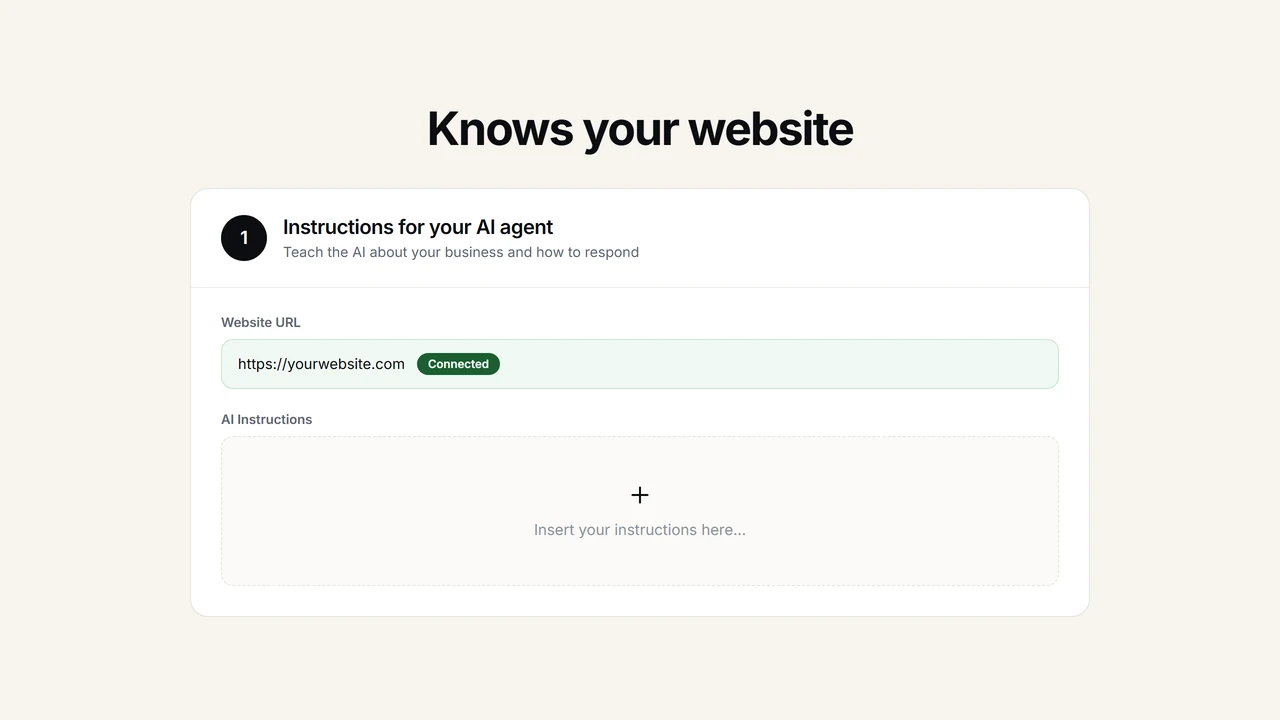
- Absorbs your entire content surfaceYour published pages, help articles, pricing details, product catalogs, and policy documents are ingested automatically when you provide your site URL.
- Incorporates private operational knowledgeUpload internal handbooks, carrier procedures, warranty playbooks, or region-specific guidelines as PDFs or pasted text. The AI treats them identically to public content.
- Behavioral guardrails written in plain languageDefine escalation thresholds, prohibited commitments, tone expectations, and greeting protocols using everyday sentences. The AI enforces them across every conversation it powers.
Most questions never need a human when AI powers the response
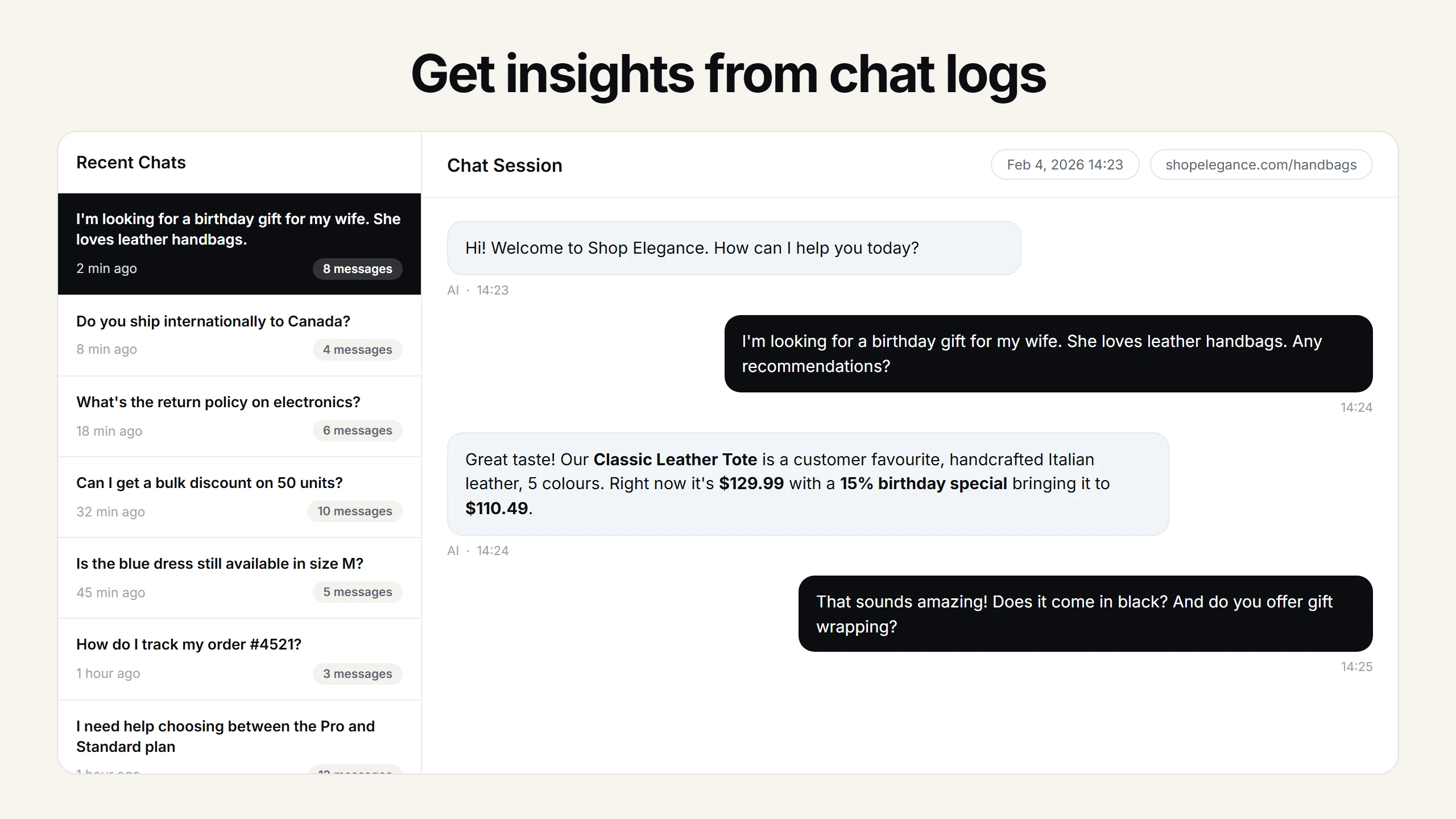
AI powered support changes the default from "human handles, AI assists" to "AI resolves, human intervenes." The majority of inbound questions — pricing inquiries, return procedures, product comparisons, account basics — resolve completely within the AI conversation, freeing your team for work that requires creative thinking.
- End-to-end resolution without handoffWhen the answer exists in your knowledge base, the AI delivers it directly — no queue, no wait, no agent involvement. The visitor leaves satisfied in seconds.
- Context-rich escalation when neededFor situations requiring human judgment, the AI captures contact details and the complete transcript, then delivers everything to your dashboard and inbox simultaneously.
- Personalized responses for logged-in visitorsOn Standard and Pro plans, push customer data through window.Asyntai.userContext so the AI can reference account details, order history, or subscription status in its responses.
From zero to AI powered support in a single sitting
Deploying AI as the engine of your support operation sounds like a major infrastructure project. It is not. One JavaScript snippet, one site crawl, a handful of behavioral rules, and your support frontline is powered by AI before the end of the day.
- Register for a free Asyntai account and retrieve your unique JavaScript snippet from the dashboard.
- Insert the snippet into the
<head>section of your website using your CMS header field, a plugin, or the raw template. - Supply your website URL for automatic content ingestion and attach any private documents the AI should reference.
- Author behavioral instructions covering tone, escalation boundaries, and greeting style, then verify with test conversations before activating.
<script src="https://asyntai.com/widget.js"
data-id="your-site-id" async>
</script>
</head>
# Your support frontline is now AI powered.
AI powered support — common questions
What operations and leadership teams ask before letting AI run the first line of support.
What distinguishes AI powered support from AI-assisted support?
AI-assisted support still assumes a human agent handles every conversation, with AI providing suggestions, drafts, or summaries in the background. AI powered support reverses the default: the AI handles the conversation independently, and humans only enter when escalation rules trigger. The result is dramatically fewer agent hours spent on routine questions, because the AI resolves them outright rather than merely helping someone else resolve them.
How much of our support volume can AI realistically power on its own?
For businesses whose inbound questions are predominantly content-answerable — shipping timelines, pricing details, return procedures, product specifications, billing mechanics, feature availability — the AI typically resolves 60 to 80 percent of conversations without human involvement. The exact figure depends on how thoroughly your knowledge base covers the topics visitors ask about, and how clear your escalation boundaries are.
Will visitors know they are interacting with AI rather than a human?
Yes. The widget identifies itself as an AI assistant, and when a human agent joins an escalated conversation, their replies carry a visible agent label — so visitors always know whether a response came from the AI or from your team. This is more than good practice: under the EU AI Act, chatbots that interact with people must clearly inform them they are talking to AI, and similar transparency rules are emerging in other jurisdictions. Asyntai handles that disclosure for you, so deploying AI powered support keeps you on the right side of these requirements. In practice, transparency costs nothing — an AI that answers instantly and accurately earns far more trust than one pretending to be human.
What safeguards prevent the AI from overstepping its authority?
Behavioral instructions act as hard boundaries. You define them in plain sentences: "never authorize refunds exceeding fifty dollars," "escalate any mention of legal action immediately," "do not quote custom project pricing." The AI obeys these constraints on every conversation it powers, regardless of how the visitor phrases their request. When a boundary is reached, the AI transitions to lead capture and human handoff.
Does AI powered support work across multiple languages without separate configurations?
Yes. The interface is localized in 36 languages, and the AI identifies each visitor's language from their opening message. A visitor writing in Korean receives Korean responses. One writing in Dutch receives Dutch. There is no per-language setup, no translation layer to configure, and no additional cost for multilingual coverage.
Can the AI power personalized responses for returning customers?
On Standard and Pro plans, your page code populates window.Asyntai.userContext with whatever customer fields you choose — account tier, recent order ID, renewal date, loyalty status. The AI incorporates that data into its responses, so a returning customer asking about their subscription gets a specific answer rather than a generic policy explanation.
What is the pricing structure for AI powered support?
The free tier provides 50 AI-powered responses monthly for a single website. Paid plans begin at $39 per month covering 800 messages. Higher tiers accommodate greater volume and additional websites. Each AI response counts as one message. Warnings arrive by email before you approach the cap, and the system pauses rather than generating surprise charges if you exceed it.
Can one account power support across several distinct websites?
Yes. Site limits scale with your plan: 1 on free, 2 on Starter, 3 on Standard, and up to 10 on Pro. Every website maintains an independent knowledge base, independent behavioral rules, and independent conversation history — so AI powered support for a retail brand operates completely separately from AI powered support for a SaaS product under the same account.
AI powered support — what it means when AI is the engine, not the assistant
Most businesses that adopt AI for customer support do so cautiously, slotting the technology into a helper role beside their existing agents. The AI suggests a reply, the agent edits it, the agent clicks send. That pattern — sometimes called AI-assisted support — delivers incremental speed improvements but leaves the fundamental cost structure unchanged. You still need agents for every conversation. You still hire proportionally to ticket volume. The math gets slightly better, not fundamentally different. AI powered support starts from a different premise entirely: the AI is the primary operator, handling conversations from first greeting through resolution, and the human team exists to manage the exceptions that genuinely require judgment, empathy, or authority the AI should not exercise.
The distinction between "powered" and "assisted" is not semantic hairsplitting. It determines staffing models, cost curves, and operational architecture. In an AI-assisted setup, the bottleneck is still human capacity — you cannot serve more visitors than you have agents, regardless of how fast each agent works with AI suggestions. In an AI powered setup, the bottleneck shifts to knowledge quality: if the AI has access to comprehensive, accurate content about your products and policies, it can serve essentially unlimited concurrent visitors across every language and time zone. The constraint becomes what the AI knows, not how many people you employ.
Building that knowledge layer is where AI powered support either succeeds brilliantly or falls apart. A poorly trained AI that "powers" your support will fabricate answers, contradict your published policies, and erode visitor trust faster than no AI at all. Asyntai addresses this through content grounding: the system crawls your website when you provide the URL, absorbing product pages, pricing structures, policy documents, help articles, blog posts, and FAQ content into a unified knowledge base. Private materials — operational handbooks, carrier-specific shipping procedures, internal pricing matrices, region-specific compliance notes — get uploaded separately as PDFs or pasted text. The AI draws exclusively from this assembled knowledge when powering responses. It does not reach into general training data to fill gaps; when a question falls outside the knowledge base, it acknowledges the limitation and routes to a human.
Behavioral guardrails are the second pillar that makes AI powered support viable for real businesses rather than just demos. Knowledge alone tells the AI what it can say; guardrails tell it what it must not do. You write these in ordinary sentences: "never approve a refund without human review if the amount exceeds one hundred dollars," "escalate immediately when a visitor mentions legal counsel," "do not speculate about competitor pricing," "always offer a callback option when a visitor expresses frustration." These instructions bind every conversation the AI powers, in every language, at every hour. They function as the policy layer that would normally live in an agent training manual — except they execute perfectly every time, without the drift that occurs when a human team interprets guidelines slightly differently across shifts.
The operational shift for teams that move to AI powered support is more psychological than technical. Support managers accustomed to monitoring agent queues and staffing schedules find themselves monitoring knowledge completeness and instruction accuracy instead. The daily question stops being "do we have enough agents online" and becomes "does the AI have good enough content to resolve this category of question." That shift is uncomfortable at first and liberating once it settles. Adding coverage for a new product launch means updating the knowledge base, not scrambling for overtime. Handling a seasonal traffic surge means verifying the message cap, not hiring temporary agents. The operational cadence changes from reactive staffing to proactive knowledge management.
International coverage illustrates the powered model's strongest advantage over the assisted model. In an AI-assisted setup, multilingual support still requires multilingual agents — someone who speaks Korean to assist with Korean suggestions, someone who speaks Portuguese to handle Portuguese replies. In an AI powered setup, the system identifies each visitor's language from their first message and responds accordingly across 36 languages without any per-language configuration. A single installation of Asyntai serves a German visitor in German, a Thai visitor in Thai, and a Brazilian visitor in Portuguese simultaneously, drawing from the same knowledge base. For companies whose international traffic has outgrown their ability to hire multilingual agents, this capability alone transforms the economics of global support.
Personalization elevates AI powered support from competent to genuinely impressive. Generic AI that recites your return policy is useful; AI that greets a returning customer by name and references their specific subscription tier feels like a different category of experience. Asyntai enables this through the User Context mechanism on Standard and Pro plans. Your website pushes customer-specific data into a JavaScript variable before the chat initializes — account type, recent order identifiers, renewal dates, loyalty tier, any fields you choose. The AI weaves that context into its responses naturally. A Pro-tier subscriber asking about feature access gets a different answer than a free-tier user asking the same question, because the AI knows which tier is active. The data pipeline is one-directional and scoped entirely by your code, avoiding the security and permission overhead of bidirectional API integrations.
Escalation design is what separates mature AI powered support from a reckless automation experiment. The goal is never to eliminate human involvement entirely — it is to ensure humans spend their time on conversations where their judgment creates real value. When the AI encounters a question that falls outside its knowledge, or when a behavioral guardrail triggers, the handoff process activates: the AI collects the visitor's name and email address, preserves the complete conversation transcript, and delivers everything to the Asyntai dashboard. If email forwarding is enabled, the same package arrives in your team's inbox simultaneously. The human agent who picks up the thread already knows what was discussed, what the visitor is seeking, and why the AI chose to escalate. There is no cold restart, no repeated explanation, no friction point that makes the visitor regret engaging with the AI in the first place.
The analytics that emerge from AI powered support serve a fundamentally different purpose than traditional support metrics. When humans handle every ticket, analytics focus on agent performance — response time, resolution rate, satisfaction score per agent. When AI powers the frontline, analytics reveal content performance — which questions surface most frequently, which topic clusters the AI resolves confidently versus flags for escalation, which pages on your site generate the highest chat volume, and what language distribution your actual visitor base presents. Over weeks and months, these patterns become an actionable improvement roadmap for your website itself. Recurring questions about a specific policy indicate that the policy page needs rewriting. Frequent escalations around a particular product suggest the product documentation has gaps. AI powered support does not merely answer questions — it reveals which parts of your content ecosystem need strengthening.
Cost modeling for AI powered support follows a different curve than traditional support budgets. A human agent costs somewhere between thirty-five thousand and eighty thousand dollars annually depending on region and seniority, delivering capacity for one conversation at a time during working hours. AI powered support through Asyntai starts at thirty-nine dollars monthly for 800 messages — covering simultaneous conversations around the clock in every supported language. The per-conversation cost is measured in cents rather than the double-digit dollars characteristic of human handling. For organizations where the majority of inbound questions are content-answerable, the cost reduction is not incremental — it is structural. The remaining budget can be redirected toward the smaller team of senior agents who handle the escalated cases that genuinely benefit from human attention.
Multi-site deployment matters for organizations operating across several brands, product lines, or client properties. A retail group running four storefronts needs four independent AI instances, each reflecting different products, policies, and brand voices. An agency managing client websites needs separate configurations that never cross-contaminate. Asyntai accommodates this through plan-based site limits: one site on the free tier, two on Starter, three on Standard, and up to ten on Pro. Each site operates with its own crawled content, its own uploaded documents, its own behavioral instructions, and its own conversation archive. The AI powering support for Site A has no knowledge of Site B's content, ensuring clean separation across every property.
Teams transitioning from assisted to powered AI support often worry about losing the human touch that defines their brand's service reputation. The concern is legitimate and worth addressing directly. AI powered support does not mean removing humanity from the support experience — it means concentrating human involvement where it creates the most impact. A customer with a straightforward pricing question gets a fast, accurate, friendly AI response instead of waiting in a queue. A customer dealing with a damaged shipment or a billing dispute gets routed to a human who has time and context to handle the situation thoughtfully, because that agent is not buried under a hundred password-reset tickets. The net effect on service quality is typically positive, because the humans who remain in the loop are focused on the conversations that benefit most from their judgment.
Deploying AI powered support is operationally simpler than the phrase implies. You register an account, copy a JavaScript snippet, and paste it into your website header. You supply your site URL and the system ingests your published content. You upload any private documents and write behavioral instructions in plain sentences. You test a dozen representative conversations to verify tone, accuracy, and escalation behavior. You go live. Most teams complete this within an afternoon. The following week is typically spent refining instructions based on real visitor interactions — tightening an escalation rule here, adding a knowledge document there, adjusting tone for a specific topic. From that point forward, AI powers your support frontline continuously, and your team's role shifts from answering every message to curating the knowledge and rules that make the AI effective.