AI-powered enterprise search that understands what people actually mean
Keyword search forces people to guess the right words. AI-powered enterprise search understands intent. Someone types "the policy we updated last quarter about remote work" and the AI finds it — no exact filename, no folder path, no boolean operators. Follow-up questions refine the results through conversation. Results appear as visual cards with context, not a wall of blue links. It works across 36 languages from a single index, stays current through live data feeds, and gets smarter the more your organization uses it. Search that thinks, not search that matches.
See how AI-powered search understands your content
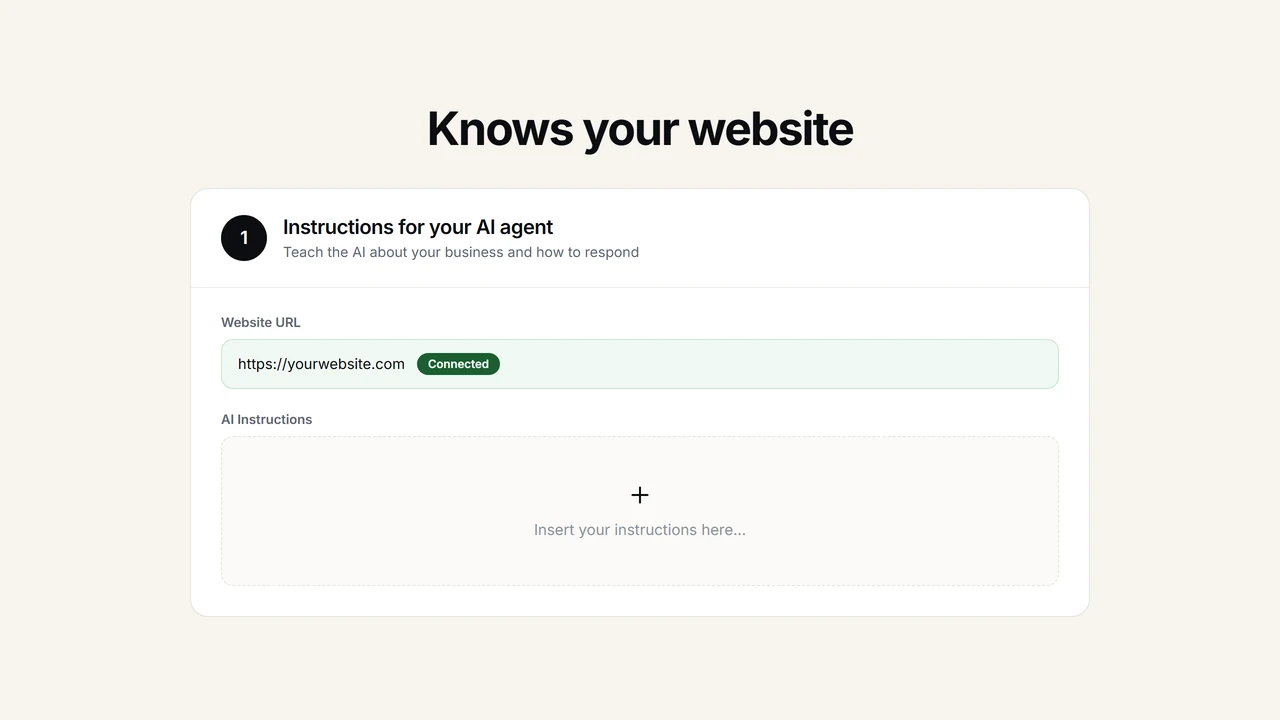
Enter your website URL and watch the AI understand queries that would break keyword search
Ask in plain language — the AI parses meaning, not keywords
Traditional enterprise search treats every query as a bag of keywords. "Q3 sustainability presentation" returns every document containing "Q3" or "sustainability" or "presentation" — hundreds of results, mostly irrelevant. AI-powered enterprise search understands that query as a request for a specific presentation, from a specific quarter, on a specific topic. It narrows results to the handful of documents that actually match. And when the results are close but not quite right, users refine through conversation — "the one with the carbon footprint data" or "not that one, the version Sarah presented to the board." Each follow-up adds context. Each response gets more precise. The AI remembers the full conversation, not just the last query. This is what intent understanding means at enterprise scale: search that behaves like a colleague who knows the organization, not a text-matching engine that returns everything containing your words.
- Intent parsing, not keyword matchingThe AI reads the full query and extracts meaning. "Something for our Q3 presentation on sustainability" is understood as a request for presentation materials from Q3 related to sustainability — not a keyword search for those four words individually. Ambiguous queries get clarifying questions instead of 10,000 irrelevant results.
- Conversational refinement replaces filtersInstead of clicking through dropdown filters for date range, department, file type, and author, users narrow results by talking. "Just the ones from the engineering team." "From this year only." "The one with the budget breakdown." Each follow-up refines the search without starting over, because the AI carries the full context of the conversation forward.
- Cross-language search from a single indexA user in Tokyo asks in Japanese. The AI searches your English-language knowledge base, finds the relevant documents, and responds in Japanese with the answer. No separate language indexes, no translated metadata, no language-specific search configurations. 36 languages, one unified search experience. The AI handles the language layer; your content stays in whatever language it was written in.
Visual cards, live data, and actions — not a list of links to click through
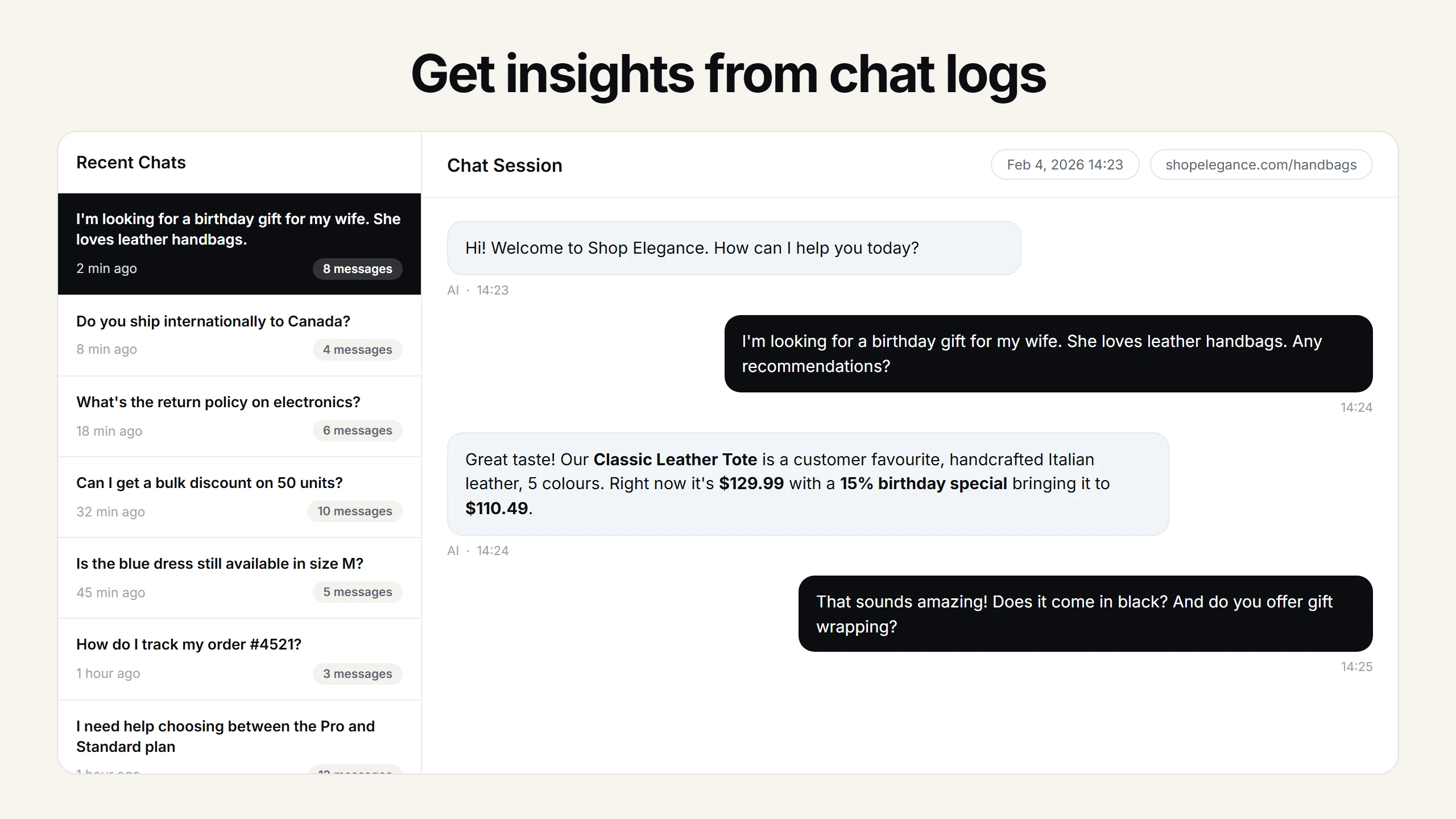
Finding the right information is only half the problem. The other half is presenting it in a way that's immediately useful. AI-powered enterprise search returns results as Dynamic Product Cards — visual cards with images, descriptions, key details, and action buttons — directly inside the conversation. Users see the answer, not a link to a page that might contain the answer. Behind those cards, the Real-Time Data Feed keeps everything current: product catalog changes, inventory updates, pricing adjustments, and knowledge base revisions reflect immediately. And with Custom Tools, the AI goes beyond search — it can take action on behalf of the user. Check order status. Create a support ticket. Book an appointment. Look up account details. The search becomes the starting point for a complete workflow, not just a place to find documents.
- Dynamic Product Cards replace blue linksSearch results appear as rich visual cards inside the chat — product image, title, description, key attributes, and an action button. Multiple results display as a swipeable carousel. Users see the information immediately without clicking through to separate pages. Whether the result is a product, a document, a knowledge base article, or live data from an API, it renders as a structured, visual card.
- Real-Time Data Feed keeps results currentConnect a URL (JSON, CSV, or API endpoint) that returns your current data — product catalog, inventory levels, pricing, availability. The AI reads the feed on each query, so changes reflect immediately. New items appear within 24 hours. Discontinued items stop showing up. Standard plan supports up to 200,000 characters; Real-Time Data Feed Max handles up to 10,000,000 characters for large-scale enterprise catalogs.
- Custom Tools turn search into actionThe AI doesn't just find answers — it acts on them. Connect your own API endpoints as Custom Tools, and the AI can check order status, look up account details, create support tickets, book appointments, initiate returns, or perform any action your API supports. A customer searches for their order, finds it, and checks the shipping status — all in one conversation, without leaving the chat.
Deploy AI-powered enterprise search without infrastructure
No Elasticsearch cluster. No Solr configuration. No indexing pipeline to build and maintain. Add one script tag, connect your data sources, and your organization has AI-powered search that understands intent, works across languages, and stays current automatically.
- Sign up at Asyntai and copy the embed script from your dashboard — one line of JavaScript that loads the AI search widget on any page.
- Let the AI crawl your website, knowledge base, and documentation. It indexes your content automatically and starts answering questions within hours.
- Connect a Real-Time Data Feed for live data — product catalogs, inventory systems, or any structured data source. The AI keeps results current without manual re-indexing.
- Add Custom Tools to extend search into action — connect API endpoints so the AI can check status, create tickets, look up accounts, or perform any operation your systems support.
<!-- One script. No search infrastructure to manage. -->
<script src="https://asyntai.com/widget.js"
data-id="your-site-id" async>
</script>
# No Elasticsearch. No Solr. No indexing pipeline.
# The AI understands intent out of the box.
AI-powered enterprise search — FAQs
Common questions from enterprise teams, IT leaders, and product managers evaluating AI-powered search for their organization.
How does AI-powered search understand intent differently from keyword search?
Keyword search matches the exact words in your query against an index of documents. If you search "remote work policy updated Q3," it looks for documents containing those words — and returns everything from Q3 financial reports to outdated remote work policies from three years ago. AI-powered search parses the meaning of the full query: you're looking for a policy document, specifically about remote work, that was updated during Q3. It understands temporal context ("last quarter"), document type ("policy"), and topic ("remote work") as distinct facets of a single intent. It also handles synonyms, paraphrasing, and conceptual queries — "work from home rules" finds the same document as "remote work policy" because the AI understands they mean the same thing.
How accurate are the results? Does the AI ever make things up?
The AI answers using your content — your knowledge base, your crawled pages, your Real-Time Data Feed, your uploaded documents. It does not generate answers from general knowledge or fill gaps with plausible-sounding information. Every answer is grounded in a specific source from your organization's data. When the AI cannot find a relevant answer in your content, it says so rather than guessing. This grounding approach means accuracy is directly tied to the quality and completeness of the content you provide. The more comprehensive your knowledge base and data feeds, the more accurate and complete the AI's answers become.
How does cross-language search work?
The AI understands 36 languages natively. When a user asks a question in Japanese, the AI understands the query in Japanese, searches across all your content regardless of what language that content is in, finds the relevant information, and responds in Japanese. There is no separate index per language, no translated metadata requirement, and no language-specific configuration. Your content stays in English (or whatever language it was written in), and the AI handles the translation layer. This means a single knowledge base serves your entire global workforce without duplicating or translating content for each region.
Does the AI learn and improve over time?
The AI's knowledge improves as your content improves. When you add more documents to the knowledge base, expand your Real-Time Data Feed, or refine your AI Instructions, the AI's answers get better because it has more and better content to work with. The crawl keeps your indexed content current, and the Real-Time Data Feed reflects changes immediately. You can also review conversation analytics to see what users are asking, where the AI falls short, and which topics need better coverage — then improve your content accordingly. The improvement loop is content-driven, not model-driven, which means you control exactly what gets better and when.
Can the AI personalize results for different users?
Yes, through the User Context feature. Your application can pass user-specific information — role, department, account details, order history, preferences — to the AI via a JavaScript API. The AI uses this context to personalize responses. An engineer asking "what's our deployment process?" gets the engineering deployment guide. A marketing manager asking the same question gets the campaign launch checklist. A customer asking "where's my order?" gets their specific order status pulled from your systems via Custom Tools. Personalization comes from the context you provide, not from the AI profiling users.
What kind of analytics does AI-powered search provide?
The analytics dashboard shows what your users are actually searching for — the exact questions they ask, which topics come up most frequently, where the AI couldn't find an answer, and which conversations lead to actions. This is fundamentally different from keyword search analytics, which show you search terms. AI search analytics show you intent: "users are asking about return policies 40 times a day" or "12% of queries are about a product feature that isn't documented yet." These insights help you identify content gaps, prioritize documentation, and understand what your customers or employees actually need — information that keyword search logs never reveal.
How does this compare to building enterprise search with open-source tools?
Building enterprise search with tools like Elasticsearch or Solr means managing infrastructure: clusters, indexing pipelines, query parsing, relevance tuning, synonym dictionaries, language analyzers, and scaling. You get powerful keyword search, but intent understanding requires additional NLP layers, embedding models, vector databases, and re-ranking pipelines — each with its own infrastructure and maintenance burden. Asyntai provides the intelligence layer out of the box: intent understanding, conversational refinement, cross-language support, visual results, and live data integration. You connect your data sources and get an AI-powered search experience without building or maintaining search infrastructure. The trade-off is control versus speed: if you need deeply customized search ranking algorithms, build your own. If you need intelligent search that works this week, use Asyntai.
What does AI-powered enterprise search cost?
The AI chat widget works on all plans, including Free, with knowledge base answers from your crawled content. Real-Time Data Feed and Dynamic Product Cards require the Standard plan ($139/month) or Pro plan ($449/month). Standard includes up to 15,000 messages/month and 200,000 characters of data feed capacity. Pro includes 50,000 messages/month and Real-Time Data Feed Max with up to 10,000,000 characters — enough for large enterprise catalogs. Custom Tools for post-search actions are available on Standard and Pro. There are no per-query fees, no infrastructure costs, and no minimum commitment beyond the monthly plan.
The evolution from keyword search to AI-powered enterprise search — and why intelligence changes everything
Enterprise search has been broken for decades, and everyone knows it. Study after study finds that knowledge workers spend between 20% and 30% of their time looking for information — searching shared drives, scanning email archives, browsing wikis, asking colleagues on Slack. The tools exist. The content exists. The problem is the gap between how people think about information and how search engines retrieve it. People think in concepts, context, and relationships: "the slide deck from the board meeting where we discussed the acquisition." Search engines think in keywords: they find documents containing "slide deck" and "board meeting" and "acquisition" and return hundreds of results, most of which are irrelevant. AI-powered enterprise search closes that gap by understanding what people actually mean.
The fundamental limitation of keyword search is that it operates on the surface of language rather than its meaning. When an employee searches "onboarding process for remote contractors in APAC," keyword search decomposes that into individual terms — onboarding, process, remote, contractors, APAC — and looks for documents containing those words. It cannot understand that this is a query about a specific HR workflow, for a specific employment type, in a specific region. It returns the generic onboarding guide, a facilities document about APAC offices, a contractor agreement template, and seventeen other documents that happen to contain some of those words. The employee clicks through six results, skims each one, and either finds the answer buried on page three of the fourth document or gives up and asks HR directly. Multiply that across every employee, every query, every day, and the cost of bad search is staggering — not in software licensing fees, but in lost productivity and frustrated people.
AI-powered enterprise search approaches retrieval differently. Instead of decomposing a query into keywords, it reads the full query as a coherent request and interprets its meaning. "Onboarding process for remote contractors in APAC" is understood as a single intent: the user wants the specific onboarding procedure that applies to contractors who work remotely and are located in the Asia-Pacific region. The AI searches across the organization's knowledge base — crawled pages, uploaded documents, real-time data feeds — for content that matches that intent, even if the exact words differ. A document titled "APAC Region: Independent Contractor Integration Guide" matches, even though it doesn't contain the word "onboarding." A section in the HR handbook headed "Remote Workforce Setup by Region" matches, even though it doesn't say "contractor" in the heading. The AI understands semantic equivalence: onboarding and integration, contractor and independent consultant, APAC and Asia-Pacific. This is what intent understanding means in practice — the search system comprehends the question the way a knowledgeable colleague would.
Context is the second dimension of intelligence that keyword search completely lacks. When a user asks "what about for contractors?" in the middle of a conversation, keyword search has no idea what "what about" refers to. It would search for documents containing "contractors" and return generic contractor-related content. AI-powered search remembers the conversation. If the previous exchange was about the company's remote work policy, the follow-up is understood in that context: the user wants to know how the remote work policy applies to contractors specifically. The AI doesn't restart the search — it refines it, using the accumulated context of the conversation to narrow results. This conversational refinement is transformative for complex information needs that can't be expressed in a single query. A researcher exploring a topic, a support agent diagnosing a problem, a manager looking for a specific report — all of them naturally narrow their search through follow-up questions. Keyword search forces them to re-formulate each query from scratch. AI-powered search lets them think out loud.
Ambiguity is where intelligence earns its keep. In any organization, the same words mean different things in different contexts. "Mercury" could be a planet, a chemical element, a car brand, or an internal project name. "Pipeline" could refer to a sales pipeline, a data pipeline, or an oil pipeline. Keyword search returns all of them, leaving the user to sort through the noise. AI-powered search handles ambiguity by considering the full context of the query. "Mercury pipeline status" in a conversation about the data engineering team clearly refers to a data pipeline for a project called Mercury — not planetary science or automotive sales. When ambiguity can't be resolved from context alone, the AI asks a clarifying question: "Are you looking for the Mercury data pipeline status or the Mercury sales pipeline?" One clarifying question eliminates pages of irrelevant results. This ability to recognize and resolve ambiguity is a qualitative difference from keyword search, not just a quantitative improvement in ranking.
Cross-language search represents perhaps the most dramatic advantage of AI-powered intelligence over keyword-based systems. Traditional enterprise search requires separate indexes, analyzers, and stemming rules for each language. A global organization with content in English, German, Japanese, and Spanish needs four separate search configurations, and a user searching in one language will never find content written in another. AI-powered search understands all 36 supported languages natively. A user in Munich can ask in German: "Wo finde ich die Richtlinie zum mobilen Arbeiten?" The AI understands this as a request for the remote work policy, searches the English-language knowledge base, finds the relevant document, and responds in German with the answer. No translation layer, no multilingual index, no language detection routing. The intelligence handles language the same way a multilingual colleague would — by understanding the question in any language and finding the answer regardless of what language it was written in. For global enterprises, this eliminates the need to translate and maintain parallel knowledge bases for each region.
The presentation layer matters as much as the intelligence layer. Finding the right information is useless if it's buried in a list of document titles that the user has to click through. AI-powered enterprise search presents results as Dynamic Product Cards — structured visual cards that display the key information immediately. For product searches, cards show the product image, name, price, description, and an action button. For document searches, cards can show the document title, a relevant excerpt, the author, and a direct link. For data lookups, cards display the specific information requested — order status, account balance, inventory level — formatted for quick comprehension. Multiple results appear as a carousel the user can browse without leaving the conversation. The visual format transforms search from a discovery tool (find the link, click the link, read the page, go back, click the next link) into a delivery tool (here's the answer, in context, with everything you need visible at a glance).
Grounding in real data is what prevents AI-powered search from becoming AI-powered hallucination. The AI answers using your content — your knowledge base, your crawled pages, your Real-Time Data Feed, your uploaded documents. It does not supplement gaps with plausible-sounding information from its general training. When the AI does not have relevant content to answer a question, it says so. When it finds partial information, it presents what it has and notes the limitation. This grounding approach means that the accuracy of AI-powered search is a direct function of the quality and completeness of your content. A well-maintained knowledge base with comprehensive documentation produces accurate, detailed answers. A sparse knowledge base produces limited but honest answers. The AI never fills the gap with invention. For enterprise deployments where accuracy is non-negotiable — legal, financial, medical, compliance — this grounding in authoritative sources is essential. The intelligence is in understanding the question and finding the right content, not in generating content that sounds right.
The Real-Time Data Feed is the mechanism that keeps AI-powered search current without manual re-indexing. In traditional enterprise search, updating the index is a batch process — a crawler runs nightly, or an admin manually triggers a re-index. Between updates, search results are stale. A price change, an inventory update, a new policy document — none of it appears in search results until the next crawl. The Real-Time Data Feed changes this model. You point Asyntai at a URL — JSON, CSV, or API endpoint — that returns your current data. The AI reads the feed on each relevant query, which means changes reflect immediately. A product price drops from $449 to $149 during a flash sale: the next search shows $149. An item goes out of stock: it stops appearing in results. A new policy document is published: it's findable within hours. For enterprises where information currency matters — and when doesn't it? — this eliminates the gap between reality and search results.
Custom Tools extend AI-powered search beyond information retrieval into action. Traditional search finds documents. AI-powered search with Custom Tools finds answers and then does something about them. A customer asks "where's my order?" The AI searches for the order, finds it via a Custom Tool connected to the order management system, and returns the tracking number, current status, and estimated delivery date — all in one response, without the customer navigating to a separate order tracking page. An employee asks "how do I request PTO?" The AI explains the process from the HR knowledge base and then offers to open the PTO request form. A partner asks "is the API down?" The AI checks the status page via a Custom Tool and returns the current status of each service endpoint. Each Custom Tool you connect adds another action the AI can take after finding the answer. Search becomes the front door to your entire operational stack.
The analytics that AI-powered search generates are qualitatively different from keyword search analytics. Keyword search logs show you search terms: "return policy," "shipping times," "product X specs." Those terms tell you what words people typed, but not what they wanted. AI search analytics show you intent: "47 customers this week asked about the return policy for electronics specifically," "support agents are repeatedly searching for the troubleshooting guide for firmware version 3.2, which doesn't exist yet," "12% of internal searches are about a benefits change that was announced but not documented." These insights reveal content gaps, training needs, and operational bottlenecks that keyword search logs never surface. They transform search from a utility into a diagnostic tool — a window into what your customers, employees, and partners actually need to know, expressed in their own words.
Enterprise use cases for AI-powered search divide into two broad categories: customer-facing and internal. Customer-facing deployments put AI search on websites, help centers, and customer portals. Customers find products, get answers to support questions, check order status, and browse documentation — all through a conversational interface that understands what they need. The intelligence layer handles the gap between how customers describe their problems ("my widget isn't connecting to the thingy") and how your documentation categorizes them ("Troubleshooting: Connectivity Issues for Model X"). Internal deployments serve employees, partners, and contractors. Engineers search technical documentation, HR teams look up policies, sales reps find competitive intelligence, support agents research customer issues. In both cases, the value proposition is the same: people find what they need faster because the search understands what they mean.
The operational simplicity of AI-powered enterprise search is worth emphasizing. Traditional enterprise search — whether built on Elasticsearch, Solr, or a commercial platform — requires infrastructure: clusters to provision, indexes to configure, analyzers to tune, synonyms to maintain, relevance algorithms to adjust. It requires ongoing maintenance: re-indexing schedules, schema updates, capacity planning, version upgrades. It requires expertise: search engineers who understand inverted indexes, TF-IDF scoring, and query parsing. AI-powered search through Asyntai requires none of this. You add a script tag to your website or application, connect your data sources, and the AI handles the rest. No clusters, no indexes, no schema, no relevance tuning. The intelligence is the infrastructure. For enterprises that want AI-powered search without building a search engineering team, this is the difference between a six-month project and an afternoon.
The gap between what people expect from search and what keyword search delivers has been growing for years. Users are conditioned by consumer AI experiences to expect that a search system will understand them — not just echo their words back as matches. When an employee types "how do I expense a conference registration" into the company search bar and gets a list of documents containing the word "expense" and the word "conference," that's not a search experience — it's a word-matching exercise that happens to have a search box in front of it. AI-powered enterprise search closes that gap. The employee asks the question in natural language. The AI understands the intent — a specific process for a specific type of expense. It finds the relevant section of the expense policy, the link to the expense form, and the approval workflow for conference costs. It presents the answer directly, in the conversation, with links to the relevant documents. No clicking through results pages. No scanning document titles. No guessing which of twelve results might contain the answer. The search understood the question and delivered the answer. That is what intelligence means in enterprise search, and it changes how organizations find and use their own knowledge.
The enterprises that benefit most from AI-powered search share a characteristic: they have large volumes of valuable content that people struggle to find. Knowledge bases with thousands of articles. Product catalogs with tens of thousands of items. Documentation repositories that have grown organically over years. Policy libraries spanning multiple departments and regions. In these environments, the content exists but is effectively invisible because keyword search can't surface it reliably. AI-powered search makes that content discoverable again — not by reorganizing it or rewriting it, but by understanding what people are looking for and matching it to what exists. The content hasn't changed. The intelligence layer has. And that intelligence — intent understanding, conversational refinement, cross-language comprehension, contextual memory, visual presentation — is the difference between a search system that people avoid and one they actually rely on.