AI helpdesk chatbot that resolves requests autonomously
Asyntai delivers an AI helpdesk chatbot that goes beyond scripted deflection. It comprehends nuanced questions, synthesizes answers from your entire documentation library, and resolves support requests that traditional bots would have routed straight to your queue.
Watch the AI helpdesk chatbot handle your real content
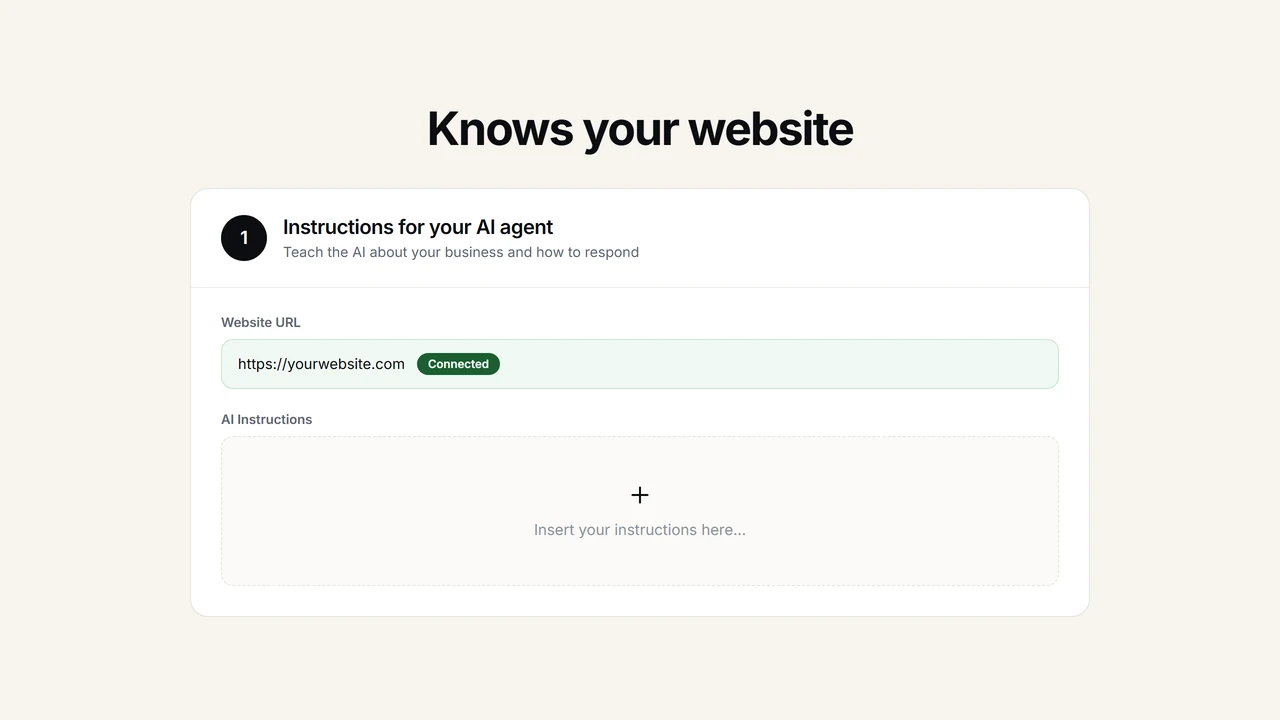
Paste your support site or product URL and observe the AI composing answers from what it finds
Traditional bots match keywords — an AI helpdesk chatbot reads for meaning
Keyword-matching chatbots fail the moment a visitor phrases something differently from the expected pattern. An AI helpdesk chatbot parses the actual intent behind a request, locates the relevant documentation sections, and composes an answer that directly addresses what was asked — regardless of phrasing.
- Semantic understanding across your entire corpusThe AI helpdesk chatbot reads every page, article, and uploaded document holistically. When a visitor asks a compound question spanning billing and feature limits, it pulls from both sections and weaves a coherent response.
- Handles ambiguity without falling back to menusWhen a question is vague, the chatbot asks a clarifying follow-up rather than dumping the visitor into a button tree. The conversation feels like messaging a knowledgeable colleague, not navigating a phone system.
- Behavioral guardrails you author in plain sentences"Decline to speculate on upcoming features." "When a refund request exceeds $200, collect the order number and escalate." "Never share internal SLA benchmarks." The AI helpdesk chatbot obeys written boundaries consistently.
Measures resolution, not just deflection — because bouncing a ticket sideways is not success
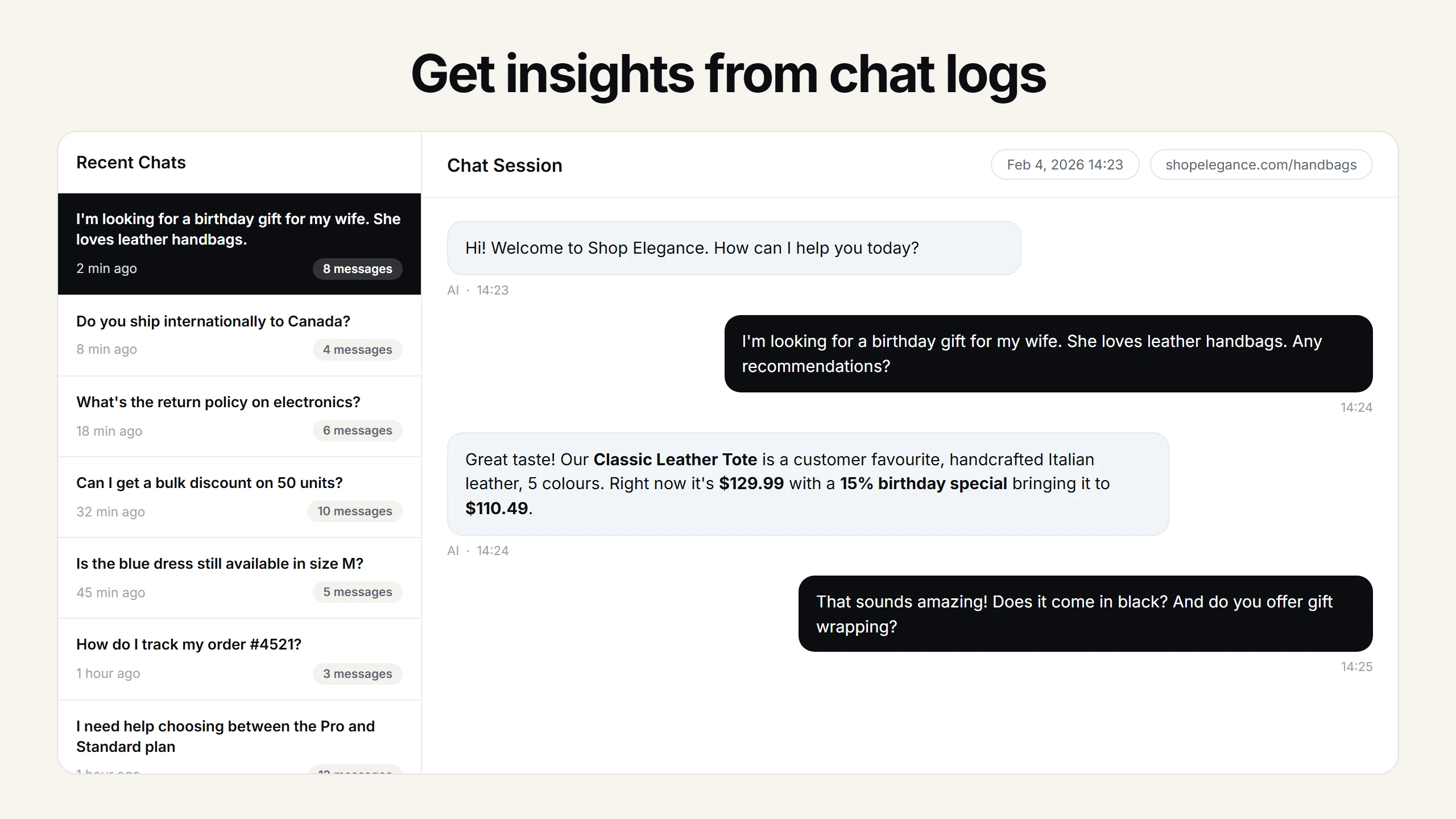
Most chatbot metrics celebrate deflection: tickets diverted away from agents. An AI helpdesk chatbot should measure resolution — whether the visitor's actual problem was solved. Asyntai tracks completed resolutions versus escalations, giving you a genuine picture of automated support quality.
- Resolution vs. escalation ratioThe dashboard breaks down how many conversations the AI helpdesk chatbot fully resolved versus how many required human involvement, segmented by topic and time period.
- Knowledge gap detectionQuestions the chatbot could not answer are grouped by theme. Each gap becomes an actionable signal: write the missing article, and future visitors with the same question get resolved automatically.
- Escalation arrives pre-triagedWhen the AI helpdesk chatbot hands off, the transcript includes which documentation it already referenced and what the visitor confirmed — so your agent picks up mid-conversation rather than restarting from scratch.
Deploy the AI helpdesk chatbot on your support surface
Whether your helpdesk lives inside a product app, a standalone support portal, or your main marketing site, the AI helpdesk chatbot installs the same way: a single script tag placed before the closing </head>.
- Register a free Asyntai account and copy your dedicated helpdesk snippet from the dashboard.
- Place the snippet in the header of your support portal, product app, or company website.
- Feed the AI your knowledge base URL and upload any internal procedure documents it should reference.
- Author escalation rules, verify a handful of realistic support scenarios, and activate.
<script src="https://asyntai.com/widget.js"
data-id="your-site-id" async>
</script>
</head>
# AI helpdesk chatbot now active on your support surface.
AI helpdesk chatbot — FAQs
Technical and operational questions teams raise before deploying autonomous AI on their support surface.
How does an AI helpdesk chatbot differ from a regular helpdesk chatbot?
A regular helpdesk chatbot operates on decision trees and keyword matching — it follows pre-built paths and breaks when visitors phrase things unexpectedly. An AI helpdesk chatbot uses machine comprehension to parse the actual meaning of a request, locate relevant documentation sections, and compose a unique answer grounded in your content. The distinction matters operationally: the AI version handles the long tail of phrasing variations that rule-based bots systematically miss.
Can the AI helpdesk chatbot resolve multi-step support requests?
Yes. The chatbot maintains conversation context across multiple exchanges within a session. A visitor who starts with "my export failed," clarifies "it was a CSV export of the billing report," and then asks "will I lose the filters I set up" receives a coherent thread of answers referencing all three messages rather than treating each as isolated. Complex workflows that require sequential troubleshooting steps are delivered in order with confirmation checkpoints.
What prevents the AI from giving incorrect technical answers?
The chatbot is constrained to your documentation and uploaded materials as its source of truth. It cannot pull from general internet knowledge or training data when formulating answers. If the documentation does not contain the answer, the chatbot acknowledges the gap and offers escalation rather than fabricating a response. Behavioral rules let you add further constraints: "never troubleshoot hardware issues," "always confirm firmware version before suggesting a reset procedure."
Does it integrate with existing ticketing systems like Zendesk or Freshdesk?
The AI helpdesk chatbot works alongside your existing ticketing system rather than replacing it. Escalated conversations are delivered via email notification with the full transcript attached. Route that notification to your ticketing system's intake address and the conversation becomes a properly threaded ticket. No API keys, no OAuth setup, no middleware — just email forwarding to the address your ticketing system already monitors.
Can the chatbot provide account-specific answers to logged-in users?
On Standard and Pro plans, your application passes logged-in user attributes into a JavaScript object via window.Asyntai.userContext before the chatbot loads. The AI incorporates those attributes — plan tier, subscription status, feature entitlements, recent activity — into its responses. A user on your Enterprise plan asking about API rate limits receives Enterprise-specific numbers rather than a generic answer.
How many languages does the AI helpdesk chatbot support?
The interface and AI responses cover 36 languages. Language detection occurs automatically from the visitor's first message — no dropdown selector, no URL parameter, no browser-language sniffing. A visitor typing in Turkish receives Turkish responses composed from your English-language documentation. The translation quality is native-level because the AI comprehends the source material and re-expresses it rather than performing mechanical word substitution.
What does it cost for a support team handling significant volume?
Free tier includes 50 messages per month on one site. Paid plans begin at $39 per month for 800 messages across two sites. Standard and Pro tiers scale further for teams with higher throughput. Compared to adding another support agent at $4,000-6,000 per month fully loaded, the AI helpdesk chatbot covering the content-answerable portion of your queue is substantially more economical at every volume tier.
Can I deploy the chatbot across multiple support properties?
Yes. Free covers 1 site, Starter covers 2, Standard covers 3, Pro covers up to 10. Each property receives its own independent AI helpdesk chatbot with its own documentation source, its own behavioral rules, and its own escalation routing. Multi-product companies, SaaS platforms with separate help centers per product line, and agencies managing client support properties all use the multi-site structure.
AI helpdesk chatbot — the shift from scripted deflection to genuine machine resolution
Somewhere around 2019, the helpdesk software industry collectively decided that chatbots were the answer to growing ticket volume. What they shipped, almost universally, was a decision-tree builder wearing a chat interface — a branching set of canned responses triggered by keyword patterns, with a fallback to the human queue whenever the visitor strayed off-script. Those early bots did reduce ticket counts, but they achieved that reduction by frustrating visitors into giving up rather than by actually resolving their issues. The metric was "deflection," and nobody questioned too closely whether deflection and resolution were the same thing. They were not. An AI helpdesk chatbot represents a genuinely different architecture: one where the machine reads your documentation the way a well-prepared support agent would, understands the visitor's actual question regardless of how they phrase it, and composes a substantive answer that solves the problem. The difference is not incremental. It is categorical.
Understanding why the distinction matters requires looking at how support requests actually behave in the wild. A rule-based bot handles a question like "how do I reset my password" acceptably because the phrase is predictable and the answer is singular. But real support traffic includes compound questions ("I reset my password and now my two-factor codes stopped working"), conditional questions ("can I downgrade mid-cycle if I prepaid annually"), comparative questions ("what is the difference between the export in Settings and the one in Reports"), and contextual questions that reference something the visitor already tried ("I followed the steps on your troubleshooting page and it still does not work"). None of these fit neatly into a decision tree. An AI helpdesk chatbot processes the full meaning of the request, cross-references the relevant documentation sections, and produces an answer that addresses the compound, conditional, or contextual nature of what was actually asked. That capability is what converts deflection into resolution.
The retrieval mechanism is central to how an AI helpdesk chatbot earns trust. Asyntai's approach is straightforward: you provide your knowledge base URL, the AI crawls every reachable article and page, and that content becomes the chatbot's working source. Internal materials — escalation playbooks, engineering runbooks, product-team decision rationale documents, troubleshooting trees that were never published externally — get uploaded as PDFs or pasted text and merge into the same knowledge layer. The chatbot answers from this combined corpus. When a question falls outside the corpus entirely, the chatbot says so and routes to a human. There is no "creative" response synthesis from general training data. The boundary between what the chatbot knows and what it does not know is sharp, which is precisely what a support team needs before trusting an AI with live visitor interactions.
Behavioral rules are the second layer of trust. Even with high-quality documentation as the source, a support team needs the chatbot to follow operational policies that go beyond content. Asyntai's approach is plain-English instructions that the AI helpdesk chatbot treats as binding directives. "If a visitor reports data loss, immediately collect their account identifier and escalate — do not attempt resolution." "When asked about pricing changes, reference only the published pricing page and do not speculate on future adjustments." "For any request involving personally identifiable information, confirm the visitor's identity by asking for the email on file before proceeding." These rules operate across every language and every conversation. They are the operational equivalent of the policy manual a new support hire reads during onboarding, except the AI follows them with perfect consistency rather than variable adherence.
Escalation quality is where the AI helpdesk chatbot diverges most sharply from its predecessors. A traditional bot escalating a ticket produces, at best, a short summary and the visitor's email address. The human agent receiving that ticket starts over: "Can you describe the issue you are experiencing?" The visitor, already frustrated by the bot's failure, repeats everything. An AI helpdesk chatbot escalating through Asyntai delivers the entire conversation transcript, including which documentation the chatbot already cited and what the visitor confirmed or denied along the way. The agent receiving the escalation enters the conversation mid-flow with full context. For the visitor, the experience transitions seamlessly from automated to human without the demoralizing reset that characterizes most chatbot-to-agent handoffs. For the agent, time-to-resolution drops because the diagnostic groundwork is already done.
Measuring an AI helpdesk chatbot on resolution rather than deflection changes what you optimize. Deflection-oriented metrics incentivize the chatbot to avoid creating tickets at all costs, which leads to aggressive dead-ending of conversations and artificially suppressed escalation. Resolution-oriented metrics incentivize the chatbot to actually solve the visitor's problem, with escalation treated as the correct outcome when the chatbot genuinely cannot help. Asyntai's analytics dashboard surfaces both: how many conversations concluded with the visitor's issue addressed, how many escalated to a human, and crucially which topics generate the most escalations. That third metric is the actionable one. Each high-escalation topic represents a gap in your documentation. Write the missing article, and the AI helpdesk chatbot begins resolving that category autonomously in future sessions. Over months, the resolution rate climbs steadily because the documentation improves in response to real visitor needs.
The multilingual dimension elevates an AI helpdesk chatbot from useful to strategically significant for any operation serving international users. Traditional multilingual support requires either hiring agents in each language market or routing non-English tickets to a translation layer that adds latency and loses nuance. The AI helpdesk chatbot handles 36 languages natively — the interface localizes, the AI detects the visitor's language from the opening message, and the response is composed in that language from your documentation regardless of what language the docs were written in. A Brazilian visitor writing Portuguese about a billing discrepancy receives a Portuguese answer synthesized from your English billing documentation. A Korean visitor asking about API rate limits in Korean receives a Korean explanation composed from your English developer docs. The quality is not machine translation in the traditional sense; the AI comprehends the source and re-expresses it fluently, which produces substantially better output than phrase-by-phrase translation tools.
Account-aware responses through User Context take the AI helpdesk chatbot from generic documentation lookup to personalized support. On Standard and Pro plans, your application pushes visitor-specific data into a JavaScript object before the chatbot initializes: plan tier, subscription renewal date, feature entitlements, recent support interactions, whatever your system knows about the current user. The chatbot incorporates this context into every answer. A visitor on your Professional plan asking "what is my storage limit" receives "your Professional plan includes 50 GB of storage" rather than a generic table of all tiers. A visitor whose subscription renews in three days asking about cancellation receives timeline-aware guidance. The mechanism is push-based — your application controls exactly which attributes the chatbot sees — so there is no database access to manage, no API integration to maintain, and no credential rotation to schedule.
The operational model for teams already running a helpdesk tool is coexistence, not replacement. The AI helpdesk chatbot sits upstream of your existing ticketing system — Zendesk, Freshdesk, Intercom, Jira Service Management, Help Scout, or whichever platform you use — and intercepts visitors before they generate tickets. The visitors whose questions the chatbot resolves never enter the ticketing system at all. The visitors whose questions require human judgment are escalated via email notification to your ticketing system's intake address, creating a ticket that looks and behaves exactly like any email-originated ticket. Your agents continue working in their familiar tool. The only change they observe is a thinner queue with better-contextualized tickets. No migration, no retraining, no new dashboard to learn. The chatbot simply absorbs the content-answerable layer of your incoming volume.
Pricing is structured to reflect the reality that an AI helpdesk chatbot replaces variable human cost with predictable software cost. The free tier carries 50 messages per month — enough for a small product with modest support traffic to validate the approach. Paid plans begin at $39 per month for 800 messages, which absorbs the deflectable volume of most mid-sized support operations comfortably. Higher tiers exist for teams with substantial inbound volume. Site limits scale with the plan: 1, 2, 3, or up to 10. For context, a single additional support agent costs between $4,000 and $6,000 monthly when you include salary, benefits, tooling, and management overhead. If the AI helpdesk chatbot resolves even a fraction of what that agent would have handled, the economics are unambiguous.
The organizations that extract the most value from an AI helpdesk chatbot share a recognizable support profile. Their ticket volume includes a substantial proportion of questions answerable from existing documentation. Their agents spend meaningful time on repetitive inquiries that do not require judgment, investigation, or system access. Their user base spans multiple languages or time zones, creating coverage gaps that human staffing cannot fill economically. SaaS companies with active self-serve tiers match this profile almost universally. Ecommerce operations with high volumes of shipping, returns, and product specification questions match it. Developer platforms with dense technical documentation and a global developer community match it. Internal IT helpdesks at companies above a hundred employees match it. Educational institutions running support for students and faculty across departments match it. In every case, the pattern is the same: a large base of resolvable questions currently consuming human time that would be better spent on genuinely complex cases.
Deploying the AI helpdesk chatbot is deliberately the simplest part of the entire process. Place the JavaScript snippet in your support portal or product application header. Provide your knowledge base URL so the AI can absorb your documentation. Upload any internal materials the chatbot should reference alongside public content. Write behavioral rules that encode your support policies. Verify the chatbot's responses against a representative sample of recent ticket topics. Activate. Most support teams complete this sequence within a single working session. The week that follows is refinement: monitoring real conversations, tightening rules where the chatbot's judgment needs guidance, identifying documentation gaps the chatbot surfaces. By the second week, the AI helpdesk chatbot is operating as a reliable first responder — resolving the requests it can handle, escalating the ones it cannot, and producing a continuous stream of intelligence about where your support documentation needs to grow next.