AI for insurance agencies: answer policy questions and capture leads while your office is closed
An AI chatbot that reads your agency website, answers coverage questions accurately, captures quote requests from new prospects, and handles claims inquiries — day, night, weekends, and holidays.
See how the AI handles real insurance questions
Paste your agency website below. The AI reads your pages — carriers, coverage types, claims process, contact info — and builds a working chatbot in seconds.
Your phones ring constantly — and most callers are asking the same ten questions
Insurance agencies run on phone calls. Every new prospect, every renewal question, every claim status check, every coverage clarification — it all comes through the same phone line. A mid-size independent agency handles dozens of calls per day, and the majority follow predictable patterns: "What does my deductible look like?" "Do you write umbrella policies?" "How do I file a claim?" "Are you open Saturday?" These are important questions that deserve clear answers, but they do not require a licensed agent's expertise to answer. When your producers spend half their day fielding routine inquiries, they are not writing new business. An AI chatbot on your agency website intercepts those repetitive questions before they become phone calls, answers them accurately using your own website content, and captures the caller's information as a lead when the conversation involves a quote or policy change. It runs on every plan — Free gives you 50 messages per month to test it, Starter at $39/month handles 800 messages, Standard at $139/month covers 15,000 messages across 3 sites, and Pro at $449/month scales to 50,000 messages and 20 sites.
- Answers policy and coverage questions instantlyThe AI reads your website content — carrier pages, coverage descriptions, FAQ sections, claims instructions — and answers visitor questions in natural conversation. "Does your agency write flood insurance?" gets an accurate answer pulled from your site, not a generic response. The chatbot handles the questions your CSRs answer ten times a day, freeing them for work that actually requires a license.
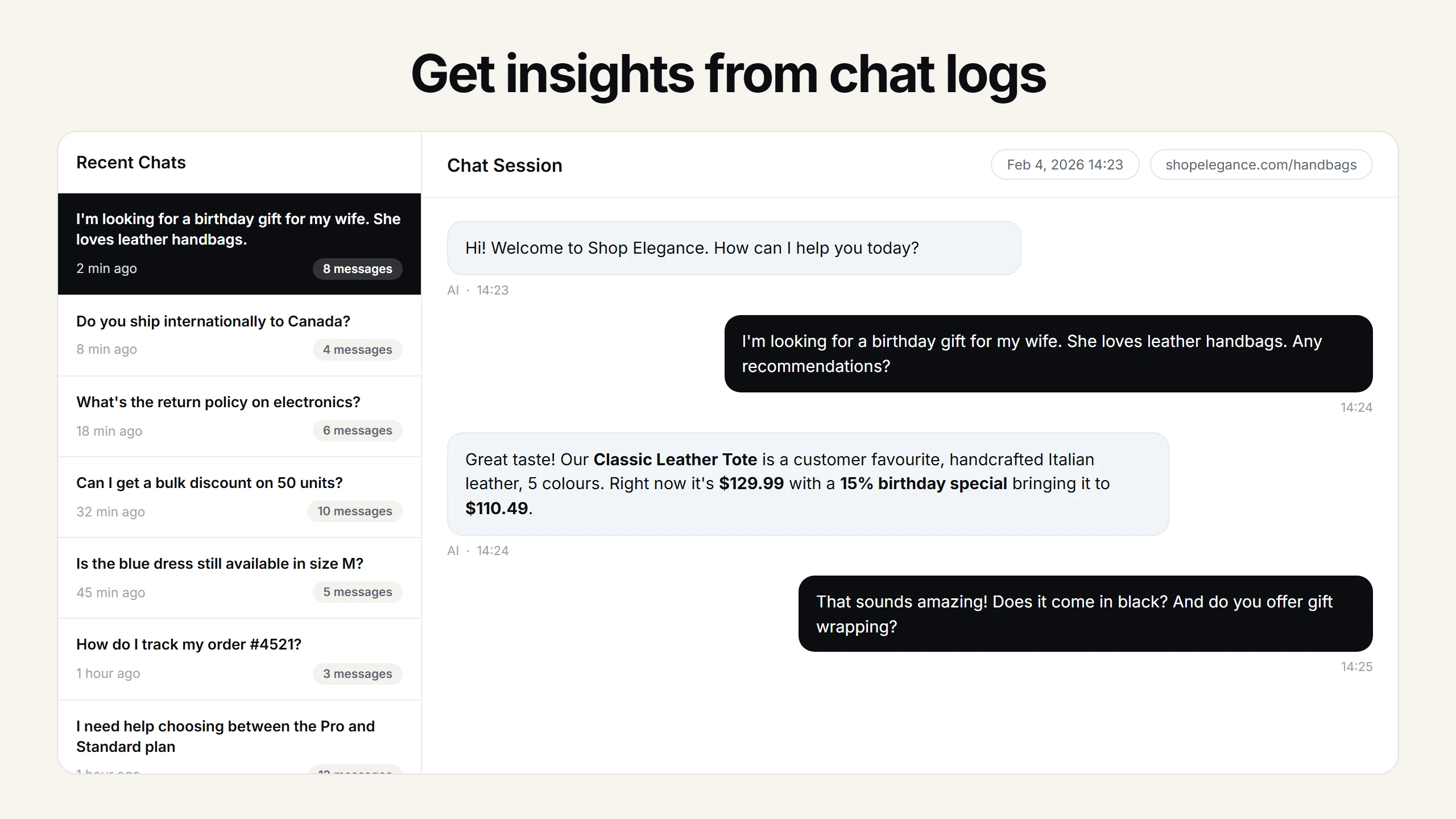
- Captures quote requests with contact detailsWhen a visitor asks about getting a quote — auto, home, business, life — the chatbot collects their name, email, phone number, and basic details about what they need. That information appears in your Asyntai dashboard as a lead, ready for your producer to follow up. No form abandonment, no "I'll call back later" that never happens. The lead is captured in the conversation.
- Covers nights, weekends, and the hours you lose the most prospectsInsurance questions do not stop at 5 PM. A homeowner notices water damage at 9 PM and wants to know their claims process. A prospect comparison-shopping on Sunday wants a quote. A business owner reviewing coverage at midnight has a question about their BOP. The chatbot is there for all of them — answering questions, collecting information, and making your agency feel responsive even when nobody is in the office.
Connect your management system and let the AI pull live policy data
Answering general questions from your website content covers a large share of visitor inquiries. But some questions need live data — "What is my current deductible?" or "When does my policy renew?" With Custom Tools, available on Standard ($139/month) and Pro ($449/month) plans, the AI chatbot calls your agency management system's API during a conversation, retrieves the policyholder's actual data, and responds with specifics. The visitor gets their answer without waiting on hold; your staff handles one fewer call.
- Claims status without the phone queueConnect a claims status endpoint and the chatbot can tell a policyholder where their claim stands — submitted, under review, adjuster assigned, payment issued. They ask in the chat, provide their claim number, and get an answer in seconds instead of sitting on hold for fifteen minutes.
- Policy details on demandPolicyholders forget their coverage limits, deductible amounts, and named insureds. A Custom Tool connected to your management system lets the chatbot pull that information mid-conversation. "Your homeowner's policy has a $1,000 deductible and $300,000 dwelling coverage" is a far better answer than "Please call us during business hours."
- Coverage explanations grounded in their actual policyWhen a policyholder asks "Am I covered if a tree falls on my car?" the chatbot can check whether they carry comprehensive auto coverage and answer accordingly. The response is not generic insurance advice — it reflects what the visitor actually has on their policy.
- Renewal dates and upcoming paymentsRenewal season floods agencies with "when does my policy renew?" calls. A connected chatbot handles those lookups instantly — policy renewal date, premium amount, payment due date — reducing the seasonal surge that overwhelms front-desk staff every quarter.
- Lead qualification by policy typeNot every quote request is the same. The chatbot can ask qualifying questions — vehicle year and model for auto, square footage and year built for home, industry and revenue for commercial — and pass structured lead data to your producers. They open the lead already knowing what the prospect needs, which lines are involved, and whether it fits your agency's appetite.
Get the chatbot live on your insurance agency website
No IT department needed. Add your agency URL, let the AI read your content, and paste one script tag on your site. Twenty minutes from signup to a working chatbot.
- Sign up at asyntai.com/pricing — Free gives you 50 messages to test. Starter ($39/month) handles 800 messages. Standard ($139/month) and Pro ($449/month) add Custom Tools for live policy lookups.
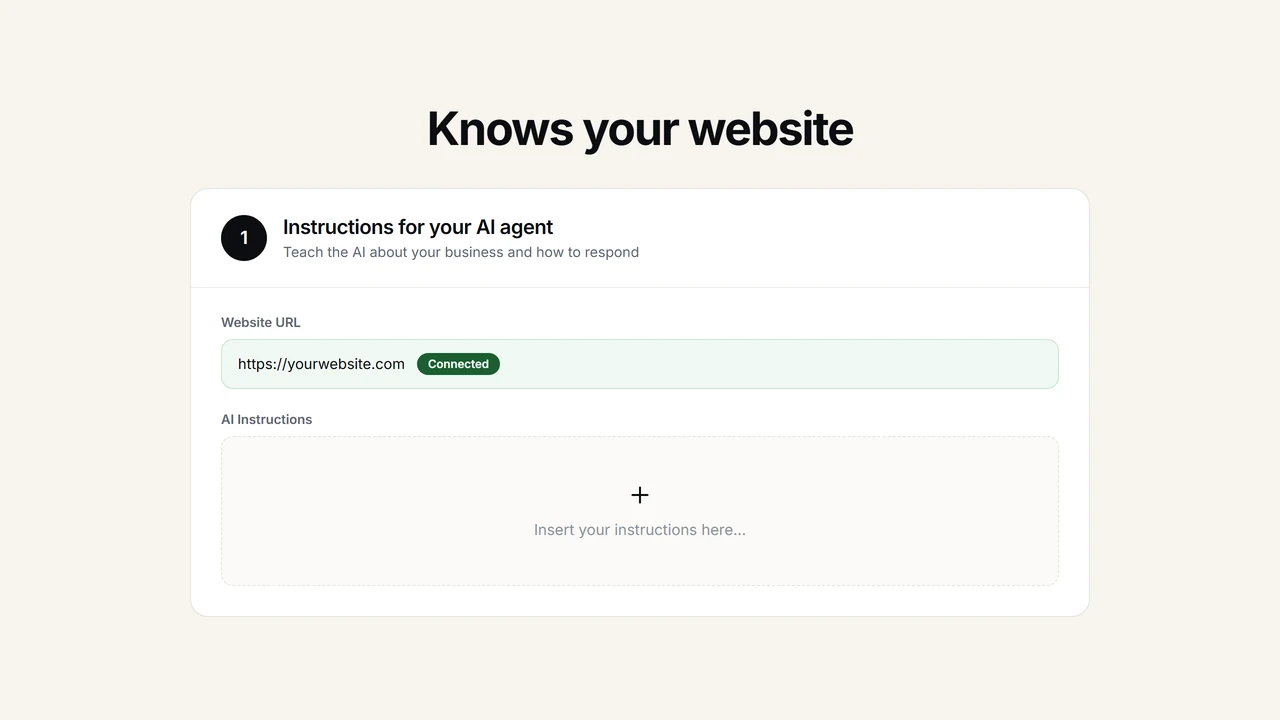
- Add your agency website URL. The AI reads your pages — carrier information, coverage descriptions, claims procedures, office hours, team bios — and builds a knowledge base automatically. Up to 50 pages crawled.
- Upload any supplementary documents — policy summary templates, claims filing guides, coverage comparison sheets — to fill in details not on your public website.
- Copy the embed script from your dashboard and add it to your website. Works on WordPress, Squarespace, Wix, Weebly, and any platform that supports a script tag. The chatbot appears on your site immediately.
<script src="https://asyntai.com/widget.js"
data-id="your-site-id" async>
</script>
# One line of code. Answers policy questions 24/7.
AI for insurance agencies — FAQs
Common questions from independent agents and agency owners evaluating AI chatbots for their websites.
Can the AI give accurate answers about specific insurance products and coverages?
Yes — the AI reads your agency website content and uses it to answer questions. If your site describes your homeowner's coverage options, deductible structures, and carrier partners, the chatbot answers questions about those topics using that information. It does not generate generic insurance advice. It answers based on what your agency has published. You can also upload documents — coverage comparison sheets, claims guides, FAQ documents — to expand what the AI knows beyond your public web pages.
Does the chatbot provide insurance advice or act as a licensed agent?
No. The chatbot answers informational questions using your published content — it explains what coverages your agency offers, how to file a claim, what documents are needed for a quote, and similar factual questions. It does not recommend specific coverage amounts, advise on policy decisions, or bind coverage. You control the chatbot's behavior through custom instructions — you can add disclaimers like "This is general information only. Contact a licensed agent for specific coverage recommendations" to any response category. The chatbot handles the informational layer; your licensed producers handle the advisory layer.
Is visitor data handled securely?
Yes. All data is encrypted in transit and at rest. Conversation transcripts and captured lead information are stored securely and accessible only through your authenticated Asyntai dashboard. You can export and delete data at any time. For agencies using Custom Tools to connect to management systems, the API calls are made over HTTPS and no policyholder data is stored by Asyntai beyond the conversation transcript. Review the security page for full details on data handling practices.
Can I connect the chatbot to our agency management system?
If your management system exposes API endpoints — for policy lookups, claims status, or account details — you can connect them as Custom Tools. The AI calls those endpoints during a conversation when a visitor asks a relevant question. This is available on the Standard plan ($139/month) and Pro plan ($449/month). Not every management system has a public API, so check with your vendor. If they offer REST API access, it works with Custom Tools.
How does the chatbot handle quote requests?
When a visitor asks about getting a quote, the chatbot collects their contact information and basic details — what type of coverage they need, relevant details like vehicle information or property address, and their preferred contact method. That data appears in your Asyntai dashboard as a lead. Your producer follows up with the full quoting process. The chatbot does not generate quotes or bind coverage — it captures the lead and relevant details so your team can quote efficiently.
We serve a multilingual community. Does the chatbot support other languages?
Yes — 36 languages with automatic detection. If a visitor types in Spanish, the chatbot responds in Spanish using your English website content. No separate configuration or translated content required. This is particularly valuable for agencies in communities with significant Spanish-speaking, Vietnamese, Chinese, Korean, or other non-English-speaking populations. The AI handles the language translation; your content stays in whatever language you published it in.
What happens when someone asks a question the AI cannot answer?
You configure this through custom instructions. Common setups for insurance agencies: collect the visitor's name, email, and question, then let them know an agent will follow up within a specified timeframe. You can also route specific topics — like claims involving injuries or complex commercial policies — directly to a human handoff. The chatbot captures the lead either way, so no inquiry goes unanswered even when the AI does not have the information to resolve it on the spot.
Can I add the chatbot to multiple agency websites or locations?
Yes. The Starter plan covers 2 sites, Standard covers 3, and Pro covers 20 — each with its own knowledge base and custom instructions. An agency with separate websites for personal lines and commercial lines, or separate sites for different office locations, can deploy independent chatbots on each. Every site gets its own crawled content, its own Custom Tools, and its own captured leads.
How long does it take to set up?
About 20 minutes for a basic deployment. Sign up, add your website URL (the AI reads it automatically), adjust the widget appearance to match your agency branding, and paste the script tag on your site. If you want to add Custom Tools for policy lookups or claims status, that takes additional time depending on your management system's API — typically another 30-60 minutes per endpoint. Most agencies start with the knowledge-base chatbot and add Custom Tools later.
AI for insurance agencies: why the industry that runs on trust needs a chatbot that gets the details right
Insurance is one of the last industries where the telephone is still the primary interface between a business and its customers. Banks have apps. Retailers have self-service portals. Airlines have chatbots that rebook flights. But when a policyholder wants to know whether their homeowner's policy covers a burst pipe, the default action in 2026 is still to pick up the phone and call their agent's office. And when they call at 6:30 PM on a Tuesday and get voicemail, or at 11 AM on a Monday and wait on hold behind three other callers, the experience does not feel like it belongs in the same decade as everything else they interact with online. This gap between what policyholders expect and what most agencies deliver is not a technology problem — the technology exists. It is an adoption problem. And agencies that close the gap first gain an edge that compounds over time.
The resistance to chatbots in insurance has always been rooted in a legitimate concern: accuracy. Insurance is a precision business. The difference between "your policy covers water damage from a burst pipe" and "your policy covers flood damage" is not a nuance — it is the difference between a covered claim and a denial. Generic chatbots that generate answers from broad language models cannot be trusted with this kind of specificity. They will confidently tell a visitor something plausible but wrong, and in insurance, a wrong answer can create an errors-and-omissions exposure for the agency. This is why Asyntai works differently. The AI does not generate answers from general knowledge. It reads your agency's website content — your coverage descriptions, your carrier pages, your claims process documentation, your FAQ answers — and responds using that specific information. If your website says you offer flood insurance through a specific program, the chatbot says that. If your website does not mention flood insurance, the chatbot does not invent an answer about it.
Quote request capture is where the chatbot pays for itself fastest. Every insurance agency website has a quote request form, and every agency knows the abandonment rate on those forms is painful. A prospect lands on your auto insurance page, considers filling out the form, sees fifteen required fields, and decides to "come back later" — which means never. A chatbot turns that form into a conversation. The visitor says "I need a quote for auto insurance," and the chatbot asks a few natural follow-up questions: "What vehicles are you looking to insure? What is your zip code? What is the best email to send the quote to?" The interaction feels like talking to a helpful person, not filling out a bureaucratic form. The lead data arrives in your dashboard with all the same information — name, contact, coverage type, key details — but the completion rate is dramatically higher because conversations have lower friction than forms.
Claims inquiries represent the most emotionally charged interactions an insurance agency handles, and they are also the most repetitive. A policyholder whose car was hit in a parking lot wants to know three things: how to file a claim, what their deductible is, and how long the process takes. A homeowner with storm damage wants to know the same three things, adjusted for property claims. These conversations follow predictable patterns, and the answers are largely the same across similar claim types. A chatbot that can walk a policyholder through the initial claims reporting steps — "Here is how to file a claim with us: gather your policy number, document the damage with photos, and call our claims line at 555-0123 or submit the claim through your carrier's app" — handles the informational part of the interaction before the emotional part requires a human touch. The policyholder gets immediate guidance instead of a voicemail box, and your staff handles the claim itself rather than explaining the process for the hundredth time.
After-hours coverage is not a luxury for insurance agencies — it is a revenue leak they can measure. Insurance questions do not follow business hours. A new homeowner closing on a house Friday afternoon needs proof of insurance before Monday. A business owner reviewing their coverage Sunday night before a contract deadline has a question about their certificate of insurance. A prospect comparing auto insurance quotes at 10 PM wants to know whether your agency writes policies for drivers under 25. Every one of these interactions is a potential new policy, a retention touchpoint, or a service moment — and every one of them currently goes to voicemail or an unanswered contact form. A chatbot that handles the informational layer of these interactions captures leads that would otherwise evaporate, answers questions that would otherwise fester into frustration, and makes the agency feel alive when the office is dark.
The complexity of insurance products is paradoxically both the problem and the opportunity for AI chatbots. Policyholders do not understand their own coverage. They do not know the difference between replacement cost and actual cash value. They do not know what an umbrella policy covers that their auto and home policies do not. They do not know whether their business owner's policy includes professional liability. And when they have these questions, they feel intimidated — calling an agent to ask "basic" questions feels like admitting ignorance. A chatbot removes that barrier entirely. Nobody feels embarrassed asking a chatbot a simple question. The visitor types "what is the difference between comprehensive and collision?" and gets a clear, accurate answer pulled from the agency's own content. They leave the interaction more informed, more confident in their coverage, and more loyal to an agency that made learning easy.
Multi-policy households are the backbone of profitable independent agencies, and the chatbot becomes a quiet cross-sell engine for them. A policyholder visiting the website to check on their auto policy renewal sees the chatbot and asks a question. The conversation is about auto, but the chatbot's knowledge base includes the agency's home, umbrella, and life insurance pages. When the policyholder asks "what other types of coverage do you offer?" the chatbot walks them through the options — and captures the lead for the lines they do not currently carry. This is not aggressive upselling. It is answering a question the policyholder asked, with information the agency has already published. The cross-sell happens naturally because the chatbot knows the full breadth of what the agency offers, and the policyholder was curious enough to ask.
Commercial lines represent a different set of questions and a higher-value opportunity. A business owner visiting your agency's website at midnight is not casually browsing. They have a need — maybe they are starting a business and need general liability, maybe their current carrier non-renewed them and they are shopping under pressure, maybe they are expanding and need to add locations or vehicles. Commercial prospects tend to have specific, detailed questions: "Do you write artisan contractors?" "Can you insure a fleet of 12 delivery vans?" "Do you offer employment practices liability?" The chatbot answers these from your website content, captures the business details, and delivers a qualified commercial lead to your producer by morning. In commercial lines, where a single policy can generate thousands in annual commission, capturing even one additional lead per month more than justifies the chatbot's cost.
Compliance and disclaimers are a natural fit for AI chatbot instructions. Every insurance agency knows they need to include certain language in client-facing communications — that quotes are estimates, that coverage is subject to underwriting, that the chatbot does not constitute professional advice. With custom instructions, you write these rules in plain English and the AI follows them in every conversation. "Always include: This information is for general purposes only and does not constitute a binding quote or coverage guarantee. Contact a licensed agent for specific policy recommendations." The chatbot includes this language consistently — more consistently, in fact, than a human CSR who might forget the disclaimer during a busy afternoon. The compliance layer is baked in, not bolted on.
Renewal seasons expose the staffing constraint that every agency owner knows but rarely solves. When a block of policies comes up for renewal, the phone volume spikes. Policyholders call to ask about their renewal premium, whether their coverage changed, why their rate went up, and whether they should shop around. Each call takes five to fifteen minutes, and during peak renewal months, the call volume can double or triple the norm. The chatbot absorbs the repetitive portion of that surge — the policyholder who just wants to know their renewal date, or wants to confirm their payment was received, or wants to understand a coverage change letter they received. On Standard and Pro plans with Custom Tools connected to your management system, the chatbot can pull actual renewal dates and premium amounts, handling these lookups without any staff involvement.
Independent agencies and captive agencies benefit differently from the chatbot, but both benefit. An independent agency writing with multiple carriers can use the chatbot to explain which carriers they represent, what each carrier specializes in, and how the quoting process works across carriers — information that is already on their website but that visitors rarely read in full. A captive agency can use the chatbot to go deep on the single carrier's product suite, explaining the differences between policy tiers, available endorsements, and bundling discounts. In both cases, the chatbot becomes the most patient, most knowledgeable front-desk employee the agency has ever had — one that never takes a lunch break and never calls in sick.
Custom Tools transform the chatbot from an information resource into an operational tool. The knowledge base handles "what" questions — what coverages you offer, what the claims process looks like, what your office hours are. Custom Tools handle "my" questions — what is my deductible, when does my policy renew, what is the status of my claim. This second category is where policyholders spend the most time on the phone, and it is where the time savings are largest. A policyholder who calls to check a claim status ties up a CSR for three to five minutes. A policyholder who checks claim status through the chatbot gets an answer in seconds and the CSR's time is never consumed. Multiply that across fifty claim status checks per week and the math is obvious. Custom Tools are available on Standard ($139/month) and Pro ($449/month) plans.
Multilingual capability matters more for insurance agencies than for most industries, because insurance is local and communities are diverse. An agency in a neighborhood with a large Spanish-speaking population needs to serve those clients in Spanish — not just during office hours when a bilingual CSR is available, but at 8 PM when the bilingual CSR has gone home. The chatbot supports 36 languages with automatic detection. A visitor types in Vietnamese and the chatbot responds in Vietnamese, pulling answers from the agency's English-language website content. No translated website required. No separate chatbot configuration. The agency serves its entire community without hiring for every language spoken in its zip code.
Lead qualification through the chatbot solves a downstream problem that most agencies do not think about until it costs them. When every quote request arrives as an unstructured email or voicemail — "Hi, I need insurance, call me back" — the producer spends the first five minutes of every follow-up call just figuring out what the prospect needs. Auto? Home? Business? Bundle? What state? What is their current coverage situation? The chatbot gathers this information during the initial conversation, before the prospect ever speaks to a human. By the time the producer picks up the phone, they know: this is a prospect in [zip code] looking for [coverage type] with [relevant details]. The follow-up call is shorter, more focused, and more likely to close because the producer demonstrates immediate competence — they already know what the prospect needs.
Trust is the currency of insurance, and accuracy is how the chatbot earns it. A prospect visiting your agency website for the first time is making a judgment: does this agency seem competent, professional, and reliable? A chatbot that answers their questions accurately — pulling real information from the agency's own content, not generating plausible-sounding fiction — reinforces every positive signal the website is trying to send. "Yes, we write umbrella policies starting at $1 million in additional liability coverage. Here is what it covers beyond your auto and home policies." That answer, delivered instantly at 9 PM on a Saturday, tells the prospect more about the agency's competence than any "About Us" page ever could. The chatbot does not replace trust — it accelerates it by giving the prospect accurate information exactly when they are looking for it.
Ready to give your policyholders and prospects a better experience? Start with the free plan — 50 messages, no credit card — and see how the AI handles your agency's real questions. Or go straight to Standard for Custom Tools and policy lookups.