AI-driven customer support that replaces the inbox treadmill with an engine that never stops
Asyntai automates your first line of support — answering visitor questions using your own content, in 36 languages, around the clock — so your team stops firefighting and starts building.
Watch AI-driven support handle your real content
Enter your URL and see how the automation responds to visitor questions pulled straight from your pages
Turn your published content into a 24/7 support machine
Manual support is a treadmill: every new visitor brings the same questions your team answered yesterday, last week, last quarter. AI-driven customer support breaks that cycle by converting your existing website pages, help articles, PDFs, and policy documents into an automated response layer that resolves the repetitive volume without human involvement. Asyntai crawls up to 50 pages from your site, indexes uploaded documents alongside them, and uses that combined knowledge to answer questions accurately — no scripting, no decision trees, no maintenance of canned responses that go stale.
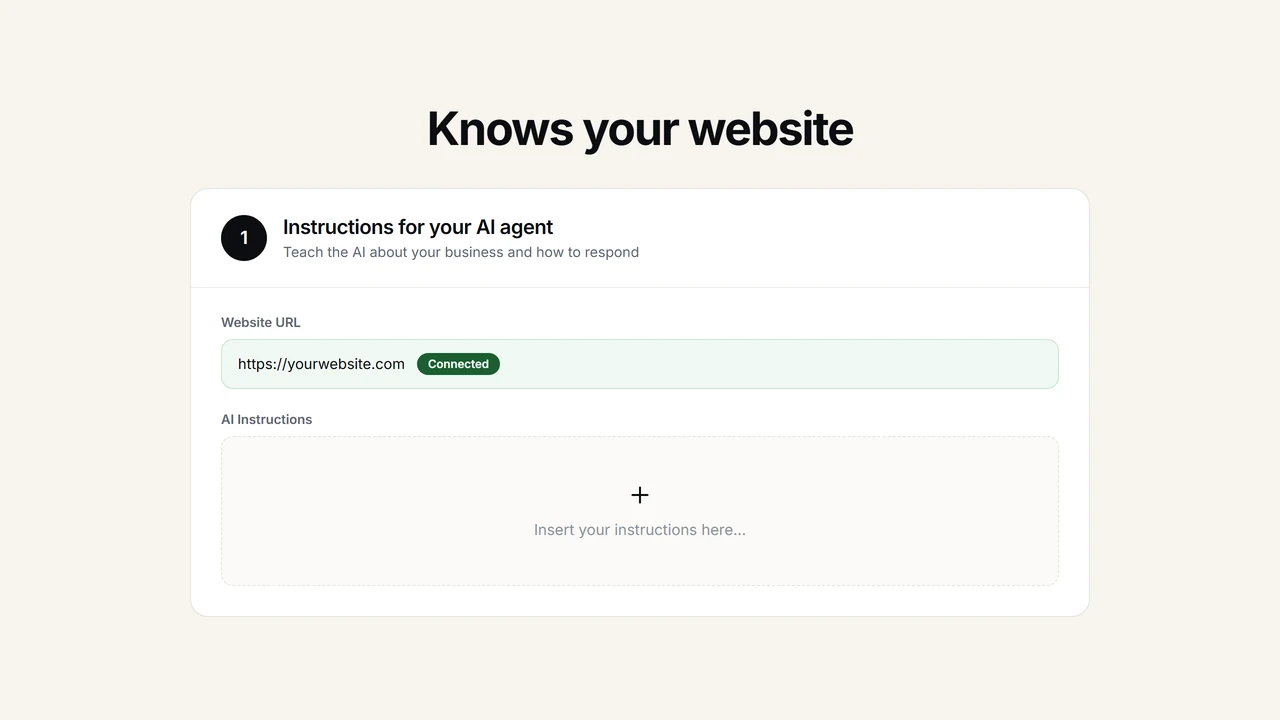
- Automatic content ingestionProvide your URL and the system crawls your public pages — product listings, pricing tables, FAQs, blog posts, policy documents — building a knowledge layer without any manual data entry.
- Private document uploadsAttach internal handbooks, shipping procedures, warranty terms, or partner guidelines as PDFs or pasted text. The AI references them alongside public content when resolving visitor questions.
- Behavioral rules in plain languageWrite instructions like "never promise same-day shipping" or "always collect an email before discussing account-specific details." The AI enforces every rule on every conversation, every hour of the day.
AI-driven support that pulls live data and takes action
Static knowledge bases cover the common questions. But visitors increasingly expect real-time answers — order status, appointment availability, account balances — that require reaching into your backend systems. With Custom Tools on Standard ($139/month) and Pro ($449/month) plans, the AI calls your own API endpoints mid-conversation to retrieve live data or trigger workflows like booking confirmations, return initiations, or ticket creation, turning passive chat into an active service channel.
- Real-time data retrievalThe AI calls your endpoints to fetch order tracking, inventory levels, subscription status, or appointment slots — delivering specific answers instead of generic policy recitals.
- Action execution within chatConfigure tools that let the AI initiate returns, reschedule appointments, update preferences, or create support tickets directly from the conversation without human handoff.
- Personalized context for logged-in visitorsPush customer data via window.Asyntai.userContext on Standard and Pro plans so the AI knows the visitor's account tier, recent orders, or membership status before they say a word.
- 36-language auto-detectionThe interface and AI responses operate in 36 languages. A German visitor gets German. A Japanese visitor gets Japanese. No separate configuration, no translation plugins, no additional cost.
- Intelligent escalation with full contextWhen a question exceeds the AI's scope or triggers an escalation rule, the system collects contact details, preserves the entire transcript, and delivers everything to your dashboard and inbox simultaneously.
Deploy AI-driven support before end of day
No procurement cycle, no integration project, no vendor onboarding. One JavaScript snippet in your site header, one content crawl, a few behavioral rules, and your support operation has an automated first line that runs continuously.
- Create a free Asyntai account — no credit card, no sales call. The free plan covers 1 site and 50 messages per month at $0, enough to validate AI-driven support on real traffic.
- Copy your unique snippet from the dashboard and paste it into your website's
<head>section via your CMS, tag manager, or a native plugin for WordPress, Shopify, WooCommerce, Magento, Joomla, Drupal, or Odoo. - Point the crawler at your URL and upload any private documents. The AI builds its knowledge layer from your actual content — no scripting, no decision-tree authoring.
- Scale when ready: Starter at $39/month covers 2 sites and 800 messages, Standard at $139/month covers 3 sites and 15,000 messages with Custom Tools, and Pro at $449/month covers 20 sites and 50,000 messages with white-label branding.
<script src="https://asyntai.com/widget.js"
data-id="your-site-id" async>
</script>
# Your support automation is live. No servers, no maintenance.
AI-Driven Customer Support — FAQs
The questions operations leaders and founders ask before switching from manual triage to AI-driven automation.
What does "AI-driven" mean compared to a traditional chatbot?
Traditional chatbots follow scripted decision trees — if the visitor says X, reply Y. AI-driven support works differently: the AI reads your actual content, understands the visitor's question in natural language, and composes a relevant answer from your knowledge base. There are no flowcharts to build, no keyword triggers to maintain, and no dead-end menus that frustrate visitors who phrase things unexpectedly.
How much of our support volume can AI realistically automate?
For businesses where the majority of inbound questions are answerable from published content — shipping timelines, return policies, product specs, pricing details, feature availability — the AI typically resolves 60 to 80 percent of conversations without any human involvement. The exact percentage depends on how thoroughly your knowledge base covers the topics visitors actually ask about.
Does the AI fabricate answers if it does not have the information?
No. The AI draws exclusively from your crawled pages and uploaded documents. When a question falls outside that knowledge — or when a behavioral rule restricts the topic — the AI acknowledges the gap and transitions to lead capture and human escalation rather than guessing or inventing an answer.
Can AI-driven support handle multiple languages without separate setups?
Yes. The system detects each visitor's language from their first message and responds accordingly across 36 languages. A visitor writing in Korean receives Korean responses, one writing in Portuguese receives Portuguese. There is no per-language configuration, no translation plugin, and no additional cost for multilingual coverage.
What happens when the AI cannot resolve a question?
Escalation activates: the AI collects the visitor's name and email, preserves the complete conversation transcript, and delivers everything to your Asyntai dashboard. If email forwarding is enabled, the same package arrives in your team's inbox simultaneously. The human who picks up the thread sees the full context without asking the visitor to repeat anything.
How is pricing structured for AI-driven support?
Plans are based on monthly message volume, not seats or agents. The free tier covers 50 messages for 1 site. Starter is $39/month for 800 messages across 2 sites. Standard is $139/month for 15,000 messages across 3 sites with Custom Tools. Pro is $449/month for 50,000 messages across 20 sites with white-label branding. You receive email warnings before approaching the cap, and the system pauses rather than generating surprise charges.
Can the AI call our backend systems for live data?
On Standard and Pro plans, Custom Tools let the AI call your own API endpoints mid-conversation — retrieving order status, checking appointment availability, looking up account details, or triggering workflows like return initiations. You define the endpoints and the AI decides when to call them based on the visitor's question.
How quickly can we go from sign-up to live AI-driven support?
Most teams are live within a single afternoon. The process is: create an account, paste one snippet into your site header, provide your URL for content crawling, upload any private documents, write a few behavioral rules, and test with sample questions. There is no integration project, no vendor onboarding, and no minimum commitment.
Can one account run AI-driven support across multiple websites?
Yes. Site limits scale with your plan: 1 on Free, 2 on Starter, 3 on Standard, and 20 on Pro. Each website maintains its own knowledge base, behavioral rules, styling, and conversation history — so AI-driven support for a retail brand operates independently from support for a SaaS product under the same account.
AI-driven customer support — how automation reshapes the economics of helping people
Every support team has a breaking point. It arrives quietly — not as a single catastrophic event but as a slow accumulation of pressure. Ticket volume climbs five percent this quarter, ten the next. Response times drift upward. The backlog that once cleared by noon now stretches into the afternoon, then into the evening. Hiring another agent buys breathing room for a few months before the cycle restarts. This is the treadmill that AI-driven customer support was built to dismantle. Not by eliminating the human team, but by removing them from the repetitive machinery so they can focus on the work that actually requires a person.
The economics tell the story most clearly. A human support agent costs somewhere between forty and ninety thousand dollars annually depending on region, seniority, and benefits — and that agent handles one conversation at a time during working hours. AI-driven support through Asyntai starts at zero dollars on the free tier and scales to $39 per month for 2,500 automated conversations, each one handled instantly, simultaneously, around the clock. The per-conversation cost drops from double-digit dollars to single-digit cents. For businesses where most inbound questions have answers already published on the website — and most do — that cost curve changes the math on how support departments are staffed, budgeted, and managed.
What makes AI-driven support fundamentally different from a rules-based chatbot is the absence of scripting. Traditional chatbots require someone to anticipate every possible question, write a matching response, and wire them together in a decision tree. When a visitor phrases a question slightly differently than expected, the tree breaks. When a new product launches, someone has to build new branches. When a policy changes, someone has to find and update every affected node. AI-driven support sidesteps all of that. Asyntai reads your website content — product pages, FAQ sections, pricing tables, help articles, policy documents — and uses that knowledge to compose answers on the fly. The visitor asks in whatever words come naturally, and the AI responds from your actual published information.
The always-on dimension matters more than businesses expect until they experience it. A company operating in a single time zone still receives traffic from visitors in other time zones, from night owls, from people browsing on their lunch break overseas. Without AI-driven support, those visitors hit a contact form and wait. With it, they get an immediate answer at two in the morning on a Sunday, generated from the same knowledge base that serves the nine-to-five crowd. The resolution happens before the human team clocks in. For businesses with any international presence — or any aspirations toward one — this eliminates the choice between staffing a night shift and ignoring off-hours traffic entirely.
Multilingual capability amplifies the always-on advantage by removing the second staffing constraint that limits traditional support operations. Hiring agents who speak Korean, Portuguese, Arabic, and German is expensive and operationally complex even for large enterprises. For a small business, it is functionally impossible. AI-driven support through Asyntai operates in 36 languages with automatic detection — a Thai visitor gets Thai responses, a Dutch visitor gets Dutch, a Hebrew visitor gets Hebrew — all from the same installation, the same knowledge base, the same behavioral rules. The visitor's language choice does not create a routing problem or a hiring need. It simply works.
Content ingestion is where the automation begins, and it is deliberately frictionless. You provide your website URL and the system crawls up to 50 pages, absorbing everything from product descriptions to return policies. Internal documents that should not be public — shipping carrier agreements, warranty exception procedures, partner pricing matrices, regional compliance notes — can be uploaded as PDFs or pasted text. The AI treats all sources equally when composing responses, drawing from public and private content alike. Updating the knowledge is equally simple: re-crawl when the site changes, swap a document when a policy updates. No retraining, no pipeline rebuilds, no waiting for a batch job to finish.
Behavioral guardrails are what make AI-driven automation safe enough for real business operations. Knowledge tells the AI what it can say; guardrails tell it what it must not do. You write them in ordinary sentences: "never promise a refund without human approval if the order is older than sixty days," "always collect a phone number when someone mentions an urgent delivery issue," "do not discuss competitor pricing," "escalate immediately if the visitor mentions legal action." These rules bind every conversation the AI handles — in every language, at every hour — with a consistency that no human team can match across shifts and time zones. The guardrails are not suggestions; they are hard constraints.
The transition from passive answering to active service happens through Custom Tools, available on Standard ($139/month) and Pro ($449/month) plans. Where the base AI draws from static knowledge, Custom Tools let it reach into your live systems mid-conversation. A visitor asks about their order status — the AI calls your fulfillment API and returns the tracking number. Someone wants to reschedule an appointment — the AI checks your calendar system and offers available slots. A customer needs to initiate a return — the AI triggers the process through your returns endpoint and confirms the label is on its way. These interactions happen within the chat, without human handoff, without the visitor opening a separate portal or sending an email.
Personalization deepens the automation further. On Standard and Pro plans, your website pushes visitor-specific data into the chat through a JavaScript variable before the conversation begins — account type, recent order IDs, subscription renewal dates, loyalty tier, preferred shipping method. The AI incorporates this context into its responses naturally. A Pro-tier subscriber asking about upgrade options gets a different answer than a free-tier user, because the AI knows which plan is active. A returning customer with an open order gets proactive tracking information instead of being asked to look up their order number. The support interaction feels aware rather than generic, without requiring the visitor to identify themselves or repeat information your systems already hold.
Escalation design separates responsible AI-driven support from reckless automation. The goal is not to eliminate human involvement — it is to concentrate human attention on conversations where judgment creates real value. When the AI encounters a question outside its knowledge, when a behavioral guardrail triggers, or when the visitor explicitly requests a human, the handoff process activates: the AI collects contact details, preserves the complete transcript, and delivers everything to the Asyntai dashboard and optionally to a team inbox via email. The human agent who picks up the thread sees exactly what was discussed, what the visitor needs, and why the AI escalated. There is no cold restart, no repeated explanation, no moment where the visitor regrets talking to the AI first.
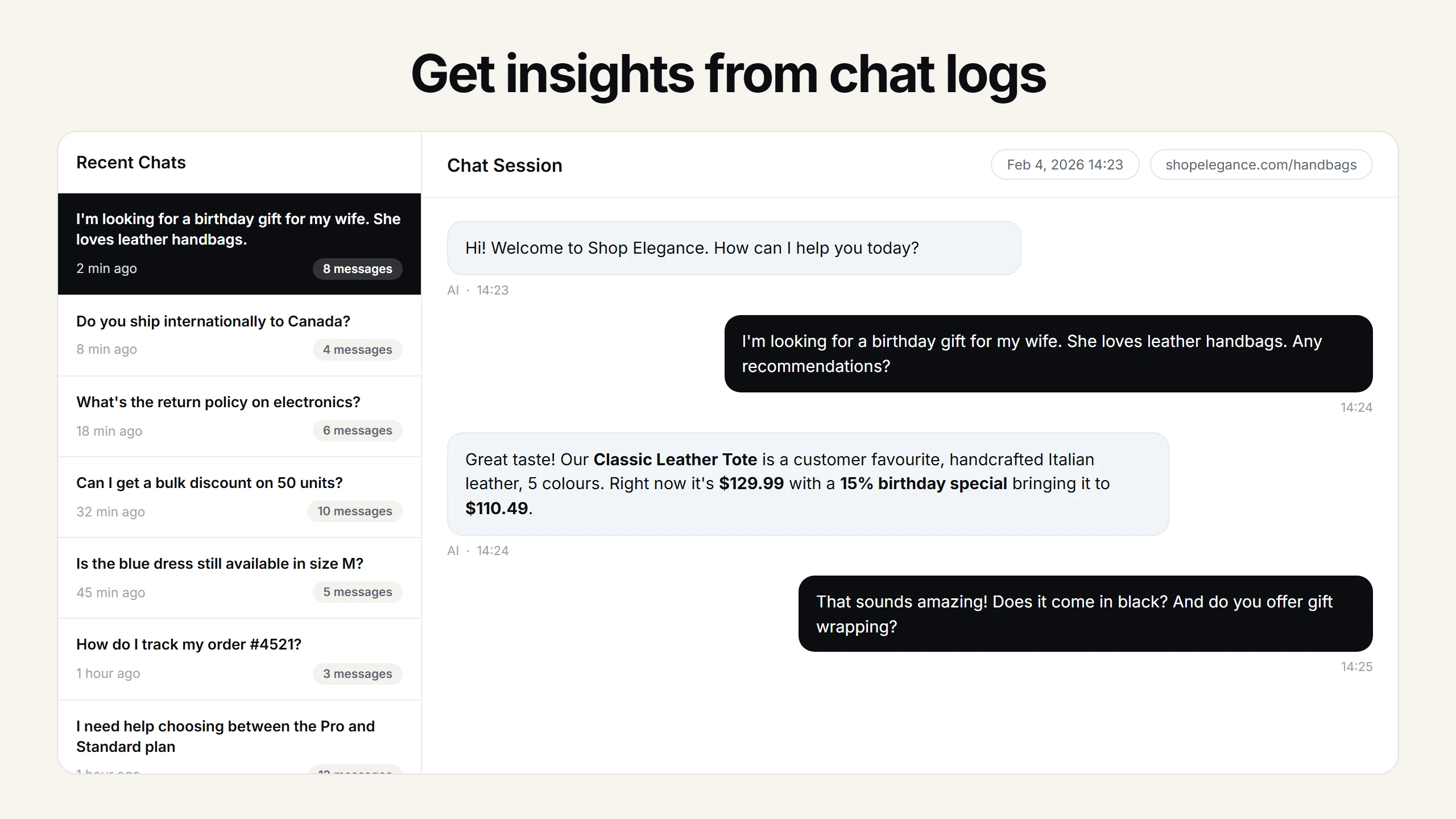
The analytics that emerge from AI-driven support serve a different purpose than traditional ticket metrics. When humans handle every inquiry, analytics measure agent performance — response time, handle time, satisfaction per agent. When AI drives the frontline, analytics reveal content gaps and customer behavior patterns instead. Which questions appear most frequently? Which topics resolve confidently and which trigger escalation? Which pages on your site generate the most chat activity? What language distribution does your actual visitor base present? Over weeks and months, these patterns become a roadmap for improving your website itself. Recurring questions about a confusing checkout step signal that the checkout page needs rewriting. Frequent escalations around a specific product indicate documentation gaps. The AI does not just answer questions — it shows you which parts of your content ecosystem need strengthening.
Multi-site deployment matters for organizations running multiple brands, product lines, or client properties. A hospitality group with four hotel websites needs four independently configured AI instances, each reflecting different amenities, booking policies, and local attractions. An agency managing client support needs clean separation between accounts. Site limits scale with the plan — 1 on Free, 2 on Starter, 3 on Standard, 20 on Pro — and each site operates with its own crawled content, uploaded documents, behavioral rules, and conversation archive. The AI driving support for one property has zero knowledge of another property's content, ensuring brand separation and data isolation across every deployment.
The installation itself takes minutes, not weeks. You register an account, copy a JavaScript snippet from the dashboard, and paste it into your website header. You provide your URL for automatic content crawling and upload any supplementary documents. You write behavioral instructions in plain sentences. You run a handful of test conversations to verify accuracy and tone. You go live. The entire process fits inside an afternoon for most teams. The following days involve watching real conversations, tightening an escalation boundary here, adding a knowledge document there, adjusting a greeting. From that point forward, the AI drives your support frontline continuously, and your team's role shifts from answering every message to curating the knowledge and rules that keep the automation effective.
The teams that benefit most from AI-driven customer support share a common profile: enough traffic that support costs are a real line item, a product or service complex enough that visitors have genuine questions, and a small enough team that nobody can afford to spend their day on repetitive inquiries. Whether that is an e-commerce store fielding the same shipping questions hundreds of times a month, a SaaS company answering feature availability queries around the clock, a university admissions office handling the same application deadline questions every cycle, or a services firm whose after-hours visitors currently bounce without getting answers — the pattern is the same. The questions are answerable, the content exists, and the only missing piece is an engine to deliver it continuously.
AI-driven customer support through Asyntai is free to start — 1 site, 50 messages, no credit card — and designed to prove its value on real traffic before you commit a dollar. Paid plans begin at $39/month for Starter, scaling through Standard and Pro as your volume and automation ambitions grow. The gap between where your support operation sits today and where it could operate with AI driving the frontline is smaller than you think, and the pricing page is the fastest way to see exactly how the tiers map to your traffic.