AI customer support software that speaks SaaS as fluently as your product team
Asyntai absorbs your product docs, API references, and help center — then handles feature questions, billing inquiries, and onboarding walkthroughs before they become tickets. One snippet, 36 languages, zero agent seats required.
Watch it handle your product questions
Drop your SaaS marketing site or docs URL below — the AI will show you what instant product support looks like
Turns your entire product surface into an answerable knowledge layer
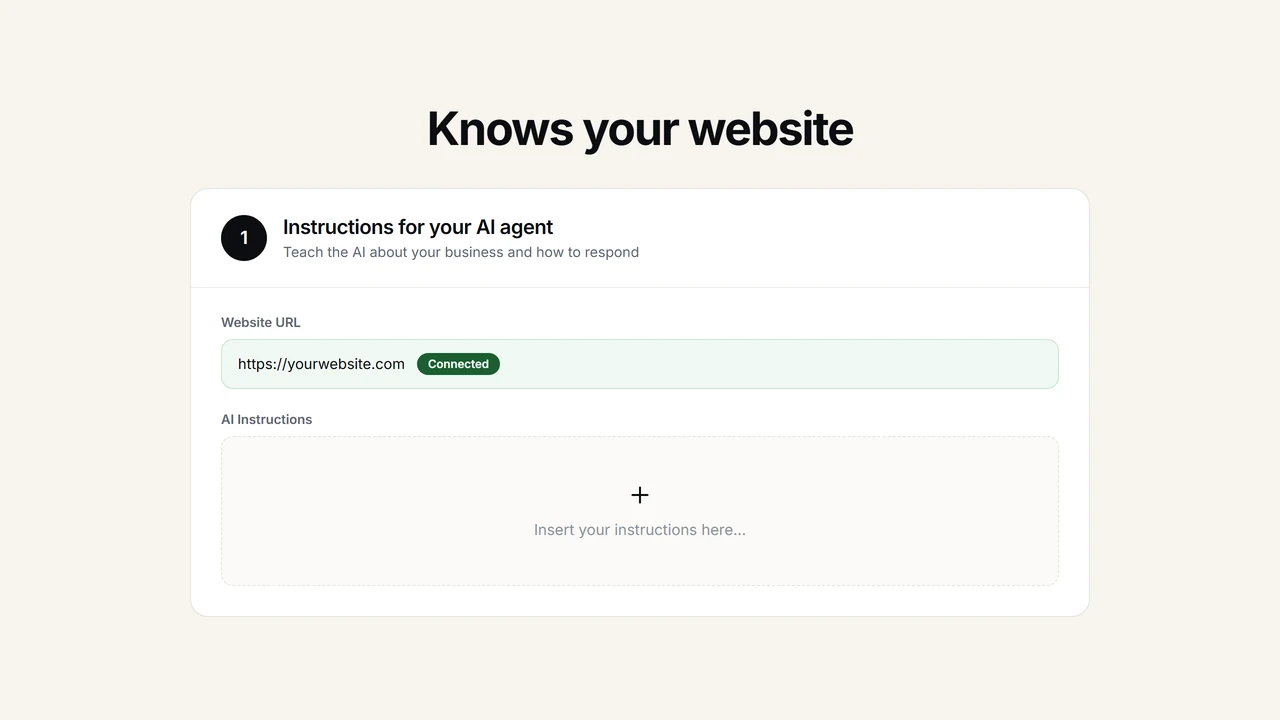
SaaS support tickets cluster around a handful of categories: how does feature X work, what plan includes Y, where are the API docs for Z. The answers already exist — scattered across your marketing site, help center, changelog, and developer portal. Asyntai consolidates all of it. Point it at your URLs and upload any internal documents, and the AI assembles a single knowledge layer it queries every time a user asks a question. No manual article-to-intent mapping, no decision tree authoring, no months-long chatbot build.
- Crawls your public product surfaceMarketing pages, help center articles, API documentation, changelog entries, pricing tables — any publicly accessible content on your domain gets absorbed automatically.
- Accepts internal operational docsUpload runbooks for edge cases, internal troubleshooting guides, beta feature notes, or compliance documents as PDFs or pasted text. The AI treats them as first-class knowledge.
- Re-index after every releaseShipped a new feature or updated your docs? Re-crawl from the dashboard and the AI references the latest content within minutes — no retraining cycle.
Goes beyond static answers with Custom Tools that query your backend
Static knowledge handles the majority of product questions, but SaaS users also ask account-specific things: what plan am I on, when does my trial expire, why did my last API call fail. Custom Tools on Standard ($139/month) and Pro ($449/month) plans let the AI call your own endpoints mid-conversation — pulling subscription details, checking usage quotas, looking up invoice history, or verifying API key status — and weaving the live data into its response without exposing your backend directly.
- Subscription and billing lookupsThe AI can check a user's current plan, billing cycle, upcoming invoice amount, or payment method status by calling your billing API endpoint.
- Usage and quota checksWhen a user asks why something stopped working, the AI can verify whether they hit a rate limit, storage cap, or message quota — and explain next steps.
- API key and integration statusDevelopers asking about failed API calls get specific answers: the AI can confirm key validity, check recent error logs, or verify webhook delivery status through your endpoints.
- Account action triggersConfigure tools that let the AI initiate password resets, resend verification emails, or generate temporary access tokens — all within guardrails you define.
- User Context for personalized repliesPush account tier, feature flags, and user role into window.Asyntai.userContext so the AI tailors every answer to the specific user asking.
Ship AI customer support alongside your next deploy
Adding Asyntai to your SaaS product takes less time than writing a Jira ticket about adding it. One script tag in your app shell, one crawl of your docs, a few behavioral rules, and your users get instant AI-powered answers on every page where the widget loads.
- Create a free Asyntai account and grab the JavaScript snippet from your dashboard. The free plan covers 1 site and 50 messages per month — enough to validate on staging before going live.
- Paste the snippet into the
<head>of your SaaS application shell, marketing site, or docs portal. It loads asynchronously and will not affect your page performance. - Supply your docs URL for automatic crawling and upload any internal runbooks. The AI builds its knowledge layer from everything you provide — product pages, API references, help articles, and private documents alike.
- Write behavioral instructions covering tone, escalation triggers, and topic boundaries — then test with real product questions. Scale up when ready: Starter at $39/month for 2 sites and 800 messages, Standard at $139/month for 3 sites and 15,000 messages, or Pro at $449/month for 20 sites and 50,000 messages.
<script src="https://asyntai.com/widget.js"
data-id="your-site-id" async>
</script>
# Works in React, Next.js, Vue, Angular, or plain HTML.
# Add to your app shell layout and it loads on every page.
AI Customer Support Software for SaaS — FAQs
Questions SaaS founders and support leads ask before deploying AI on their product.
Can the AI answer questions about our API documentation?
Yes. If your API docs are publicly accessible, Asyntai crawls them alongside your other content. The AI can then answer developer questions about endpoints, authentication, error codes, rate limits, and request formats — drawing directly from your published documentation rather than generic programming knowledge. For private or pre-release API docs, upload them as documents.
How does this handle questions about features on different pricing tiers?
The AI references your pricing page content to answer plan comparison questions accurately. On Standard and Pro plans, you can push the current user's plan tier into User Context, so the AI knows which features are available to them specifically. A free-tier user asking about a Pro feature gets an accurate answer that includes the upgrade path, not a generic feature description.
Will the AI fabricate answers about product capabilities we do not have?
No. Asyntai answers using your own content — it does not invent features or capabilities. When a question falls outside the knowledge base, the AI acknowledges it cannot answer and offers to connect the user with your team. You can reinforce this with behavioral instructions like "never speculate about unreleased features" or "do not confirm roadmap items."
Can the AI handle onboarding questions for new trial users?
Effectively, yes. If your onboarding documentation, getting-started guides, and setup walkthroughs are part of the crawled content, the AI walks new users through them conversationally. This is particularly valuable during trial periods when responsiveness directly affects conversion — the AI is available instantly, around the clock, in whatever language the user writes in.
What happens when the AI cannot resolve a technical support issue?
The AI collects the user's email and the full conversation transcript, then delivers everything to your Asyntai dashboard and optionally to your team's email inbox. Your support engineer picks up the thread already knowing what was asked, what the AI attempted, and what remains open. No cold restart, no repeated context gathering.
Does it work inside our web app, or only on our marketing site?
Both. The snippet loads wherever you place it — your marketing site, your in-app dashboard, your developer portal, your help center. Many SaaS teams install it in their app shell so it is available on every authenticated page, then separately on their public marketing site with a different knowledge scope.
Can we white-label the chat widget to match our product brand?
Yes. You can customize colors, position, greeting text, avatar, and launcher style from the dashboard. Full white-label — removing the Asyntai branding entirely — is automatic on Pro ($449/month) and available on Standard ($139/month) by contacting [email protected].
What does pricing look like for a SaaS product with moderate support volume?
The free tier covers 50 messages monthly for one site — useful for validating on staging. Starter is $39/month for 2 sites and 800 messages. Standard is $139/month for 3 sites and 15,000 messages, which suits most SaaS products with active user bases. Pro is $449/month for 20 sites and 50,000 messages, built for high-traffic products or multi-product companies. Each AI response counts as one message.
How quickly can we go live?
Most SaaS teams complete the full setup — snippet installation, content crawl, behavioral instructions, and testing — within an afternoon. The AI starts answering product questions immediately after the initial crawl. The following days are typically spent refining tone and adding instructions for edge cases based on real user conversations.
AI customer support software for SaaS — why ticket deflection is the wrong framing
Every SaaS company eventually arrives at the same inflection point. The product grows, the user base expands, and support tickets start accumulating faster than the team can clear them. The instinct is to hire — another support agent, a part-time contractor, someone to handle the overnight queue. And hiring works, until the next growth spike, when the same math repeats. What breaks the cycle is not more people handling the same questions, but eliminating the conditions that generate those questions in the first place. AI customer support software for SaaS does that by intercepting the question at the moment it forms and resolving it before it ever becomes a ticket.
The shape of SaaS support requests is distinctly different from ecommerce or service-industry support. A retail customer asks about shipping times and return policies — concrete, transactional questions. A SaaS user asks how to configure a webhook, whether the API supports batch requests, what happens to their data if they downgrade, or why the integration they set up yesterday stopped syncing. These questions sit at the intersection of product knowledge and technical specificity, and they require the answering system to genuinely understand the product surface, not just pattern-match against FAQ titles. Generic chatbot platforms stumble here because they rely on manually authored response trees that cannot possibly anticipate the long tail of technical product questions.
Asyntai approaches this differently by working from the content you have already written. Your API documentation, help center articles, product guides, changelog entries, pricing page, and feature comparison tables already contain the answers to the vast majority of user questions — the problem is that users either cannot find the right article or do not want to read through a three-thousand-word doc to extract the one paragraph relevant to their situation. The AI reads your entire content surface and retrieves the specific information needed for each question. A developer asking "does the webhook include the user ID in the payload" gets the exact field from your API docs, not a link to the full webhook reference page. A trial user asking "what happens to my data after the trial ends" gets a direct answer from your terms or help article, not a redirect to the pricing page.
The technical architecture matters for SaaS teams more than most. Asyntai operates through retrieval — the AI searches your ingested content for relevant passages, then constructs an answer grounded in what it found. It does not memorize your documentation into model weights, which means the knowledge stays current with your content rather than drifting as your product evolves. When you ship a new feature, update your API, or change a billing policy, you re-crawl from the dashboard and the AI references the updated content within minutes. For SaaS companies shipping weekly or biweekly, this is the difference between a support tool that keeps pace with the product and one that falls behind after every release.
Custom Tools transform the AI from a documentation reference desk into something closer to a tier-one support agent with backend access. Available on Standard ($139/month) and Pro ($449/month) plans, Custom Tools let you define API endpoints the AI can call during a conversation. A user asks "am I on the free plan or the starter plan?" and the AI checks your billing system in real time. A developer reports "my API key is not working" and the AI verifies the key status against your authentication service. A customer asks "when is my next invoice?" and the AI pulls the date from your payment provider. These are the questions that historically required a human agent to alt-tab into an admin panel, look something up, and type the answer — now resolved in seconds without any human involvement.
Onboarding is the stage of the SaaS lifecycle where AI customer support software delivers disproportionate value. New users during a trial period have the highest question density and the lowest tolerance for waiting. They are evaluating your product against alternatives, and every unanswered question increases the probability of churn before conversion. A human support team operating in business hours leaves trial users in evenings, weekends, and international time zones without help during their most formative product experience. The AI handles onboarding questions around the clock, in 36 languages, with zero queue time. A user in Tokyo signing up at 3 AM local time gets the same quality walkthrough as someone in New York at noon. For products with global trial traffic, this alone can measurably improve trial-to-paid conversion.
The language dimension deserves specific attention for SaaS products with international user bases. A developer tool used across Europe and Asia generates support questions in German, Japanese, French, Korean, and Portuguese — often from users whose English is functional but not comfortable for technical troubleshooting. Hiring multilingual support agents at that breadth is economically impractical for most SaaS companies outside the enterprise tier. Asyntai detects the user's language from their first message and responds accordingly, pulling from your English-language documentation and presenting the answer in the user's native language. The knowledge base stays in one language; the support experience extends to thirty-six.
Behavioral guardrails are what prevent AI customer support from becoming a liability for SaaS companies that handle sensitive data or operate in regulated industries. You write instructions in plain sentences: "never discuss unreleased features," "escalate immediately if the user mentions data deletion or GDPR," "do not confirm pricing for enterprise plans — route to sales," "always clarify that uptime figures refer to the SLA, not a guarantee." These rules bind every conversation the AI handles, providing the policy consistency that even well-trained human agents occasionally miss on a busy day. For SaaS companies in fintech, healthtech, or edtech where a wrong answer carries compliance risk, the guardrails are not optional — they are the feature that makes AI support deployable.
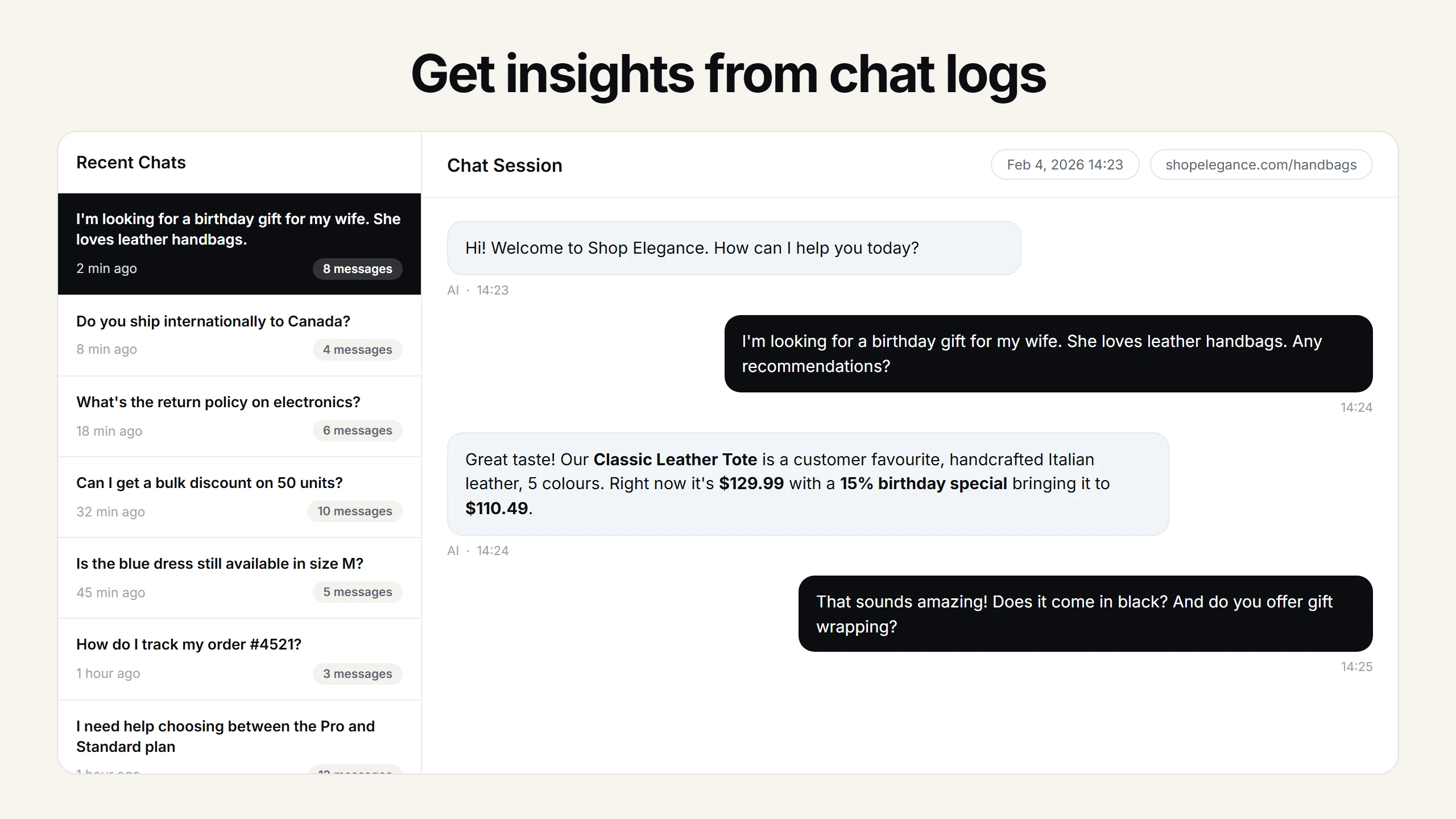
The analytics that accumulate from AI-handled conversations serve a product intelligence function that traditional ticket queues obscure. When a human agent resolves fifty tickets about the same API endpoint, the pattern is buried in ticket tags and agent memory. When the AI handles those conversations, the data is structured and visible: which features generate the most questions, which documentation pages are cited most and least, where the AI consistently escalates because the knowledge base has gaps, and what language distribution your actual user base presents. Over weeks, these patterns become an actionable roadmap for documentation improvements, UX fixes, and feature clarification that reduces support volume at the source rather than just handling it faster.
Multi-product SaaS companies and those operating separate apps under one umbrella benefit from the site-separation architecture. Each Asyntai site maintains its own crawled content, uploaded documents, behavioral instructions, and conversation archive. A company running a project management tool and a time-tracking tool can deploy separate AI support instances with completely independent knowledge bases, even under the same account. The AI supporting the project management product has no access to the time-tracking documentation, and vice versa — preventing the cross-contamination that makes multi-product support confusing when everything runs through a single knowledge base.
Escalation design in SaaS support requires more nuance than a simple "hand off to a human" mechanism. Different question types warrant different routing: a billing dispute should reach your finance team, a technical integration issue should reach engineering support, a feature request should be captured but not necessarily escalated. Asyntai handles this through custom instructions that define escalation behavior per topic. You can instruct the AI to collect different information depending on the category — error logs for technical issues, invoice references for billing questions, account identifiers for access problems — so the human who picks up the escalation has exactly what they need to resolve it without a follow-up email asking for details.
The cost arithmetic for SaaS support is straightforward once you map it out. A human support agent costs between forty and eighty thousand dollars annually, handles one conversation at a time, works defined hours, and requires ramp-up time on product changes. AI customer support through Asyntai starts at thirty-nine dollars monthly for 800 messages — each message being one AI response in a conversation. For a SaaS product where the majority of inbound questions are answerable from existing documentation, the cost per resolved conversation drops from double-digit dollars to cents. The remaining budget funds senior support engineers who handle the genuinely complex cases that benefit from human judgment, technical depth, and empathy.
White-labeling matters for SaaS companies that consider support an extension of their product experience. The chat widget is fully customizable — colors, position, greeting, avatar, and launcher style adjust from the dashboard. On the Pro plan ($449/month), Asyntai branding is automatically removed. On Standard ($139/month), white-label is available by contacting [email protected]. The result is a support experience that looks native to your product, indistinguishable from a custom-built in-app assistant but operational within an afternoon instead of a quarter-long engineering project.
Deployment for SaaS products follows the same pattern regardless of your tech stack — React, Next.js, Vue, Angular, or server-rendered HTML. Paste the script tag into your application layout, supply your documentation URLs for crawling, upload any internal content, write behavioral instructions, and test with representative user questions. Most SaaS teams complete the full setup within a few hours. The first week after launch is typically spent refining instructions based on real conversations — tightening an escalation rule for billing topics, adding a document that covers a frequently asked edge case, adjusting the tone for developer-facing versus end-user-facing contexts. From there, the AI quietly absorbs the repetitive support workload that was previously consuming your team's best hours.
If your SaaS product has outgrown the capacity of your support team but has not outgrown the content already published in your help center and docs, the leverage is obvious: the answers exist, the delivery mechanism is missing. Asyntai fills that gap. Start with the free plan to validate on your staging environment, scale to a paid tier when the conversation volume warrants it, and watch the ticket queue thin out as users get answers in seconds instead of hours. The pricing page has the full plan comparison.