An AI customer support agent that doesn't just answer — it acts
Asyntai's AI customer support agent connects to your systems through Custom Tools — it looks up orders, checks inventory, processes returns, and resolves issues end-to-end. Not a chatbot that reads FAQs. An agent that calls your APIs and gets things done.
See the AI agent handle your customers' questions
Enter your website URL and watch the AI customer support agent answer real questions using your actual content
Calls your APIs to resolve issues — not just describe them
What makes Asyntai an AI customer support agent instead of a chatbot is Custom Tools. The AI calls your own endpoints mid-conversation — order lookups, inventory checks, account status, return processing — and uses verified live data to give the customer a real answer. No more "please check your email" or "let me transfer you."
- Tool calling, not template matchingWhen a customer asks "where is my order #10294?", the AI extracts the order number, calls your endpoint, and replies with the actual tracking status. Real data, not a generic response.
- You define the tools, the AI decides when to use themConfigure each tool with a name, description, and your API endpoint. The AI reads the conversation context and calls the right tool at the right moment — no decision trees or flowcharts.
- Server-side execution, zero client codeAsyntai makes the HTTP request to your endpoint from its server. You don't write callbacks, webhooks, or browser-side scripts. If your endpoint already exists, the tool works.
From "where is my order" to a tracking link — in one conversation
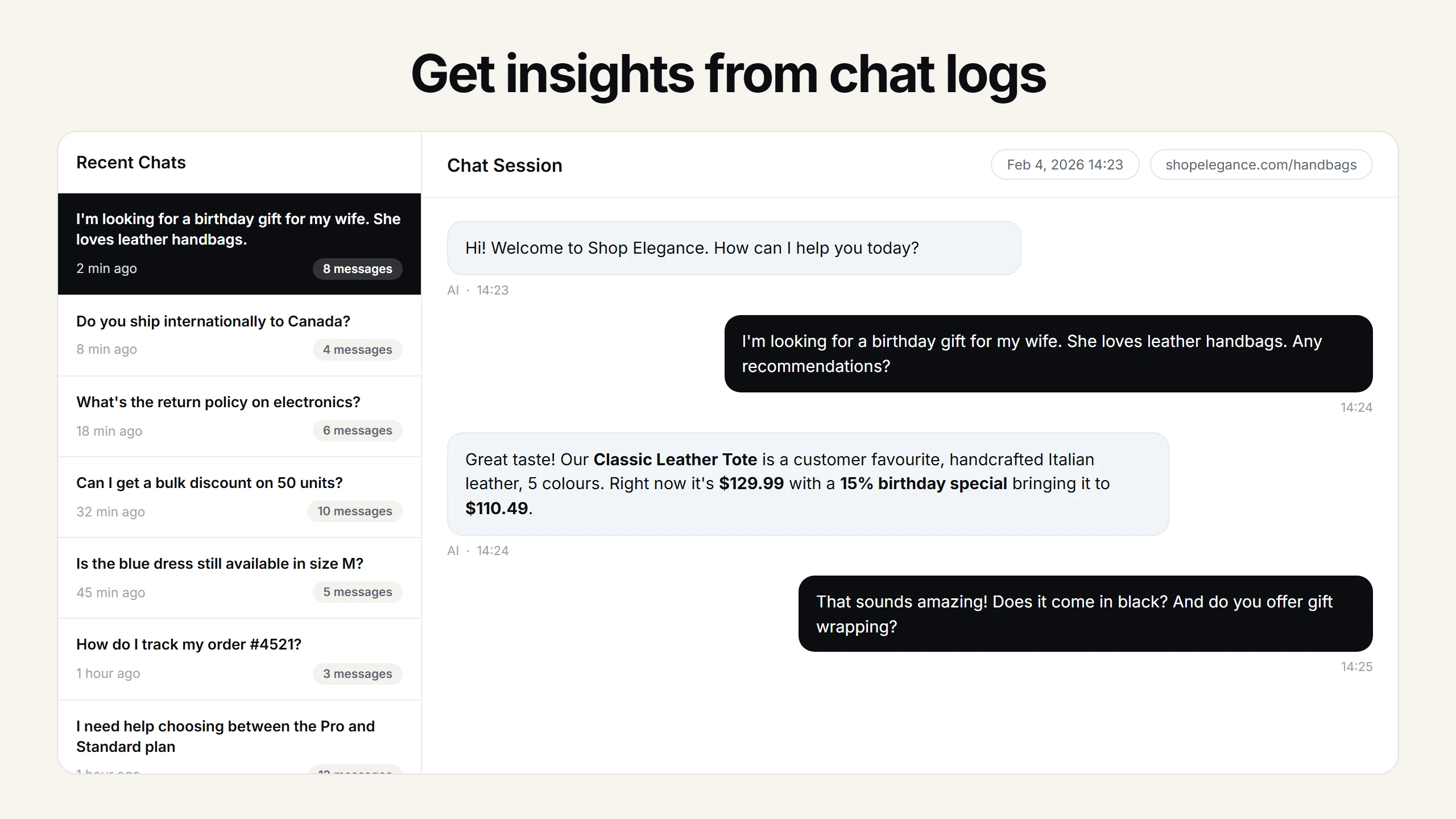
An AI customer support agent earns its name by resolving issues, not routing them. With Custom Tools, Asyntai handles the full loop: understand the question, call the right system, interpret the response, and deliver a clear answer — all within the same chat, in seconds.
- Works with any REST endpointOrder management, CRM, inventory, shipping, billing — if it has an API that returns JSON, the AI agent can call it. GET or POST, with optional auth headers for secured endpoints.
- Combines tools with knowledge baseThe agent uses Custom Tools for live data and your crawled content for policies and procedures. A return request gets both the order details from your API and the return policy from your help docs — in one reply.
- Escalates with full context when neededWhen the agent hits a boundary you've set — "never approve refunds over $200 without human review" — it captures the customer's info, the full conversation, and the data it retrieved, then hands everything to your team.
Connect your first Custom Tool in minutes
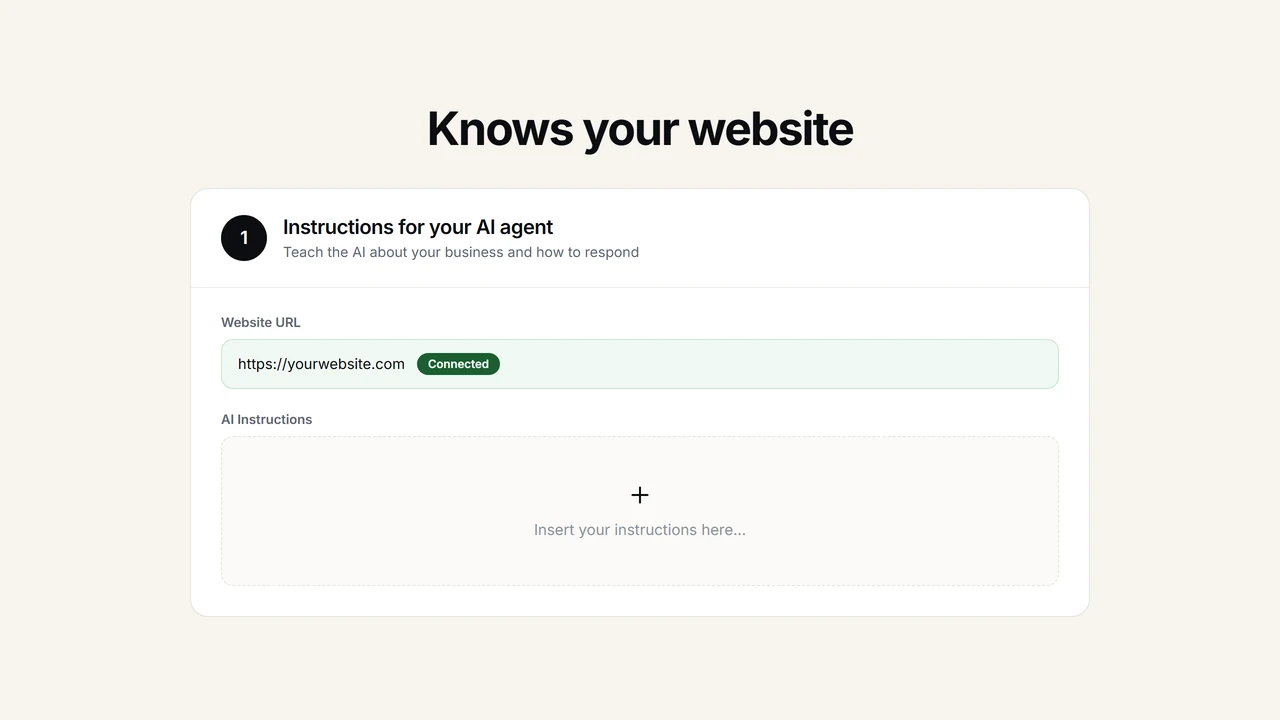
If your system already has an API endpoint, connecting it to the AI agent is a dashboard form — not a development project. No SDK, no middleware, no code deployment. Point, describe, save.
- Add the Asyntai snippet to your site's
<head>and let the agent crawl your content. - Go to Custom Tools in your dashboard and add a tool — name it, describe when the AI should use it, and paste your endpoint URL.
- Define parameters (like
order_number) so the AI knows what to extract from the conversation and send to your endpoint. - Test it by asking your bot a matching question — the AI calls your endpoint live and answers with the real data.
<script src="https://asyntai.com/widget.js"
data-id="your-site-id" async>
</script>
</head>
# One snippet. Your AI agent is live.
AI customer support agent — FAQs
Common questions from support leaders, ops teams, and founders evaluating AI agents for customer service.
What makes this an "agent" instead of a chatbot?
A chatbot reads your FAQ and repeats answers. An AI customer support agent takes action. Through Custom Tools, Asyntai calls your own API endpoints mid-conversation — order lookups, inventory checks, account status, return initiation — and uses the live data to resolve the customer's issue. The agent doesn't just describe what to do. It does it.
What kinds of actions can the AI agent perform?
Anything your API supports. Common examples: look up order status by order number, check real-time inventory for a specific SKU, retrieve account details for a logged-in user, fetch shipping rates for a destination, check warranty eligibility, look up appointment availability, and process return requests. If your system has an endpoint that accepts a parameter and returns data, the AI agent can call it.
Do I need to build an API for Custom Tools to work?
You need an HTTP endpoint that accepts a request and returns JSON or plain text. Most ecommerce platforms, CRMs, and business systems already expose these. If your Shopify store has an order status endpoint, or your booking system has an availability API, the tool just points at it. You don't build anything new — you connect what already exists.
How does the AI know when to call a tool versus answer from the knowledge base?
You write a plain-English description for each tool — for example, "Look up the status of a customer order. Call this whenever the customer provides an order number." The AI reads the conversation, matches the customer's intent to the right tool, extracts the required parameters, and makes the call. For questions that don't need live data — like "what's your return policy?" — the agent answers from your crawled content instead.
Is the API call secure? Who sees the data?
Asyntai makes the call server-side — the customer's browser never contacts your endpoint directly. You can add auth headers (like an API key) that Asyntai sends with each request. The response data is used to compose the reply and is stored in the conversation log, which only you can access from your dashboard. Your endpoint, your auth, your data.
Can the agent use multiple tools in one conversation?
Yes. A customer might ask "where is my order #10294?" and then follow up with "is the blue version of that item in stock?" The agent calls the order lookup tool first, then the inventory check tool, maintaining full conversational context throughout. Each tool is independent — you can have as many as your workflow requires.
What happens if the API call fails or returns an error?
The agent handles it gracefully. If the endpoint returns an error or is unreachable, the AI tells the customer it couldn't retrieve the information right now and offers to escalate to a human agent. It doesn't fabricate data or pretend the call succeeded. You can also configure fallback instructions — "if order lookup fails, ask for their email and escalate."
Which plans include Custom Tools?
Custom Tools are available on Standard and Pro plans. Free and Starter plans include the full AI agent with knowledge base answers, multilingual support, and smart escalation — but tool calling requires Standard or higher. User Context (for passing logged-in customer data) is also Standard+ and works alongside Custom Tools.
What an AI customer support agent actually is — and why tool calling changes everything
The phrase "AI customer support agent" gets used loosely enough that it's worth starting with what separates an agent from a chatbot. A chatbot reads your FAQ, matches keywords, and recites answers. It can handle "what's your return policy?" because that answer is static — it lives on a page somewhere and never changes based on who's asking. But the moment a customer asks "where is my order?" or "is my warranty still valid?" or "can I switch to the annual plan?" — the chatbot stalls. It doesn't know. It can't check. It says something like "please contact our support team" and the customer is right back where they started.
An AI customer support agent resolves those questions. Not by guessing, not by routing to a human, but by calling the system that has the answer — your order management API, your inventory database, your CRM — retrieving the actual data, and composing a response with it. That's what "agent" means in this context: the ability to take action, not just respond from memory. The technology that enables this is called tool calling, and it's the single feature that turns an AI chatbot into something that genuinely reduces your support workload.
Asyntai implements tool calling through a feature called Custom Tools. The concept is straightforward. You define a tool in your dashboard: a name, a description of when the AI should use it, your API endpoint URL, and the parameters it needs. When a customer asks a question that matches the tool's description, the AI extracts the relevant values from the conversation — an order number, a product SKU, an email address — and calls your endpoint with those values. Your endpoint returns data. The AI reads the response and composes a natural-language answer for the customer. The entire round trip happens in seconds, within the same chat window, with no human involvement.
Consider the most common support question in ecommerce: "Where is my order?" Without tool calling, the best an AI can do is say "you can check your order status in your account" or "I'll have someone look into that." With Custom Tools, the AI extracts the order number from the customer's message, calls your order status endpoint — something like GET /api/order-status?order_number=10294 — and gets back the tracking number, carrier, estimated delivery date, and current status. The customer gets a real answer: "Your order #10294 shipped via FedEx on June 15th, tracking number 7749382910. It's currently in transit and estimated to arrive June 22nd." That's not a chatbot response. That's an agent resolving a ticket.
The power of Custom Tools scales with how many endpoints you connect. An ecommerce store might start with order status, then add inventory checks ("is the blue XL in stock?"), return eligibility ("can I still return this?"), and shipping rate lookups ("how much to ship to Germany?"). A SaaS company might connect subscription status, usage metrics, and billing history. A hotel or booking platform might connect room availability, reservation details, and cancellation processing. Each tool you add is another category of support ticket the AI agent handles autonomously — without a human ever seeing the conversation.
The way the AI decides which tool to call — and when — is driven by the description you write for each tool. This is plain English, not code. A tool description like "Look up the current status of an order. Call this whenever a customer provides an order number or asks about a shipment" tells the AI exactly when to trigger the call. A description like "Check real-time inventory for a product. Call this when a customer asks whether a specific item, size, or color is available" triggers on a different set of questions. The AI reads the customer's message, matches intent to the most relevant tool, extracts the parameters, and makes the call. If no tool matches — if the customer is asking a general policy question — the agent answers from your crawled knowledge base instead. No decision trees, no flowcharts, no if-else logic. The AI reasons through it.
What makes this genuinely agentic — rather than just "API integration with a chat UI" — is that the AI composes its response by combining the tool's data with its broader knowledge. When a customer asks "can I return this order?", the agent doesn't just call the order lookup. It retrieves the order details, checks the order date against your return policy (which it learned from crawling your site), and gives a complete answer: "Your order #10294 was placed 12 days ago, and your return window is 30 days, so you're eligible. Here's how to start the return process." The tool provided the data. The knowledge base provided the policy. The agent combined both into a resolution. That synthesis is what distinguishes an agent from a lookup widget.
Setup is deliberately simple because complexity is where most AI agent projects die. You don't install an SDK. You don't write middleware. You don't build webhooks. If your system already has an API endpoint that returns data — and most modern platforms do — connecting it to Asyntai is a form in your dashboard. Name the tool, describe when to use it, paste the endpoint URL, define the parameters (what the AI should extract from the conversation and send), optionally add an auth header for secured endpoints. Save. Ask your bot a matching question. The AI calls your endpoint live and answers with real data. Most teams connect their first Custom Tool in under ten minutes.
The auth model is intentionally minimal. You add a single header name and value — like X-API-Key: your-secret-key — and Asyntai sends it with every request to that endpoint. The call happens server-side, between Asyntai's infrastructure and your endpoint. The customer's browser never sees your endpoint URL, your API key, or the raw response. The AI uses the data to compose a human-readable reply, and the full conversation (including tool calls and responses) is logged in your Asyntai dashboard for auditing.
Where most businesses underestimate Custom Tools is in the combination with escalation rules. The AI agent can resolve a huge percentage of tickets autonomously — but you still control the boundaries. "Look up the order, but if the customer wants a refund over $200, capture their email and escalate to a human." "Check warranty eligibility, but never approve a replacement without human review." "Fetch the account status, but if the account is flagged, don't disclose the reason — just escalate." These rules are written in plain English as custom instructions and apply across every conversation. The agent follows them without drift. You get autonomous resolution where it's safe and human oversight where it matters.
The economics of an AI customer support agent with tool calling are different from a knowledge-base-only chatbot because the resolution rate is dramatically higher. A chatbot that can only answer from static content typically resolves 40-50% of tickets — the rest require a human because the customer needs specific data the chatbot can't access. An agent with Custom Tools pushes that to 70-85% because it handles the "where is my order" and "is this in stock" and "what's my balance" questions that account for a massive share of support volume. Each percentage point of resolution rate is a direct reduction in human agent hours. At Asyntai's pricing — starting at $39/month for 800 messages — the cost per resolved ticket is measured in fractions of a cent.
The agent's multilingual capability extends to tool-calling conversations. A German customer asks "Wo ist meine Bestellung #10294?" — the AI understands the intent, extracts the order number, calls your (English) API endpoint, receives the response, and composes the answer in German. The endpoint doesn't need to support multiple languages. The AI handles the translation layer while the tool provides the data layer. This means a single endpoint serves customers in all 36 supported languages without any localization work on your side.
Custom Tools and User Context work together for the most complete agent experience. User Context pushes known data about the logged-in visitor — name, email, plan tier, recent orders — into the widget before the conversation starts. Custom Tools fetch on-demand data during the conversation based on what the customer says. A logged-in customer might have their name and account tier loaded via User Context, but when they ask about a specific order, the AI calls the order lookup tool with the order number they provide. Both data sources feed into the same agent, which combines them with your crawled knowledge base to deliver complete, personalized resolutions.
The conversations the agent handles with Custom Tools are genuinely different from what a knowledge-base chatbot produces. Instead of "According to our shipping policy, orders typically arrive in 5-7 business days," the agent says "Your order #10294 shipped yesterday via UPS, tracking number 1Z999AA10123456784. Based on UPS estimates, it should arrive by Thursday." Instead of "You can check your account status in your dashboard," the agent says "Your Pro plan renews on July 15th for $99. You've used 8,200 of your 50,000 messages this month." Instead of "Please contact our team for return assistance," the agent says "Your order was placed 8 days ago and is eligible for return. I've noted your request — you'll receive a prepaid shipping label at the email on your account within the hour." Every response is grounded in real data from your systems, not generic policy language.
Scaling an AI customer support agent with Custom Tools doesn't require scaling your tools. The same order status endpoint that handles one customer's lookup handles a thousand — the AI agent manages the concurrency, not your API. During traffic spikes — a product launch, a Black Friday surge, a viral moment — the agent calls your endpoints as needed and maintains sub-second response times. You don't hire seasonal support staff. You don't queue customers. The agent resolves tickets at the same speed and quality whether it's 2 PM on a Tuesday or midnight on Black Friday.
The diagnostic value of tool-calling conversations is higher than knowledge-base conversations. When you see that 200 customers this month called the order status tool, you know your order confirmation emails aren't clear enough. When inventory check calls spike for a particular SKU, you know demand is outpacing what your product page communicates. When return eligibility checks increase after a specific promotion, you know that promotion attracted buyers who don't convert to keepers. Custom Tool call logs in your dashboard provide operational intelligence that goes beyond "what are customers asking" into "what are customers trying to do" — which is a fundamentally more actionable data set.
The businesses that get the most from an AI customer support agent share a common trait: they have systems that already expose data via APIs, and they have customers who ask questions that require that data. Ecommerce stores with order management APIs. SaaS companies with subscription and usage endpoints. Booking platforms with availability and reservation systems. Service businesses with appointment scheduling APIs. Healthcare platforms with patient portal integrations. Financial services with account balance and transaction endpoints. In each case, the AI agent becomes the conversational layer on top of systems that already exist — reducing the need for customers to navigate dashboards, call support lines, or wait for email replies. The data was always there. The agent just makes it accessible through the channel where customers are already asking.
The difference between deploying a chatbot and deploying an AI customer support agent comes down to one question: does the AI just talk, or does it do things? Custom Tools are the answer. They turn your AI from a sophisticated FAQ reader into an autonomous agent that calls your systems, retrieves live data, combines it with your knowledge base, and resolves customer issues end-to-end. That's not a marginal improvement over a chatbot. It's a fundamentally different category of support tool — one that replaces human effort on the majority of tickets rather than just deferring it.