AI chat for ecommerce that closes the questions killing your cart
Asyntai offers AI chat for ecommerce stores — answering from your product catalog, your shipping terms, and your return policies. Answers shoppers in the moment they hesitate, in 36 languages, on any platform.
Try AI chat for ecommerce on your store
Paste your store URL and watch the chatbot handle the questions your product pages don't answer clearly
Knows your products as well as your product page copy does — and then some
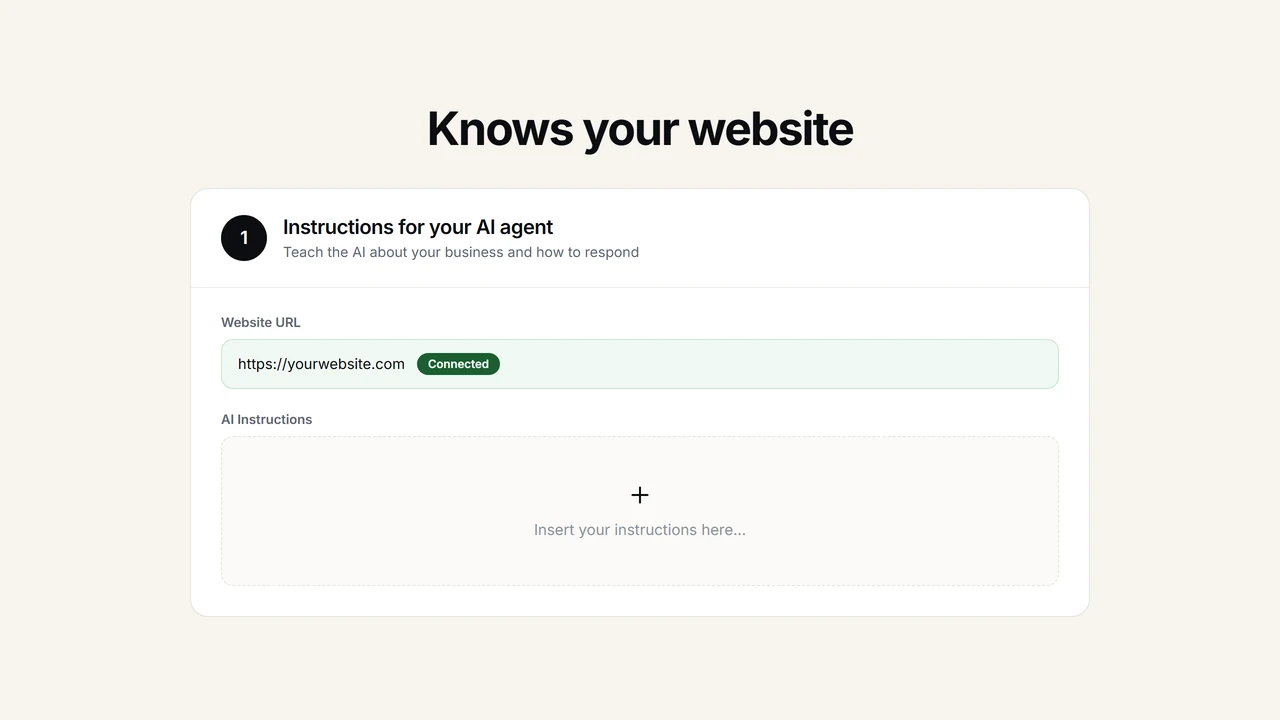
AI chat for ecommerce is only useful if it actually knows the catalog. Asyntai crawls your store — products, variants, prices, collections, policy pages — and adds any private documents you upload. Every answer is grounded in your actual inventory, not generic e-commerce boilerplate.
- Crawls the full catalog and policiesProduct pages, collections, size charts where public, shipping terms, returns, promotions — all absorbed into the chat's working memory.
- Upload what shoppers can't seeInternal size fit notes, care instructions, supplier timelines, wholesale terms, seasonal promotion rules — add them as PDFs or pasted text.
- Rules for how to sell"Recommend bestsellers when a shopper is undecided." "Never promise shipping before asking destination." "Suggest the matching accessory when possible." You write the rules; the chat follows them.
The moments that decide whether the cart gets checked out
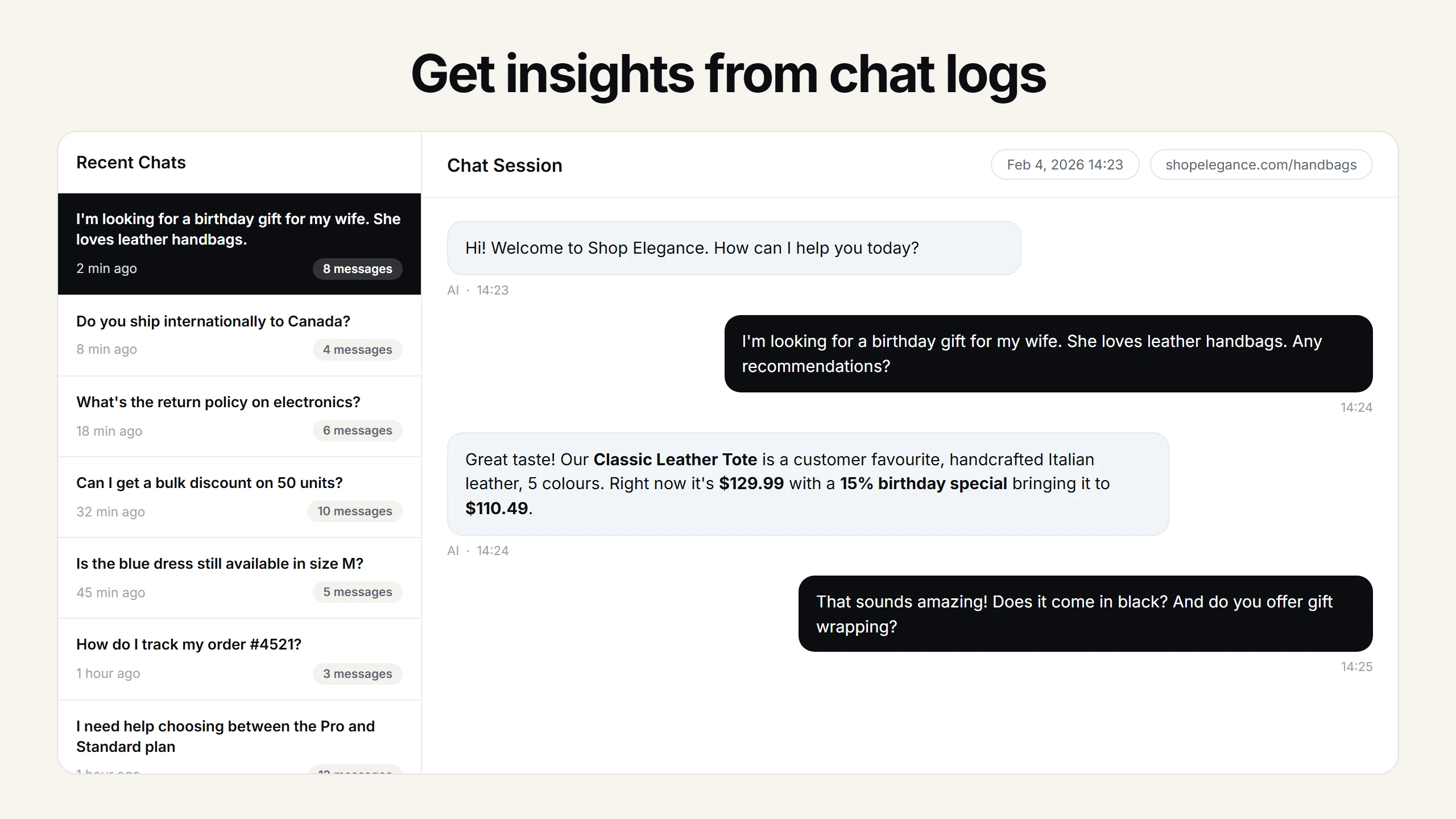
The decisions in ecommerce happen at specific moments — the product page, the size question, the shipping calculation, the hesitation before clicking buy. AI chat for ecommerce is built to be present at those moments, not waiting in a corner for a click that never comes.
- Opens proactively on product and cart pagesConfigurable auto-trigger surfaces the chat at the moments where shoppers typically hesitate or bounce.
- Order-status answers via User ContextWith User Context on Standard and Pro plans, your store can pass logged-in customer order data so the AI answers "where is my order" directly.
- Captures leads when the AI can't closeEmail or phone number requested during the conversation, logged in your dashboard with full transcript — so warm leads don't evaporate.
One script tag. Any ecommerce platform.
AI chat for ecommerce should work on the platform you already use — not force a migration. Asyntai installs via a single JavaScript snippet on Shopify, WooCommerce, BigCommerce, Magento, PrestaShop, Squarespace Commerce, and any custom storefront. Paste, train, go live.
- Sign up for a free Asyntai account and copy your personal snippet.
- Paste it into your store's
<head>— through your theme editor, a header app, or a CMS header setting. - Point Asyntai at your store URL so the AI learns your catalog and policies.
- Test a few shopper conversations, tune the welcome message, go live.
<script src="https://asyntai.com/widget.js"
data-id="your-store-id" async>
</script>
</head>
# Works the same on every ecommerce platform.
AI chat for ecommerce — FAQs
What store owners usually check before wiring this into their storefront.
Which ecommerce platforms does this work with?
All of them. Asyntai is a JavaScript widget, not a platform-specific app, so it works the same way on Shopify, WooCommerce, BigCommerce, Magento, PrestaShop, Squarespace Commerce, Wix Stores, and fully custom storefronts. We also have dedicated plugins for many of these — the one-click flow differs slightly, but the chat capability is identical across platforms.
Does the chat actually know my specific product catalog?
Yes. Asyntai crawls your storefront and reads every public product page, collection, and policy. For WooCommerce specifically, we have a deeper integration that syncs products, prices, and images directly. The chat can then answer variant-specific questions, show product cards mid-conversation, and guide shoppers to the right SKU.
Can the AI handle order status questions?
Yes, via the User Context feature on Standard and Pro plans. Your store passes the logged-in customer's order data — order number, status, tracking details, ETA — into a JavaScript object before the widget loads. The AI then answers "where is my order" directly, without needing any API integration or broad store permissions.
How does multilingual work for international shoppers?
The widget UI is available in 36 languages and the AI detects the shopper's language from their first message. A French shopper gets French, a German shopper gets German, a Japanese shopper gets Japanese — without any translation plugin, without Shopify Markets setup, without manual configuration.
Will it slow down my checkout or product pages?
The widget loads asynchronously after your page renders, so it doesn't block the initial paint or the checkout flow. It's a single script tag that behaves the same way as a Meta Pixel or Google Tag on your storefront.
Can I customize the chat to match my brand?
Yes. Primary color, widget position, welcome message, avatar, and tone of voice are all configurable from the Asyntai dashboard with a live preview. Custom instructions in plain English let you control how the AI handles specific ecommerce moments — recommendations, upsells, escalation, etc.
What about returns, refunds, and complex support questions?
The AI handles content-answerable questions directly — return windows, exchange policies, warranty terms — using your published policies. For specific disputes or custom refund requests, it captures the shopper's details and conversation, and routes the handoff to your existing support inbox with full context.
Can I run this across multiple stores?
Yes on paid plans. Free: 1 site, Starter: 2, Standard: 3, Pro: up to 10. Each store gets its own separately indexed AI chat — useful for brand portfolios, multi-region storefronts, and agencies running ecommerce chat across client accounts.
AI chat for ecommerce — what it changes and why it works
Every ecommerce store leaks revenue at the same three points, and any store owner who's ever watched a session-recording tool knows exactly where. A shopper lands on a product page after clicking an ad or an organic search result. They scroll through the photos, skim the description, and a specific question forms in their head — will this fit a 1.7-meter frame, does it ship to Norway in time for Christmas, what's the warranty if the battery fails, is there a different color coming in. The question isn't on the page, the FAQ is buried three clicks away, the contact form demands a phone number they don't want to share, and the tab closes. A second shopper reaches the cart, pauses because the shipping estimate wasn't visible until this moment, and bounces. A third shopper is just curious about whether you actually stock their size and would have bought if asked directly. Each of these is a lost sale that happened silently. AI chat for ecommerce exists to intercept all three before the tab closes.
The honest case for putting AI chat on an ecommerce store isn't "automation" — it's conversion math. You're paying somewhere between $1 and $15 per click to drive traffic to your product pages. Average e-commerce conversion rates hover around 2–3%. The other 97–98% of your paid traffic leaves, and a meaningful slice of them are leaving over a question that existed somewhere in your store but wasn't easy to find. Every conversation the chat closes with a useful answer is a conversion you already paid to produce, rescued from silent bounce. The cost of the AI chat layer — a few tens of dollars a month for typical stores — becomes vanishingly small compared to the value of recovering even a small percentage of those questioning shoppers.
What separates ecommerce chat from generic chatbots is the depth of catalog knowledge required. A clothing brand has hundreds of products with variants across size, color, fit, material, care instructions, restock timelines, and regional availability. A home goods store has dimensions, weight, assembly requirements, and shipping restrictions per SKU. A beauty brand has ingredients, usage instructions, and skin-type compatibility. A useful AI chat for ecommerce has to answer questions grounded in all of this without guessing. Asyntai handles it by reading the catalog directly. On WooCommerce specifically, the chat pulls products, prices, images, and variants via a real integration, so variant-level questions — "is the blue one in stock in size medium" — get specific answers. On other platforms, the AI crawls your storefront and absorbs the product data from the public product pages. Either way, the chat isn't improvising.
Proactive intervention is where ecommerce chat diverges most from generic chat widgets. A passive chat sitting in the corner gets ignored 95% of the time. A chat that opens at the moment a shopper hesitates — after a configurable delay on product pages, on the cart, at the checkout step — actually catches questioning shoppers. Asyntai's auto-trigger does this with separate behavior for desktop and mobile, because full-screen takeovers on a phone drive shoppers away rather than helping them. The calibration matters: too aggressive and you hurt bounce rate; tuned correctly, proactive opening is where most of the measurable conversion lift comes from.
Order-status questions are the highest-volume category of post-purchase support traffic for any ecommerce brand, and historically the category most likely to require a human or a separate tool. AI chat for ecommerce handles them through the User Context feature, available on Standard and Pro plans. Your store passes the logged-in customer's order data — status, tracking number, items, ETA, address — into a JavaScript object before the widget loads. The AI uses that context to give direct answers: "Your order shipped yesterday via DHL Express, tracking JD014600007421, expected delivery Wednesday." No API integration required, no broad store permissions, no access to any data beyond what your own storefront chooses to pass into the object.
International shoppers are where multilingual chat pays back fastest. An ecommerce brand that ships globally will see visitors from a dozen language markets in the same week, and most product pages are written in one language. A German shopper who asks a sizing question in German and gets an English reply either translates in their head, hits the browser's translate, or gives up. The Asyntai widget UI supports 36 languages, and the AI detects the shopper's language from their message. A French shopper gets French, a Japanese shopper gets Japanese, a Brazilian shopper gets Portuguese — from the same installation, no translation plugin, no Shopify Markets setup, no duplicate configuration. For DTC brands with even modest international reach, this is often the single biggest conversion improvement in the first month.
Lead capture handles the category of conversations where the AI can't close the sale directly — which is fine, because not every question has a one-turn answer. When a shopper asks something the AI genuinely can't resolve (a custom bulk request, an unusual return edge case, a compatibility question with a product you don't stock), the chat asks for an email or phone number and logs the conversation to your Asyntai dashboard. If you turn on email notifications, the full transcript lands in your team's inbox in real time. The lead arrives with context: what the shopper was browsing, the question they asked, and the AI's attempted answer. Your team follows up with the shopper warm, not cold.
Custom behavior instructions are what make the AI chat for ecommerce feel like it was built for your specific store, not dropped in from a template. Plain-English rules let you shape every response. "Recommend the matching accessory when a shopper adds a main product." "For questions about size, always suggest sizing up if they're between sizes on our size chart." "Never quote exact restock timelines — say 'within a few weeks' instead." "If a shopper mentions a competitor, don't compare directly; focus on what we do well." These instructions apply to every conversation in every language the chat handles. You don't fine-tune a model; you write instructions.
Analytics turn the AI chat into a live map of where your product pages fail. Every recurring shopper question points at a gap on your storefront. If twenty shoppers this week asked whether a specific product is machine-washable, the product page needs care instructions added. If most international shoppers ask about duties before checkout, your shipping page needs a duties-included badge. If a specific blog post drives shoppers to ask about a discontinued variant, the blog post needs updating. The conversation log in the Asyntai dashboard groups questions by frequency and topic, so patterns surface without you having to dig through scattered contact-form submissions. Over time, AI chat for ecommerce doesn't just answer questions — it tells you which product pages need more detail so fewer shoppers ask in the first place.
The pricing question gets asked more than any other before a store commits. The free tier includes 50 messages a month, enough to test the chat on a small catalog or a single product line launch. Paid plans start at $39 a month for 800 messages, which handles typical mid-size store volume comfortably. Higher tiers scale up for stores running serious traffic — active DTC brands, flash sales, Black Friday peaks, viral product moments. Site limits step with the plan (1, 2, 3, 10), which matters if you run a portfolio of brands or an agency running AI chat for multiple ecommerce clients. Before the widget actually pauses for exceeding usage, email warnings give you runway to upgrade, so a sudden traffic spike doesn't silently disable chat during a sale.
Different ecommerce categories benefit in different ways, which is worth naming honestly. Fashion and apparel gain the most from sizing, fit, and material questions answered in real time — the category where silent bounces concentrate on product pages. Skincare and beauty win on ingredient and compatibility questions. Home goods benefit from dimension and delivery questions before cart abandonment. Dropshippers, where customers are least familiar with the actual products, rely on the chat to close trust gaps about shipping and returns. Subscription box brands use the chat to handle pause, skip, and cancel questions before they become churn. Electronics and technical products gain on spec-clarification questions. Food and beverage brands handle allergen and dietary questions. The common pattern across verticals: wherever repetitive shopper questions sit between traffic and conversion, AI chat for ecommerce removes the gap.
A fair objection to all of this is that not every shopper question should be handled by AI, and that some shoppers can tell when they're being routed to a bot. Both are true. Asyntai handles this by being honest about what it does and doesn't attempt. The AI resolves content-answerable questions — the vast majority of pre-purchase and post-purchase volume — and hands genuinely complex cases to humans with full context. Custom escalation rules let you draw the line: "escalate any complaint involving a damaged shipment", "never quote custom-embroidery pricing without a team response", "offer a human for any order over $1,000". The chat respects the line, captures the handoff context, and delivers the transcript to your team. Shoppers don't feel bounced around because every transition is clean and purposeful.
Setup is the least interesting part of the story. Paste a snippet into your store's header. Point the AI at your URL. Upload any internal documents that aren't on the public storefront. Write a handful of custom instructions that capture how you want the chat to sell. Test five or six shopper conversations to make sure the voice lands. Go live. Most ecommerce stores complete the full setup in under an hour. From there, AI chat for ecommerce works quietly — intercepting the questions that would have become closed tabs, capturing the leads that would have slipped away, surfacing the product-page gaps that need editing, and changing the conversion economics of every new visitor your ads and SEO bring in.