An AI agent for Magento that knows your catalog and works your APIs
Asyntai's AI agent crawls your Magento storefront to learn every configurable, bundled, and grouped product in your catalog. Then it connects to Magento's REST API through Custom Tools to look up orders, check inventory by SKU, pull customer account data, and process returns. One JS snippet in your theme header. Thousands of support conversations handled without a human.
Watch it answer questions from your Magento store
Paste your Magento store URL and see the AI agent respond using your actual product catalog and content
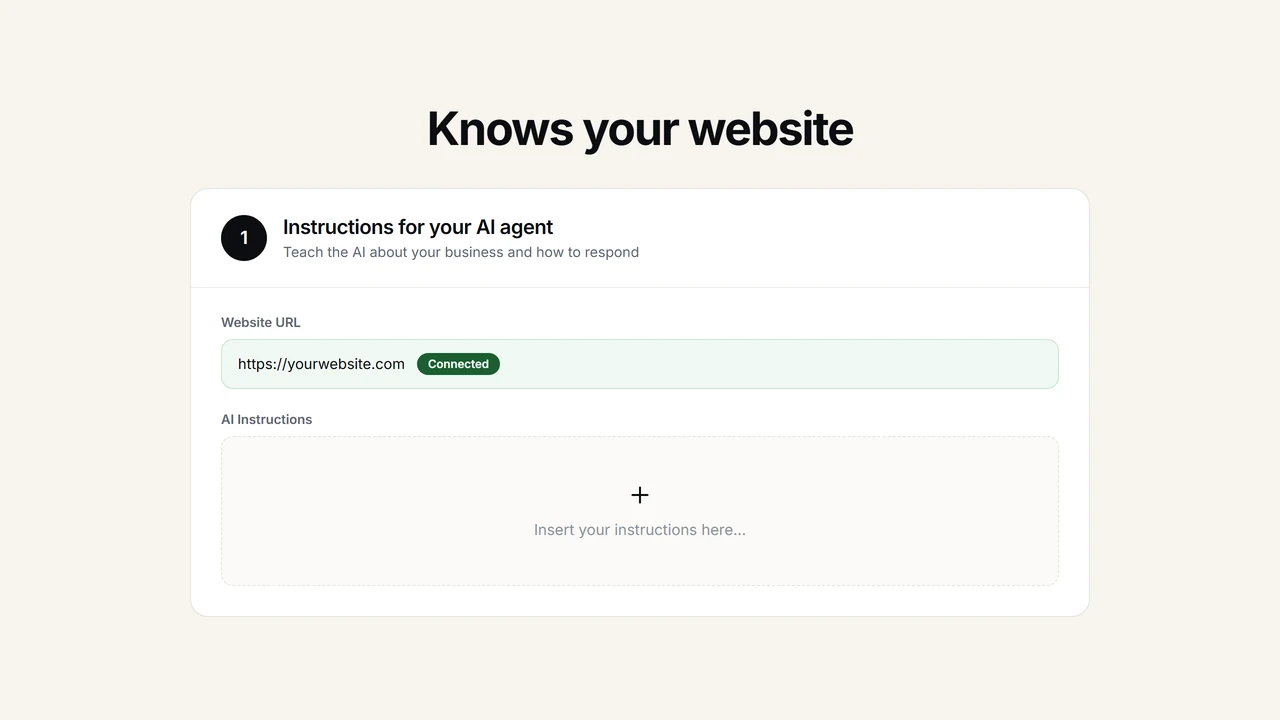
Crawls your entire Magento catalog — configurables, bundles, and all
Magento catalogs are structurally complex. Configurable products with dozens of size-color combinations. Bundle products with selectable components. Grouped products linking related items. The AI agent crawls your storefront and learns the full catalog hierarchy — product attributes, category structure, CMS pages, and store policies — so it can answer questions about any product variation without static FAQ entries.
- Understands configurable product structuresWhen a visitor asks "does this jacket come in red, size L?" the agent knows which simple products are associated with that configurable and whether that specific combination exists in your catalog — without you mapping every variant manually.
- Reads CMS pages and policy blocksYour shipping policy in a CMS static block, your return policy on a dedicated page, your size guide embedded in a category description — the agent crawls all of it and uses it to answer customer questions accurately.
- Follows your category and navigation structureThe agent understands how your catalog is organized — top-level categories, subcategories, layered navigation attributes — so it can guide shoppers to the right products even when they describe what they want in plain language.
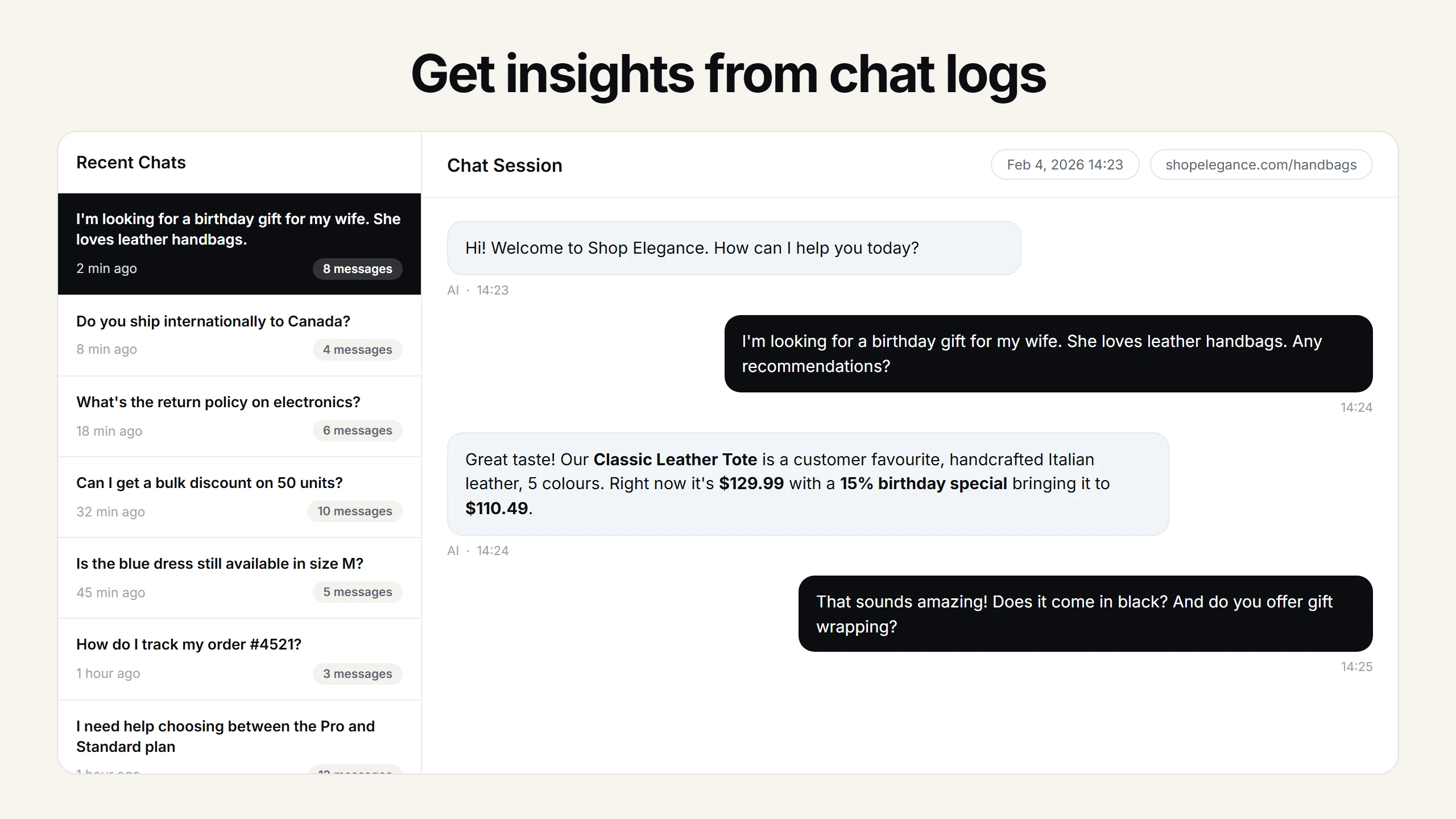
Calls Magento's REST API mid-conversation for live data
Static catalog knowledge handles product questions. But "where is my order?" and "is this SKU in stock?" require live data from your Magento backend. Custom Tools connect the AI agent to Magento's REST API endpoints — order lookups, inventory checks, customer account data, return processing — so it resolves questions with real data instead of deflecting to a human.
- Order tracking through Magento's sales APIThe agent calls your
/rest/V1/ordersendpoint with the customer's order number, retrieves shipment tracking, item status, and payment details, and delivers a complete answer — carrier, tracking number, estimated delivery — in the same chat window. - Real-time inventory checks by SKUWhen a customer asks if a specific size or color is available, the agent calls your
/rest/V1/stockItemsendpoint and reports actual stock levels. No stale "check back later" responses. Real numbers from your Magento inventory index. - Return and RMA processingThe agent checks order dates against your return window, verifies item eligibility, and can initiate an RMA through your returns endpoint — capturing the reason, item details, and customer info without requiring a form submission or email chain.
Add the AI agent to your Magento store in minutes
Drop the JS snippet into your Magento theme header or a CMS static block. The agent starts crawling your catalog immediately. Then connect your Magento REST API endpoints through Custom Tools in the dashboard — no Magento extension to install, no composer packages, no deployment pipeline.
- Add the Asyntai snippet to your Magento theme's
<head>section viadefault_head_blocks.xmlor a CMS static block in the admin panel. - The AI agent crawls your storefront — product pages, categories, CMS content, and policy pages — building its knowledge base automatically.
- Go to Custom Tools in your Asyntai dashboard and connect your Magento REST API endpoints — order status, inventory, customer data, returns.
- Test with a real question like "where is my order #100000042?" and watch the agent call your Magento API and respond with live data.
<script src="https://asyntai.com/widget.js"
data-id="your-site-id" async>
</script>
</head>
# One snippet in your Magento theme. The agent is live.
AI agent for Magento — FAQs
Questions Magento merchants and Adobe Commerce teams commonly ask about deploying an AI agent on their store.
Does this work with Magento 2 and Adobe Commerce?
Yes. The AI agent works with any Magento 2 Open Source or Adobe Commerce store. It crawls your storefront over HTTP — the same pages your customers see — so it's independent of the specific Magento edition or version. Custom Tools connect to Magento's REST API, which is standard across Magento 2.x and Adobe Commerce. If your store serves product pages in a browser, the agent can crawl it and learn from it.
How does it handle configurable products with many attribute combinations?
The agent crawls your product pages and understands the relationship between a configurable product and its simple product variants. When a customer asks "is the blue medium in stock?" for a configurable product, the agent identifies the specific simple product behind that combination and can check inventory for it via Custom Tools. It doesn't need a flat spreadsheet of every variant — it learns the structure from your storefront the same way a customer navigates it.
We run Varnish full-page cache and a CDN. Will the agent still work?
Absolutely. The agent crawls your storefront as a standard HTTP client, so it receives the same cached pages your visitors see. Varnish, Fastly, Cloudflare, or any other caching layer doesn't affect the crawl — the agent reads the rendered HTML content. Your cache actually makes the crawl faster. The JS snippet loads asynchronously and doesn't interfere with your Varnish cache rules or hole-punching configuration.
Our catalog has over 50,000 SKUs. Can the agent handle that?
Yes. The agent crawls your category pages and product pages progressively — it doesn't need to load every product simultaneously. It learns from the pages it crawls and continues discovering new content over time. For targeted questions about specific products, the crawled content provides the context. For live data like inventory or pricing, Custom Tools call your Magento API directly — the catalog size is irrelevant because the API returns data for the specific SKU the customer is asking about.
We have a multi-store setup with different websites and store views. How does that work?
Each Magento store view gets its own Asyntai widget with its own site ID. You point each widget at the specific store view URL, and the agent crawls that storefront independently — learning the products, categories, pricing, and policies for that particular store. Custom Tools can also be configured per widget, so each store view can connect to the appropriate REST API scope. Your B2C storefront and your B2B portal can each have a tailored AI agent.
Does it work with Magento's B2B features — shared catalogs, company accounts, requisition lists?
The agent crawls the public-facing storefront, so it knows your standard catalog and content. For B2B-specific data — company account status, negotiated pricing, requisition lists — you connect Custom Tools to Magento's B2B REST API endpoints. The agent can then look up company-specific pricing or check requisition list contents when a B2B buyer asks. The crawled catalog provides general product knowledge; the API tools provide account-specific data.
How do I install the snippet — do I need a Magento extension?
No extension required. The simplest method is adding the script tag to your theme's default_head_blocks.xml layout file. Alternatively, paste it into a CMS static block that's rendered in your header, or add it through Google Tag Manager if you already use GTM on your store. It's a single async script tag — no Composer package, no module installation, no setup:upgrade, no compilation step.
What about seasonal traffic spikes — Black Friday, holiday sales?
The AI agent handles concurrent conversations without degradation. During traffic surges, it continues answering product questions from its crawled knowledge base and calling your Magento API for live data — order lookups, inventory checks, return processing — at the same speed and quality. You don't provision extra support staff for peak periods. The agent scales with your traffic automatically, and your Magento REST API handles the same request volume it would from any other API consumer.
Why Magento stores need an AI agent that understands complex catalogs and calls the Magento REST API
Magento occupies a unique position in ecommerce. It's the platform merchants choose when their catalog is too complex for simpler solutions — when products come in dozens of attribute combinations, when the same store serves B2B wholesale buyers and B2C retail customers, when multi-store setups span different brands or regions under a single admin panel. That complexity is what makes Magento powerful. It's also what makes customer support on a Magento store exceptionally difficult to automate.
A typical Magento catalog isn't a flat list of products with a name, price, and description. It's a web of product types, each with different structural logic. A configurable product — say, a performance running jacket — might have 48 simple product children representing every combination of size (XS through XXL) and color (black, navy, crimson, charcoal, olive, steel). A bundle product lets the customer choose components — a home theater system where they select the receiver, speakers, and subwoofer from curated option lists, each with their own pricing. Grouped products link related items — a furniture set where the dining table, chairs, and bench are displayed together but purchased individually. Every support conversation about one of these products requires understanding not just the product itself but its type, its children, its attributes, and how those map to what the customer is actually asking.
When a customer contacts support and asks "does the Alpine Performance Jacket come in red in a large?" — that is not a simple lookup. In Magento's data model, the customer is asking whether a specific simple product exists within a configurable product's attribute matrix. A support agent would need to find the configurable, look at its associated simples, and check whether the intersection of color=red and size=L exists and is enabled. A FAQ chatbot has no hope of answering this accurately. It would either give a generic "please check the product page" response or guess wrong. An AI agent that has crawled the storefront and understands the product structure can give a direct answer — "Yes, the Alpine Performance Jacket is available in Red / Large. It's $129.00 and ships within 2 business days" — because it learned the product's attribute matrix by crawling the same product detail page the customer sees.
Asyntai's AI agent approaches a Magento catalog the way a well-trained support agent would: by reading the storefront. It crawls your product pages, category pages, CMS content pages, and policy pages. It reads the product descriptions, the attribute tables, the category structures, the layered navigation options. It reads the CMS blocks you've embedded in category headers and the static pages with your shipping policies and return procedures. When a customer asks a question, the agent draws on this crawled knowledge base — the same information the customer could find by navigating your site, but delivered instantly in a conversational format without the browsing effort.
But crawled content only covers half the support equation. The other half — and the half that generates the majority of support tickets — involves live data. "Where is my order?" "Is this SKU in stock?" "What's my account balance?" "Can I still return this?" These questions cannot be answered from a static knowledge base because the answers change with every transaction, every shipment, every inventory adjustment. This is where Magento's REST API becomes the critical integration point, and where Asyntai's Custom Tools turn the AI from a knowledgeable assistant into an operational agent.
Magento 2 ships with a comprehensive REST API. Order data lives at /rest/V1/orders. Inventory is queryable through /rest/V1/stockItems/{sku}. Customer data sits behind /rest/V1/customers. CMS content, catalog rules, cart data, shipment tracking — nearly every entity in Magento's architecture is API-accessible. Custom Tools let the AI agent call these endpoints mid-conversation. A customer asks about their order. The agent extracts the order increment ID from the message, calls your Magento order endpoint, receives the order status, item details, shipment tracking, and payment information, and composes a complete answer. The entire round trip — parsing the question, making the API call, interpreting the response, generating the reply — happens in seconds.
The practical difference this creates is significant. Without API access, the best an AI can do with an order question is recite your generic tracking instructions: "You can find your order status in My Account under Orders and Returns." With Custom Tools connected to Magento's order API, the agent says: "Your order #100000042 was shipped on June 17th via UPS Ground — tracking number 1Z999AA10123456784. It's currently in transit in Chicago and estimated to arrive June 21st. The order includes the Alpine Performance Jacket in Navy / Medium and the Trail Running Cap in Charcoal." That's not assistance. That's resolution. The customer got their answer. The ticket is closed. No human was involved.
Inventory questions are particularly high-value on Magento stores because of the catalog complexity. A customer browsing a configurable product with 48 variants wants to know if their specific combination is in stock before they commit. On many Magento stores, the product page shows "In Stock" at the configurable level even when specific size-color combinations are sold out — the customer doesn't discover this until they select their options and see "Out of Stock" in red text. This creates frustration and support tickets. The AI agent can short-circuit this entirely. "Is the Alpine Performance Jacket available in Olive, XL?" — the agent calls the inventory endpoint for that specific simple product's SKU, checks the quantity, and responds: "The Olive / XL currently has 7 units in stock. It's ready to ship." Or, if it's out of stock: "The Olive / XL is currently sold out, but the Olive in L and XXL are available. The Navy / XL is also in stock if you're flexible on color." The agent doesn't just answer the question — it offers alternatives, because it understands the product structure.
Returns are another area where Magento's complexity multiplies the support burden. A Magento store might have different return policies for different product types — electronics with a 15-day window, apparel with 30 days, custom or personalized items that are final sale. The return policy might live in a CMS page. The order data lives in the database, accessible via API. A return request requires both: checking the order date against the applicable policy and then processing the RMA. With Custom Tools, the AI agent handles the full workflow. It calls the order API to get the purchase date and item details. It checks those against the return policy it learned from crawling your CMS content. If the customer is eligible, it can call a returns endpoint to initiate the RMA — capturing the item, the reason, and the customer's contact information. The customer gets a resolution in one conversation. Your support team gets a completed RMA in their queue instead of an unstructured email they need to research.
Multi-store is a defining feature of Magento, and it creates a unique support challenge. A single Magento installation can serve multiple websites, each with multiple store views — different brands, different regions, different languages, different catalogs, different pricing. A merchant running a B2C storefront and a B2B wholesale portal from the same Magento instance needs support that understands which store the customer is on and applies the right catalog, pricing, and policies. Asyntai handles this by letting each store view have its own widget configuration. The B2C store gets an agent answering using consumer product pages with standard retail policies. The B2B portal gets an agent answering using wholesale catalogs with negotiated pricing logic and company account workflows. Each widget crawls its own storefront. Each connects to the relevant API scope. The customer on your wholesale portal asks about their company's negotiated pricing — the agent knows that context because it's operating within that store view.
The B2B dimension of Magento — especially in Adobe Commerce — adds another layer of support complexity. B2B buyers have company accounts, shared catalogs with custom pricing, requisition lists, purchase orders, and quote-request workflows. These aren't edge cases; they're core to how B2B buyers interact with the platform. An AI agent connected to Magento's B2B REST API endpoints can look up a company's shared catalog to confirm their negotiated pricing on a specific product. It can check a requisition list and let the buyer know if any items have gone out of stock since they last updated it. It can retrieve the status of a pending quote or a purchase order awaiting approval. For B2B merchants, this isn't convenience — it's replacing a significant portion of account management work that would otherwise require a dedicated sales rep or customer service agent to handle manually.
Performance is a perennial concern for Magento merchants, and rightly so. Magento stores typically run behind Varnish full-page cache, often with Fastly or Cloudflare as a CDN layer. They've spent time configuring cache warming, hole-punching for dynamic content, and TTL rules for different page types. Any tool added to the site needs to work within this infrastructure, not against it. Asyntai's JS snippet loads asynchronously — it doesn't block page rendering, doesn't interfere with Varnish cache rules, and doesn't require any cache purging or hole-punching configuration. The snippet is a single async script tag. The crawler reads the same cached pages your visitors see. Your carefully tuned Magento performance stack remains untouched.
The installation process reflects how Magento stores actually operate. You have two paths. The developer path: add the script tag to your theme's default_head_blocks.xml layout file, deploy, and you're done. The admin path: paste the script into a CMS static block that's referenced in your header, save, flush cache, done. If you're already using Google Tag Manager on your store, you can add the snippet as a custom HTML tag — no theme changes, no deployment, no Composer updates. The point is that adding the AI agent doesn't touch your Magento codebase. There's no module to install, no setup:upgrade to run, no DI configuration, no compilation step. It's front-end only — a JavaScript file loaded in the browser, talking to Asyntai's backend. Your Magento version, your custom modules, your deployment pipeline — none of it changes.
Custom Tool configuration for Magento follows a predictable pattern because Magento's REST API is well-documented and standardized. The first tool most Magento merchants create is order status: endpoint /rest/V1/orders?searchCriteria[filterGroups][0][filters][0][field]=increment_id&searchCriteria[filterGroups][0][filters][0][value]={order_number}, with an integration token in the auth header. The agent extracts the order number from the conversation, makes the call, and returns the relevant fields — status, items, shipment tracking. The second tool is typically inventory: /rest/V1/stockItems/{sku}, where the SKU is extracted from the customer's product question and mapped to the inventory source. From there, merchants add tools based on their specific support patterns — customer account lookup, return processing, reward points balance, gift card balance, quote status. Each tool takes five minutes to configure in the dashboard. No code. No middleware. Just an endpoint URL, parameters, an auth token, and a plain-English description of when the AI should use it.
The authentication model for Magento API tools is straightforward. Magento supports integration tokens — long-lived API tokens created in the admin panel under System > Integrations. You create an integration with access to the specific API resources the AI agent needs (orders, inventory, customers), copy the access token, and paste it into the Custom Tool's auth header field in Asyntai's dashboard as Authorization: Bearer your-integration-token. The token never reaches the customer's browser — Asyntai calls your Magento API server-side, receives the response, and uses the data to compose the chat reply. Your integration token stays between Asyntai's infrastructure and your Magento backend. You can scope the integration's access to read-only resources if you want the agent to look up data but not modify it — a reasonable starting point before you enable write operations like RMA creation.
Seasonal traffic patterns hit Magento stores particularly hard. Black Friday, Cyber Monday, holiday shopping, seasonal clearance sales — these events can multiply traffic and order volume by 5x or 10x in a matter of hours. Support ticket volume follows. "Where is my order?" spikes the day after a major sale. "Is this still in stock?" surges during flash promotions. "Can I return this?" peaks in January. Hiring seasonal support staff for a three-week window is expensive and the ramp-up time means they're barely trained before the peak passes. An AI agent doesn't need training, doesn't need to learn your return policy, and doesn't slow down when volume spikes. It answers the thousandth "where is my order?" the same way it answered the first — by calling your Magento API, getting the live data, and giving a complete answer. Your support team focuses on the complex issues — the edge cases, the escalations, the angry customers who need a human touch — while the agent handles the repetitive volume that makes up 70-80% of tickets during peak season.
The multilingual dimension is worth noting because Magento's multi-store architecture is commonly used for language-based store views. A merchant serving the US, Germany, and France might have three store views with content translated into each language. The AI agent handles this naturally. When crawling the German store view, it learns the German product descriptions, German policy pages, and German CMS content. When a customer on that store view asks a question in German, the agent responds in German — drawing from the German content it crawled. Custom Tool responses from the Magento API (which typically return data in the API's default language) are translated on the fly by the AI into the customer's language. The German customer gets German answers, even when the underlying API returns English field names and status values. No additional localization work on the Magento side. The AI handles the translation layer automatically.
Data from Custom Tool call logs provides operational intelligence that goes beyond basic chatbot analytics. When you see that 300 customers this month called the order status tool, and 40% of those were within 24 hours of their order being placed, you know your order confirmation emails aren't giving customers enough confidence that their purchase went through. When inventory check calls spike for a specific SKU that's listed as "in stock" on the product page but consistently comes back with zero quantity from the API, you've found a sync issue between your inventory source and your Magento stock index. When return requests cluster around a particular product category, you've identified a quality or expectation-mismatch problem before your returns report catches it next quarter. The AI agent's tool call history becomes a real-time diagnostic layer on your Magento operation — one that reveals not just what customers are asking, but what they're trying to do and where your store is failing to meet their expectations.
Magento merchants who have already invested in their REST API — building endpoints for mobile apps, headless frontends, ERP integrations, or third-party marketplace connectors — get outsized value from Custom Tools because those endpoints already exist. They don't build anything new. They point the AI agent at the same order status endpoint their mobile app uses, the same inventory endpoint their POS system checks, the same customer endpoint their CRM syncs with. The AI agent becomes another consumer of the same API infrastructure — one that happens to have a conversational interface and serves the customer directly. The investment they made in their API pays a dividend they didn't plan for: AI-powered customer support that resolves tickets using the same data sources that power the rest of their operation.
The competitive reality for Magento merchants is that customer expectations don't adjust for platform complexity. A customer shopping on a Magento store with 50,000 configurable products and a multi-warehouse inventory system expects the same instant, accurate support experience they get from a Shopify store with 50 products. They expect to ask about their order and get a tracking number. They expect to ask about product availability and get a real answer. They expect to request a return and have it processed without sending three emails. The platform complexity is the merchant's problem, not the customer's. An AI agent that understands Magento's catalog structures and connects to its REST API closes that expectation gap — delivering the instant, data-driven support experience customers demand, regardless of the structural complexity behind the scenes.
The path from installation to a fully operational AI agent on a Magento store typically follows a clear progression. Week one: add the snippet, let the agent crawl the catalog and content, and enable it for basic product and policy questions. The agent immediately handles "what's your return policy?" and "do you ship to Canada?" and "tell me about the Alpine Performance Jacket" — the knowledge-base layer works from day one. Week two: connect the order status API and inventory check endpoints. Now the agent handles "where is my order?" and "is this in stock?" — the two highest-volume support questions in ecommerce. Week three: add return processing, customer account lookup, and any specialized endpoints your store needs. By the end of the month, the AI agent is handling the majority of your support volume autonomously, your human agents focus on complex issues that genuinely need a person, and your support queue looks fundamentally different than it did thirty days ago. Not because you deployed an enterprise AI platform. Because you added a script tag and pointed some API tools at endpoints that already existed.