An AI agent for lead generation that qualifies visitors while you sleep
Asyntai turns every website visit into a qualification conversation. The AI agent asks about budget, timeline, and needs — answers pricing and product questions from your content — captures contact details — and books meetings through your calendar API. Not a form. Not a pop-up. A conversation that converts.
Watch the AI agent qualify a visitor on your site
Enter your website URL and see how the AI lead generation agent answers prospect questions and captures lead details using your actual content
Answers pricing, feature, and product questions so prospects self-qualify
Before a visitor is ready to give you their email, they have questions. What does it cost? Does it integrate with my stack? What's the onboarding timeline? Asyntai answers those questions instantly from your crawled content — pricing pages, case studies, feature comparisons, documentation — so prospects qualify themselves through a natural conversation instead of digging through your site or waiting for a sales rep to reply.
- Pricing questions answered in secondsProspects ask about pricing, plans, or custom quotes and get accurate answers pulled directly from your published pricing page. No "contact us for pricing" dead-ends — the AI gives them the number and lets them self-select.
- Feature and integration questions on demand"Does it integrate with Salesforce?" "Can I import CSV data?" "Is there an API?" The agent searches your documentation and feature pages to answer specific capability questions, eliminating the back-and-forth that delays pipeline movement.
- Case studies and social proof surfaced contextuallyWhen a prospect in healthcare asks about compliance, the agent finds your healthcare case study. When an enterprise buyer asks about scale, it surfaces your uptime stats and enterprise customer logos. The right proof, at the right moment, without a sales rep curating it.
Books meetings, pushes leads to your CRM, and scores qualification — automatically
Answering questions is half the job. The other half is capturing the lead and moving them into your pipeline. Through Custom Tools, Asyntai calls your own APIs mid-conversation — booking a demo slot through your calendar, creating a contact record in your CRM, checking availability for a sales rep, scoring leads based on the qualification data it collected. The agent doesn't just qualify. It acts on the qualification.
- Books meetings through your calendar APIWhen a qualified prospect says "I'd like a demo," the agent calls your scheduling endpoint, checks available slots, presents options, and confirms the booking — all within the conversation. No redirect to Calendly. No "someone will reach out."
- Pushes lead data to your CRM in real timeEvery qualification detail the agent collects — name, email, company, budget range, timeline, use case — gets pushed to your CRM via a Custom Tool call. The lead appears in Salesforce, HubSpot, or Pipedrive within seconds of the conversation ending, with full context attached.
- Scores and routes leads based on conversation dataYou define the scoring criteria. Budget over $50K? Enterprise company size? Timeline under 30 days? The agent evaluates what it learned during the conversation and routes high-value leads to senior reps, mid-tier leads to SDRs, and information-seekers to a nurture sequence.
Start qualifying leads in minutes — not months
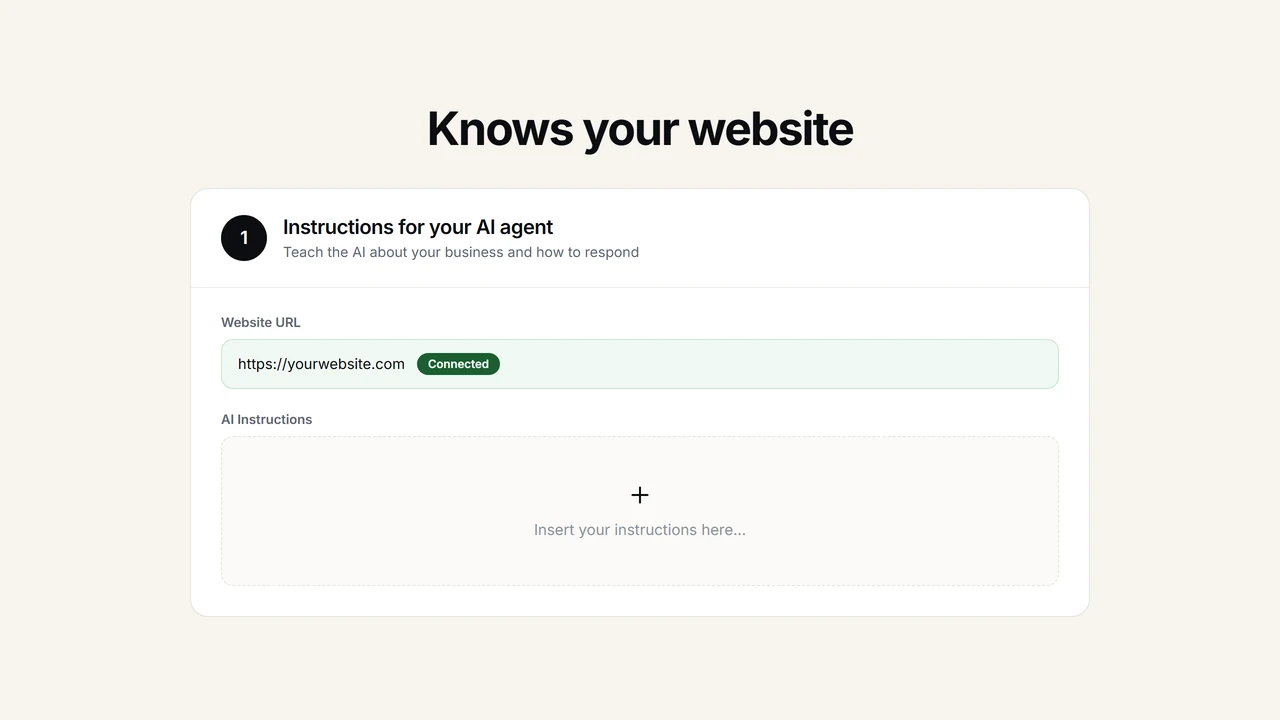
Add a single snippet to your site, point the agent at your content, and connect your calendar or CRM endpoint. No CRM middleware, no Zapier chains, no developer sprints. The AI agent starts qualifying visitors immediately.
- Add the Asyntai snippet to your site's
<head>and let the agent crawl your product pages, pricing, and docs. - Write custom instructions telling the AI what qualifying questions to ask — budget, timeline, company size, use case — and how to prioritize them.
- Connect Custom Tools for booking and CRM: paste your calendar API endpoint and your CRM's contact creation endpoint, define the parameters, and save.
- Test it by visiting your site as a prospect — ask about pricing, answer the qualification questions, and watch the agent book a demo and push the lead to your CRM.
<script src="https://asyntai.com/widget.js"
data-id="your-site-id" async>
</script>
</head>
# One snippet. Your AI agent is live.
AI agent for lead generation — FAQs
Common questions from marketing leaders, sales teams, and founders evaluating AI agents for lead qualification and capture.
How is this different from a lead capture form or chatbot?
A form sits on your page and waits. A basic chatbot follows a script. An AI lead generation agent has a real conversation. It understands what the prospect is asking, answers product and pricing questions from your actual content, asks qualifying questions naturally based on the flow of conversation, and takes action — booking a meeting, pushing the lead to your CRM — all without a human. It's the difference between a form that collects an email and a conversation that qualifies a buyer.
What qualifying questions can the AI agent ask?
Whatever you tell it to. You write plain-English instructions like "Ask about their budget range, timeline for implementation, team size, and what solution they're currently using." The AI weaves these questions into the conversation naturally — not as a rigid survey, but as a dialogue. If a prospect volunteers their budget unprompted, the agent doesn't ask again. It adapts to each conversation while still collecting the data points you need.
Can the AI agent actually book meetings on my calendar?
Yes, through Custom Tools. You connect your calendar API endpoint — Calendly, Cal.com, Google Calendar API, or any scheduling system with a REST endpoint — and the agent checks available slots and books meetings mid-conversation. The prospect picks a time, the agent confirms the booking, and it appears on your calendar. No redirect, no separate scheduling page, no friction.
How does the agent push leads to my CRM?
You set up a Custom Tool that points to your CRM's contact creation endpoint. When the agent has collected qualification data — name, email, company, budget, timeline — it calls your endpoint with those fields. The lead appears in Salesforce, HubSpot, Pipedrive, or any CRM with a REST API within seconds, tagged with the source and qualification details. The conversation transcript is included so your sales rep has full context.
What happens with visitors who aren't ready to buy?
They still get value. The agent answers their product questions, explains features, surfaces relevant case studies, and helps them understand whether your solution fits their needs. Not every conversation ends with a booked demo — some end with an informed prospect who comes back later. But the agent captures whatever contact details they're willing to share and the qualification data from the conversation, so your marketing team can nurture them.
Does the agent work outside business hours?
That's one of the biggest advantages. The AI agent runs 24/7 — qualifying visitors at 11 PM, on weekends, and across time zones. A prospect in Tokyo browsing your site at 3 AM your time gets the same quality conversation as someone visiting during business hours. After-hours leads are qualified, captured, and — if you've connected a scheduling tool — booked for the next available slot. No lead sits in a form queue until Monday morning.
Can I control how the agent qualifies leads — like scoring or routing?
Yes. You define scoring criteria in your custom instructions — for example, "If budget is over $50K and timeline is under 60 days, mark as high-priority and route to the enterprise sales team." The agent evaluates what it learns during the conversation and can call different Custom Tools based on the score — one endpoint for hot leads that books an immediate demo, another for mid-tier leads that adds them to a nurture sequence. Your qualification logic, executed by the AI.
Which plans include the lead generation features?
Every Asyntai plan includes the AI agent with full knowledge base answers, multilingual support, and lead capture through conversation. Custom Tools — which enable meeting booking, CRM integration, and automated lead scoring — are available on Standard and Pro plans. Most businesses doing serious lead generation use Standard or Pro to get the full qualifying-plus-action workflow.
Why conversations qualify leads better than forms — and how an AI agent makes it scale
Every B2B website has the same lead generation architecture, and it hasn't fundamentally changed in fifteen years. A visitor lands on your site, reads some content, maybe watches a demo video, and then hits a form: name, email, company, "tell us about your needs." They fill it out — or they don't. If they do, the form submission lands in a queue. A sales rep picks it up hours or days later, sends an introductory email, and tries to schedule a call. During that call, the rep asks the qualifying questions that could have been asked when the prospect was actually on the site, engaged, and thinking about the problem. The delay between interest and qualification is measured in days. The drop-off is enormous.
The reason this architecture persists isn't that it works well — it's that there hasn't been a viable alternative. You can't staff live chat with sales reps around the clock. You can't build a decision-tree chatbot sophisticated enough to handle the variability of real prospect questions. And you can't replace the qualifying conversation with more form fields without cratering your conversion rate. So businesses accept the trade-off: capture the lead now, qualify later, lose everyone who drops off in between.
An AI agent for lead generation changes that trade-off. Instead of separating capture from qualification into two events spread across days, the agent handles both in a single conversation — the moment the visitor is on your site. The prospect asks a question about your product. The agent answers it from your knowledge base. The prospect asks about pricing. The agent pulls the answer from your pricing page. Then, naturally, the agent asks a qualifying question: "What's your timeline for getting started?" or "How many users would you need?" The prospect answers, the agent asks another, and within a few minutes, you have a qualified lead with budget, timeline, use case, and contact details — without a human touching the conversation.
What makes this work — and what separates it from the rigid chatbot flows that have been tried and abandoned — is that the AI agent handles the full breadth of a prospect's questions, not just a scripted path. A real prospect doesn't follow your funnel. They ask about pricing, then pivot to "do you integrate with Salesforce?", then ask about data security, then want to know about onboarding timelines. A scripted bot breaks at the first unexpected question. An AI agent that reads from your entire knowledge base handles every question, in any order, and keeps the conversation flowing toward qualification. The qualifying questions feel like a dialogue, not a survey.
The knowledge base is the foundation of this capability. When you deploy Asyntai, the agent crawls your website — product pages, pricing tables, documentation, case studies, FAQ sections, blog posts — and indexes all of it. When a prospect asks "What does the Enterprise plan include?", the agent finds the answer on your pricing page and responds with specifics. When they ask "Do you have customers in healthcare?", the agent surfaces your healthcare case study. When they ask "How does the API work?", it pulls from your documentation. Every answer is grounded in your actual published content, not generic AI-generated filler. The prospect is getting the same information they'd find on your site, delivered conversationally and instantly, without them having to search for it.
This information exchange is what creates the opening for qualification. When a prospect has their questions answered, they reciprocate. It's a basic conversational dynamic — you gave me something useful, so I'll answer your question. "What's your timeline?" feels natural after the agent just explained your integration options in detail. "What's your approximate budget?" feels reasonable after the agent walked through the three pricing tiers and their differences. The agent earns the right to ask qualifying questions by being genuinely helpful first. Compare that to a form that demands name, email, company, and phone number before offering anything in return — and it's obvious why conversational qualification converts better.
But qualification without action is just data collection. The second half of what makes an AI lead generation agent valuable is Custom Tools — the ability to call your own API endpoints mid-conversation to take action on the qualification data. The most common action is booking a meeting. When a prospect qualifies — right budget, right timeline, right use case — the agent doesn't say "someone will be in touch." It says "I can book a demo for you right now. Are you available Thursday at 2 PM or Friday at 10 AM?" It calls your calendar API, checks available slots, presents options, and confirms the booking in real time. The prospect goes from anonymous visitor to booked meeting in a single conversation, with zero human involvement.
Meeting booking is the highest-impact Custom Tool for lead generation, but it's not the only one. A CRM integration tool pushes every qualified lead into Salesforce, HubSpot, Pipedrive, or whatever system your sales team lives in. The agent collects name, email, company, budget range, timeline, and use case during the conversation, then calls your CRM's contact creation endpoint with all of those fields populated. The lead shows up in your pipeline within seconds of the conversation ending, tagged with the source (Asyntai), the qualification score, and the full conversation transcript. Your sales rep opens the record and knows exactly what the prospect asked, what they care about, what their budget is, and what objections they raised — before making the first outbound call.
Lead scoring through Custom Tools lets you route leads based on the qualification data the agent collected. You define the criteria in plain English: "If annual budget is over $50,000, company size is over 200 employees, and timeline is under 60 days, score as high-priority and route to the enterprise team. If budget is under $10,000, score as SMB and add to the self-serve nurture sequence." The agent evaluates the conversation against your criteria and calls the appropriate endpoint — one that books a demo with a senior AE for high-priority leads, another that adds mid-tier leads to a drip campaign, another that sends information-seekers a resource pack. Different outcomes for different leads, all automated, all instant.
The after-hours value of an AI lead generation agent is where the ROI gets hardest to ignore. Your website generates traffic 24 hours a day. Paid campaigns run overnight. Prospects in other time zones browse your site while your team is asleep. A form captures their email at best — and many visitors won't fill out a form at 11 PM for a product they just discovered. But they will ask a question. "What does this cost?" "Does it work with Shopify?" "Can I see a demo?" The AI agent answers those questions, engages the prospect, qualifies them, and books a meeting for the next business day — all at 11 PM on a Sunday. When your sales team starts Monday morning, the demo is already on the calendar, the lead is in the CRM, and the qualification data is attached. They didn't lose the weekend traffic. They monetized it.
The economics of conversational lead generation are straightforward once you measure cost per qualified lead. A paid search campaign might deliver clicks at $15-40 each, depending on your industry. Of those clicks, maybe 3-5% fill out a form. Of those form submissions, maybe half are genuinely qualified after a sales rep spends 15 minutes on a discovery call. So your cost per qualified lead is somewhere between $200 and $800 — the ad spend plus the rep time. An AI agent that qualifies visitors on the site compresses the funnel. The same $15 click leads to a conversation. The agent qualifies in real time, captures the lead, and books the meeting. The rep skips the discovery call entirely — the qualification data is already in the CRM. Even if the agent only qualifies 10% of visitors who engage with it, the cost per qualified lead drops dramatically because you eliminated the manual qualification step and reduced the form drop-off.
Speed-to-lead research consistently shows that the probability of qualifying a lead drops by an order of magnitude after the first five minutes. A prospect who fills out a form at 2:17 PM and gets a call at 2:22 PM is far more likely to engage than one who gets an email the next morning. An AI agent responds in seconds. The qualification conversation happens while the prospect is still thinking about the problem, still has the browser tab open, still remembers why they visited your site. There is no speed-to-lead lag. The agent meets the prospect at the moment of peak intent and captures the value before it decays.
For companies selling to other businesses, the agent's ability to answer detailed product questions is what separates it from a glorified chatbot. B2B buyers do research before they talk to sales. They want to know about integrations, security certifications, SLA terms, API rate limits, and implementation timelines. They want to compare your product to alternatives. They want specific answers, not "book a demo and we'll tell you." An AI agent that can answer "Do you support SSO with Okta?" from your documentation page — and then follow up with "Great, and what identity provider are you currently using?" as a qualifying question — keeps the prospect engaged and moving forward. The moment you say "I can't answer that, but a sales rep can" is the moment you lose a percentage of visitors who won't wait.
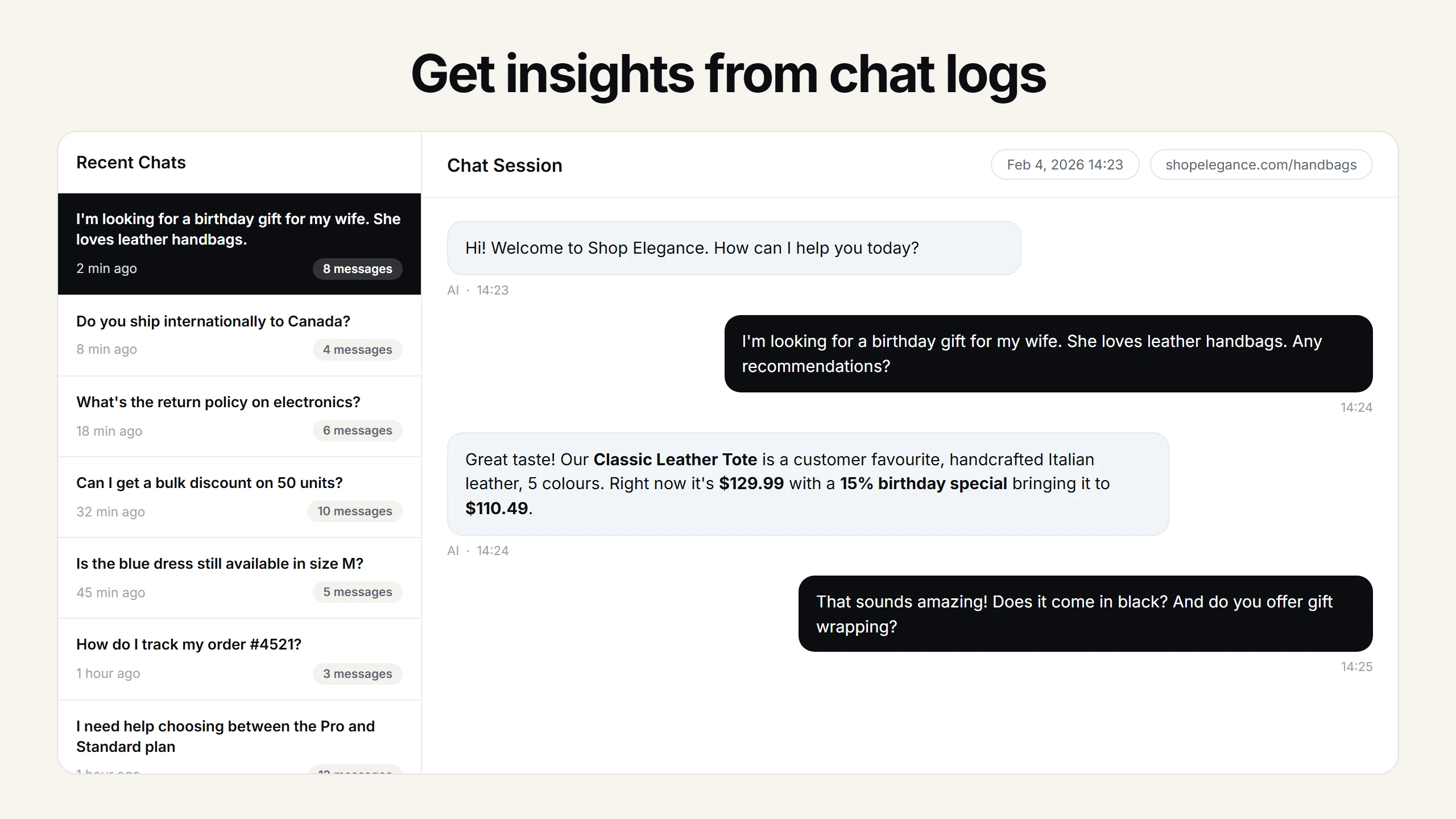
The conversational data the agent generates is valuable beyond the individual lead. After a month of operation, you can see exactly what prospects ask about most. If 40% of conversations include a pricing question, your pricing page might not be clear enough — or it might be behind a login wall that's creating friction. If prospects frequently ask about a specific integration, that's a signal to prioritize it in your product roadmap. If the most common objection in conversations is "your competitor offers X," that's competitive intelligence your sales team can use. Every conversation is logged in your dashboard with the full transcript, the tools called, and the qualification outcome — giving your marketing team a real-time feed of prospect intent that no form submission could provide.
The multilingual capability means the agent qualifies leads in whatever language the prospect speaks. A German visitor asks "Was kostet das Enterprise-Paket?" — the agent answers from your (English) pricing page in German, then asks qualifying questions in German, and pushes the lead to your CRM with English field values and a German transcript attached. A Japanese prospect browsing at 3 AM Tokyo time gets the same conversational quality as a New York visitor at noon. You don't need localized sales teams to capture international leads. The AI handles the language layer while your content and tools provide the data layer.
Implementation is designed to be fast because lead generation is a high-urgency problem — every day without qualification is leads lost. You add the Asyntai snippet to your site. The agent crawls your content. You write custom instructions describing your qualifying questions and lead routing logic. You connect Custom Tools for calendar booking and CRM push. The whole process takes hours, not weeks. There's no CRM middleware to configure, no Zapier chains to maintain, no developer sprint to schedule. If your calendar system has an API and your CRM has a contact creation endpoint — and virtually all modern tools do — the connection is a form in your dashboard.
The AI agent handles the full spectrum of visitor intent, not just the ready-to-buy segment. Some visitors are early-stage researchers who want to understand the category. Some are comparing three vendors and want feature-level specifics. Some know exactly what they want and are ready to book a demo. The agent adapts its approach to each. An early-stage visitor gets educational answers and a gentle qualification question or two — maybe just an email. A comparison shopper gets detailed feature answers and competitive positioning. A ready-to-buy prospect gets immediate qualification and a meeting booked before they leave the page. One agent, multiple outcomes, each appropriate to where the prospect actually is in their buying journey.
What makes this approach scale is that the agent improves your funnel without replacing any of it. Your content marketing still drives traffic. Your ad campaigns still bring clicks. Your sales team still closes deals. The AI agent sits at the conversion layer — the gap between "visitor" and "qualified lead" — and compresses it from days into minutes. It doesn't require you to rethink your go-to-market strategy. It requires you to add a snippet, write some instructions, and connect an endpoint. The leads that would have bounced, or filled out a form and gone cold, or browsed your pricing page at midnight and left — those are the leads the agent captures. Not by being intrusive. By being helpful, available, and ready to act.
The distinction between an AI chatbot and an AI agent for lead generation comes down to what happens after the conversation. A chatbot can answer questions from your FAQ and maybe collect an email. An agent answers questions, asks qualifying questions, scores the lead, pushes it to your CRM, and books a demo — all within the same conversation, without a human involved. That full loop — from anonymous visitor to qualified, scored, CRM-logged, meeting-booked lead — is what "agent" means in this context. And it runs at 3 AM on a Saturday with the same quality as 10 AM on a Tuesday. Every hour of every day, your best-performing sales development rep is a conversation on your website, answering questions and booking meetings. It just happens to be AI.