An AI agent for IT support that resolves tickets — not just logs them
Asyntai's AI agent for IT support connects to your internal systems through Custom Tools — it checks service status, looks up user accounts, verifies license availability, and creates tickets. Not a static FAQ page. An agent that queries your infrastructure and gives employees real answers.
See the AI agent handle your employees' IT questions
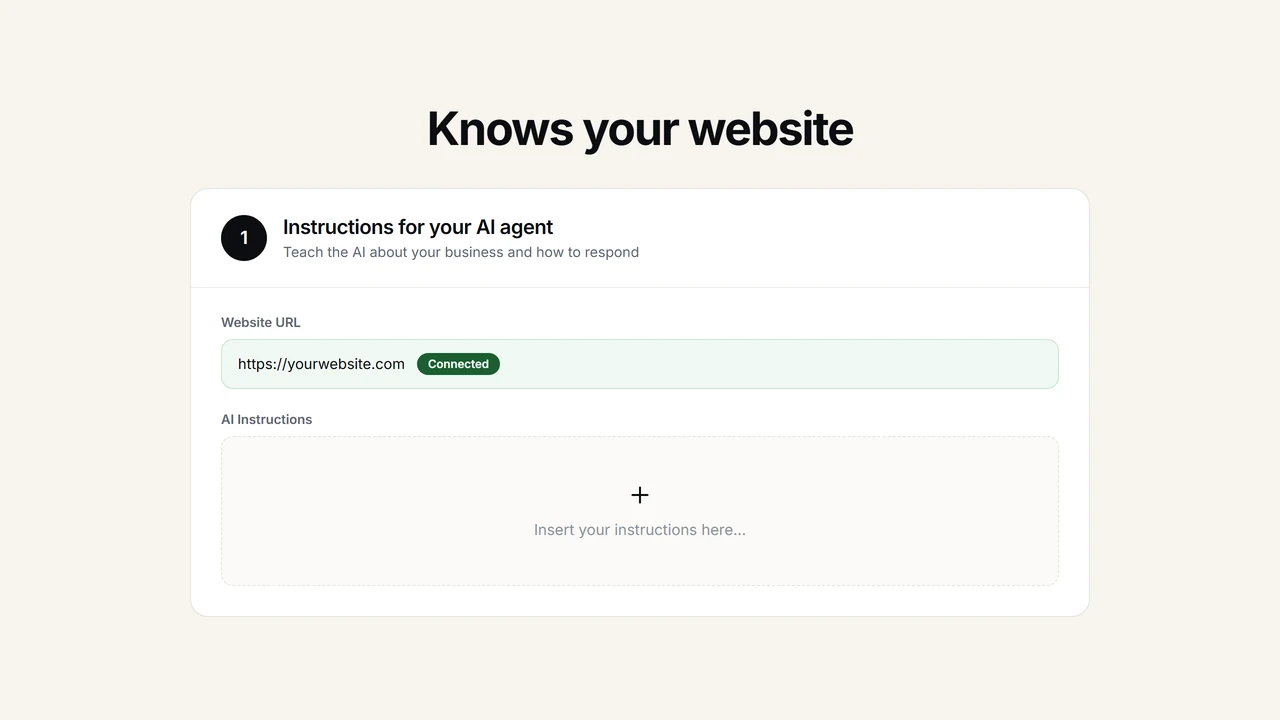
Enter your support portal URL and watch the AI agent for IT support answer real questions using your actual documentation
Answers IT questions from your own documentation — instantly
The foundation of every AI agent for IT support is the knowledge base. Asyntai crawls your IT documentation, setup guides, troubleshooting runbooks, and company policies — then answers employee questions using that verified content. Password resets, VPN configuration, software installation steps, printer setup, security policies. The answers employees actually need, drawn from the documentation you already maintain.
- Crawls your internal documentation automaticallyPoint the agent at your IT wiki, intranet, or support portal. It indexes setup guides, troubleshooting articles, policy documents, and FAQ pages — then serves the right answer when employees ask questions in natural language.
- Handles the questions that flood your helpdesk"How do I connect to the VPN?" "Where do I find the shared drive?" "What's the password policy?" These account for a massive share of L1 tickets. The agent answers them instantly from your existing documentation, no human intervention required.
- Stays current as your documentation changesWhen you update a setup guide or publish a new policy, the agent re-crawls and picks up the changes. No manual syncing. No stale answers pointing employees to deprecated procedures or retired tools.
Queries your systems mid-conversation — status checks, account lookups, ticket creation
What makes Asyntai an AI agent for IT support instead of a search bar over your wiki is Custom Tools. The AI calls your own endpoints during the conversation — service status dashboards, Active Directory lookups, license management APIs, ITSM ticket creation — and uses the live data to resolve the employee's issue or route it correctly. Not "please submit a ticket." An agent that checks the system and tells you what's happening right now.
- System status checks in real timeWhen an employee asks "is the CRM down?", the AI doesn't guess. It calls your monitoring endpoint, checks the current status, and reports back: "The CRM is experiencing degraded performance — the infrastructure team is investigating. ETA for resolution is 2:30 PM." Real status, not a redirect to the status page.
- Account and license lookups without IT involvementEmployee needs to know if their design software license is active? The AI calls your license management endpoint, checks availability, and gives an immediate answer. No ticket. No waiting for an IT admin to look it up manually.
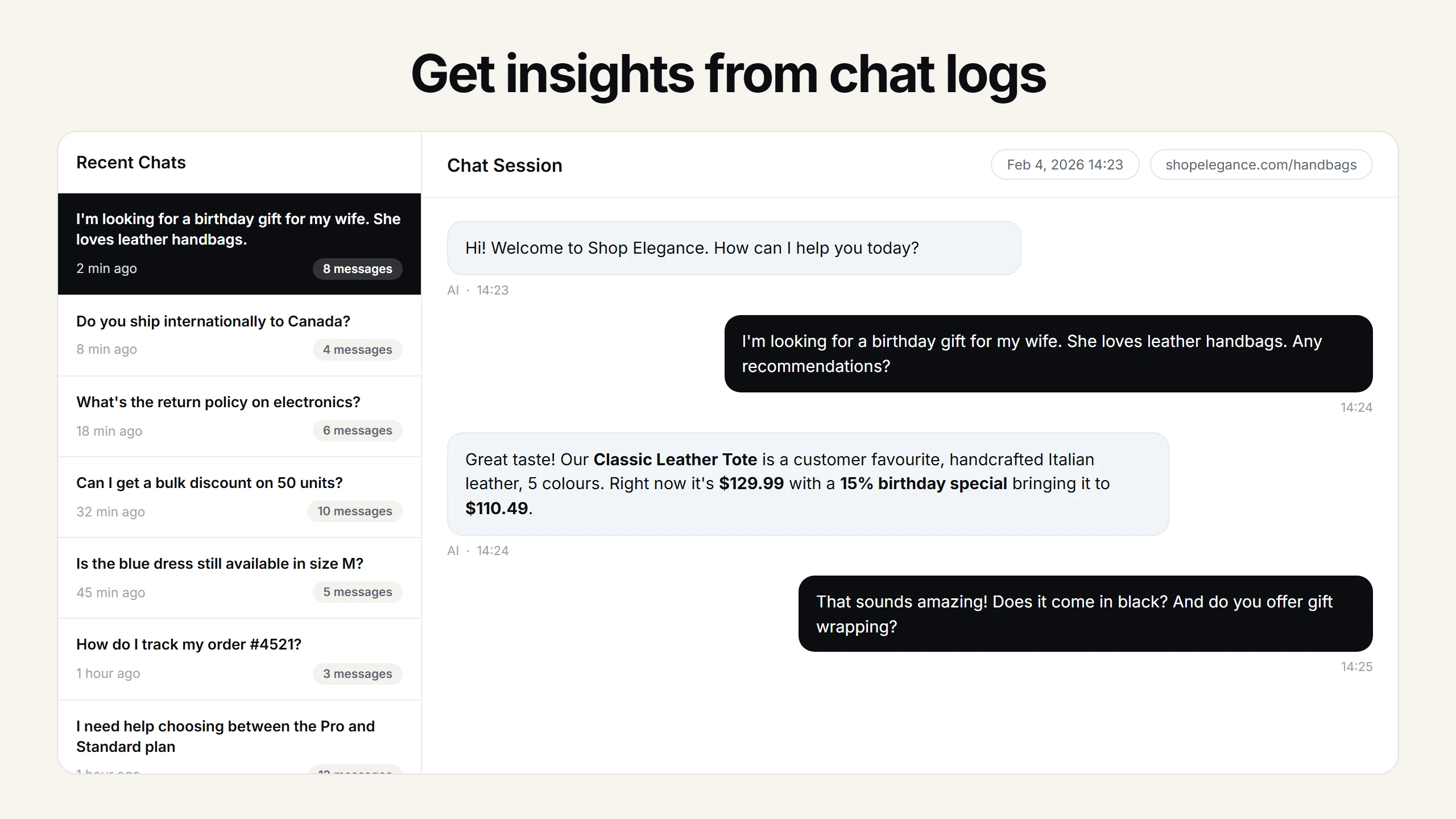
- Ticket creation with full contextWhen an issue requires human IT intervention, the agent creates a ticket in your ITSM system with the employee's details, the problem description, diagnostic information gathered during the conversation, and a suggested priority level. No more "what's your employee ID?" back-and-forth — the agent collects everything before routing.
Deploy the IT support agent on your intranet in minutes
If your organization has internal documentation and API endpoints for your IT systems, connecting them to the AI agent is a dashboard configuration — not a development sprint. No middleware, no custom integrations, no procurement cycle. Embed, point, describe, go.
- Add the Asyntai snippet to your intranet portal or internal support page and let the agent crawl your IT documentation.
- Go to Custom Tools in your dashboard and connect your first system — service status, account lookup, or ticket creation endpoint.
- Define parameters (like
employee_emailorservice_name) so the AI knows what to extract from the conversation and send to your endpoint. - Test it by asking your agent an IT question — the AI calls your endpoint live and answers with real system data.
<script src="https://asyntai.com/widget.js"
data-id="your-site-id" async>
</script>
</head>
# One snippet. Your IT support agent is live.
AI agent for IT support — FAQs
Common questions from IT managers, MSPs, and operations teams evaluating AI agents for internal IT support.
Can this be deployed on an internal intranet rather than a public website?
Yes. The agent is a JavaScript widget that runs wherever you embed it — your company intranet, internal support portal, SharePoint site, or any internal web page. As long as the page loads in a browser, the agent works. There's no requirement for the page to be publicly accessible. Many IT teams embed it on their internal helpdesk landing page so employees see it the moment they go to submit a ticket.
Does the agent support SSO and SAML for employee authentication?
Asyntai itself uses standard account authentication. For employee identification within conversations, you use the User Context feature to pass the logged-in employee's details — name, email, department, role — into the widget from your intranet's authentication layer. The agent then knows who it's talking to and can personalize responses, look up their specific account, or pre-fill ticket details. Your SSO/SAML handles the authentication; Asyntai receives the context it passes.
How does this handle data security for internal IT systems?
Custom Tool calls are made server-side — the employee's browser never contacts your endpoints directly. You add auth headers (API keys, tokens) that Asyntai sends with each request. Response data is used to compose the reply and stored in conversation logs accessible only to your admins. You control which endpoints are exposed, what data they return, and what level of detail the agent shares. The agent never accesses systems you haven't explicitly connected.
Can it integrate with our existing ITSM tools like ServiceNow, Jira Service Management, or Freshservice?
If your ITSM tool has a REST API — and ServiceNow, Jira Service Management, Freshservice, Zendesk, and most modern ITSM platforms do — the agent can call it through Custom Tools. You create a tool that points at the ticket creation endpoint, define the parameters the AI should collect from the conversation (issue description, category, priority, requester email), and the agent creates properly formatted tickets automatically. The same approach works for querying existing ticket status or updating tickets.
Can the agent handle multiple departments beyond IT — HR, facilities, finance?
Absolutely. The knowledge base can include documentation from any department, and Custom Tools can connect to any system with an API. An employee asking "how do I submit an expense report?" gets answered from HR documentation, while "is my building access card active?" could trigger a facilities system lookup. You organize it all through one agent, and the AI routes to the right knowledge or tool based on the question. Many organizations start with IT and expand to shared services.
How accurate is the agent when troubleshooting technical issues?
The agent answers strictly from your documented troubleshooting content — it doesn't invent steps or guess at solutions. If your runbook says "restart the print spooler service, then re-add the printer," that's exactly what the agent tells the employee. If the documented steps don't resolve the issue, the agent escalates to a human technician with the full conversation context, including which steps the employee already tried. Accuracy is bounded by your documentation quality, not by the AI hallucinating technical procedures.
Does this meet compliance requirements for regulated industries?
Asyntai stores conversation data securely and provides full audit logs of every interaction, including Custom Tool calls and responses. For organizations with specific compliance needs — HIPAA, SOC 2, GDPR, or industry-specific frameworks — the key consideration is what data your Custom Tool endpoints return. You control what the agent can access and what it can share. Many regulated organizations use the agent for general IT support questions while restricting Custom Tool access to non-sensitive systems.
What happens when the AI agent cannot resolve an issue?
The agent escalates with full context. It captures the employee's information, the complete conversation, any diagnostic data gathered during troubleshooting, and the Custom Tool responses it received. This gets routed to your IT team through your preferred channel — a ticket in your ITSM system via Custom Tools, an email notification, or the Asyntai dashboard. Your technician sees exactly what was tried, what failed, and what the employee reported, so they pick up without asking the employee to repeat everything.
Why IT helpdesks drown in L1 tickets — and how an AI agent for IT support changes the math
Every IT department knows the pattern. The helpdesk opens Monday morning to a queue of tickets, and the vast majority are the same questions asked by different people. "How do I connect to the VPN from home?" "My Outlook keeps crashing — what do I do?" "I need access to the project management tool." "The printer on the third floor isn't working." "How do I reset my password?" These are not complex engineering problems. They are documented, repeatable, answerable-in-under-two-minutes questions that nonetheless consume hours of technician time every single week because no amount of "please check the wiki first" signage changes the behavior. Employees ask IT because it's easier than searching through a disorganized SharePoint or a documentation site with seventeen layers of navigation.
This is the L1 problem, and it's universal. Industry data consistently shows that 60-70% of all IT helpdesk tickets fall into the L1 category — issues that can be resolved with information that already exists in documentation. Password resets, VPN setup instructions, software installation guides, printer configuration, email client settings, two-factor authentication enrollment, shared drive access, screen sharing instructions, Wi-Fi troubleshooting, permission requests. Each one takes a technician three to eight minutes to handle — not because the answer is hard, but because the process of reading the ticket, looking up the documented procedure, writing it out, and closing the ticket has irreducible overhead even when the technician has done it five hundred times before.
Multiply that across a mid-size organization — say 500 employees, generating an average of 400 IT tickets per month, with 65% being L1 — and you get roughly 260 L1 tickets monthly. At five minutes average handling time per ticket, that's about 22 hours of technician time per month spent answering questions whose answers are already written down. In a three-person IT team, that's nearly one full-time equivalent doing nothing but L1 triage. One person, spending their entire work week, every week, telling people how to connect to the VPN.
An AI agent for IT support changes this equation by sitting at the point where employees naturally go for help — the support portal, the intranet helpdesk page, the IT landing page — and resolving the documented questions before they become tickets. The employee types "how do I set up the VPN on my Mac?" and the agent answers immediately from the IT documentation that was crawled when you deployed it. Not a link to a document. Not a redirect to a wiki page. The actual step-by-step instructions, in the chat, in seconds. The employee follows the steps, the issue is resolved, and no ticket was ever created. No technician was interrupted. No queue was lengthened.
The knowledge base side of the agent is powerful on its own, but it only handles the questions where a documented answer exists and is sufficient. The IT support domain has a second category of common questions that require live data: "Is the CRM system down right now?" "Do we have any available licenses for Adobe Creative Cloud?" "What's the status of the ticket I submitted last week?" "Is my VPN account active?" These questions can't be answered from documentation because the answer changes minute by minute. This is where Custom Tools transform the AI from a documentation search engine into a genuine IT support agent.
Custom Tools let the AI call your internal system endpoints during the conversation. You set up a tool called "check_service_status" that points at your monitoring dashboard API. When an employee asks "is Salesforce down?", the AI extracts the service name, calls your monitoring endpoint, and reports the current status: "Salesforce is experiencing intermittent connectivity issues. The infrastructure team identified the cause at 10:15 AM and is deploying a fix. Estimated resolution: 11:30 AM." The employee got a real, current answer in seconds. Without the agent, this question becomes a ticket that sits in queue for twenty minutes while the employee tries calling the IT desk, pinging colleagues on Slack, and refreshing the app hoping it comes back.
License management is another high-volume use case. "I need access to Figma for a design project." Without the agent, this is a ticket that gets assigned to an IT admin, who logs into the license management portal, checks how many seats are available, checks whether the requester's role qualifies, and either provisions access or replies asking for manager approval. With a Custom Tool connected to your license management API, the agent handles the lookup in real time: "We have 3 available Figma licenses. Your department is authorized for design tool access. I've created a provisioning request — ticket #IT-4892 — and the license team will activate your account within 4 hours." The employee gets an answer and a timeline. IT gets a pre-formatted ticket with all the context. Nobody waited. Nobody typed the same fields into the same form for the hundredth time.
The ticket creation capability deserves attention because it addresses a persistent friction point in IT support workflows. When an employee encounters an issue the agent cannot resolve — a hardware failure, a permissions change requiring manager approval, a network issue affecting a specific workstation — the agent doesn't just say "please submit a ticket." It creates the ticket through a Custom Tool connected to your ITSM platform. ServiceNow, Jira Service Management, Freshservice, Zendesk — any system with a REST API works. The agent collects the relevant information during the conversation (what's the issue, which device, which application, what did you already try), formats it into a properly categorized ticket with priority level and full diagnostic notes, and submits it. The employee gets a ticket number and an expected response time. The IT technician gets a well-documented ticket instead of "my computer doesn't work."
This structured ticket creation alone has measurable ROI. Poorly written tickets — vague descriptions, missing asset tags, no mention of troubleshooting already attempted — are one of the biggest time sinks in IT operations. A technician reads "Outlook is broken," then spends three reply cycles asking "which version?", "which device?", "when did it start?", "did you try restarting?" before even beginning to diagnose. The AI agent gathers this systematically in the initial conversation. By the time the ticket reaches a technician, it includes the employee's name, department, device type, operating system, application version, error description, and a list of troubleshooting steps already attempted. That's the difference between a five-minute resolution and a twenty-minute ping-pong thread.
For Managed Service Providers — MSPs managing IT for multiple client organizations — the AI agent scales in a way that hiring technicians does not. An MSP with fifteen clients might handle 3,000 L1 tickets per month across all of them. Each client has their own documentation, their own system endpoints, their own policies. Traditionally, this requires L1 technicians who either know all fifteen environments (unlikely) or specialize in a subset (limiting routing flexibility). An AI agent for IT support, deployed per client with that client's documentation and Custom Tool endpoints, handles L1 resolution for each organization independently. The MSP's human technicians focus on L2 and L3 issues — the complex problems that actually require expertise. The math is straightforward: if the agent resolves 60% of L1 tickets across fifteen clients, and each technician handles 25 tickets per day, the MSP frees up the equivalent of seven to eight technician-days per month. That's either a cost reduction or an opportunity to take on more clients without hiring.
After-hours IT support is where the agent's value becomes most visible. IT issues don't respect business hours. An employee working late hits a VPN problem at 9 PM. A remote team member in another timezone can't access the shared drive at 6 AM. A critical deployment is blocked at 2 AM because someone can't find the credentials policy for the staging environment. Without an AI agent, these after-hours requests either go unanswered until the next business day — costing productivity — or require on-call technicians who are expensive and dislike being woken up for "how do I reset my password." The agent handles after-hours L1 support at zero marginal cost. It doesn't sleep. It doesn't bill overtime. It provides the same quality of response at 3 AM as at 10 AM, drawing from the same documentation and calling the same system endpoints.
Security considerations in internal IT deployment are legitimate and worth addressing directly. The AI agent accesses only the systems you connect through Custom Tools — nothing more. You define which endpoints are callable, what parameters they accept, and what data they return. API keys and auth tokens are sent server-side from Asyntai's infrastructure; the employee's browser never sees them. Conversation logs are accessible only to your administrators through the Asyntai dashboard. For organizations with strict data governance requirements, the key principle is that you control the data boundary. If your monitoring endpoint returns "Salesforce status: degraded," the agent sees that and composes a response from it. It doesn't have broad access to your network, your Active Directory, or any system you haven't explicitly connected. The attack surface is limited to the specific API endpoints you choose to expose.
The question of accuracy in IT troubleshooting is one that IT managers raise early, and the answer is structurally different from what most people expect. The AI agent does not improvise troubleshooting steps. It answers from your documented procedures. If your runbook says "to resolve the VPN connection error on macOS, first open System Preferences, navigate to Network, select the VPN configuration, click the minus button to remove it, then re-add it using these settings," then that's exactly what the agent tells the employee. It doesn't invent shortcuts or suggest steps it picked up from general internet training data. This is critical in IT environments where following unapproved procedures can create security issues, break configurations, or void warranties. The agent is as accurate as your documentation — no more, no less. When documentation is missing or the issue doesn't match any documented scenario, the agent escalates to a human technician instead of guessing.
The deployment pattern most IT teams follow starts narrow and expands. Week one: connect the agent to your internal IT documentation — the wiki, the knowledge base, the FAQ page. This alone handles password reset instructions, VPN setup, software installation guides, and the other high-frequency documentation questions. Week two: add a system status Custom Tool so the agent can answer "is X down?" in real time. Week three: connect your ITSM ticket creation endpoint so unresolved issues are automatically routed with full context. Week four: add account or license lookup tools so the agent can answer "do I have access to X?" questions. Each week adds a new category of resolved tickets. Within a month, the agent typically handles 50-65% of incoming IT support volume — and that percentage climbs as you add more documentation and connect more system endpoints.
The economic argument for an AI agent for IT support is not about replacing IT staff. It's about reallocating them. Most IT teams are understaffed relative to their responsibilities. They're supposed to be driving infrastructure improvements, security hardening, cloud migrations, and strategic projects — but they spend half their time answering L1 tickets about printers and passwords. The agent absorbs the repetitive volume, and the technicians who were previously doing L1 triage can focus on the L2 and L3 work that actually requires their expertise. In organizations where IT is measured by both resolution metrics and project delivery, this reallocation is the difference between an IT department that's perpetually reactive and one that has capacity for the work that moves the organization forward.
The multilingual capability matters more in IT than most people realize. Global organizations have employees in multiple countries, and while IT documentation is often written in English, the employee asking "how do I connect to the VPN?" in the Tokyo office shouldn't need fluent English to get a clear answer. The AI agent handles this automatically — an employee asks in Japanese, the agent answers in Japanese, drawing from English-language documentation and translating the response. The same documentation serves employees in all 36 supported languages. You don't need translated versions of every setup guide. You write the documentation once, in English, and the agent delivers it in whatever language the employee uses.
What distinguishes a genuine AI agent for IT support from an IT chatbot is the same distinction that applies across support domains: the ability to act, not just respond. A chatbot reads your wiki and tells employees where to find information. An agent resolves the issue — by giving them the exact troubleshooting steps, by checking whether the system they're asking about is actually down, by looking up whether they have an available license, by creating a properly categorized ticket when human intervention is needed. Every resolved question is a ticket that was never created. Every well-formatted escalation ticket is a technician-hour saved on back-and-forth clarification. Every after-hours answer is an employee unblocked without an on-call page. The cumulative effect is an IT helpdesk that handles the same volume of requests with dramatically less human effort — not because the humans disappeared, but because they stopped spending their time on problems that were already solved in the documentation.