AI agent development without the development part
Asyntai lets you build AI agents that do real work — look up orders, book appointments, trigger refunds — straight from a dashboard. No Python, no infrastructure, no engineering hire.
See what your AI agent would know out of the box
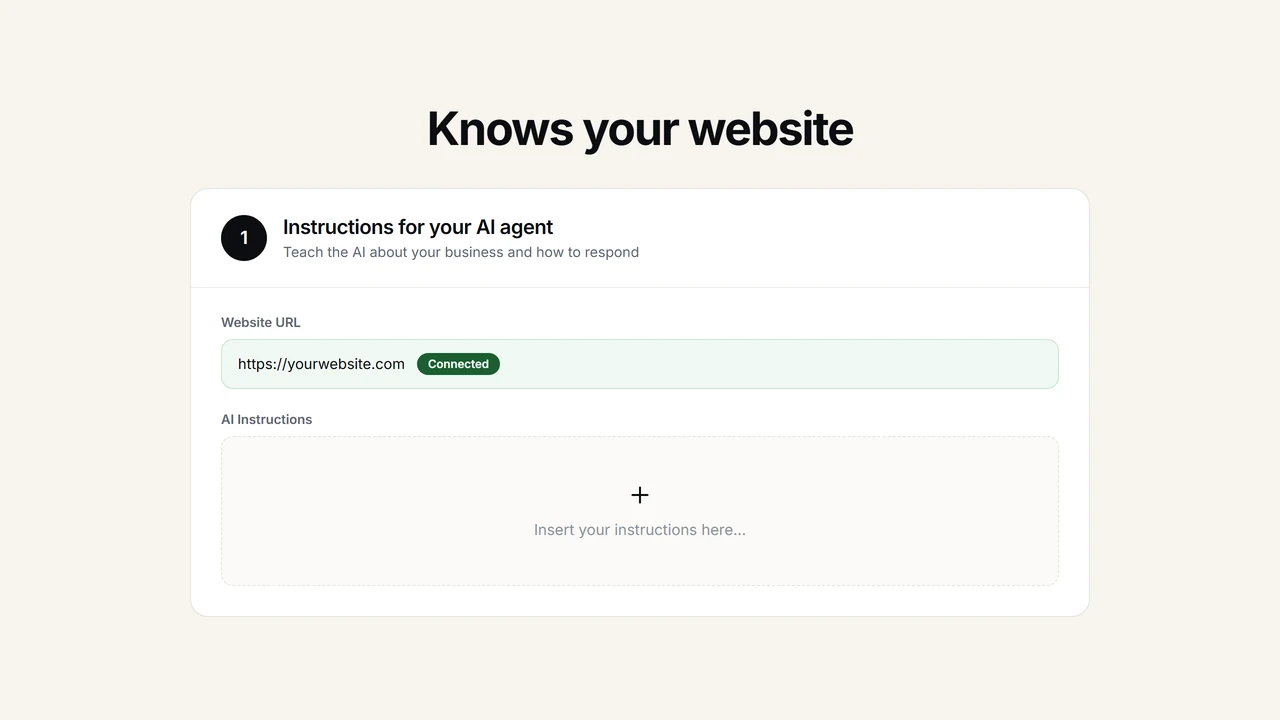
Enter your website URL and watch the agent answer visitor questions using your actual content — before you configure a single thing
Your website becomes the agent's brain in minutes
Traditional AI agent development starts with months of data preparation — scraping content, chunking documents, wiring up a vector store, debugging retrieval pipelines. Asyntai collapses that entire phase into a single input field. You type your URL, the crawler reads up to fifty pages of your site, and the agent immediately begins answering visitor questions using your real content. Pages, products, policies, blog posts — everything public becomes part of the agent's working knowledge without a single line of ingestion code.
- Automatic content retrievalThe crawler indexes your published pages and builds a retrieval layer the agent consults on every conversation. No manual FAQ lists, no intent mapping, no sample utterances to write.
- Private documents via uploadInternal pricing sheets, vendor agreements, staff procedures — upload PDFs through the dashboard and the agent treats them identically to crawled pages. Nothing leaves Asyntai's infrastructure.
- Plain-English behavioral rulesWrite instructions the way you would brief a new employee: "Never quote exact prices for custom work — collect their email instead." "Always link to the warranty page when someone asks about repairs." The agent follows them on every reply.
Custom Tools turn a chatbot into an agent that acts
The difference between a chatbot and an agent is the ability to do things, not just say things. Custom Tools on Standard ($139/month) and Pro ($449/month) plans let your AI agent call your own API endpoints mid-conversation — checking inventory, pulling order status, initiating a return, reserving a time slot — and weave the live result into its reply. You define each tool in the dashboard with a name, a description, the endpoint URL, and the parameters. No SDK, no webhook framework, no deployment pipeline.
- Read actions — fetch live dataPoint a tool at your order-status API and the agent pulls tracking numbers, delivery estimates, and shipment details on demand. The visitor asks; the agent checks; the answer is current to the second.
- Write actions — trigger real operationsReturns, cancellations, appointment bookings, subscription changes — if your backend exposes the endpoint, the agent can call it. The visitor doesn't fill a form; they describe what they need in natural language and the agent handles the rest.
- Parameter extraction from conversationThe agent identifies which parameters each tool needs — an order number, an email address, a preferred date — and collects them conversationally before making the call. No rigid slot-filling dialogs.
- Conditional tool routingBehavioral instructions control when tools fire. "Only process refunds for orders under $200" or "Check appointment availability before offering to book" — the agent evaluates the rule, then decides whether to call the endpoint or escalate to a human.
- Dashboard-only configurationEvery tool is defined, tested, and deployed from the Asyntai dashboard. You never write glue code, deploy a serverless function, or configure a webhook receiver. If the endpoint exists, you just tell the agent where it lives.
Deploy your first AI agent in four steps
The entire path from zero to a working AI agent on your website takes less time than writing a project brief for a development team. No staging environments, no code reviews, no sprint planning — just a dashboard and a script tag.
- Create a free Asyntai account ($0, no card required) — the free plan covers 1 site and 50 messages per month, enough to validate the agent on real traffic.
- Enter your website URL. The crawler reads your pages and builds the agent's knowledge base automatically. Upload any private documents the agent should also reference.
- Paste the embed snippet into your site's HTML. For agent capabilities with Custom Tools, upgrade to Standard ($139/month, 3 sites, 15,000 messages) or Pro ($449/month, 20 sites, 50,000 messages).
- Configure Custom Tools in the dashboard — add your API endpoints, define parameters, write behavioral rules — and the agent goes live with the ability to act, not just answer.
<script src="https://asyntai.com/widget.js"
data-id="your-site-id" async>
</script>
# The agent answers from your content immediately.
# Add Custom Tools in the dashboard to enable
# order lookups, bookings, returns, and more.
AI agent development — FAQs
What teams evaluating AI agent platforms typically want to know before committing.
What is the difference between a chatbot and an AI agent?
A chatbot answers questions by referencing stored knowledge. An AI agent does that and also takes actions — checking an order status against your fulfillment system, booking an appointment through your scheduling API, initiating a return in your order management platform. Asyntai starts as a chatbot the moment you connect it to your site, and becomes an agent when you configure Custom Tools that give it permission to call your endpoints.
Do I need developers to build an AI agent with Asyntai?
Not for the agent itself. The knowledge base, behavioral rules, appearance, and Custom Tool definitions are all configured through the dashboard without writing code. The one place where a developer may be involved is on your side — if you want the agent to perform actions like order lookups or bookings, your backend needs to expose an API endpoint for the agent to call. If that endpoint already exists, the entire setup is no-code.
Which plans include Custom Tools?
Custom Tools are available on Standard ($139/month) and Pro ($449/month). The free plan and Starter ($39/month) include the full knowledge-based chatbot — automatic content retrieval, multilingual replies, lead capture — but do not support tool-calling. If your use case requires the agent to fetch live data or trigger actions, Standard is the entry point.
What kinds of actions can Custom Tools perform?
Any action your backend can expose as an HTTP endpoint. Common examples include order status lookups, shipment tracking, appointment scheduling, return initiation, subscription management, inventory checks, and account balance queries. You define the endpoint URL, the HTTP method, the expected parameters, and a plain-English description of what the tool does. The agent decides when to call it based on the conversation and your behavioral instructions.
How does the agent decide when to use a tool versus answering from content?
The agent evaluates each visitor message against both its knowledge base and the available Custom Tools. If a visitor asks "what is your return policy," the agent answers from your published policy page. If the same visitor then says "I want to return order 4821," the agent recognizes the intent, collects any missing parameters, and calls the returns endpoint. Behavioral instructions let you add guardrails — for example, requiring email verification before processing a return.
Can I white-label the agent under my own brand?
Yes. On the Pro plan ($449/month), white-labeling is automatic — all Asyntai branding is removed from the widget. On Standard ($139/month), white-labeling is available manually; email [email protected] and the team will configure it for your account. The agent appears to your visitors as a native part of your product, with your colors, your name, and no third-party attribution.
How many languages does the agent support?
The widget interface and the AI responses both cover 36 languages. Language detection happens automatically from the visitor's first message — a Spanish-speaking visitor gets Spanish replies, a Japanese visitor gets Japanese, without any per-language configuration. Your knowledge base can be in a single language; the agent translates its answers on the fly while preserving accuracy.
What happens when the agent cannot resolve a request?
The agent captures the visitor's name, email, and the complete conversation transcript and surfaces it as a lead in your Asyntai dashboard. Enable email notifications and the same record arrives in your inbox within seconds. The visitor gets a clear response that a human will follow up, and the handoff includes full context so your team never starts from scratch.
How does this compare to hiring a development team to build an AI agent?
A custom-built AI agent typically requires a retrieval pipeline (vector database, embeddings, chunking logic), a tool-calling framework (LangChain, CrewAI, or similar), deployment infrastructure (containers, monitoring, scaling), and ongoing maintenance. That is a three-to-six month project for a team of two or three engineers. Asyntai replaces the entire stack with a managed service: the retrieval layer, the tool-calling layer, the deployment, and the hosting are all handled, and the configuration happens in a browser. The tradeoff is flexibility — a custom build can do anything, while Asyntai's agent operates within the scope of your website content and the HTTP endpoints you expose.
AI agent development services — what changed, and what it means for your business
Eighteen months ago, building an AI agent meant assembling a small engineering team with a very specific set of skills. You needed someone who understood retrieval-augmented generation well enough to pick the right vector database. You needed someone comfortable writing tool-calling logic — the plumbing that lets a language model reach outside its own context and interact with real systems. You needed infrastructure: a place to host the model calls, a way to monitor latency, a fallback for when the third-party API returned an error at two in the morning. Most companies that explored the idea got as far as a proof of concept, showed it to a stakeholder, and then quietly shelved the project when the estimate for production-grade deployment landed on the table. The gap was never ambition. The gap was operational cost.
What shifted is that the components underneath an AI agent — retrieval, reasoning, tool execution — matured enough to be packaged rather than assembled. The same way web hosting moved from racking servers to clicking a button in a cloud console, AI agent development moved from stitching libraries together to configuring a managed platform. Asyntai sits squarely in that new category. It is not a framework you install locally. It is not a library you import into a codebase. It is a hosted service where the retrieval pipeline, the language model orchestration, the tool-calling infrastructure, and the deployment layer are already running — and the only thing left for you to supply is the knowledge and the endpoints that make the agent yours.
The knowledge layer works through retrieval rather than fine-tuning. You provide the URL of your website, the crawler walks up to fifty pages, and every piece of published content — product descriptions, service breakdowns, pricing tables, policy documents, blog posts — becomes material the agent can reference when a visitor asks a question. This is not a training step; the content is not baked into a model's weights. It is indexed and retrieved on demand, which means changes you make to your site are reflected the next time the agent consults that page. If your knowledge extends beyond what is publicly accessible — internal handbooks, vendor rate sheets, operational playbooks — you upload those documents as PDFs and they enter the same retrieval pool. The effect is an agent that knows your business to the depth of whatever you have chosen to share with it, without a data-engineering phase between you and that outcome.
The action layer is what separates an AI agent from a sophisticated FAQ widget. Asyntai calls this feature Custom Tools, and it is available on the Standard and Pro tiers. Each Custom Tool is a bridge between a natural-language conversation and an HTTP endpoint your business already operates. You define the tool in the dashboard: a human-readable name ("Check Order Status"), a description the model reads to decide when to invoke it ("Call this when a visitor asks about the status of an existing order"), the endpoint URL, the HTTP method, and the parameters the endpoint expects (an order number, an email address). From that point forward, the agent can call your fulfillment system, your booking platform, your CRM, your inventory database — any service that speaks HTTP — and fold the response into its conversation with the visitor. The visitor never sees the API call. They asked a question in plain language and received a specific, live answer.
Consider what this means for an e-commerce operation. A customer visits your store at eleven at night, three hours after your support team logged off. They want to know where their order is. Without an AI agent, they fill out a contact form and wait until morning. With an agent that has a Custom Tool pointed at your order-tracking API, they type "where is order 7294" into the chat, the agent extracts the order number, calls the endpoint, receives the carrier and tracking status, and replies with a specific delivery estimate — all within seconds, all without a human in the loop. Now extend that to returns: the visitor says they want to send back the jacket from that order, the agent confirms the item, checks your return-eligibility endpoint, and initiates the process. Two interactions that used to require a support agent, a ticketing system, and a twelve-hour response window now resolve themselves before the customer finishes their evening coffee.
The same architecture serves fundamentally different industries. A medical clinic configures a Custom Tool that checks appointment availability against their scheduling system and books the slot when the patient confirms. A property management company wires up a tool that pulls lease terms and maintenance request status from their tenant portal. A SaaS company connects a tool that queries their subscription management API to tell customers their current plan, usage, and renewal date. Each of these would have previously required either a dedicated developer building a bespoke integration or an expensive vertical AI product purpose-built for that industry. With Custom Tools, the agent is industry-agnostic — it becomes specialized the moment you connect your endpoints, and the specialization costs you a dashboard session, not a development sprint.
Behavioral instructions are the guardrails that keep the agent operating within the boundaries you set. They are written in plain language and evaluated by the model before every response. "Do not process refunds on orders older than ninety days — direct those customers to email [email protected]." "When a visitor asks to reschedule, confirm the new date before calling the booking tool." "If inventory is zero, do not say the item is out of stock — say it is temporarily unavailable and offer to notify them when it returns." These are not keyword triggers or decision-tree branches. They are contextual directives that the agent weighs alongside the conversation history and the available tools. The result is an agent whose judgment reflects deliberate business decisions rather than generic defaults — without those decisions being encoded as if-else logic by an engineer.
Multilingual capability is built into the infrastructure rather than bolted on as an afterthought. The widget interface ships in thirty-six languages, and the model detects the visitor's language from the first message they send. A German visitor typing in German gets German answers sourced from your English-language website. A Korean visitor on a Spanish e-commerce store receives Korean replies drawn from the Spanish product catalog. This automatic translation applies to both the knowledge layer and the action layer — when a Custom Tool returns a JSON payload containing an order status, the agent translates the relevant fields into the visitor's language before presenting the answer. For businesses with international traffic, this eliminates the need for per-language chatbot instances or multilingual support teams covering overnight hours.
White-labeling ensures the agent presents as your product rather than a third-party widget. On the Pro plan, all Asyntai branding is removed automatically — the widget carries your name, your colors, and no visible attribution. On Standard, white-labeling is handled manually; an email to [email protected] and the branding is stripped within a business day. This matters for agencies deploying agents on behalf of clients, for SaaS companies embedding support into their product, and for any brand that treats the chat experience as part of its product surface rather than an add-on utility.
Lead capture operates as the safety net for conversations that exceed the agent's scope. When a visitor's request falls outside the knowledge base and available tools — a complex negotiation, a legal question, a complaint that requires human judgment — the agent collects the visitor's contact information and wraps the full conversation transcript into a lead record. That record appears in the Asyntai dashboard and, if email notifications are enabled, arrives in your inbox within seconds. The follow-up starts with full context: the visitor's question, the agent's attempted answers, and the point where escalation occurred. For sales teams, this context-rich handoff eliminates the cold-start problem that makes most chatbot-generated leads feel generic.
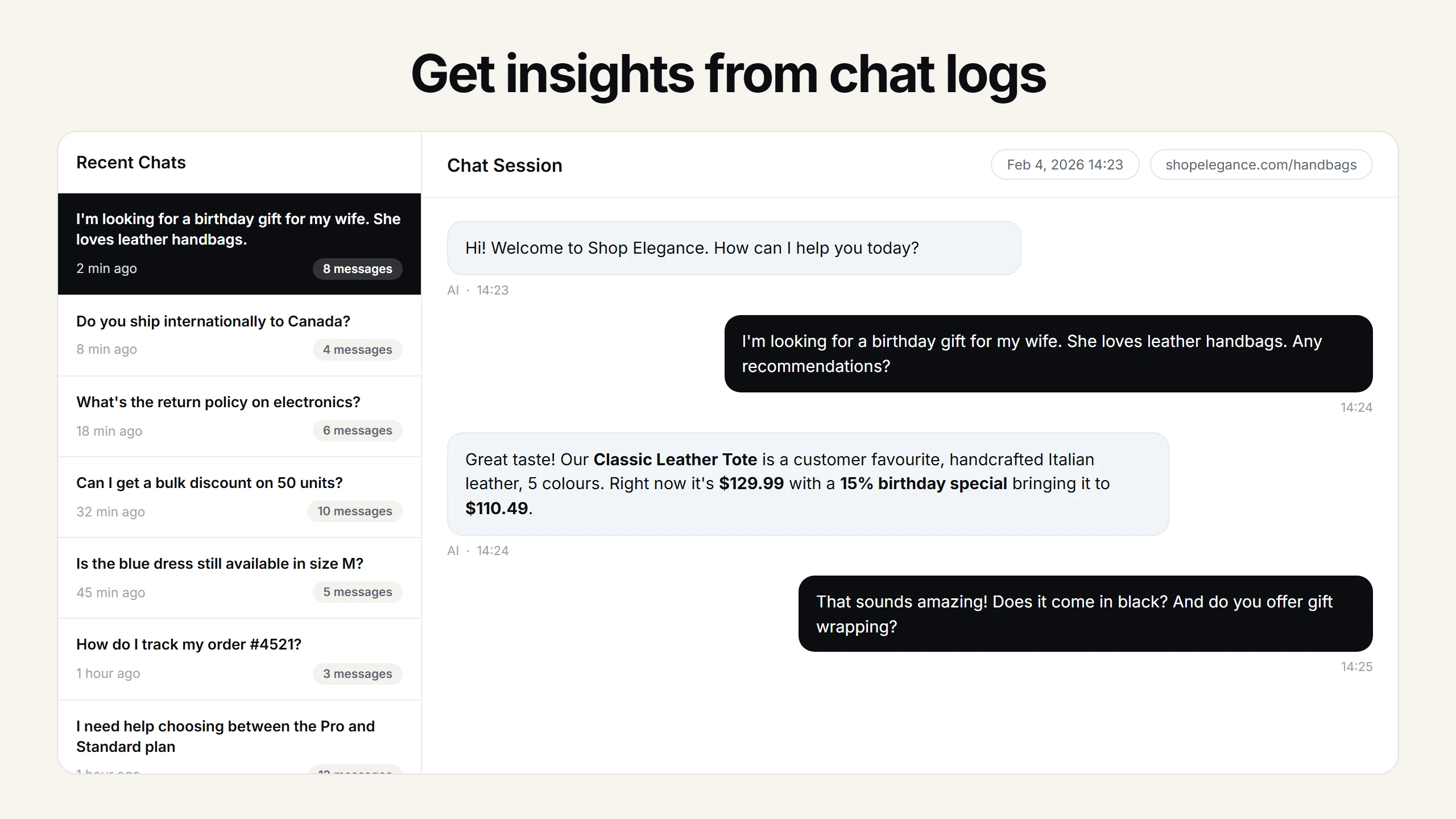
The analytics layer surfaces patterns that would otherwise take weeks to notice. Every conversation is logged and categorized: which questions are asked most often, which Custom Tools are invoked most frequently, which topics produce unresolved threads, which pages generate the most chat traffic. After a month of operation, this data doubles as a product-feedback mechanism. If thirty visitors asked about a feature your documentation does not cover, you know what to write next. If the returns tool fires eighty times a week while the booking tool fires twice, you know where the agent is delivering the most operational value. Traditional analytics platforms measure clicks and page views; an AI agent measures what your customers actually needed and whether they got it.
The cost comparison against custom development is stark enough to change the decision calculus for most organizations. A custom AI agent project — retrieval pipeline, tool-calling framework, hosting, monitoring, maintenance — runs six figures over a six-month timeline for a competent team, with ongoing engineering costs after launch. Asyntai's Standard plan, which includes Custom Tools, is a hundred and thirty-nine dollars a month. The Pro plan, with automatic white-labeling and twenty site slots, is four hundred and forty-nine. The free tier covers 50 messages on a single site for teams that want to validate the concept before investing. There is a genuine tradeoff: a custom build can do literally anything, while Asyntai's agent operates within the scope of your website content and HTTP endpoints. But for the vast majority of businesses — the ones whose agents need to answer questions, look up data, and perform standard operations — the managed platform delivers ninety percent of the capability at a fraction of a percent of the cost.
The question that used to gate AI agent adoption — "can we afford the development?" — has been replaced by a different and more productive question: "what should the agent do first?" Start with the knowledge layer and see how the agent handles your visitor questions out of the box. Add Custom Tools when you are ready to move from answering to acting. Define behavioral rules as you learn which boundaries matter. The infrastructure is running. The retrieval layer is built. The tool-calling plumbing is in place. What remains is your content, your endpoints, and ten minutes in a dashboard. Start with the free plan and build from there, or compare all tiers to find the right starting point for your agent.