The AI agent chatbot — answers like a chatbot, acts like an agent
Asyntai is the chat widget that crosses the line between chatbot and agent. It learns your content and answers FAQs in 36 languages like a chatbot — then calls your APIs through Custom Tools to look up orders, check availability, and take real action like an agent. One widget, both capabilities, no code required.
Watch the AI agent chatbot handle real questions
Enter your website URL and see how the chatbot answers from your content — and how the agent takes action when questions need live data
Learns your content and answers questions like an expert
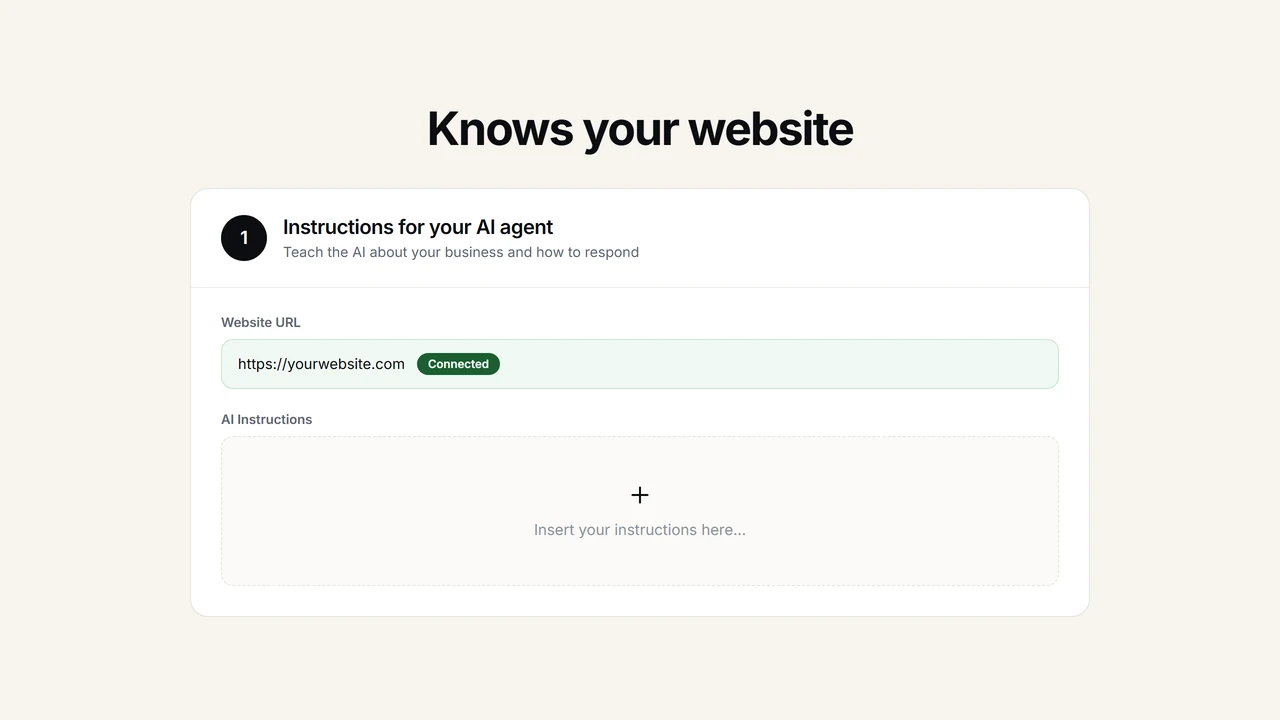
The chatbot half of an AI agent chatbot handles everything your knowledge base covers. Asyntai crawls your website, reads your help docs, product pages, and policies, then answers visitor questions using that content — accurately, instantly, in 36 languages. No scripted flows. No keyword matching. The AI understands the question and finds the right answer from your own material.
- Answers using your content, not generic responsesThe AI crawls your site and builds a knowledge base from your actual pages — product descriptions, FAQs, shipping policies, help articles. When a visitor asks a question, the answer comes from your content, not from a template.
- 36 languages without translation workA visitor in Tokyo asks in Japanese, the chatbot answers in Japanese — using content you wrote in English. The AI handles translation automatically across 36 supported languages. One knowledge base serves a global audience.
- Understands intent, not just keywords"How long until my package arrives?", "What's the delivery time?", and "When will I get my stuff?" all get the same accurate answer from your shipping policy. The AI reasons about meaning, not string matching.
Calls your APIs and takes action mid-conversation
The agent half is what makes an AI agent chatbot fundamentally different from a traditional chatbot. Through Custom Tools, Asyntai calls your own API endpoints during a conversation — order lookups, inventory checks, lead qualification, appointment booking — and uses live data to resolve requests instead of deflecting them.
- Custom Tools turn chat into actionDefine a tool in your dashboard with a name, description, and API endpoint. When a visitor's question matches, the AI extracts the relevant data from the conversation and calls your endpoint — returning real results, not canned responses.
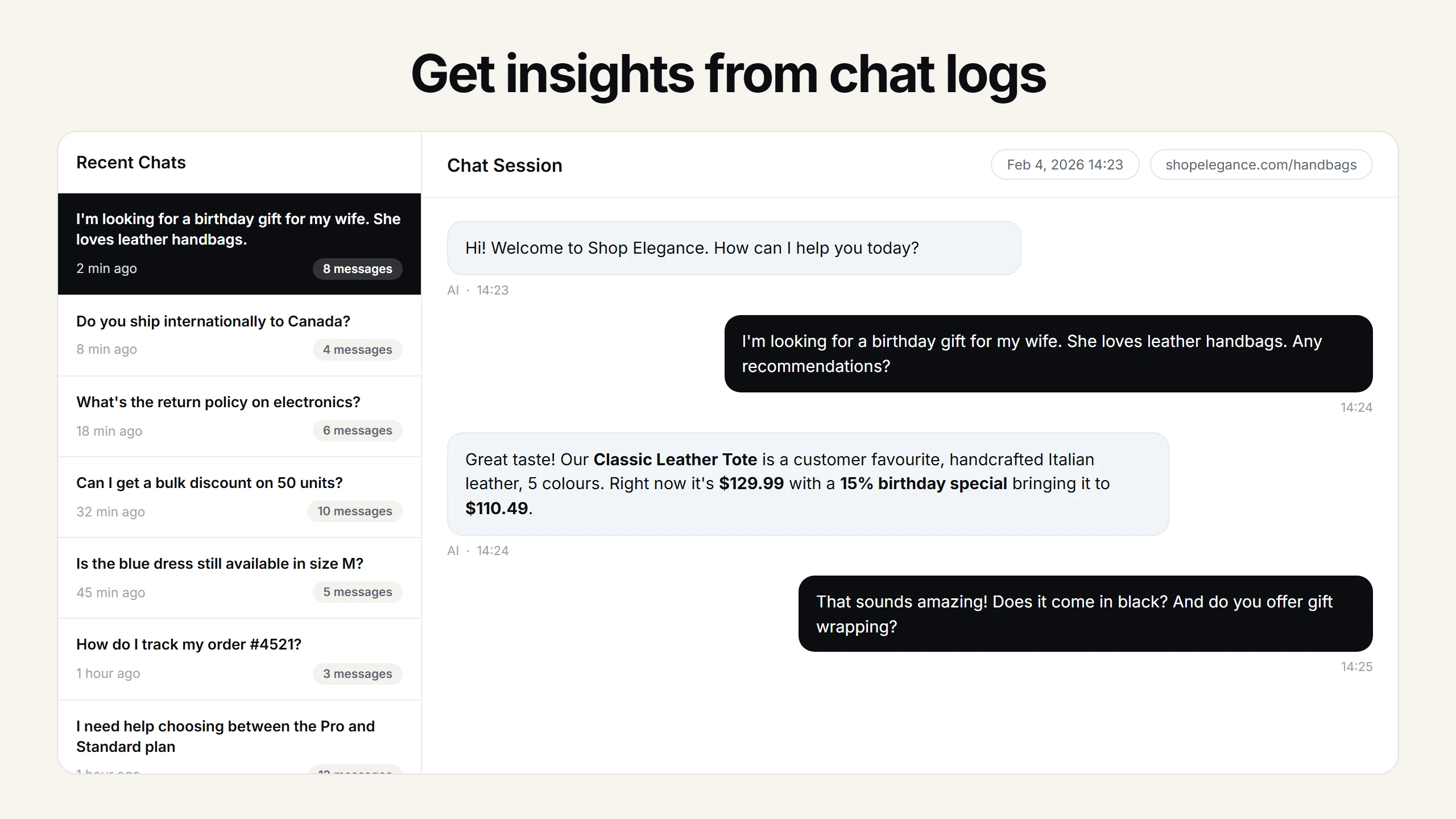
- Live data in every answerInstead of "check your account for order status," the agent says "Your order #4821 shipped yesterday via DHL, arriving Thursday." Real tracking numbers. Real inventory counts. Real account balances. Data from your systems, delivered through chat.
- Both sides work together in one replyA visitor asks about returning an item. The agent calls your order lookup tool for the purchase date, pulls your return policy from the knowledge base, and combines both: "Your order is 11 days old and your return window is 30 days — you're eligible. Here's how to start."
Set up your AI agent chatbot in minutes
One script tag gives you the chatbot. A few dashboard forms give you the agent. No SDK, no middleware, no deployment pipeline. If your systems already have API endpoints, the agent side connects to them through your browser.
- Add the Asyntai snippet to your site and let the AI crawl your content — the chatbot side is live immediately.
- Open Custom Tools in your dashboard to add the agent side — name each tool, describe when the AI should use it, and paste your endpoint URL.
- Define parameters like
order_idoremailso the AI knows what to extract from the conversation and send to your API. - Test it live — ask your bot a question that triggers the tool and watch it call your endpoint and answer with real data.
<script src="https://asyntai.com/widget.js"
data-id="your-site-id" async>
</script>
</head>
# Chatbot + agent. One snippet.
AI agent chatbot — FAQs
Common questions from teams evaluating AI agent chatbots — what they do, how they differ from traditional chatbots, and what it takes to set one up.
What is an AI agent chatbot?
An AI agent chatbot combines two capabilities in one widget. The chatbot side answers questions from your knowledge base — FAQs, product info, policies, help docs. The agent side calls your APIs through Custom Tools to take real action — looking up orders, checking inventory, qualifying leads, retrieving account details. Traditional chatbots can only do the first part. An AI agent chatbot does both.
How is this different from a regular AI chatbot?
A regular AI chatbot reads your content and answers questions about it. That works for static information — return policies, business hours, feature explanations. But the moment a visitor needs something specific — "where is my order?" or "is this item in stock?" — a regular chatbot can't help. An AI agent chatbot calls your systems to get the answer. The difference is the ability to act, not just respond.
Do I need technical skills to set up the agent features?
The chatbot side requires zero technical skills — add the script tag, let it crawl your site, done. The agent side requires that your systems have API endpoints the AI can call. If those endpoints already exist (most ecommerce platforms, CRMs, and booking systems have them), connecting them is a dashboard form: name, description, URL, parameters. No code to write on Asyntai's side.
Can I start with just the chatbot and add agent features later?
Yes, and many teams do exactly that. Deploy the widget, let it learn your content, and handle FAQ traffic immediately. When you're ready to add action capabilities, open Custom Tools in your dashboard and connect your first endpoint. The chatbot and agent sides are additive — adding tools doesn't change how the knowledge base works.
What kinds of actions can the agent take?
Anything your API supports. Common examples include looking up order status, checking product availability, retrieving subscription details, fetching appointment slots, verifying warranty eligibility, calculating shipping costs, and qualifying leads by collecting structured data. If your system has a REST endpoint that accepts parameters and returns data, the agent can call it.
How does the AI decide whether to answer from the knowledge base or call a tool?
Each Custom Tool has a plain-English description — for example, "Check order status. Use this when a visitor provides an order number." The AI reads the visitor's message and matches intent to the right tool. If the question is about static information — "what's your return policy?" — it answers from the knowledge base. If it needs live data — "where is order #5521?" — it calls the tool. No decision trees or rules to configure.
Does the chatbot work in multiple languages even when calling tools?
Yes. A visitor can ask in Spanish, the AI extracts the relevant data (like an order number), calls your English API endpoint, receives the response, and composes the answer in Spanish. The translation layer handles the conversation; the tool layer handles the data. One API endpoint serves visitors in all 36 supported languages.
Which plans include the agent (Custom Tools) features?
Custom Tools are available on Standard and Pro plans. Free and Starter plans include the full chatbot with knowledge base answers, multilingual support, and human handoff — everything except tool calling. You can start on any plan and upgrade to Standard when you're ready for agent capabilities.
From chatbot to agent — why the best AI chat widget does both
There's a reason the term "AI agent chatbot" exists as its own search query. People aren't looking for a chatbot. They aren't looking for an AI agent platform. They're looking for the specific thing that sits in between — a chat widget that can answer questions from a knowledge base the way chatbots do, and also call APIs and take action the way agents do. It's a real category now, born from the frustration of deploying a chatbot that handles half the conversation and punts on the rest.
The frustration is predictable once you understand what traditional chatbots actually do. You install a widget. You feed it your website content — FAQ pages, product descriptions, shipping policies, help articles. The AI reads all of it, and when a visitor asks "what's your return policy?" or "do you offer free shipping?" or "what sizes does this come in?", the chatbot pulls the answer from your content and delivers it clearly. This works. It works well, actually. For static information — anything that lives on a page and doesn't change based on who's asking — a knowledge-base chatbot is fast, accurate, and available around the clock. It handles the repetitive questions your support team answers fifty times a day, in 36 languages, without breaking a sweat.
The problem arrives about three conversations in. A visitor asks "where is my order #7823?" and the chatbot doesn't know. It can't know. The answer isn't on your website — it's in your order management system. The chatbot says something like "you can check your order status by logging into your account" or "I'll connect you with a team member who can help." The visitor came to chat specifically to avoid logging into an account or waiting for a human. The chatbot failed the one test that mattered: resolving the question the visitor actually had.
Multiply this across every question that requires live, specific data. "Is the navy version in stock?" — can't check inventory. "What plan am I on?" — can't look up the account. "Can I reschedule my appointment to Friday?" — can't access the booking system. "How many API calls do I have left this month?" — can't query usage metrics. These aren't edge cases. In most businesses, questions that require real-time data from backend systems account for 40-60% of total support volume. A chatbot that only reads your knowledge base is, at best, handling half the workload. The other half still needs humans.
This is precisely where the "agent" part of an AI agent chatbot comes in. An agent doesn't just retrieve stored information — it takes action. In Asyntai, that capability is delivered through Custom Tools. You define a tool by giving it a name, a plain-English description of when the AI should use it, your API endpoint URL, and the parameters it needs. When a visitor asks a question that matches the tool's description, the AI extracts the relevant values from the conversation — an order number, a product name, an email address — and calls your endpoint. Your system returns data. The AI reads it and composes a natural-language response. The entire cycle — understanding the question, calling the API, interpreting the result, delivering the answer — happens in seconds, inside the same chat window.
The practical difference is immediately visible in conversations. Without the agent side: "Where is my order?" becomes "Please check your account or contact our team." With the agent side: "Your order #7823 shipped via UPS on June 16th, tracking number 1Z999AA10456789012. It's in transit and expected to arrive by Friday." Without: "Is the navy jacket available in large?" becomes "You can check product availability on our store page." With: "Yes, the Navigator Jacket in Navy / Large is in stock — 7 units available. It ships within 1-2 business days." Without: "I need to cancel my appointment." becomes "Please call our office to reschedule." With: "I've cancelled your June 24th appointment. Would you like me to look up available slots for a new date?"
What makes Asyntai's approach work is that both sides — chatbot and agent — operate inside the same AI brain and the same conversation. The AI doesn't switch modes. It doesn't route you to a "tool-calling module." It reasons about the visitor's question and decides what it needs: stored knowledge, live data, or both. A visitor might ask "can I return the jacket from order #4190?" — the agent calls the order lookup tool to get the purchase date, pulls the return policy from the crawled knowledge base, and synthesizes both into one answer: "Your order was placed 9 days ago, and your return window is 30 days. You're eligible for a full refund. Here's how to start the process." That seamless blend of static knowledge and live data is the defining characteristic of an AI agent chatbot.
The chatbot side deserves more credit than it usually gets in the "agent" conversation. Knowledge base answers aren't the boring part — they're the foundation. Before you can look up an order, you need to answer "what's your return policy?" and "do you ship internationally?" and "what payment methods do you accept?" and "how do I reset my password?" These high-frequency questions make up a huge share of chat volume, and answering them well — from your own content, in the visitor's language, instantly — is what keeps visitors in the chat long enough to ask the action-oriented questions the agent handles. A widget that can call APIs but can't answer basic questions from your help docs is an API client with a chat UI. An AI agent chatbot does both because both matter.
The 36-language capability extends across both sides of the widget equally. The chatbot answers in whatever language the visitor writes in, translating from your English knowledge base on the fly. The agent side works the same way: a visitor asks in Korean, the AI extracts the order number, calls your English API endpoint, receives the response, and answers in Korean. Your API doesn't need to support multiple languages. Your knowledge base doesn't need to be translated. The AI handles the language layer while the tools handle the data layer and the knowledge base handles the content layer. Three layers, one widget, any language.
Setting up an AI agent chatbot with Asyntai follows a two-phase pattern that mirrors the chatbot-agent split. Phase one is the chatbot: add the script tag to your site, let the AI crawl your pages, and you have a working knowledge-base chatbot in minutes. It handles FAQ traffic immediately. Phase two is the agent: open Custom Tools in your dashboard and connect your API endpoints. Name each tool. Write a plain-English description of when the AI should call it — "Look up order status when a customer provides an order number." Paste the endpoint URL. Define parameters like order_number or email. Add an auth header if the endpoint requires one. Save. Ask the chatbot a question that triggers the tool. Watch it call your API and answer with real data. Most teams complete phase two in under fifteen minutes per tool.
The parameter extraction is worth understanding because it's where the "intelligence" in an AI agent chatbot becomes tangible. When you define a Custom Tool with a parameter called order_number and describe it as "the customer's order number, usually formatted as a number or alphanumeric code," the AI does the extraction work. A visitor might say "I placed order 7823 last week and haven't received it" — the AI identifies "7823" as the order number, passes it to your endpoint, and responds with the tracking details. Another visitor might say "my order number is ORD-2024-7823, can you check it?" — the AI extracts "ORD-2024-7823" instead. You don't write regex patterns or define extraction rules. The AI reasons about the conversation and pulls the right values.
Scaling the agent side means adding more tools, not more complexity. An ecommerce store might start with order status, then add inventory lookup, return eligibility, and shipping rate calculation. A SaaS company might connect subscription status, usage metrics, billing history, and feature eligibility checks. A healthcare platform might add appointment availability, prescription refill status, and insurance verification. Each tool is independent — adding a new one doesn't affect existing ones, and the AI decides which to call based on the conversation context. Five tools or fifty tools, the visitor experiences the same seamless chat.
The boundary between autonomous resolution and human escalation is yours to draw, and it applies to both sides of the AI agent chatbot. On the chatbot side, you can instruct the AI to escalate when a question isn't covered by your knowledge base — "if you don't have information about enterprise pricing, collect the visitor's email and escalate." On the agent side, you can set limits on what actions the AI takes — "look up orders, but never process refunds over $100 without human approval." These instructions are written in plain English as custom rules, and the AI follows them across every conversation. You get full automation where it's safe and human oversight where you need it.
The operational intelligence from an AI agent chatbot is richer than what a chatbot alone provides. Knowledge base analytics tell you what visitors are asking. Tool call analytics tell you what visitors are trying to do. When 300 visitors this month triggered the order status tool, you know your order confirmation emails need work. When inventory check calls spike for a specific product on Monday mornings, you know weekend marketing is driving demand you're not surfacing well on product pages. When lead qualification tools collect 50 visitor emails in a week, you know your pricing page needs a clearer CTA. The agent side doesn't just resolve conversations — it generates structured data about visitor intent that static analytics can't capture.
The economic argument for an AI agent chatbot over a chatbot alone comes down to resolution rate. A knowledge-base chatbot typically resolves 40-50% of incoming conversations — the rest need a human because the visitor needs specific data the chatbot can't access. Adding the agent side pushes resolution to 70-85% because it handles the data-dependent questions that drive the majority of support tickets: order status, inventory availability, account details, booking confirmations. Each additional tool you connect captures another slice of volume that would otherwise require a human agent. At Asyntai's pricing, the cost per resolved conversation is a fraction of a cent — compared to $5-15 per ticket for a human agent.
User Context adds a third dimension to the AI agent chatbot when the visitor is logged in. You push known data about the visitor — name, email, account tier, recent purchases — into the widget before the conversation starts. The chatbot side uses this context to personalize answers: "As a Pro plan member, you have access to priority support." The agent side uses it to pre-fill parameters: when a logged-in visitor asks about their last order, the AI already knows their email and can query your system without asking for it. Context makes the chatbot smarter. Tools make it capable. Together, they make the widget feel less like software and more like a knowledgeable colleague who has access to all the right systems.
The trajectory of customer expectations explains why the AI agent chatbot category is growing. Five years ago, visitors were impressed by a chatbot that could answer FAQ questions without a human. Today, that's table stakes. Visitors expect the chat widget to actually do things — check their order, verify their appointment, tell them if something is in stock. They don't distinguish between "chatbot features" and "agent features" in their heads. They just ask a question and expect an answer. An AI agent chatbot meets that expectation by bringing both capabilities into the same widget, the same conversation, the same experience. The visitor doesn't know or care that one answer came from a crawled help page and another came from an API call to your order management system. They just got their question answered.
Choosing an AI agent chatbot is a decision to stop drawing an artificial line between "questions we can automate" and "questions that need a human." The chatbot side automates knowledge. The agent side automates action. Together, they cover the vast majority of what visitors actually want when they open a chat widget: answers and outcomes. Asyntai puts both in one embeddable script tag — crawl your content, connect your APIs, and deploy a widget that handles the full spectrum of visitor needs without routing half of them to a queue. That's the chatbot-to-agent evolution, and it's already here.