AI agent agency: what they build, what they cost, and the tools behind the agents
An AI agent agency designs, deploys, and maintains autonomous AI systems for businesses — agents that handle inbound conversations, qualify leads, schedule meetings, research prospects, and take actions across multiple software tools. This guide explains what an agent engagement actually involves, where the budget goes, when an agency is the right call, and which capabilities you can deploy yourself with the same SaaS tools the agencies build on — starting with the conversational AI agent we offer directly.
See a conversational AI agent built without an agency in real time
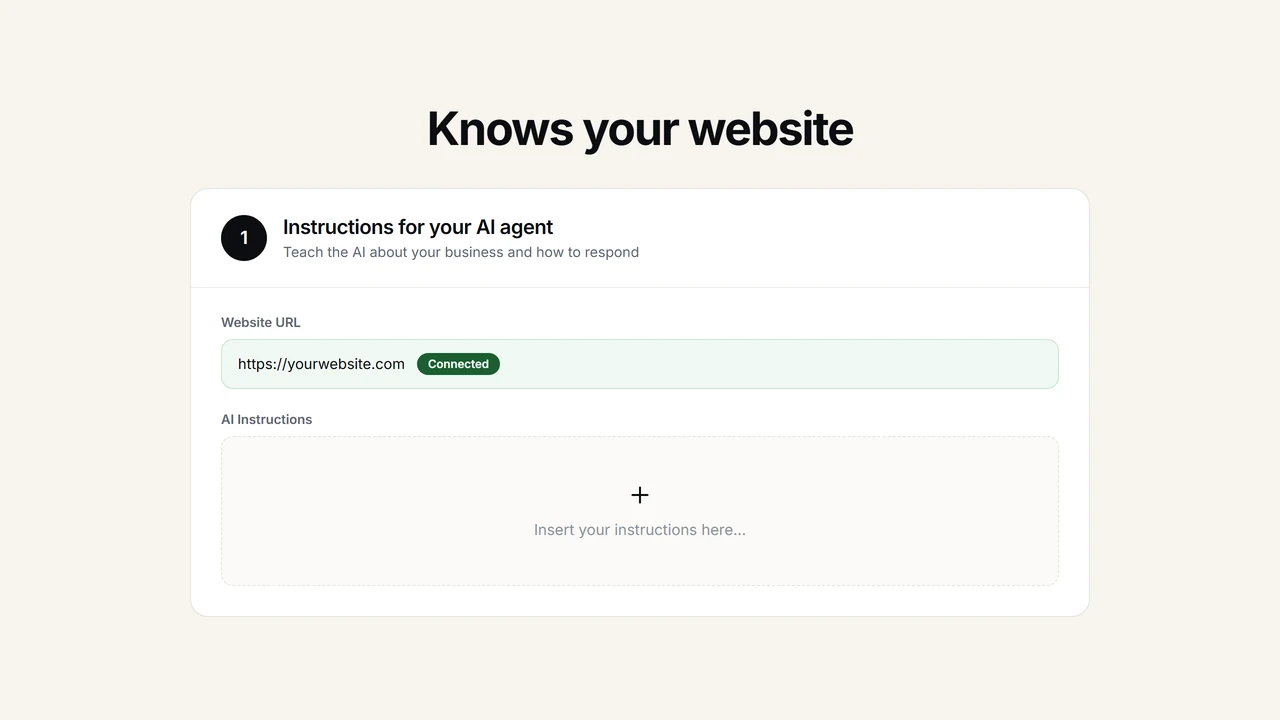
Paste your URL and watch the AI absorb your content. No discovery workshop, no agent-orchestration code, no agency markup
What an AI agent agency actually delivers — and where the budget goes
AI agent agency engagements range from $5,000 single-agent builds to $150,000+ multi-agent enterprise deployments. The deliverable is an orchestrated set of AI agents — typically built on top of LLM APIs like OpenAI Assistants or Anthropic's Claude, agent frameworks like LangChain, AutoGen, or CrewAI, and integration platforms like Make.com or n8n that connect the agents to business systems. The agency provides design, configuration, evaluation, and ongoing tuning. They do not build the underlying AI capability.
- Use-case scoping and agent designAgencies start by mapping which processes are agent candidates, what tools the agents will need to call, and what guardrails they must operate within. This phase typically runs 1-3 weeks and is more involved than chatbot scoping because agents take real actions.
- Orchestration and integration buildThe agency wires the LLM, the agent framework, and the downstream tools together. This includes prompt engineering, function-calling schemas, retry logic, and guardrails that prevent agents from taking destructive actions outside their authorized scope.
- Evaluation and ongoing maintenanceUnlike chatbots, agent systems require continuous evaluation — failure modes are subtler because agents can complete tasks incorrectly without obvious errors. Most engagements include a monthly retainer for monitoring agent decisions, refining prompts, and adapting to upstream API changes.
When an AI agent agency is worth the cost — and when a tool subscription is enough
Hiring an AI agent agency makes sense for organizations with multi-step processes spanning several systems, regulated industries requiring careful agent behavior boundaries, or operations teams without engineering capacity to build and evaluate agent flows. For many businesses — particularly those whose immediate need is a customer-facing conversational agent on a website — a direct subscription to a chatbot platform like Asyntai delivers the same outcome at a fraction of the cost and timeline.
- Hire an agency when agent autonomy is the valueIf the goal is an agent that pulls data from your CRM, drafts a personalized message, books a meeting, and updates the deal record — all without human review — the agency's design and evaluation labor is worth the investment.
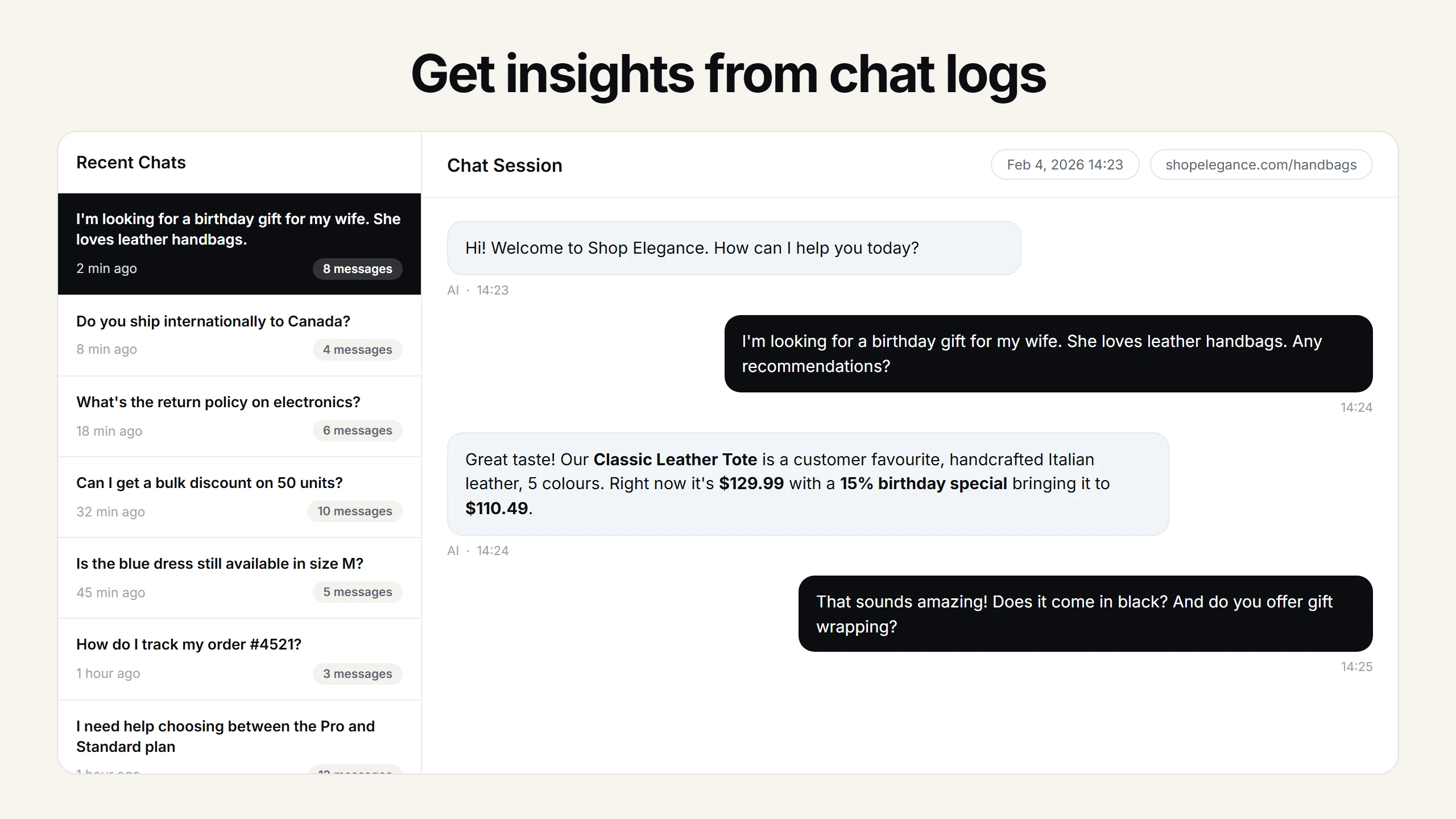
- Use a chatbot platform when conversation is the valueIf the goal is an AI that answers visitor questions on your website, captures leads, and escalates the rest to your team, that is a chatbot use case — Asyntai handles it directly without agent-orchestration complexity.
- Be cautious of agent lock-inCustom-built agents living in the agency's accounts on LLM APIs and orchestration platforms disappear when the engagement ends. Insist on platform subscriptions in your own name, or start with a SaaS tool you already control.
Skip the orchestration build — deploy a conversational agent in minutes
A custom AI agent build through an agency typically runs 6-20 weeks from kickoff to production deployment, with months of ongoing evaluation work after launch. For the customer-facing conversational layer specifically, Asyntai compresses that timeline into a single working session. Use it as the conversation entry point for your broader agent stack, or as the only AI tool you need if a smart chatbot is your immediate priority.
- Register a free Asyntai account and copy your widget snippet from the dashboard.
- Place the snippet in the header of your website — works on WordPress, Shopify, Webflow, or any platform.
- Provide your knowledge base URL and the AI crawls and trains itself within minutes.
- Author behavioral rules in plain English, test against your most common scenarios, and activate.
<script src="https://asyntai.com/widget.js"
data-id="your-site-id" async>
</script>
</head>
# Conversational agent now live. No orchestration code, no evaluation loop required.
AI agent agency — FAQs
The questions teams ask before deciding between hiring an AI agent agency and assembling the components themselves.
What's the difference between an AI agent and an AI chatbot?
A chatbot answers questions and holds conversations — its job is communication. An AI agent goes further: it takes actions in other software systems based on what the conversation reveals or what an internal trigger requires. An agent might read a CRM record, compose a personalized outreach message, send it through your email tool, watch for a reply, and update the CRM with the outcome — all without a human in the loop. Chatbots are conversational interfaces; agents are autonomous workers that may or may not include a chat interface. Many real-world deployments combine the two: a chatbot at the entry point, with agentic behavior behind the scenes for fulfillment.
What does an AI agent agency typically cost?
Pricing varies sharply with agent complexity. A single conversational agent for one use case — for example, an inbound lead qualifier or a meeting scheduler — typically costs $5,000 to $20,000 to build, plus $1,000 to $3,500 per month in retainers for evaluation and tuning. Multi-agent systems coordinating several roles across departments run $30,000 to $80,000 upfront with retainers in the $3,000 to $10,000 range. Enterprise rollouts requiring custom evaluation harnesses, compliance review, and integration with proprietary internal systems can exceed $150,000 for the initial build. The premium over basic chatbot agency pricing reflects the added complexity of evaluating autonomous behavior.
Are AI agent agencies and AI automation agencies the same thing?
They overlap heavily but emphasize different ends of the spectrum. AI automation agencies focus on workflow automation augmented by AI — triggers, conditions, AI-assisted decisions wired into multi-system flows. AI agent agencies focus on autonomous AI that decides what to do next without an explicit workflow defining each step. The boundary is blurry because modern automation tools increasingly include agentic capabilities, and agent frameworks increasingly include workflow orchestration. When evaluating which type to hire, scope your need: deterministic flows favor automation agencies, open-ended decision-making favors agent agencies, and most real engagements end up needing a bit of both.
What tools do AI agent agencies build with?
The typical agent stack includes a foundation model API from OpenAI, Anthropic, or Google for the actual reasoning; an agent framework such as LangChain, LangGraph, AutoGen, or CrewAI for orchestrating multi-step decision flows; a vector database like Pinecone or Weaviate for memory and retrieval; integration platforms like n8n, Make.com, or custom-coded API wrappers for connecting the agent to business systems; and a chatbot platform like Asyntai when the agent needs a conversational entry point on a website. Most components have free or low-cost tiers you can subscribe to directly. The agency's value-add is selecting which pieces to combine and engineering the agent's decision logic.
Can I run my own AI agent agency using Asyntai?
Yes — for the conversational interface portion of an AI agent agency offering. Asyntai operates a reseller program designed for agencies, freelancers, and consultancies that want to provide AI-powered chatbots and conversational agents to clients under their own brand. The reseller account provides separate billing for managing client subaccounts, white-label widget options that carry your agency's brand instead of ours, and the operational infrastructure to convert one-off projects into recurring revenue. Many AI agent agencies use Asyntai for the customer-facing conversation layer and pair it with custom-built backend agents for the autonomous task execution.
How long does an AI agent agency engagement take?
Calendar time for agent builds is meaningfully longer than for chatbots because of the evaluation overhead. A single-agent engagement typically runs 6 to 12 weeks from kickoff to production. Multi-agent systems run 12 to 20 weeks. Enterprise rollouts with compliance review and integration with proprietary systems can extend to 24 weeks or beyond. By contrast, deploying an individual SaaS tool — such as Asyntai for a conversational interface — takes minutes to hours. If your immediate priority is one component of a larger agent vision, direct deployment lets you start capturing value while you decide whether the broader engagement is worth pursuing.
Will I be locked into the agency's agent framework after the project ends?
Often yes, and the lock-in is more severe than with chatbot or automation engagements because agent code is custom — there is no off-the-shelf product the agency configured. When the engagement ends, you inherit a codebase that requires ongoing engineering capacity to maintain. The clean arrangements are: insist on platform subscriptions for component pieces in your own name, document the agent design thoroughly, and ensure the codebase is delivered in a form your team or a successor agency can reasonably take over. Direct SaaS subscriptions like Asyntai sidestep the question entirely for the components they cover — the account belongs to you from day one with no custom code to maintain.
Do I need an agent agency or can I deploy a conversational AI myself?
If your immediate need is a smart conversational AI on your website — answering visitor questions, capturing leads, escalating complex cases — you do not need an agent agency. Asyntai handles content ingestion, multilingual responses, behavioral rule authoring, and widget deployment without requiring custom agent code. If your need genuinely requires autonomous multi-step task execution — an AI that reads from systems, decides between actions, and writes back to systems without human review — an agent agency may add real value. Be honest about which case you actually have. Most "we need an AI agent" needs turn out to be "we need a smart chatbot" on closer inspection.
AI agent agency — the next layer above chatbot and automation services
The AI agent agency category emerged in 2024 as a refinement of the broader AI services market. Where AI chatbot agencies focused on conversational interfaces and AI automation agencies focused on workflow orchestration, AI agent agencies positioned themselves around a more ambitious deliverable: autonomous AI that takes actions across multiple software systems without explicit step-by-step instructions for each task. The technical foundation that made this category viable was the maturation of function-calling APIs from foundation model providers, alongside open-source frameworks like LangChain, LangGraph, AutoGen, and CrewAI that gave practitioners the orchestration primitives needed to build multi-step agent flows. The marketing language followed the technical capability, and "AI agent agency" became a recognizable service offering that buyers actively search for.
Understanding what an agent actually is matters because the term is used loosely across the industry. In the strictest engineering sense, an AI agent is a system that observes its environment, decides what action to take next, executes that action, observes the result, and repeats — without a human dictating each step. Practical agent implementations vary from this ideal. Some are tightly scoped single-step systems that resemble chatbots with tool-calling. Others are sprawling multi-agent orchestrations where specialized agents collaborate on complex tasks. The difference matters operationally because the engineering burden, the evaluation difficulty, and the failure modes all scale dramatically with agent autonomy. A single-step lead qualifier is a manageable build. A team of agents collaboratively researching, drafting, and dispatching outbound campaigns is closer to a software engineering project than a SaaS configuration exercise.
The typical agent stack assembled by an AI agent agency includes several distinct layers. At the foundation is the LLM API — usually OpenAI's GPT-4 family, Anthropic's Claude, or Google's Gemini — that provides the reasoning capability. Above that sits an agent framework like LangChain, LangGraph, AutoGen, or CrewAI that handles the orchestration patterns: how decisions chain, how tool results feed back into the agent's context, how multi-agent collaboration is structured. A vector database such as Pinecone, Weaviate, or pgvector provides long-term memory and document retrieval. Integration libraries connect the agent to business systems via APIs. A chatbot platform like Asyntai often serves as the customer-facing entry point if the agent's flow includes user conversation. The agency's role is selecting these components and engineering the glue between them — not building the components themselves.
Decomposing an agent agency engagement reveals where the budget actually goes. The first phase is use-case scoping, which is more involved than chatbot scoping because the agency must determine what real-world actions the agent will take, what authorization boundaries it must respect, and what failure modes are acceptable. This phase typically consumes one to three weeks. The second phase is agent design — defining the decision flow, the tool schemas the agent can call, the prompts that govern its behavior, and the retry and fallback logic. The third phase is integration, which includes building or configuring the connections between the agent framework and the downstream business systems the agent acts on. The fourth phase is evaluation, which is the part most distinct from chatbot engagements. Agent failures are subtler than chatbot failures because an agent can complete a task incorrectly without producing an obvious error message. Building an evaluation harness that detects silent failures consumes significant engineering time and continues throughout the engagement.
For some organizations, the autonomy an agent provides justifies the agency's fees decisively. A B2B sales operation that wants AI to research prospects, draft personalized outreach, send it, monitor responses, and update the CRM with outcomes is a genuine agent use case where the autonomous decision-making between steps is the value. A customer service operation that wants AI to read the support ticket, look up the customer's account history, attempt a resolution by taking actions in the product, and only escalate when the resolution fails is another genuine agent use case. In both examples, deterministic workflow tools are insufficient because the right next action depends on the result of the previous action in ways that cannot be hardcoded.
For many other organizations, the agent framing oversells the actual need. A business that wants an AI to answer visitor questions on its website, capture leads when visitors express interest, and escalate complex cases to human staff is describing a chatbot, not an agent — even though the chatbot performs multiple functions. The conversational interface alone, equipped with content training and escalation rules, handles this case completely. Calling it an "agent" engagement adds engineering complexity, evaluation overhead, and cost without adding capability. Be honest about what your use case actually requires. The agent label has marketing momentum in 2024 and 2025, but most "we need an agent" conversations resolve into "we need a smart chatbot" on closer technical inspection.
The implementation timeline for true agent builds is meaningfully longer than chatbot or automation engagements. A single-agent build typically runs six to twelve weeks. Multi-agent systems run twelve to twenty weeks. Enterprise rollouts requiring custom evaluation harnesses, compliance review, and integration with proprietary internal systems extend to twenty-four weeks or beyond. The extension over chatbot timelines reflects the evaluation overhead — each iteration on agent behavior requires running scenarios, comparing actual versus desired outcomes, and tuning prompts and orchestration logic accordingly. By contrast, deploying a chatbot through Asyntai compresses to a single working session because the conversational use case does not carry the same autonomous-action evaluation burden.
Lock-in risk is the second cost most agent buyers underestimate, and it is more severe than with chatbot or automation engagements. Chatbot engagements at least live on a SaaS platform you can take over operating yourself if you bring the account into your own name. Agent engagements typically produce custom code — the orchestration logic, the prompt library, the evaluation harness, the integration layer — that requires ongoing engineering capacity to maintain. When the agency engagement ends, you inherit a codebase along with the operational responsibility for keeping it functional as upstream LLM APIs, agent frameworks, and business system APIs all evolve. The clean arrangements are to insist on platform subscriptions in your own name where SaaS components exist, demand thorough documentation of the custom code, and budget for ongoing engineering capacity to maintain what the agency built.
For organizations weighing the decision, the cleanest framework is to separate two questions: do you actually need autonomous multi-step task execution, and is the value of that autonomy worth the engineering investment? The first question requires honesty. If your need is a conversational interface, even a sophisticated one with multilingual support and escalation logic, that is a chatbot use case where direct platform subscription works. If your need is genuinely an autonomous worker that takes real actions across systems, the second question becomes relevant. Often the value of autonomy is real but small — the same outcome could be achieved with a workflow tool plus a human review step at lower cost than full agent autonomy. Be honest about whether removing the human review step justifies the additional engineering investment. For many use cases, it does not.
For agencies practicing in this space, Asyntai operates a reseller program suited to the conversational layer of agent stacks. The reseller arrangement provides separate billing for managing client subaccounts, white-label widget options that carry your agency's brand instead of ours, and the operational infrastructure to convert one-off conversational deployments into recurring revenue. Agencies running this model use Asyntai as the front-end interface where end users interact with the agent system, while the back-end agent orchestration runs on whatever framework the agency selected. The chatbot becomes a productized component of the agency's stack, freeing the agency's billable hours for the harder engineering work of agent design and evaluation.
Pricing for direct subscription to the conversational layer reflects the absence of the agency markup. Asyntai's free tier includes 50 messages per month on a single site, sufficient for proof-of-concept validation. Paid plans begin at $39 per month for 800 messages across two sites, suitable for most small and mid-sized businesses deploying conversational AI on their websites. Higher tiers extend to 15,000 and 50,000 messages monthly with multi-site coverage scaling up to twenty properties. Compared to a typical agent agency engagement of $15,000 upfront plus $2,500 monthly retainers, the direct subscription is one to two orders of magnitude less expensive for the conversational component. The agent agency engagement makes sense when autonomous multi-step task execution is genuinely required and the engineering complexity of evaluation justifies the cost. The direct subscription makes sense when the use case is conversational and bounded. For most chatbot-shaped needs, the second case is the honest answer regardless of how the requirement was originally framed.