A WordPress AI chatbot plugin with zero flows to build
Asyntai is the WordPress AI chatbot plugin for site owners tired of rule-based tools. It reads your pages and posts on its own, reasons about what visitors are really asking, and replies like a staff member who actually understands your business.
See the AI reply on your own WordPress site
Drop in your WordPress URL and watch the AI answer sample questions grounded in your real content — before you install anything
Actual AI reasoning, not pattern-matched replies
Classic WordPress chatbot plugins ask you to author every possible question and map it to a canned reply. The Asyntai WordPress AI chatbot plugin flips that: the underlying model reads your site, reasons about the visitor's intent, and composes a fresh answer on every turn. No intent lists. No decision trees. No "sorry, I didn't understand that."
- Composes replies on the flyEvery answer is generated from your actual content in the moment, so phrasing variations, typos, and unexpected angles on the same question all get a real response.
- Handles follow-ups in contextThe AI remembers earlier messages in the same conversation, so "how much is that one?" after a product question resolves to the right item without the visitor repeating themselves.
- Knows when to ask for clarificationIf a question is ambiguous — "the blue one or the large one?" — the AI asks a short clarifying question instead of guessing or dropping the thread.
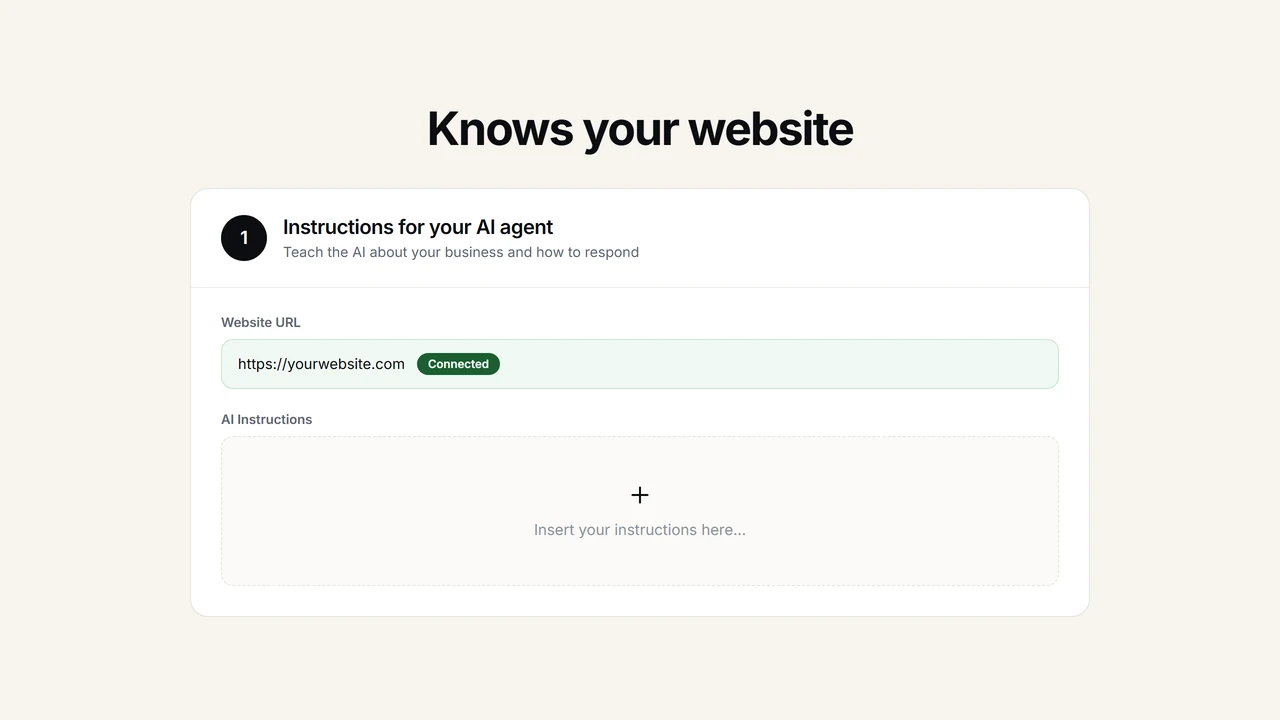
Point it at your WordPress site. Training ends there.
The one setup step that matters is connecting the plugin to your Asyntai account. From that moment the AI crawls every published URL — pages, posts, service descriptions, policy pages, WooCommerce product listings — and turns them into a retrievable knowledge layer. You don't tag intents, label utterances, or maintain an FAQ file on the side.
- Full-site crawl the moment you connectPublished pages and posts flow into the AI's retrieval index within minutes of OAuth completion. Nothing for you to upload by hand for public content.
- WooCommerce catalog via REST APIWhen WooCommerce is active, the WooCommerce AI chatbot pulls products, prices, images, and variants through the REST API so it quotes real numbers, not last month's scrape.
- Plain-English instructions override behavior"Always route enterprise questions to the booking page." "Never invent warranty terms." Type the rule in the dashboard and the AI respects it on every reply.
Install the AI plugin straight from your WordPress admin
The plugin ships as a ZIP distributed through your Asyntai dashboard. Upload, activate, click a single button, and the AI is trained and replying. The plugin targets WordPress 5.0+ on PHP 7.2+ and has been put through its paces up to the 6.9 release. Prefer no plugin at all? The same AI is also available as a JavaScript snippet.
- Create a free Asyntai account and grab
asyntai-chatbot.zipfrom the Install screen in your dashboard. - From WordPress admin, head to the standard Plugins screen, pick Add New, and then Upload Plugin. Select the ZIP and hit Install Now.
- Activate. An Asyntai entry lands in your admin menu with a single prominent button: Connect to Asyntai.
- Click it. A popup at
asyntai.com/wp-authcompletes the OAuth handshake, stores the site ID, and begins crawling — all automatically.
→ asyntai-chatbot.zip (drop in)
→ Activate plugin
→ Connect to Asyntai (OAuth popup)
# AI indexes your WordPress content.
# First intelligent reply ships in a few minutes.
WordPress AI chatbot plugin — FAQs
Questions people weighing an AI chatbot plugin for WordPress usually want answered up front.
How is this different from a regular chatbot plugin for WordPress?
A regular chatbot plugin leans on keyword triggers, intent libraries, or decision trees you build yourself. This AI chatbot plugin leans on a large language model that reads your site and generates answers on its own. You don't author the conversations; the AI does, grounded in whatever your WordPress pages already say.
Do I have to build dialog flows or train intents?
No. Flow builders and intent classifiers aren't part of the product. The AI reads your crawled content plus any documents you upload, and reasoning happens at reply time. If you want to shape tone or restrict behavior, you write plain-language instructions in the Asyntai dashboard — a paragraph, not a graph.
Where does the plugin come from — is it in the WordPress.org directory?
Not at the moment. Distribution is handled inside the Asyntai dashboard. After signup, the Install screen hands you the asyntai-chatbot.zip file, which uploads via the normal WordPress route: the Plugins section, then Add New, then Upload.
What are the technical requirements?
Anything from WordPress 5.0 upward, paired with PHP 7.2 or newer. Coverage has been verified against WordPress 6.9, and the plugin gets along with the usual production stack — caching layers, security hardening, and multisite networks.
Can the AI actually understand product questions on a WooCommerce site?
Yes. With WooCommerce active, Asyntai uses the WooCommerce REST API to sync your catalog directly. Product titles, descriptions, prices, images, and variants reach the AI, so shoppers can ask "is the 12oz one vegan?" and the AI answers from real product data rather than a best-guess crawl.
Does it recognize logged-in visitors?
If you're on a Standard or Pro subscription, your theme can populate window.Asyntai.userContext ahead of widget load with whatever the logged-in visitor's account already contains — display name, plan tier, membership state, recent orders. The AI uses that context so replies feel personal without any backend API plumbing.
Will the AI invent things that aren't on my site?
The AI is instructed to ground answers in your content and to decline when an answer isn't supported. You can tighten this further with rules like "never speculate on pricing" or "always link to the docs when explaining setup." Hallucination-style answers are the failure mode the system is explicitly designed against.
Does it play well with Elementor, Divi, and friends?
Yes. The widget renders as an overlay on top of whatever the page builder produced, so Elementor, Divi, WPBakery, Beaver Builder, Brizy, and Gutenberg all work without special handling. No template surgery needed.
How many WordPress sites can I run it on?
One on Free, two on Starter, three on Standard, up to ten on Pro. Within one Asyntai account, every connected site runs its own independently indexed AI — convenient for anyone managing a portfolio of brands or an agency's client roster.
What does it cost?
The free tier includes 50 AI messages a month. From there, the $39-per-month Starter plan unlocks 800 AI messages, with higher volumes handled by the tiers above. Email warnings reach you before the cap so a viral moment doesn't silently take the AI offline.
Why an AI chatbot plugin changes WordPress support completely
For most of chatbot history, "chatbot plugin for WordPress" meant a drag-and-drop flow editor. You'd open the plugin, stare at a canvas, and spend an afternoon wiring up branching conversations: if the visitor types "pricing," show the pricing reply; if they type "refund," show the refund reply; if they type anything you didn't predict, apologize and offer them a contact form. The product of all that effort was a brittle script. Visitors who phrased things differently, asked compound questions, or wandered off the rails got the same stock "I'm not sure how to help with that." An AI chatbot plugin is a fundamentally different tool, and it's worth understanding the distinction before installing one on a WordPress site.
The Asyntai plugin doesn't ship with a flow canvas because the plugin doesn't need one. A language model reads the crawled pages of your site at inference time and composes a reply in natural language. Whether the visitor asks "how much is the pro plan," "what does pro cost," or "is pro worth it over the starter one," the same underlying content answers all three — the AI doesn't need three separate branches, because it isn't branching. It's reading. That single architectural choice collapses what used to be an afternoon of scripting into a connect-and-go experience, and it shifts the nature of your ongoing work from conversation authoring to occasional rule tuning.
Training, too, looks nothing like the traditional intent-based plugin model. Older tools asked you to provide example utterances per intent — ten ways people might ask about refunds, another ten for shipping, another ten for hours — so the model could classify new messages against your labels. That process is slow, awkward, and usually skipped. The Asyntai WordPress AI chatbot plugin skips it by design. Once the OAuth handshake completes, a crawler walks your pages, posts, policy URLs, and WooCommerce products, and indexes them for retrieval. There's nothing to label. Nothing to classify. When a visitor asks a question, the AI retrieves the most relevant passages from that index and generates an answer grounded in them.
This flips the creative work in a good direction. Instead of worrying about whether you've covered enough phrasings, you can focus on the content itself — the services page, the FAQ post, the policy document. Every improvement to the underlying WordPress site silently upgrades the AI, because the AI reads whatever your site currently says. Rewrite your pricing page with clearer tier definitions and the chatbot starts quoting the new tiers the next time it re-crawls. Add a blog post on a common objection and the chatbot starts referencing it. The feedback loop between your content marketing and your on-site AI becomes direct in a way flow-based chatbots could never support.
Rules still exist, but they live in natural language. If you want the AI to behave a specific way — always offer a free consultation when pricing comes up, never promise discounts that aren't published, point larger prospects toward the case studies hub, refuse to answer questions about competitor products — you write those instructions in the Asyntai dashboard in plain English. The model treats them as high-priority guidance on every reply. There's no "condition block" UI to configure; it's a paragraph of intent, written once, applied globally. Teams that have spent years maintaining scripted flows usually find this uncomfortably fast at first, then mildly addictive.
Installation itself is where the plugin delivers on its "WordPress-native" promise. The distribution model is deliberate: the ZIP lives inside your Asyntai dashboard rather than in the WordPress.org directory, so you download it once per account and upload it through the familiar Plugins → Add New → Upload Plugin flow. Minimum requirements are WordPress 5.0 alongside PHP 7.2, with coverage verified through the 6.9 release. Activation surfaces a single menu item in your admin with one big button: Connect to Asyntai. Clicking it opens a popup at asyntai.com/wp-auth that completes the OAuth handshake, stores the site ID silently, and closes itself. At that point the AI begins indexing your content. No API keys, no copy-paste, no way to connect the wrong site.
The alternative to the plugin is the JavaScript snippet version of Asyntai, which some WordPress owners prefer. Both paths reach the same AI, the same knowledge base, and the same dashboard. Go with the plugin if you want the install to show up in your plugins list with everything else, if a handover to an agency is likely, if several collaborators take turns in the admin, or if the "upload, activate, configure" cadence just feels right to you. The snippet is the right pick when you'd rather not add another plugin entry to an already crowded list. Either way, the intelligence of the chatbot is identical.
Once the AI is live, the questions visitors ask look different from the ones a flow-based bot would have been scripted for. Instead of "pricing," you'll see things like "is the standard tier enough if we do about 1,500 customer questions a month" — a compound question that bakes in a usage estimate, a tier choice, and an implicit comparison. A scripted flow would have funneled this into a generic pricing reply; the AI chatbot plugin handles it by checking message allocations per tier, reasoning about the 1,500 number against them, and suggesting the right plan with a confident recommendation. That kind of reply is the entire point of using AI rather than a keyword matcher.
Follow-ups are where the difference gets most obvious. A visitor asks about a specific WooCommerce product. Two turns later they ask "and the shipping on that?" A keyword chatbot treats this as a new isolated question, pattern-matches it to a generic shipping reply, and fails the context. The Asyntai AI carries the product reference across turns — it knows "that" refers to the earlier product and pulls shipping terms filtered for it. Visitors rarely re-state what they just asked. Handling reference properly is a prerequisite for replacing a human conversation, and it's a capability that only AI-based plugins actually provide.
Multilingual behavior is handled the same way. Asyntai's widget interface ships localized into 36 languages, and the model infers the visitor's written language straight from the first message. A WordPress site that gets traffic from Germany, Brazil, and Japan on the same day sees the chatbot replying in German, Portuguese, and Japanese respectively, all from the same English-language site content. Translating your WordPress site content is not required; the model translates between the visitor's language and your content in both directions. Sites already running Polylang or WPML to manage their own translated pages keep that setup untouched — the AI runs in parallel and doesn't interfere with either plugin.
Lead capture fits naturally into a conversational AI in a way it never fit into flow-based chatbots. The AI can decide, based on the tenor of a conversation, that a prospect is ready to share contact details, and it can ask for them at the right moment rather than on a fixed step. Each lead lands in the Asyntai dashboard alongside its complete chat history, and flipping on email alerts mirrors that same thread into your inbox in real time. Every lead arrives with the context of what they were trying to figure out on your WordPress site, which is worth more to sales follow-up than an anonymous form submission with no question attached.
Recognizing signed-in users leans on a straightforward browser hook: prior to widget init, your theme or a tiny snippet fills window.Asyntai.userContext with whatever logged-in user data is appropriate — display name, membership tier, recent orders, account age. The AI treats this as signed-in context and adapts replies accordingly, without needing to call back into your WordPress database. A member asking "what's on my plan" gets a plan-specific answer. A returning WooCommerce customer asking about a recent order gets a reply that references the right order. All of this is standard on Standard and Pro plans and takes a handful of PHP lines to wire up.
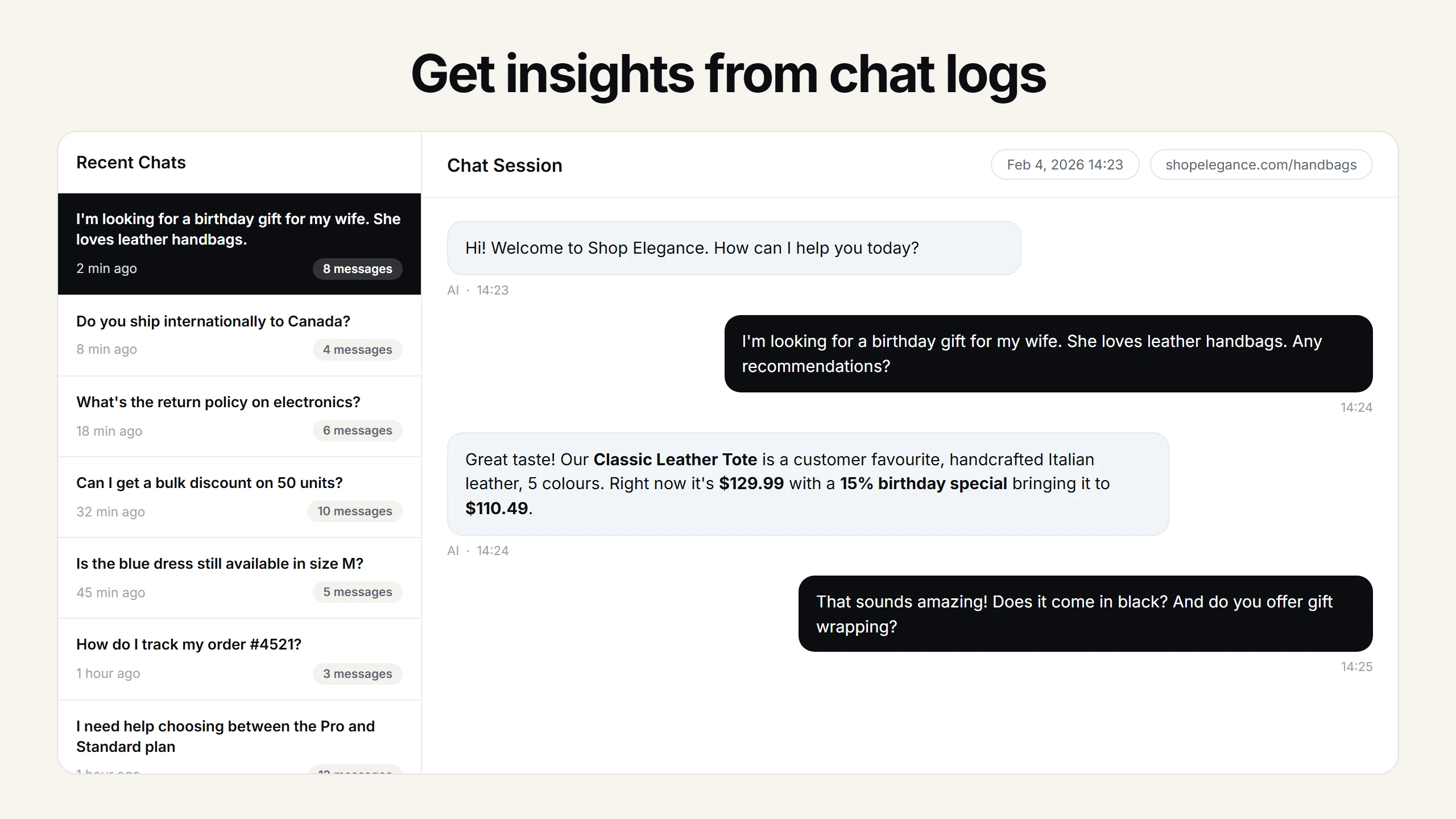
Analytics turn the chatbot into something more valuable than a deflection layer. The Asyntai dashboard logs every conversation, clusters repeated themes, and surfaces which WordPress pages generate the most chat traffic. After the first month, patterns become concrete: these are the three questions visitors ask before buying, these are the pages where they hesitate, these are the topics the AI keeps having to translate from your jargon into their vocabulary. That's a content roadmap. WordPress sites that take the AI seriously as a research tool, not just a support tool, end up with sharper pages, shorter sales cycles, and a measurable reduction in "I had a question but couldn't find the answer" exits.
Pricing stays simple. 50 AI messages a month on the free tier, 2,500 on the $39 Starter, more on Standard and Pro. Multi-site allowances scale with the plan — 1, 2, 3, and up to 10 — so agencies running the WordPress AI chatbot plugin on client sites can consolidate under a single account. Warning emails land before the cap, so surprise traffic from a breakout post doesn't catch the chatbot mid-shift. For a tool that provides always-on AI reasoning across your entire site, the math tends to favor the install.
The shortest way to describe the pitch: a WordPress AI chatbot plugin that skips the scripting, reads your real content, reasons like a junior staff member, and stays installed in the same plugins list as everything else you manage. Upload the ZIP, click Connect, and a few minutes later the model is answering visitor questions with the kind of fluency that used to require hiring a chat operator. For any WordPress site that sells, educates, or serves — and where an afternoon spent building flow diagrams feels like wasted time — this is the plugin that was supposed to exist all along.