A WordPress AI assistant that actually helps your visitors
Asyntai is a proactive WordPress AI assistant that recommends the right post, guides the right service inquiry, and remembers context across the session — so every visitor gets a librarian, not a pop-up.
See your own WordPress AI assistant in action
Drop in your WordPress URL and watch the assistant guide a sample visitor through your own content
Behaves like a concierge, not a contact form
An assistant is different from a reactive bot. Asyntai surfaces related posts while the reader is still reading, offers the relevant service when a prospect hovers near pricing, and carries what was already said into the next question. The WordPress AI assistant is trying to move the visitor forward, not simply wait for a ping.
- Conversational discovery across your contentReaders type what they actually want — "a guide for beginners" or "the one about pricing mistakes" — and the assistant surfaces the post, not a search result page.
- Session memory that survives page changesIf a visitor mentioned they're shopping for a team of five, that context carries to the next question about pricing, onboarding, or migration without them repeating it.
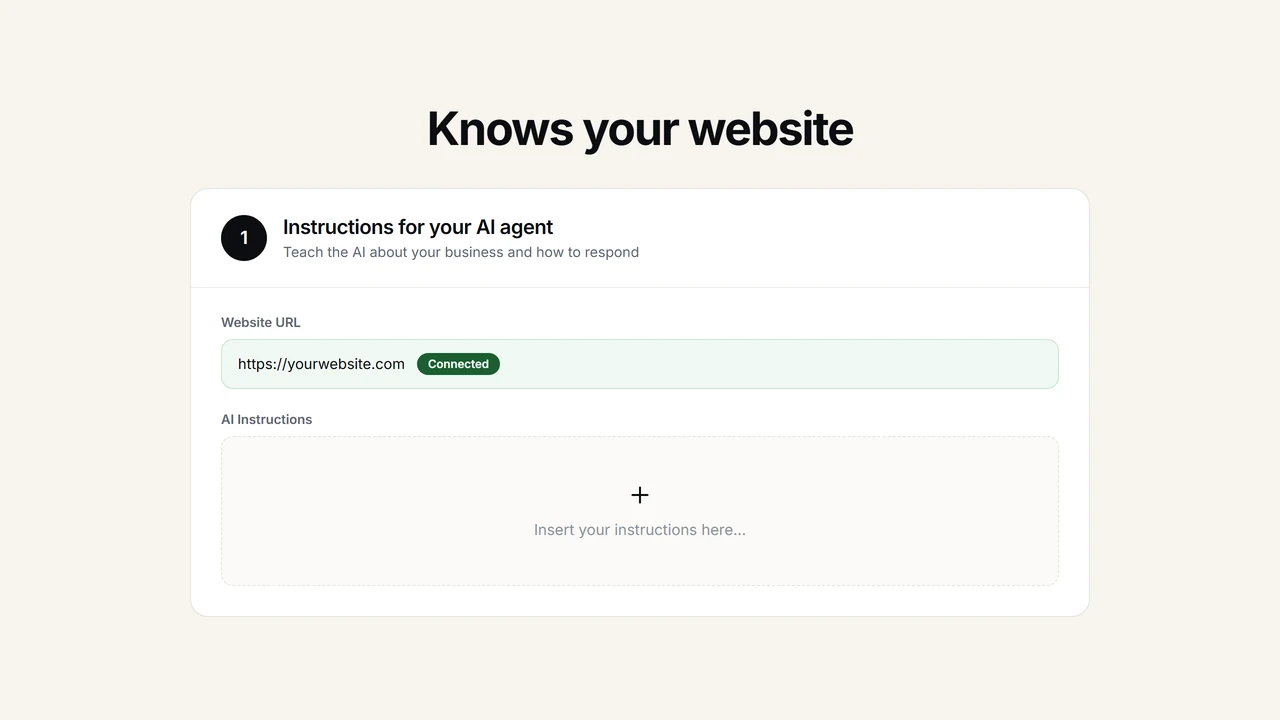
- Guidance rules in plain EnglishTell the assistant: "Offer the discovery call when a visitor mentions hiring." "Suggest the starter guide when someone says they're new." It follows the intent, not a flowchart.
Turns browsing into booked conversations
The WordPress AI assistant is tuned for the middle of the funnel — the visitor who is half-convinced, half-curious, and absolutely not going to fill out a four-field form. It asks, it listens, and when the moment is right it offers the next step.
- Intent-based prompts on the right pagesEngages on services, pricing, and long-form posts after a visitor has actually read for a while — the moment curiosity usually turns into hesitation.
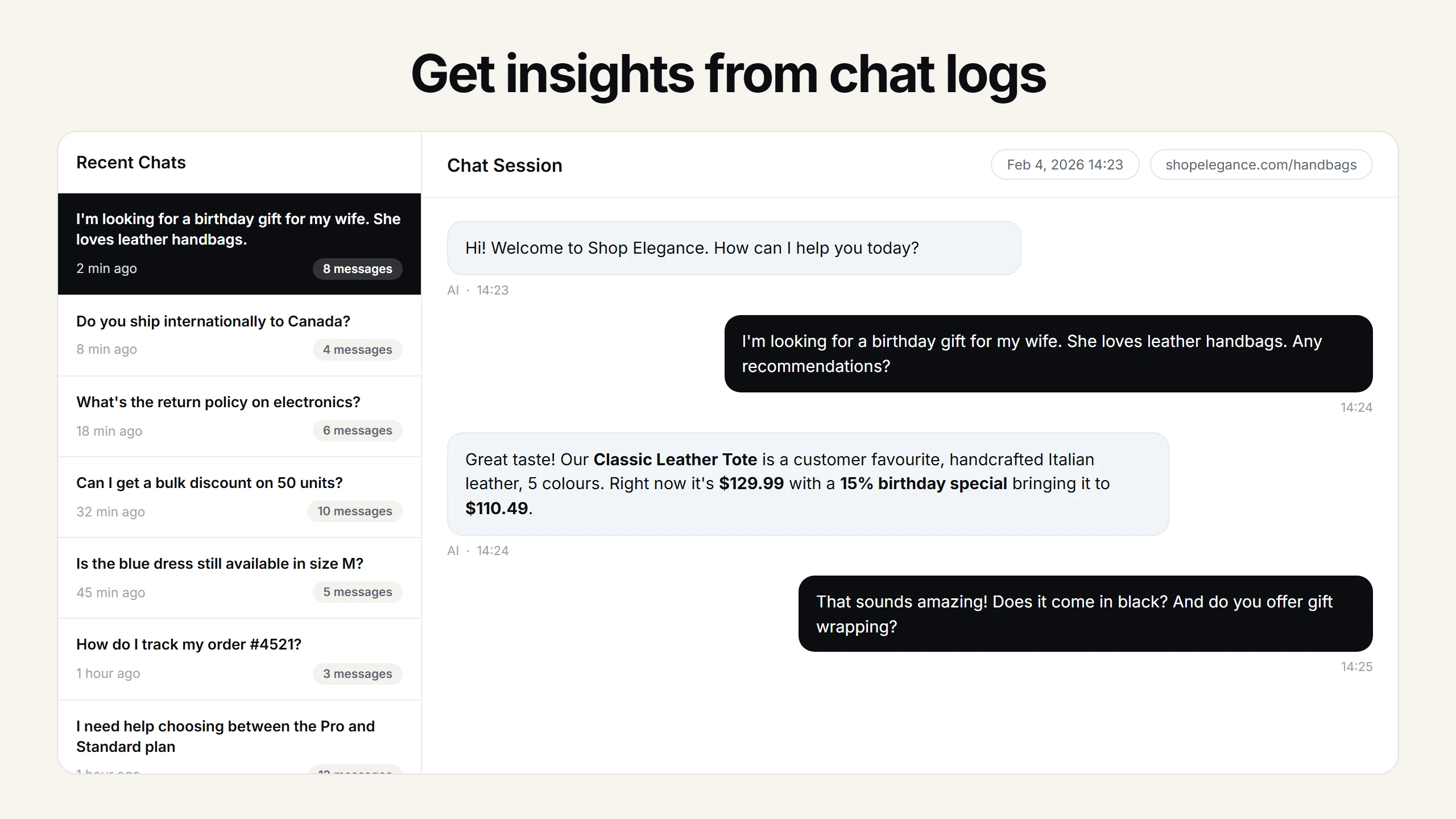
- Context-rich leads land in the dashboardEach captured email arrives with the entire conversation attached, so you know exactly what the visitor was weighing. Optional email notifications keep the sales team looped in without hunting through admin pages.
- A feedback loop on your own contentEvery unanswered question exposes a page that could be clearer. The dashboard surfaces those patterns so the assistant and the site improve together.
Live on your WordPress site in under ten minutes
There are two ways to add the WordPress AI assistant. Download the official Asyntai plugin from your dashboard if you prefer a one-click WordPress workflow, or drop the JavaScript snippet into your header through any header tool you already trust. Both routes produce the same widget; pick whichever matches your admin habits.
- Create a free Asyntai account and grab your personal snippet from the dashboard.
- Option A: install the Asyntai plugin (downloaded from your dashboard, not WordPress.org) and paste your site ID. Option B: use a header tool — Insert Headers and Footers, WPCode, or your child theme's
header.php. - Drop the snippet just above the closing
</head>tag. - Save and reload. The WordPress AI assistant is now active across pages, posts, and WooCommerce templates.
<script src="https://asyntai.com/widget.js"
data-id="your-site-id" async>
</script>
</head>
# Loads asynchronously, independent of your theme.
WordPress AI assistant — practical questions
What WordPress owners usually want clarified before letting an assistant loose on their traffic.
How is an AI assistant different from a regular WordPress chatbot?
A chatbot typically reacts to direct questions. An assistant is more proactive: it surfaces related content while someone is reading, remembers context across the session, and nudges visitors toward the next helpful step. Under the hood it's the same Asyntai engine, but tuned to guide rather than simply answer.
Can the assistant recommend blog posts based on what a reader is asking?
Yes. When a visitor describes what they're looking for, the assistant pulls from the indexed pages and posts and points them to the most relevant ones. That makes it especially useful on content-heavy WordPress sites where readers rarely use the built-in search box.
Does it work on WooCommerce product pages too?
It does. Asyntai has a dedicated WooCommerce REST API sync that pulls products, variants, and prices into the assistant's knowledge base. Shoppers can ask about sizing, availability, and shipping mid-conversation without leaving the product page.
How personalized can the answers get?
On Standard and Pro plans you can pass visitor details — logged-in username, membership tier, last order — through window.Asyntai.userContext. The assistant then references that context naturally: "Since you're on the Pro plan, here's how the annual billing cycle works." No extra CRM wiring required.
Do captured leads sync with my CRM?
Leads land in your Asyntai dashboard with the full conversation attached, and optional email notifications deliver each one to whichever inbox you choose. There's no automatic HubSpot or Klaviyo push at this time — most teams either export from the dashboard or forward the notification emails into their CRM workflow.
Does it play nicely with my existing page builder?
Yes. The widget mounts as an overlay after your page has rendered, so Elementor, Divi, WPBakery, Beaver Builder, Brizy, and Gutenberg all behave the same. Switching builders later changes nothing on the assistant's side.
How many WordPress sites can one Asyntai account run?
It depends on the plan: Free allows one site, Starter two, Standard three, and Pro up to ten. Agencies typically sit on Pro so every client site has a separately trained assistant under a single bill.
What about pricing and the free tier?
There's a permanently free plan with 50 messages per month — enough to trial the assistant on a lower-traffic WordPress site. Paid tiers begin at $39 per month for 800 messages, and email warnings arrive before you reach the cap so no conversation is cut off by surprise.
Understanding what a WordPress AI assistant changes about your site
There's an underlying shift that happens when you add an AI assistant to a WordPress site. A traditional chat widget is a small escape hatch for people who already failed to find what they wanted. An assistant aims further upstream: it tries to help the reader get where they're going before the moment of frustration arrives. It has to know the site well enough to recommend, remember enough context across a multi-question exchange, and behave with the judgment of a colleague rather than the blankness of a search bar. That matters on WordPress specifically because most WordPress sites bleed visitors at exactly the step where an assistant would have naturally helped: the second page.
Consider the reader journey on a mid-sized WordPress publication or services site. Someone arrives from a search result, skims the post they landed on, gets partial value, and then has a choice. Option one is to dig through the navigation hoping a related page exists. Option two is to try the WordPress search box, which famously returns results sorted by recency rather than relevance. Option three is to leave and try a different site. Without an assistant, option three wins the majority of the time. With a WordPress AI assistant present, a fourth option appears — ask a librarian who read the whole site. When a reader types "do you have a version of this for beginners" or "the one where you compare the two platforms," the assistant pulls the right post and hands it over in the same breath. The reader stays. The site's session depth goes up. The content you already wrote finally gets found.
The training phase feels less like installing software and more like onboarding a new team member. You point Asyntai at your WordPress domain, and the crawler walks through the public pages — posts, category archives, services, pricing, policies. Anything behind a login or inside a PDF you hand over directly: uploads, pasted text, and written-out behavior rules form the rest of the knowledge base. Ten minutes in, the assistant can already tell a prospect what your flagship service costs, which of your blog posts goes deeper on a topic, and where the contact page lives. You keep refining guidance rules the way you'd coach any new hire — "when someone mentions competitors, always link the comparison post" — and the assistant inherits those habits across every conversation.
One of the quieter advantages of an assistant over a plugin-heavy chat tool is how little it asks of your WordPress stack. Nothing is written into wp_options, no custom post types appear, no cron jobs run in the background. The script loads asynchronously from an external domain, so your page rendering continues while the widget boots up separately. That matters on WordPress because so many sites are already carrying a dozen plugins, and each new one is an actual liability — another update to track, another potential conflict when PHP jumps versions, another thing the host flags when traffic spikes. An assistant that lives entirely outside your install is easier to reason about. If you ever remove it, you delete one line from your header and move on.
Theme compatibility is similarly undramatic. Astra, Kadence, GeneratePress, OceanWP, Blocksy, Divi themes, custom child themes layered over any of the above — the assistant doesn't touch layout or template hierarchy. It's a floating element painted on top of whatever DOM your theme produces, so a builder switch or a theme redesign never forces you to retest the chat layer. Elementor, WPBakery, Beaver Builder, Brizy, and Gutenberg blocks all render to the same final HTML that the widget mounts above. You shouldn't have to notice the assistant during a builder migration, and you won't.
Where the assistant framing especially earns its keep is on blog-heavy sites. A good WordPress blog tends to grow into a library — dozens, then hundreds of posts, most of them still useful long after publication. The reality is that only the top few ever get found. A post from three years ago that answers a specific buyer question perfectly might see ten organic visits a month because it's buried four clicks deep. When a live reader asks the assistant a question that older post answers, the assistant can actually route them there. The archive stops being a graveyard and starts being a live resource. For publishers monetizing through affiliate links, sponsorships, or owned products, that retrieval layer translates directly into revenue on content that was otherwise dormant.
For membership, course, and community sites, the assistant handles the painful pre-sale questions that otherwise clog inboxes. "Is this for beginners or intermediate?" "Does the membership include the coaching calls or is that separate?" "Can I upgrade later without starting over?" Those are the kinds of questions that are perfectly answerable from existing pages, yet still somehow arrive in email multiple times a week. The WordPress AI assistant catches them at the source. Course creators running WordPress with LearnDash, LifterLMS, or MemberPress typically see the biggest relief here: fewer repetitive tickets, faster enrollment decisions, and a cleaner funnel from reading to joining.
Multilingual reach is built in because so much of the traffic WordPress content earns comes from outside the publisher's primary language. The widget interface ships in 36 languages, and the underlying model detects which language the visitor typed and replies in kind. A reader from São Paulo writes in Portuguese and gets Portuguese. A visitor from Seoul writes in Korean and gets Korean. This happens without any translation plugin configured on the WordPress side — the assistant is not attached to your WPML or Polylang setup. If you do run those plugins for your pages, they keep working independently; the assistant is operating at a different layer entirely. The net effect is that the 30% of your readership you didn't optimize for still gets a fluent experience.
On Standard and Pro plans, personalization opens up through user context. You can hand the assistant a small JavaScript object — username, plan tier, last purchase, membership status, anything your WordPress install already knows about the logged-in visitor — and the assistant will weave that into replies naturally. A returning member asking about renewal won't be walked through the public pricing page; they'll be told how their own plan renews. A student mid-way through a course gets progress-aware answers rather than generic onboarding. You don't need to stand up a CRM sync for this. The context is passed inline through window.Asyntai.userContext at page load, and the assistant treats it as session memory for the rest of the conversation.
Where the WordPress AI assistant stops being an assistant and starts being a lead generator is in how captured contact details move from the widget into your actual workflow. Every time a visitor leaves an email mid-conversation, that lead lands in the Asyntai dashboard with the full transcript attached. You see which post they were reading, which question they asked first, which answer made them lean in, and which offer prompted them to share their address. If you switch on notifications, the same thing hits your inbox in real time. Asyntai doesn't auto-push leads into a HubSpot or Klaviyo pipeline yet, so teams usually either work directly from the dashboard or forward notification emails into whatever CRM they already trust. It's a smaller surface area than a full integrations matrix, but it keeps the data flow transparent and easy to audit.
The conversation log itself is a research instrument. Every question a visitor typed is a signal about something your pages didn't cover clearly enough. When twenty people in a week ask whether you ship to Australia, your shipping page is missing that line. When readers repeatedly ask which version of a framework your tutorial applies to, that tutorial needs an updated notice at the top. When the assistant politely escalates because it couldn't answer, that's a page-level gap worth fixing. Treating the assistant's weekly report as a content roadmap reliably produces a site where visitors need to ask less over time, which is the goal — not a chattier site, a clearer one.
The economics are structured to stay sane across site sizes. The free plan covers 50 messages a month, which suits a new WordPress project or a low-traffic portfolio site perfectly. Paid plans start at $39 per month for 800 messages, and the tiers above that are for busier content sites, WooCommerce stores during seasonal surges, or agency accounts running the assistant across a portfolio. Site slots follow the plan: one on Free, two on Starter, three on Standard, up to ten on Pro. The Pro tier is the one agencies typically land on because it lets a single agency account manage separately trained assistants for ten different client sites. Email warnings go out before the monthly message cap hits, so a traffic spike from a newsletter mention or a viral post never silently cuts the assistant off mid-sentence.
A reasonable question is where an AI assistant's limits actually are. It handles content retrieval, objection clearing, light qualification, and lead capture well. It's intentionally not designed to replace human judgment on bespoke quotes, sensitive account problems, or anything requiring empathy more than information. The right mental model is that the assistant catches the long tail of answerable questions — probably 70 to 90 percent of them — so humans on your team only field the ones that genuinely need them. When the assistant hits that edge, it captures the visitor's details with full context and hands the follow-up over. That handoff matters, because the alternative is a closed tab.
Standing back, the bigger claim is that running a WordPress site without an AI assistant leaves money and attention on the table in ways that used to be invisible. Every bounced reader was a question you could have answered. Every international visitor who didn't speak your language was a translation you didn't have to write. A WordPress AI assistant quietly closes those gaps, turns the library you already own into a conversational interface, and reports back on where your content still needs work. The install is the easy part — the harder part is noticing how much traffic was leaking before you plugged it.