WooCommerce chatbot that knows your real catalog
Asyntai syncs directly with your WooCommerce store through the REST API — products, variants, prices, images, stock. The chatbot recommends, compares, and answers variant-level questions without guessing from a scraped page.
Try the WooCommerce chatbot on your store
Drop in your WooCommerce store URL and watch the chatbot handle real shopper questions about your products
REST API product sync, not a blind crawl
Most chat tools guess your catalog from whatever HTML they can scrape. Asyntai plugs straight into WooCommerce's REST API with read-only keys, so the WooCommerce chatbot sees structured product data — every variation, price, stock level, and attribute — the way your store actually stores it.
- Structured variants, not flattened textColour, size, material, and custom attributes stay separate — so the chatbot can answer "do you have this in XL navy?" accurately.
- Prices and stock from the sourceThe chatbot pulls the live product record, which means sale prices, regular prices, and in-stock/out-of-stock flags stay in sync with WooCommerce.
- Read-only, safe permissionsYou generate read-only WooCommerce API keys — Asyntai never writes orders, customers, or inventory back to your store.
A store assistant that nudges toward the cart
A passive bubble waits. A WooCommerce chatbot built for shopping opens at the right moment on the product page, surfaces relevant alternatives, and captures leads when a visitor is not quite ready to buy.
- Proactive opener on product pagesAuto-trigger opens the chat after a configurable delay, catching shoppers during the hesitation window before they close the tab.
- Lead capture into your dashboardThe chatbot can ask for an email or phone during the chat. Leads land in your Asyntai dashboard with full transcripts, plus optional instant email notifications.
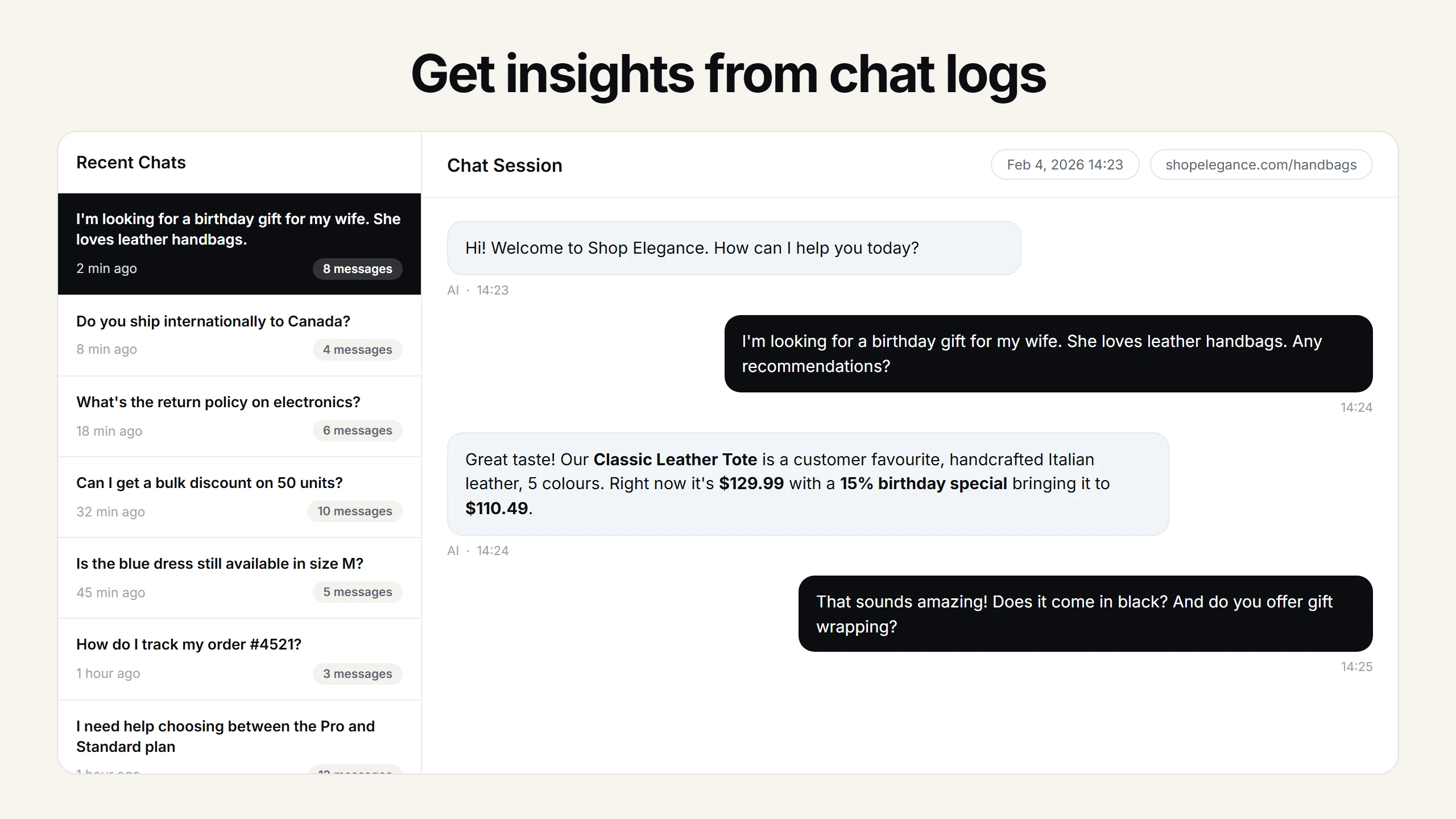
- Conversation analytics that surface gapsSee which products trigger the most questions, which policies confuse shoppers, and which variants drive the highest repeat asks.
WordPress plugin or one snippet — your choice
WooCommerce lives inside WordPress, so installing the WooCommerce chatbot follows WordPress conventions. Grab the Asyntai WordPress plugin from your dashboard and activate it, or paste the snippet into your theme header. Both paths produce the same running chatbot.
- Sign up for a free Asyntai account and add your WooCommerce store as a site.
- Either install the Asyntai WordPress plugin (downloaded from your dashboard) and paste your site ID, or drop the JS snippet into your theme's header.
- In WooCommerce → Settings → Advanced → REST API, generate read-only API keys and paste them into Asyntai to enable the product sync.
- Save. The WooCommerce chatbot is live, drawing on your catalog, ready to answer shoppers.
<script src="https://asyntai.com/widget.js"
data-id="your-site-id" async>
</script>
# Or activate the Asyntai WordPress plugin
# and paste the site ID into its settings.
WooCommerce chatbot — FAQs
Concrete answers for store owners thinking through the switch.
How is this different from a chatbot that just crawls my store?
A crawler reads rendered HTML and flattens everything into text. Asyntai connects to the WooCommerce REST API with read-only keys, so the chatbot sees your products the way WooCommerce itself sees them — with variation IDs, attribute terms, regular and sale prices, stock state, categories, and tags kept structured. That's why the WooCommerce chatbot can answer variant-specific questions correctly instead of guessing.
Do I have to use the WordPress plugin?
No. The WordPress plugin is the easiest route — download it from your Asyntai dashboard, upload it under Plugins → Add New → Upload, activate, paste the site ID. If you prefer to skip plugins entirely, the same snippet works pasted directly into your theme's header or through a headers-and-footers plugin. Both approaches produce the same widget behavior on the front end.
Does it work with WooCommerce subscriptions, bundles, or custom product types?
Yes — if WooCommerce exposes the product through its REST API, the chatbot ingests it. Simple, variable, grouped, external, subscription, and bundle products all come through. Custom product types built by extensions generally work as long as they register themselves with the REST endpoints in the standard way.
Will it slow my store down?
The widget script loads asynchronously after the page has rendered, so it stays off your critical rendering path. The product sync happens server-to-server between Asyntai and your WooCommerce REST API on a schedule — your shoppers never wait on that, and your storefront doesn't run heavier because of it.
Which languages does the WooCommerce chatbot speak?
The widget interface is localized into 36 languages, and the AI detects the shopper's language from the first message they send. A shopper typing in French gets French replies; a shopper typing in Arabic gets Arabic. No Polylang or WPML configuration is required on the chatbot side, even if your WooCommerce content is single-language.
Does it write back to WooCommerce — orders, customers, anything?
No. The REST API keys you generate are read-only. Asyntai pulls product and policy data in; it never creates an order, updates inventory, or adds a customer record. Leads captured during conversations land in your Asyntai dashboard (and your email if you enable notifications), not as WooCommerce customer entries.
What does it cost?
The free plan includes 50 messages per month and 1 site — enough to trial it on a single store. Paid plans begin at $39 per month for 800 messages. Site limits scale with the tier: Free 1, Starter 2, Standard 3, Pro up to 10. If you manage several WooCommerce stores under one roof, Pro lets you run a separate chatbot on each of them.
Can the chatbot use logged-in customer info, like order history?
On Standard and Pro plans you can pass a User Context object through the widget's JavaScript API — for example, feeding in the logged-in WooCommerce customer's name, membership tier, or any other safe attribute your theme exposes. The chatbot then personalises replies using that context. Nothing is pulled automatically; you stay in control of what gets passed.
Everything you need to know about a WooCommerce chatbot
WooCommerce occupies a strange middle ground in ecommerce. It is not a hosted platform like Shopify that locks you into one way of doing things, and it is not a bespoke stack built from scratch. It is WordPress with a shop bolted into it, which means your catalog, your theme, your payment gateway, and your shipping plugins all live side by side in the same WordPress database, and any chat tool you add needs to get along with all of that. A WooCommerce chatbot that treats the store as a generic website — a crawler pointed at a URL — misses the fact that a WooCommerce product is a structured record with variations, attributes, sale prices, stock statuses, and metadata that no HTML scrape can represent faithfully. The gap between those two approaches is the gap between an assistant that guesses and one that knows.
Asyntai closes that gap by connecting directly to the WooCommerce REST API. You generate a pair of read-only API keys from WooCommerce → Settings → Advanced → REST API, paste them into your Asyntai dashboard, and the product sync takes over from there. The chatbot pulls every published product as a structured object — simple products, variable products with all their variations expanded, grouped and external products, subscriptions, bundles, whatever your extensions add — along with categories, tags, attributes, images, and the regular and sale prices as WooCommerce itself records them. That structured ingestion is why the WooCommerce chatbot can correctly answer "is the navy hoodie in stock in size L?" instead of responding with a vague paraphrase of the product page.
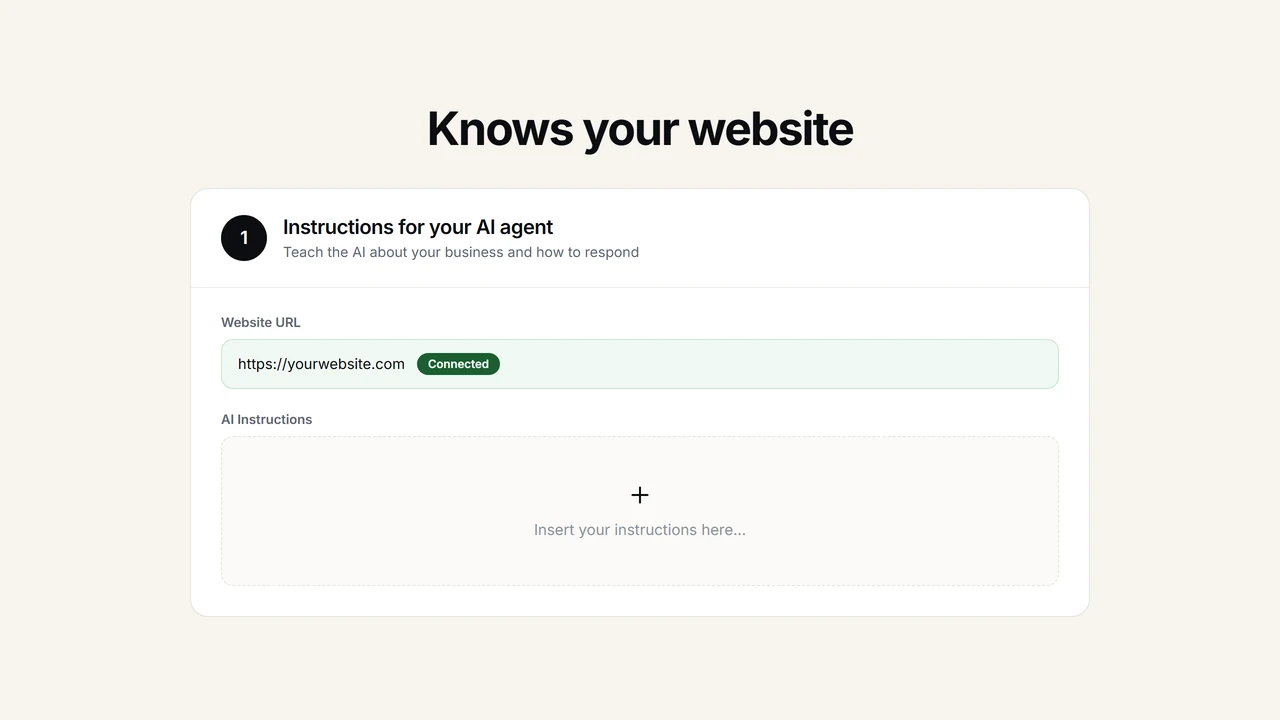
The chatbot's knowledge base is not limited to the product catalog. WooCommerce stores are still WordPress sites, which means they also have pages and posts — about pages, shipping policy pages, return terms, FAQ pages, blog content, care guides. Asyntai crawls all of that in parallel with the API sync, so the knowledge base combines the structured catalog with the unstructured content that surrounds it. If there is internal material the public site does not expose — a wholesale pricing sheet, an extended fabric care document, a seasonal shipping memo — you upload it as a PDF or paste it directly into the knowledge base, and the WooCommerce chatbot treats it as part of what it knows. Custom instructions on top of that let you shape tone and behaviour: always ask destination country before quoting shipping, always lead with the bestselling variant when the shopper seems undecided, always offer the size chart link on apparel questions.
Installation tends to be the place where WooCommerce tooling either clicks or frustrates. Because WooCommerce rides on WordPress, you have two equally valid paths and neither requires a marketplace review or App Store approval. The Asyntai WordPress plugin is downloadable from your dashboard — a standard zip you upload under Plugins → Add New → Upload — and once activated, you paste your site ID into its settings screen and the chatbot goes live. If you prefer not to add another plugin, the alternative is the same JavaScript snippet you would use on any site: dropped into your theme's header, or inserted via a lightweight header-and-footer plugin like WPCode. Either route ends at the same place, with the widget running on the front end and drawing from your synced catalog.
There is a practical difference worth naming between a general-purpose site chatbot and a WooCommerce chatbot specifically. On a content site, success looks like the visitor getting their question answered and staying engaged. On a WooCommerce site, success looks like the shopper progressing from question to cart. Asyntai is tuned for the second pattern on commerce-enabled stores: the auto-trigger opens the chat proactively on product and category pages where hesitation concentrates, the replies reference specific products by name and price when the question warrants it, and the conversation flow is designed to hand off to the cart rather than stalling in an endless loop of questions. The shopping assistant framing is not branding — it is how the behavior is actually shaped.
Variants are where most off-the-shelf chat tools quietly fall apart on WooCommerce. A variable product is not one thing; it is a parent with a set of variations, each of which has its own SKU, price, stock, weight, and attribute combination. When a shopper asks whether the medium version of a particular dress comes in the burgundy colourway, the chatbot needs to look up that specific variation, not the parent listing. Because Asyntai ingests variations as structured records, it handles variant-level questions the way a trained sales associate would: "Yes, medium burgundy is in stock at the regular price — here is the product link." That is the single biggest quality difference you feel in real conversations with real shoppers, and it is only possible because the underlying data was synced through the API rather than pattern-matched from rendered HTML.
Stock and pricing realism is the other half of that story. On a busy store, prices move: sale campaigns start and end, flash discounts drop in for a weekend, a supplier delay temporarily shifts an item into backorder. A scraped chatbot, built from a crawl that ran two weeks ago, cheerfully quotes a price that expired on Sunday. Asyntai's sync runs regularly so the chatbot works from the current state of your catalog, not a stale snapshot. Shoppers get the price they will see at checkout, the availability they will actually encounter when they add to cart, and the sale flag if there is one. Trust in the assistant's answers goes up the moment shoppers stop catching it in outdated claims.
Because WooCommerce ships all over the world and WordPress powers sites in every major market, multilingual handling matters. The widget interface is translated into 36 languages, and the AI detects the shopper's language from their first message — so the same store can converse naturally with a Polish shopper asking about shipping to Warsaw, a Brazilian visitor checking availability in Portuguese, and a Dutch buyer working through a return question, all at the same time, with no translation plugins configured on the chatbot side. If you are already running WPML or Polylang for your WooCommerce content, it keeps working exactly as it did; the chatbot's language layer is independent, so you are not configuring translation twice.
When a shopper is interested but not ready, the WooCommerce chatbot turns the conversation into a lead instead of a lost visit. It can ask for an email address, a phone number, or both, configurable per site. Captured leads drop into your Asyntai dashboard with the full transcript attached — you see the products they asked about, the objections they raised, the answers the AI provided — and if you enable email notifications, that same transcript arrives in your inbox in real time. A wavering shopper who closes the tab is not gone; they are a conversation in your dashboard with enough context to follow up intelligently through your usual email workflow. Leads are not written into WooCommerce as customer records, by design — that keeps your customer table clean and reserved for actual purchasers.
The questions shoppers ask the chatbot are, in practice, a free content audit of your store. Conversation analytics surface the patterns: which products generate the most sizing queries, which collections attract the most shipping questions, which policy pages fail to answer what shoppers really want to know, which variants keep coming up as confusing. A week of chat data usually points out three or four product descriptions that need rewriting, a shipping note that belongs higher on the policy page, and at least one size chart that needs attention. The WooCommerce chatbot does not only reply to shoppers; it tells you which parts of your store are generating friction, and the improvements tend to compound — better descriptions reduce support load, which the chatbot also handles, so your overall chat volume per converted sale drifts downward over time.
Pricing is shaped so the WooCommerce chatbot pays for itself quickly at almost any store size. The free tier includes 50 messages a month and a single site, which is plenty to evaluate the product and see real conversations before you commit to anything. Paid plans start at $39 per month for 800 messages, with higher tiers for stores that see serious chat volume during promotions or peak seasons. Site counts scale with the plan — Free 1, Starter 2, Standard 3, Pro up to 10 — which matters if you run several WooCommerce stores under one brand holdco, or operate as an agency supporting multiple client shops. When a store nears its monthly cap, Asyntai sends email warnings ahead of time so you can upgrade before the widget actually pauses, and the widget only pauses new AI replies — it does not disappear from the page.
There is always a fair question about where the AI ends and a human should begin. Asyntai handles the broad bulk of shopping questions grounded in your catalog and policies extremely well, in any of the 36 supported languages at any hour. Where a specific order dispute, a custom bulk request, or an edge-case refund genuinely needs human judgement, the chatbot captures the shopper's details and the context of the conversation as a lead, and hands them cleanly to your existing support process. The point is not to replace your team; it is to stop letting the long tail of sizing, shipping, variant, and policy questions go unanswered while your team sleeps or handles the harder work.
Put it together and the AI chatbot for WooCommerce becomes a meaningful upgrade to the storefront rather than a bolted-on widget. A real REST API sync keeps the assistant grounded in the catalog as it actually is, installation through the WordPress plugin or a single snippet keeps friction low, 36 languages keep international shoppers engaged, proactive triggering catches hesitation before it becomes a closed tab, and conversation analytics keep the store improving week over week. Set it up once, and what you have on every product page is the thing a physical store owner would build if they had an associate available at every hour — polite, informed, patient, and pointed at the cart.