Webflow chatbot that drops into Custom Code
Asyntai provides a Webflow chatbot that reads every published page on your Webflow site, greets each visitor, and answers inbound questions around the clock in 36 languages. The install happens inside Webflow's Site Settings — no Velo equivalent required, no developer on standby.
Preview the Webflow chatbot against your own site
Drop in any Webflow URL and watch the chatbot answer realistic visitor questions pulled from that exact site
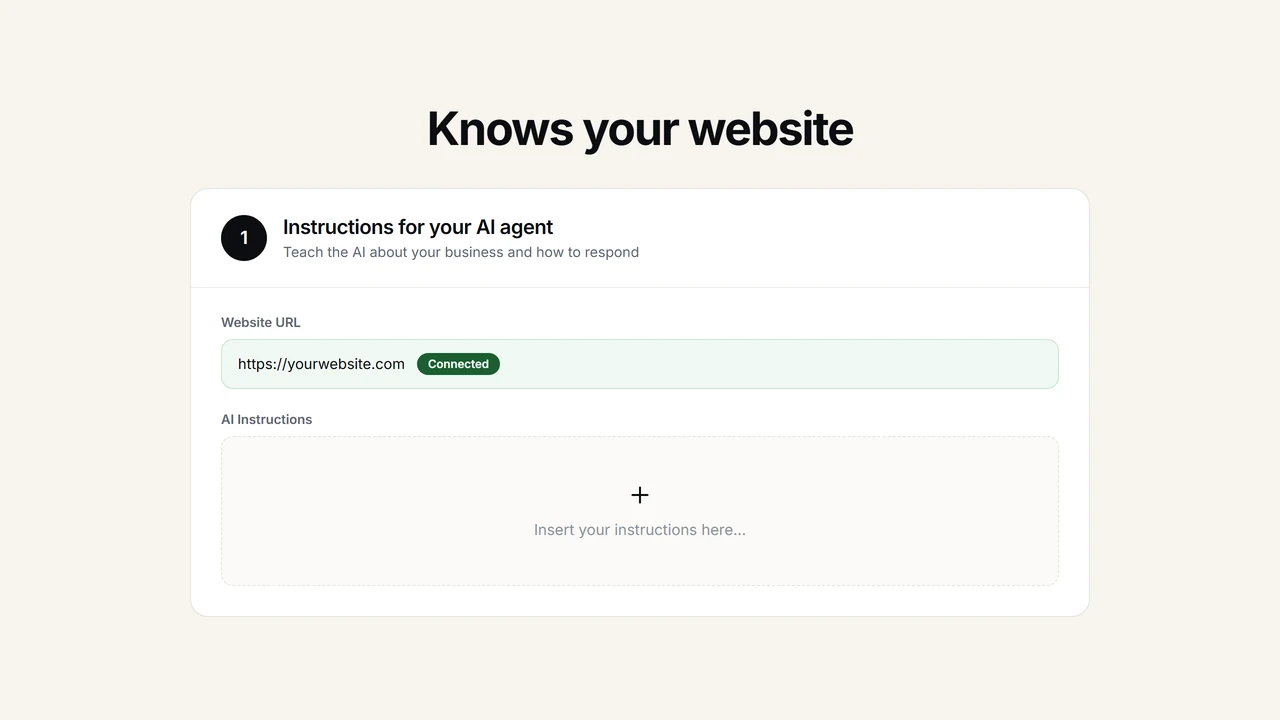
Learns your CMS collections, static pages, and blog posts on its own
The chatbot ingests whatever your Webflow site already publishes — homepage copy, services grids, CMS collection items, product pages, blog articles, contact details, policy pages — and merges that with anything confidential you hand it privately. Nothing to diagram, no dialogue trees to maintain.
- Indexes every published Webflow URLStatic pages, CMS collection templates, and individual article entries all become part of the chatbot's working context inside a few minutes.
- Feed it internal materialsProject briefs, retainer tiers, internal process documents, onboarding checklists, or unpublished case studies can be dropped in as PDFs or pasted text for reference.
- Guide behaviour with plain sentences"Invite visitors to book a discovery call when they ask about rates." "Send prospective clients to the intake form." Written rules, obeyed consistently by the Webflow chatbot.
Turns casual Webflow browsers into qualified inbound while you're away from the desk
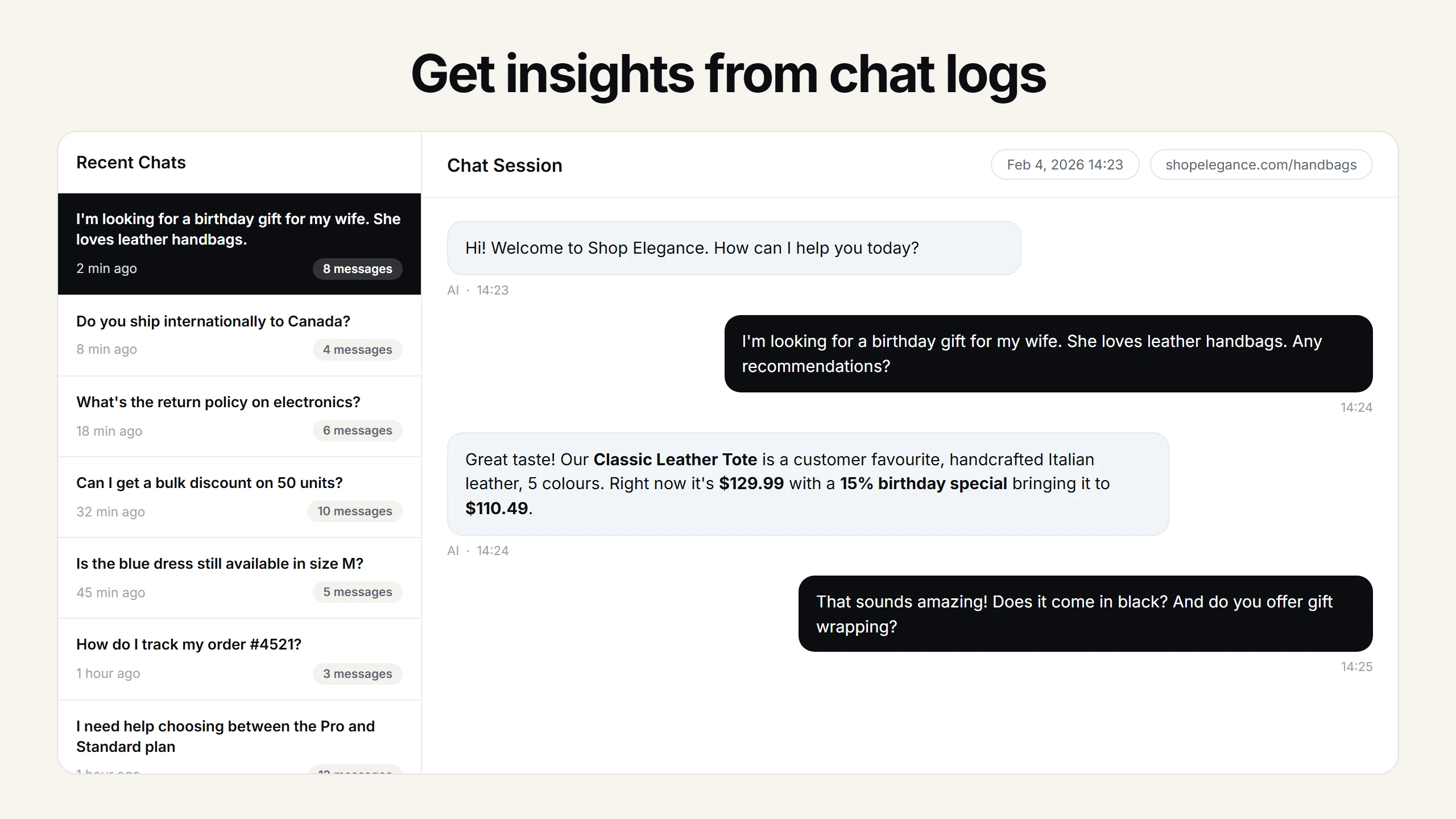
A designer, agency, or founder running a Webflow site is rarely sitting on a live support queue. The AI answers during the hours you're not there, collects leads with the full conversation context intact, and pushes new enquiries straight to wherever you need them.
- Conversational lead captureThe chatbot requests contact details at the natural moment in a conversation, so every enquiry lands with the complete back-and-forth attached.
- Inbox notifications per enquirySwitch on email alerts and each new Webflow visitor conversation arrives in your inbox the instant it wraps — with the full transcript included.
- Logged-in context through User ContextUser Context on Standard and Pro tiers lets your Webflow site pass through member or client session details so replies can reference their plan, project, or history.
Installs through Webflow Custom Code
The Webflow chatbot snippet lives in Site Settings → Custom Code, the same area where you'd normally paste Google Tag Manager, HubSpot tracking, or a Meta Pixel. Site-wide Custom Code is available on paid Webflow Site Plans (Basic and above); per-page Custom Code is available on individual pages as a separate option.
- Register for a free Asyntai account and copy the Webflow chatbot snippet generated for your workspace.
- Open your Webflow project dashboard and navigate to Site Settings → Custom Code.
- Paste the snippet into Head Code (or Footer Code if preferred), then save your settings.
- Click Publish on your Webflow site so the Custom Code reaches the live domain. The chatbot now loads on every page.
<script src="https://asyntai.com/widget.js"
data-id="your-site-id" async>
</script>
# Drop into Site Settings → Custom Code → Head Code, then Publish.
Webflow chatbot — common questions
What Webflow designers, agencies, and founders usually check before putting AI chat on a client site.
Which Webflow Site Plan do I need for the chatbot to work site-wide?
Custom Code at the site level is unlocked on Webflow's Basic Site Plan and every tier above it, so Basic, CMS, Business, and Enterprise are all fine. The Starter free plan has restricted Custom Code access, which means site-wide installation isn't reliably available there. For production Webflow sites on a connected domain, you'll almost always be on a paid Site Plan anyway, so this rarely becomes a blocker in practice.
Is there an Asyntai app inside the Webflow Marketplace?
No — intentionally. Integration happens through Webflow's own Custom Code feature as a small JavaScript tag. That avoids routing data through a third-party Marketplace app, skips any extra workspace permissions, and keeps the chatbot independent of any single vendor's hosted-app lifecycle. One snippet in Custom Code is all that's involved.
Can the chatbot read my Webflow CMS collections?
Yes. When you provide your Webflow URL, Asyntai crawls every publicly reachable page — and that includes CMS collection pages like individual blog posts, case studies, team member bios, project entries, product listings, or any custom collection template you've built. If a page is indexed and linked, the chatbot sees it. Unpublished drafts and content locked behind authentication aren't reached, which is usually the behaviour you want.
Does this work on a Webflow Ecommerce store with product pages?
It does. Webflow Ecommerce product pages are crawled like any other Webflow page, so the chatbot learns your catalogue structure, product descriptions, variant details, and whatever shipping or returns policy pages are published. Shoppers who hit a product and have a sizing, availability, or policy question get an answer inside the chat rather than abandoning the cart to email support.
Can I put the chatbot on only some pages of a Webflow site?
Yes. Webflow exposes Custom Code at both the site level and the individual page level. For pages-only installs, paste the snippet into a specific page's Custom Code rather than the site-wide setting — useful if a client wants chat restricted to service pages, blog articles, or a specific landing page while keeping marketing pages quiet.
Will this tank my Lighthouse or page-speed scores?
Loading is asynchronous, so the snippet doesn't delay paint or interactivity on your Webflow pages. It's a single tag that fetches the widget after the main document is ready — the same lightweight pattern that analytics, consent banners, and tag managers use. Webflow's CDN-hosted pages stay responsive.
What languages does the widget handle?
36 locales are covered on the widget interface, and the AI reads the visitor's language automatically from whatever they type first. Someone landing from Spain gets Spanish, someone from Seoul gets Korean, someone from Germany gets German — all served by the same single Custom Code install, no duplicate snippets per region and no translation add-on on the Webflow side.
I run multiple client sites as a Webflow agency — does licensing cover that?
Plan tiers include multi-site allowances. Free covers 1 site, Starter 2, Standard 3, and Pro up to 10 separately trained chatbots. Each Webflow site gets an isolated knowledge base, which matters for agencies where client A's content shouldn't leak into client B's answers. Many agencies re-sell the chatbot as a managed add-on for their Webflow retainers.
Webflow chatbot — what it covers and how it lands on your site
Webflow is the platform you choose when design standards are non-negotiable. The CMS is powerful enough to replace headless stacks for most marketing sites, the visual editor gives designers pixel-level control without handing off to a front-end developer, and the native hosting is fast enough that agencies can ship portfolio-grade work without bolting on a separate deploy pipeline. The result is a population of Webflow owners that skews heavily toward designers, creative studios, growth-stage SaaS companies, and founder-operators who care about the way the site feels. For this audience, dropping a generic chat widget into a carefully designed layout is a non-trivial decision — it has to be reliable, on-brand, fast, and easy to maintain. A Webflow chatbot from Asyntai is built precisely around those constraints.
Most Webflow projects aren't maintained by a 24/7 team. They're run by a founder handling product alongside marketing, an agency juggling six client retainers, or a solo designer freelancing on retainer for a handful of SaaS clients. The working reality is that inbound questions arrive on the site at all hours, from mixed timezones, in multiple languages, and very few of them coincide with the owner actively watching the inbox. That gap — between when prospects and customers send messages and when a human can reply — is the operational problem the chatbot closes. It sits on the site around the clock, answers from the actual content of the Webflow pages, prompts for contact details at just the right conversational moment, and hands over a wrapped-up thread by the time anyone sits down to check.
Installation happens inside Webflow itself, through the built-in Custom Code surface that ships with every paid Site Plan. Inside your Webflow project, the path is Site Settings → Custom Code, where you'll find a Head Code and Footer Code text area. Pasting the Asyntai snippet into either area, saving, and hitting Publish is enough to push the widget out to your live domain. The whole sequence takes a couple of minutes once you have the snippet in your clipboard. For teams that want to limit where the widget appears — a single landing page, a specific service section, a contained blog area — Webflow's per-page Custom Code is a separate option, and the same snippet works there too.
Training the Webflow chatbot is largely automatic. You hand Asyntai the public URL of the site, and the crawler walks through every reachable page it can find. Webflow's CMS collections mean one visual template can render dozens of distinct URLs — every blog article, team profile, case study, project entry, or ecommerce product lives at its own address, and every one of those becomes part of the chatbot's working context. Static pages like the homepage, pricing, about, contact, and policy pages join the same pool. When visitors later ask about a specific blog insight, a particular case study's outcome, or the details of a single product variant, the chatbot is answering from that actual content rather than a generic summary.
There's a second training layer for information that doesn't live on the public site. Retainer pricing, internal project briefs, onboarding sequences, unpublished playbooks, vendor documents, client-specific policies — anything you'd normally describe over email or a discovery call — can be uploaded as a PDF or pasted directly as text. The chatbot treats these private materials the same way it treats the crawled pages: as sources it draws from when the conversation calls for them. A designer's internal "how we scope a branding project" doc becomes available for chatbot replies without ever being exposed to visitors as a downloadable page. Custom written instructions handle tone and escalation patterns: "offer a 30-minute intro call when pricing comes up," "route technical questions to the studio email," "recommend the growth retainer when a SaaS prospect mentions a Series A."
Webflow Ecommerce deserves a separate mention because it's a meaningful share of Webflow sites and behaves differently from a static marketing site. Stores published through Webflow Ecommerce use product pages, category pages, and cart flows — all of which are regular URLs that the chatbot crawls and uses. Shoppers hitting a product page with a sizing question, a material question, a shipping-window question, or a return-policy question often abandon if the page doesn't visibly answer it. A chatbot grounded in the product description, the policies page, and any private shipping document you've uploaded closes that loop inside the session. For merchants running a Webflow-native store, this is the difference between treating the chatbot as a marketing gimmick and treating it as a revenue-recovery layer on every product URL.
International reach is where a Webflow chatbot with real multilingual coverage quietly compounds value. Webflow sites consistently rank beyond their origin market because the platform publishes clean, CDN-delivered HTML that performs well in search regardless of country. Traffic from outside the site's primary language is therefore the norm, not the exception, and the default Webflow experience typically leaves those visitors reading content in a language they partially understand without any conversational option in their own. The Asyntai widget ships with interface strings across 36 locales and the AI reads the visitor's language straight off their opening message — a Dutch visitor types Dutch and gets Dutch back, a Polish visitor gets Polish, a Japanese visitor gets Japanese. A single Custom Code install covers every market the Webflow site reaches.
For Webflow agencies specifically, the chatbot becomes an interesting retainer add-on rather than just a tool for a single site. Agencies already managing five or ten client Webflow projects on retainer can install Asyntai on each one, customise the knowledge base per client, and hand over a small monthly report of the conversations and leads generated. The multi-site allotment — free plans carry one site, Starter carries two, Standard three, with Pro stretching all the way to ten — are structured for exactly this kind of operator. Each client's knowledge base stays isolated, which matters when a boutique agency is running very different brands side-by-side and no one wants client-specific language bleeding across contexts.
User Context is the layer that unlocks personalised chatbot behaviour for Webflow projects that authenticate users. Not every Webflow site has logged-in users, but those that integrate Memberstack, Outseta, or a bespoke auth layer often need the chatbot to recognise a returning customer and adapt accordingly. Standard and Pro plans expose a window.Asyntai.userContext object you set in your own code before the widget initialises — name, plan tier, account identifier, or whatever other signals matter to your business logic. The chatbot then adapts replies: "welcome back, Noah — your Pro plan already includes the advanced module." Nothing is read from Webflow automatically; you decide precisely what the chatbot sees by controlling what your own code passes through.
What visitors actually ask the Webflow chatbot becomes a surprisingly accurate audit of the gaps in the site itself. Consistent questions about pricing usually mean the pricing page or a CTA is buried; frequent "do you work with international clients" questions mean the homepage or services page lacks geographic clarity; repeated questions about a specific feature or product detail usually mean the associated page isn't surfacing that detail visibly. The conversation analytics view inside Asyntai clusters these patterns by topic, volume, and language, which gives the Webflow owner concrete material to iterate on — edits driven by real visitor intent rather than guesswork. Most operators make more substantive edits to their Webflow site over the opening month of chatbot usage than they did across the several prior.
Pricing lines up with the typical Webflow customer profile. The free tier handles 50 messages monthly — enough for a brand-new portfolio, a low-volume consultancy homepage, or a product launch teaser. Paid tiers kick off at $39 monthly for a 800-message quota, which sits comfortably under the bill for most mid-sized Webflow marketing sites and well-trafficked Webflow Ecommerce stores. Higher tiers exist for high-volume agencies and multi-site operators. Before a site hits its message ceiling, warning emails land early enough that an upgrade can happen without a sudden pause — important for Webflow owners running paid acquisition campaigns or launching new products on a known traffic window.
Different kinds of Webflow projects get different returns from an AI chatbot. Design-led agency sites convert browsers into project-brief conversations that would otherwise die at a contact form. SaaS marketing sites built on Webflow hand off pricing and plan-fit questions before the prospect clicks away to a competitor's site. Portfolio sites for creatives turn "are you available" visitors into a warm email thread. Consultancy sites qualify fit before pushing to a scheduling link. Webflow Ecommerce stores address product questions that would otherwise kill checkout intent. Course-sales Webflow sites answer enrolment questions at midnight instead of sending prospects away to sleep on it. The shape of the conversation changes per vertical; the underlying pattern — the chatbot doing the work the Webflow owner couldn't personally do in the moment — stays constant.
The practical path onto a Webflow site is short enough to finish before a meeting. Sign up for a free Asyntai workspace. Grab the generated snippet. Open Webflow, go to Site Settings, choose Custom Code, paste into Head Code, save. Publish the site. Point Asyntai at the Webflow URL so it learns the pages. Upload any private documents you want referenced. Write a handful of plain-English behaviour rules. Run a couple of test conversations on the live site to confirm the voice matches your brand. Done. From that point on, the Webflow chatbot handles the visitor work you couldn't handle yourself — replying to every enquiry the minute it arrives, collecting leads with real context, and giving a Webflow site the always-available conversational layer that separates a nice-looking brochure from a site that actively brings in business.