A virtual customer service agent that earns its seat on the team
Asyntai gives you a virtual customer service agent that owns the conversation end to end — greets the customer, digs into the case, pulls the answer from your policies, and only pings a human when judgment is genuinely required. A teammate who shows up every shift, in every language, at a fraction of a human salary.
Hire a virtual agent for your site
Drop in your URL and watch how the virtual agent would run its first shift on your queue
An agent that owns the case from "hi" to resolution
Old chatbots read a script. A virtual customer service agent has to do the actual work of an agent: understand what the customer is really asking, reason across your policies, and commit to a response it can stand behind. Asyntai learns your business the way a new hire would — except the onboarding takes an afternoon, not six weeks.
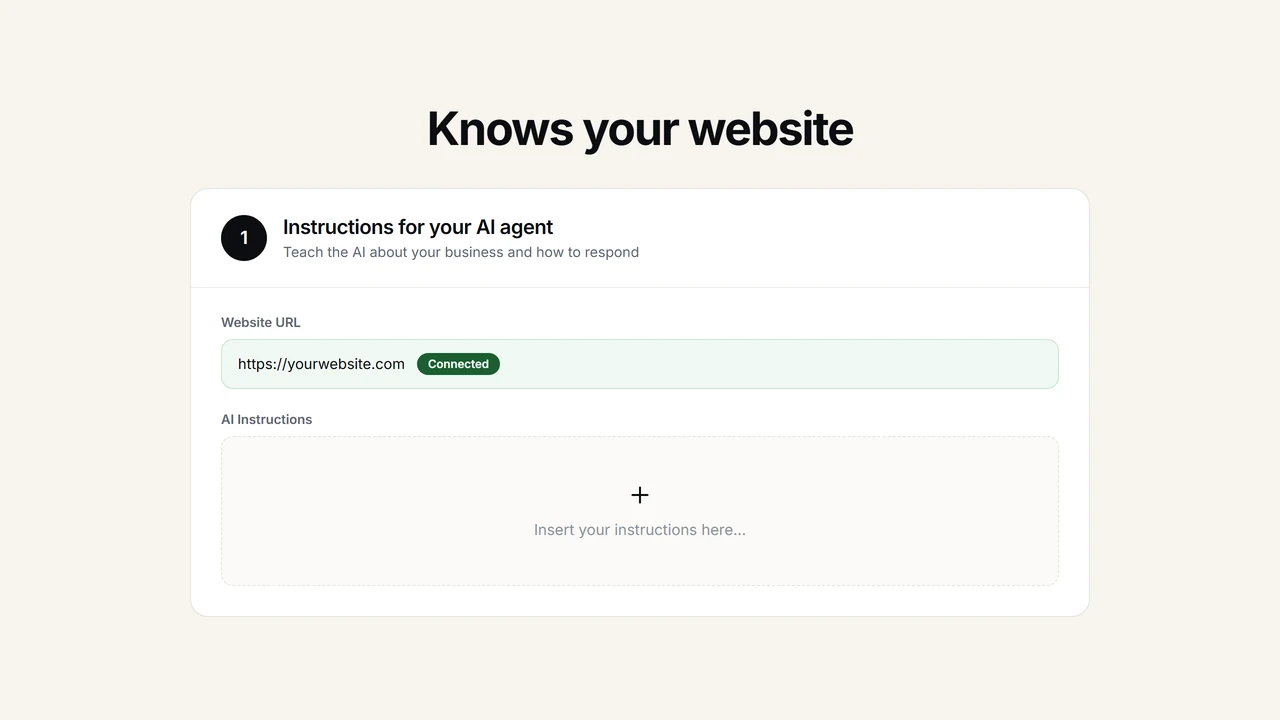
- Onboards on your public content firstHelp center, pricing grid, policy pages, product catalog, returns terms — the agent ingests everything a customer could reach on your site, in minutes.
- Learns the private playbook tooWarranty matrices, carrier SLAs, tier-specific handling, exception rules that were never meant to be public — drop them in as PDFs or paste the text. The virtual agent uses them alongside the public docs.
- Follows the floor rules you set"Always confirm a shipping address before issuing a replacement." "Quote a refund number only after human approval." "Offer the loyalty discount if the customer mentions leaving." The agent treats your instructions as non-negotiable.
Headcount economics, flipped on their head
A single full-time customer service rep in the US runs $35,000 to $50,000 per year before benefits, training time, and attrition churn. A virtual customer service agent from Asyntai starts at $39 per month. The point isn't to replace your best humans — it's to stop burning their hours on password resets and tracking numbers.
- Free tier before you commit a dollarThe first 50 messages are on us. Plug in the snippet, point the agent at your site, and watch it answer real visitors before you ever pick a paid plan.
- $39 a month covers 2,500 conversationsFor the price of a weekly team lunch, the virtual agent clears the repetitive queue volume that would otherwise occupy a real human for multiple shifts a week.
- Scales to multi-brand rostersFree covers 1 site, Starter 2, Standard 3, Pro up to 10 — each with its own trained virtual agent and its own escalation playbook, all managed under one dashboard.
Onboard the virtual agent in an afternoon
Hiring a human service agent takes a job posting, a hiring panel, three weeks of training, and a probation period. Standing up a virtual customer service agent takes a snippet, a URL, and a short list of rules. You can have it taking cases before the day is over.
- Spin up a free Asyntai account and pull your personal widget snippet from the dashboard.
- Drop the script into the
<head>of your website — any CMS, any stack, no backend work. - Point the crawler at your site URL and upload any confidential procedures the agent should reference.
- Write the agent's shift rules — tone, escalation triggers, what never to quote without approval — and switch it live.
<script src="https://asyntai.com/widget.js"
data-id="your-site-id" async>
</script>
</head>
# One agent, always on shift, on every page of the site.
Virtual customer service agent — FAQs
The questions service managers, COOs, and founder-operators usually raise before adding a virtual agent to the roster.
Is this really an agent, or is it just another chatbot with better branding?
The distinction matters. A chatbot picks from scripted answers; a virtual customer service agent reasons about the case, pulls the right facts from your knowledge base, and commits to a response shaped by your business rules. When it doesn't have enough information, it asks a clarifying question — the way a real agent would — rather than dumping a generic "here's a link to our help center." The behaviour you get from Asyntai is closer to a trained rep than to the dropdown bots most people have been burned by.
How does the cost actually compare to hiring a human rep?
The median US customer service rep salary sits between $35,000 and $50,000 per year, and that's before recruiting costs, benefits loading, training ramp, turnover, and the coverage gaps you absorb during PTO and sick leave. The Asyntai paid tier is $39 per month for 800 messages. Even if you still employ a full human team, the virtual agent absorbs the repetitive volume that was burning their most expensive hours — typically the 60 to 80 percent of tickets where the answer already lives in your content.
What happens with languages? Do we need to hire bilingual staff?
No. The virtual agent handles 36 languages natively — Spanish, French, German, Portuguese, Japanese, Mandarin, Arabic, Hindi, Korean, Polish, Turkish, and more. It detects the language from the customer's opening message and replies in kind, using the same knowledge base. If you've been staffing international support with bilingual reps you had to pay a premium for, one virtual agent covers all 36 at the same flat price.
Does the agent ever escalate, or does it try to answer everything?
It escalates whenever you tell it to, and it should. Write escalation rules in plain language — "Hand off any complaint about a damaged parcel", "Route subscription cancellation attempts to a human", "Never negotiate pricing without a rep on the call" — and the agent treats those boundaries as hard stops. When it escalates, it collects the customer's name, email, and the full chat transcript, ships it to your Asyntai dashboard, and optionally fires an email to your team inbox in real time.
Can the virtual agent pull personalized info like order status or plan details?
Yes, on Standard and Pro plans, through the User Context feature. Your site pushes the logged-in customer's data — name, tier, order ID, renewal date, whatever you choose — straight into the window.Asyntai.userContext payload at page load. The virtual agent uses that data to answer case-specific questions ("when does my subscription renew", "what's the status of order 4429") without any API wiring on our side. You decide what data leaves your page.
How do we make sure the agent stays on-brand and never invents facts?
The knowledge base is the entire playing field. The agent composes answers from what it has absorbed — your site crawl, your uploads, your instructions — and when a question falls outside of that, it says so and escalates rather than guessing. Your tone-of-voice rules, your forbidden phrases, your required disclaimers, all go into the custom instructions. The virtual agent obeys them on every reply, in every language, without drift.
We run several brand sites — can one virtual agent cover them all?
Each site gets its own purpose-trained virtual customer service agent, because cross-contamination between brand voices is a recipe for embarrassing answers. The Free plan supports one site; Starter runs two; Standard runs three; Pro scales up to ten. Every agent has its own knowledge base, escalation rules, and dashboard inbox — but you manage the roster under a single Asyntai login.
What if traffic spikes and we blow past the message allowance?
Asyntai emails you ahead of the ceiling so nothing vanishes silently. If you hit the cap, the agent stops sending new replies until the next billing cycle or until you upgrade the plan. We'd rather surface a heads-up than let a weekend traffic spike leave customers on read.
What a virtual customer service agent actually is, without the marketing fog
The phrase "virtual customer service agent" gets thrown around by every vendor selling anything chat-shaped, so it's worth being precise about what the label should mean. An agent is someone — or something — that takes ownership of a case. Not a deflector, not an FAQ index, not a greeting widget. Ownership implies the thing can understand the question in context, go find the relevant information, apply judgment, and deliver an answer it stands behind. That's a much higher bar than "bot that answers basic questions", and it's the bar we think a modern AI deserves to be held to. Everything below is about whether Asyntai clears it and where the real-world edges are.
Start with the simplest test: the virtual agent has to know your business. When a customer asks whether the size-12 version of a product ships to Ontario, the answer lives in three places — the product page, the shipping policy, and maybe a carrier-specific edge case your ops lead wrote down in a shared doc six months ago. A human rep would check all three. The AI agent has to do the same. Asyntai solves this by crawling your public site on setup and letting you paste or upload anything private that never made it onto a web page. The result is one consolidated knowledge base that the agent reasons over on every message. If the information exists somewhere your company has written it down, the agent can find it.
The second test is what the agent does when the information isn't there. This is where the "ownership" framing bites. Bad systems hallucinate a confident-sounding answer. Mediocre ones respond with "I'm not sure, please contact support" and drop the customer back into the queue. A real agent knows the edge of its knowledge and narrates that edge honestly: "I don't have the specific lead time for that SKU in the Ontario region — I'll flag this to our shipping team and get you a firm answer within the hour." Asyntai's agent is trained to do the third thing. When it escalates, it captures the customer's name, their email, the full transcript up to that point, and lands the package in your dashboard and, if you enable it, your team inbox — so the human picking up the thread has everything without a minute of re-discovery.
Now the part most buyers actually want to talk about: cost. A customer service rep in most developed markets is a meaningful line item on the P&L. Base salary for a full-time US rep lands somewhere between $35,000 and $50,000, and that's before you add benefits, payroll taxes, the recruiter's fee, the onboarding weeks where the new hire isn't yet productive, the coverage you lose to vacation and illness, and the eventual turnover cost when they leave. Even in lower-cost markets where the base is a fraction of that, the total loaded cost is rarely trivial. A virtual customer service agent on Asyntai is $39 per month for 800 messages. The math isn't about firing the human team — the best support orgs we work with still have sharp humans doing sharp work — it's about reallocating where humans spend their hours. The repetitive majority of tickets doesn't deserve a human specialist; the nuanced minority does. The virtual agent takes the first bucket so the humans can do the second one well.
Consistency is the angle that doesn't get pitched often enough. A human team of fifteen reps will, through no fault of anyone, deliver fifteen slightly different versions of your return policy. One rep half-remembers the 30-day window as 28 days. Another thinks the exception for holiday purchases applies to any gift, not just ones marked as gifts at checkout. A third gives slightly warmer language when the customer sounds frustrated, which turns out to create a refund expectation the policy doesn't support. None of this is malpractice — it's the human condition applied to support queues. The virtual agent has one version of the policy, every day, in every language, at every hour. If the window is 30 days it's 30 days on the 12,000th ticket. That consistency is boring to talk about and enormously valuable when the cost of inconsistency is refund disputes, social media screenshots, and regulatory exposure.
The international dimension is where the economics swing hardest. If you run a product line that sells in six languages, you have three real options. Hire bilingual reps at a wage premium, hire separate regional teams, or let non-English customers wait longer than English ones — a silent second-class experience that will show up in your retention numbers eventually. The virtual agent covers 36 languages at the same flat price, because detecting the customer's language and replying in it is something the underlying model does natively. For a growing business whose international segment is outpacing the speed at which you can hire, this single property often justifies the whole deployment on its own. A customer in São Paulo getting Portuguese answers at 2am is no longer a rounding error.
Personalization deserves its own paragraph because it's where most "AI agent" products quietly fall short. A real service agent doesn't just know your products — they know your customer. The fact that Maria is on the enterprise plan, that her last three tickets were about API rate limits, that her renewal is in 11 days, changes how you answer her next question. Asyntai supports this through User Context, a Standard and Pro feature. Your site pushes the signed-in customer's details into the Asyntai user-context payload at page load time, and the agent uses that data to shape its answers. You don't give us API keys. You don't hand over your CRM. You push exactly what you want the virtual agent to see, and nothing more. For most teams this ends up being name, account tier, and a handful of case-relevant fields — enough to make the conversation feel known, without turning it into a compliance review.
Judgment is the hardest thing to get right, and it's where custom instructions do the load-bearing work. You write the boundaries in plain English. "Never confirm a cancellation request — always gather the reason and route it." "If the customer references a competitor, offer a loyalty discount." "Never commit to a refund amount; book a callback." These rules become the virtual agent's operating manual. The AI doesn't freelance around them. When a situation clearly trips a rule, the conversation is handed off with the relevant flag attached. This is the difference between automation you can put on the front line and automation you have to watch nervously — the agent escalates judiciously because you've told it what judicious means.
Integration friction is one of the categories we try hardest to minimize, because in practice it's where most chatbot projects die. Asyntai installs as a single script tag. That sentence is short because the installation is. There's no backend adapter, no API contract to negotiate, no engineering sprint scheduled for next quarter. Paste the snippet into your site header — WordPress, Shopify, Webflow, Squarespace, Wix, a raw HTML site, a custom Django template, a React SPA — and the widget loads. Point the crawler at your URL and the knowledge base builds itself. Upload private docs, write your rules, switch the agent live. Most teams are in production within an afternoon of signing up. The contrast with traditional contact center software, where "afternoon" is the length of a single stakeholder meeting, is the entire point.
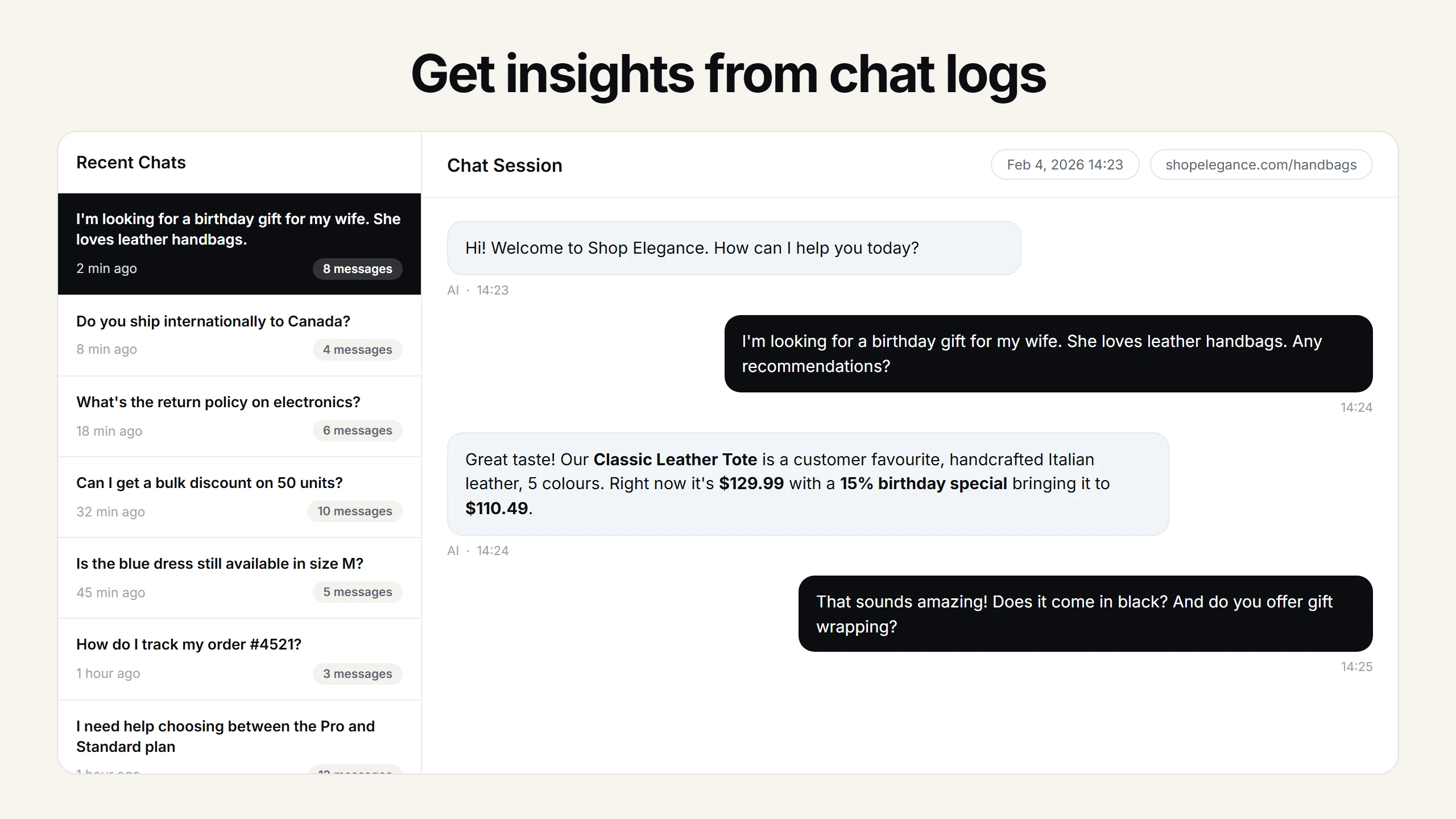
Analytics are where the virtual agent quietly pays for itself a second time. Every conversation is logged, transcripted, grouped by topic, and surfaced in the dashboard. Over a few weeks, patterns stop being anecdotal and become measurable. The fact that thirty visitors this month flagged the same confusion about shipping thresholds is a signal that your free-shipping banner is ambiguous. The fact that Spanish-speaking users ask about a region-specific feature twice as often as English-speaking ones is a product hint. The virtual agent doesn't just deflect tickets; it tells you which parts of your product and your documentation are leaking customers into tickets in the first place. A support ops lead with this data has a rewrite list for the help center that generates itself.
We should talk honestly about the cases where this doesn't work. A virtual customer service agent is not appropriate for life-safety incidents, legally regulated disclosures in some jurisdictions, or conversations where a human's emotional presence is the product. If you're running crisis support, high-stakes financial advisory, or anything where getting the tone wrong is a headline-grade risk, the virtual agent should not be the front line — at best it's a triage layer that routes fast. Outside those edges, the pattern holds up. Most service queues in ecommerce, SaaS, professional services, education, and membership businesses are dominated by repetitive, content-answerable questions that don't need a human brain to close. Those are the cases the virtual agent exists for.
One last piece, which is the quiet reason operators stick with the tool after the honeymoon. The virtual agent doesn't get tired, doesn't have an off day, doesn't ghost a shift, doesn't deliver a mediocre answer because a queue has stacked up and mental load is high. Tuesday at 4pm and Sunday at 2am are the same shift to it. The Monday after a product launch, when ticket volume triples, doesn't degrade response quality. That consistency is unglamorous to pitch but operationally enormous — it means your service experience stops being a function of who happened to be staffing the queue at that moment. A virtual customer service agent, properly trained and properly bounded, becomes one of the most reliable members of the team. And the invoice at the end of the month is two digits.