Shopify virtual assistant that helps every shopper find what they came for
Asyntai offers an AI-powered Shopify virtual assistant that lives on your storefront — answering from your catalog and policies, recommending the right products, answering questions in 36 languages, and working every hour of every day.
Try the Shopify virtual assistant on your store
Drop in your Shopify URL and see how the virtual assistant would greet shoppers and guide them through the store
Answers from every product, collection, and policy — not from generic shopping advice
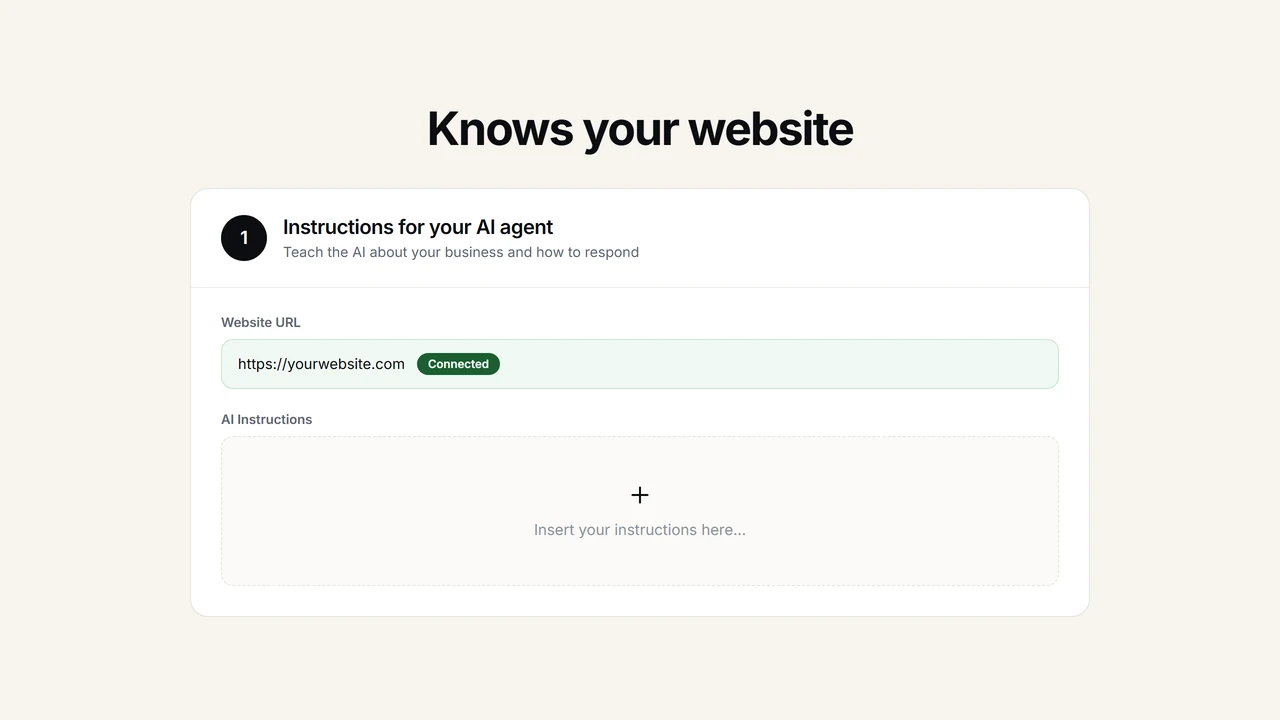
A Shopify virtual assistant is only valuable if it actually knows the store. Asyntai crawls your catalog — products, variants, collections, pricing, policies — and adds any private documents you upload, so every recommendation is grounded in what's actually on your Shopify store.
- Auto-crawls your Shopify catalogProducts, variants, collections, prices, policies — absorbed in minutes, updated whenever you re-train the assistant.
- Upload what the storefront doesn't showInternal size fit notes, care instructions, supplier timelines, wholesale terms, seasonal promotion rules — added as PDFs or pasted text.
- Your house voice and selling rules"Recommend the bestseller if a shopper is undecided." "Suggest matching accessories where relevant." "Offer a discount code at checkout hesitation." The virtual assistant follows your rules.
Guides shoppers through the buying decision, not just past it
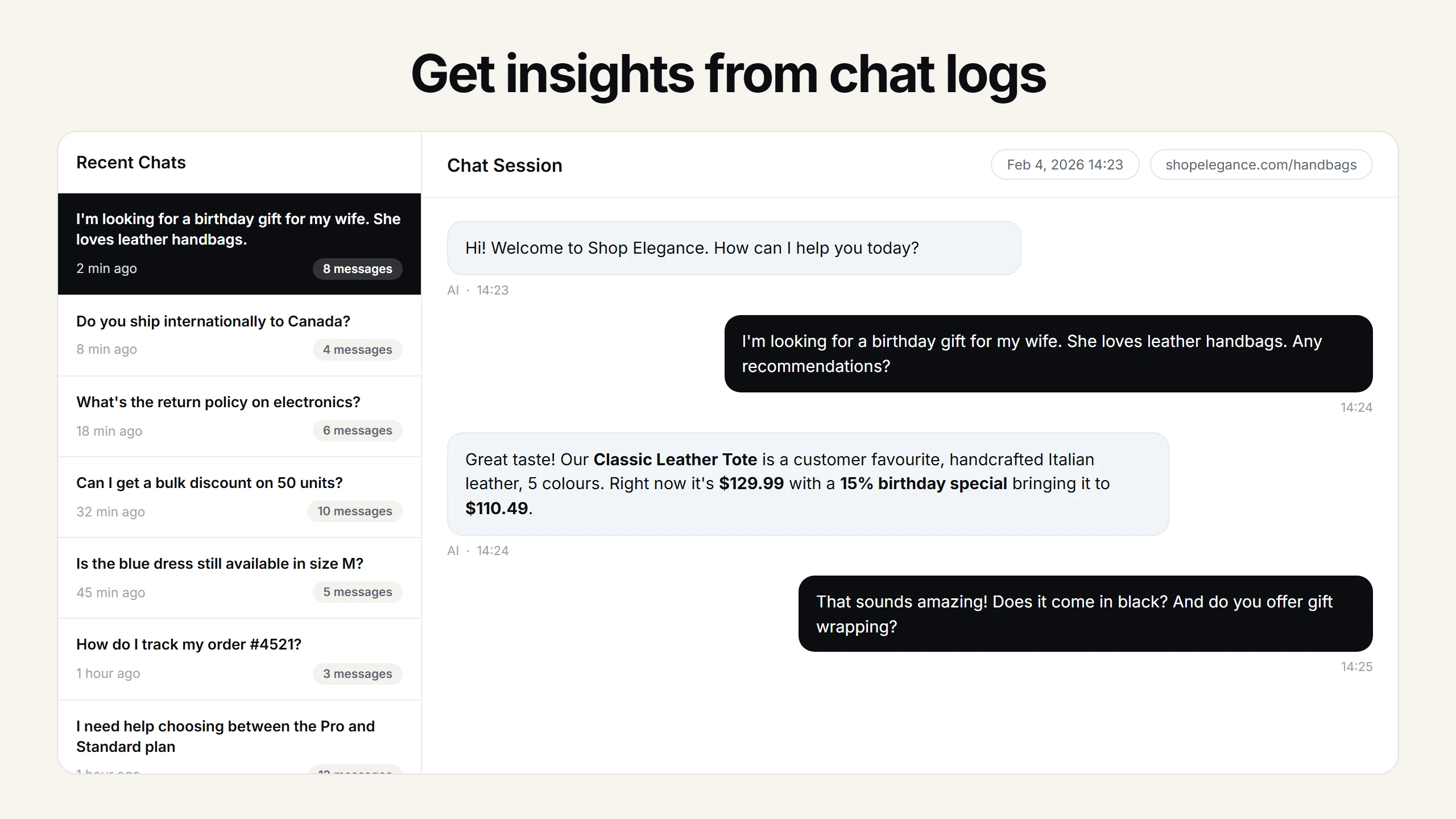
Most shoppers don't land on your store knowing exactly what they want. A good Shopify virtual assistant asks the right clarifying questions, narrows the catalog, suggests options, and closes the hesitation — the same way a skilled in-store associate would.
- Proactive on product and cart pagesOpens the assistant after a configurable delay at the moments where shoppers typically hesitate.
- Smart lead capture when neededIf a shopper isn't ready to buy, the assistant can collect an email or phone number for follow-up, with full conversation context attached.
- Personalized with User ContextWith User Context on Standard and Pro plans, your store can pass logged-in shopper data for personalized greetings, order status answers, and VIP handling.
Deployed on your store in one afternoon
The Shopify virtual assistant installs as a single JavaScript snippet in theme.liquid. No Shopify App Store install required, no recurring marketplace app fees, no broad store-data permissions — just a script tag and your existing Shopify admin access.
- Sign up for a free Asyntai account and copy your personal snippet.
- In Shopify admin, go to Online Store → Themes → Edit Code.
- Open
theme.liquidand paste the snippet before the closing</body>. - Point Asyntai at your store URL, upload any internal documents, and go live.
<script src="https://asyntai.com/widget.js"
data-id="your-store-id" async>
</script>
</body>
# Shopify virtual assistant live on every page.
Shopify virtual assistant — FAQs
What store owners usually confirm before replacing a human VA or layering this on top of one.
Is this an AI assistant or a human VA service?
AI. Asyntai provides an AI-powered Shopify virtual assistant that lives on your storefront, answers shopper questions 24/7, and recommends products based on your catalog. It doesn't replace a human VA handling store admin tasks like order fulfillment, inventory management, or supplier coordination — that's a separate job. Where it does replace a human VA is on customer-facing shopper interaction, which is where most stores spend VA hours anyway.
Does it actually recommend products to shoppers?
Yes. Once the AI has crawled your catalog, it can suggest products based on what the shopper asks — "I need a gift for my sister who likes minimalist jewelry" pulls from your jewelry collection with a relevant recommendation. It can also show product cards with images and buy buttons directly in chat, guiding the shopper toward checkout without them having to navigate back through your menu.
Can it handle order status questions for existing customers?
Yes, via the User Context feature on Standard and Pro plans. Your Shopify store passes logged-in customer order data — status, tracking number, items, shipping address — into a JavaScript object before the widget loads. The virtual assistant answers questions like "where is my order" directly without needing any Shopify App Store integration.
What languages does the Shopify virtual assistant speak?
36. The widget UI is localized into 36 languages and the AI detects the shopper's language from their first message. A French shopper gets French responses, a Japanese shopper gets Japanese, a German shopper gets German — without translation setup on your Shopify store.
How does the cost compare to hiring a human Shopify VA?
A human Shopify VA handling customer-facing chat typically costs $400–$1,500 per month for part-time coverage, depending on region and scope. The AI virtual assistant starts free (100 messages a month), with paid plans at $39/month for 2,500 conversations. For pure customer-facing chat volume, the AI is dramatically cheaper — and it covers 24/7 and 36 languages out of the box, which a human VA can't.
Will this slow down my Shopify store?
The widget loads asynchronously after your theme renders, so it doesn't block page load. It's a single script tag, similar in weight to a Meta Pixel or Google Tag on your Shopify store.
Can I train the virtual assistant on internal documents my store doesn't publish?
Yes. Size charts you keep internally, supplier-specific care instructions, wholesale pricing for B2B, onboarding guides for new customers — upload them as PDFs or paste as text into your Asyntai knowledge base, and the virtual assistant uses them in relevant conversations.
Can I run the virtual assistant on multiple Shopify stores?
Yes on paid plans. Free: 1 site, Starter: 2, Standard: 3, Pro: up to 10. Each Shopify store gets its own separately trained virtual assistant — useful for brand holdcos, multi-region operators, or agencies managing virtual assistants across client stores.
Shopify virtual assistant — what it actually does for a store
Hiring a Shopify virtual assistant used to mean posting a job on Upwork, Onlinejobs.ph, or a Filipino staffing agency, reviewing thirty applications, interviewing five candidates, onboarding the one you picked over two to four weeks, and hoping they stay long enough to learn your catalog before the turnover cycle starts again. This model works for specific operational tasks — order processing, product uploads, inventory audits, supplier coordination — and it's still the right call for most of the back-office work a growing Shopify store generates. Where it breaks down is on customer-facing interaction, which is the part of a VA's job where consistency, availability, and product knowledge matter most, and where the human model has always struggled. An AI Shopify virtual assistant solves specifically that piece, without competing with the human VA handling everything else.
The core difference between a human VA and an AI virtual assistant on a Shopify store is what each one is good at. A human VA can handle nuance, escalate judgment calls, follow up manually with difficult customers, and improvise around situations no script would cover. An AI virtual assistant can handle high volume instantly, in every language you sell in, at every hour of the day, with perfect consistency on the questions that are already answered somewhere in your store content. Most stores need both — the AI handles the 80% of shopper interaction that's repetitive and content-answerable, and the human VA (or store owner) handles the 20% that genuinely requires judgment. The point isn't to replace the human side of operations; it's to stop spending human hours on questions the store already has answers for.
The shopper experience of talking to a well-trained Shopify virtual assistant feels closer to a good in-store associate than a typical online chatbot. A shopper who types "I'm looking for a gift for my sister, she likes minimalist stuff, budget around $80" gets a response that narrows the catalog — a couple of specific product suggestions with images, a relevant collection link, and a clarifying question about size or color if that matters. A shopper who asks "will this fit someone 1.75 meters tall" gets an answer pulled from your actual size chart. A shopper who hesitates at the cart with a shipping question gets the shipping information they needed. This is different from a button-tree chatbot, which asks the shopper to self-select from a predefined menu, and it's different from a pure FAQ search, which returns links instead of answers. The virtual assistant does the work of figuring out what the shopper actually wanted and responds accordingly.
Training the Shopify virtual assistant is where most store owners are pleasantly surprised. You don't write out hundreds of Q&A pairs. You don't map conversation flows. You give Asyntai your Shopify store URL, and the AI crawls your product pages, collections, and policy pages automatically. That alone gets most stores to production-grade answers on day one. For content that doesn't live on the public site — internal size-fit notes your customer service team references, supplier-specific shipping quirks, a wholesale pricing sheet for B2B customers, care instructions that didn't make the final product page — you upload those as PDFs or paste them directly into the knowledge base. Custom instructions, written in plain English, handle tone and selling rules: "always recommend the bestseller when a shopper seems undecided," "never promise a shipping date without asking destination country first," "offer the matching accessory when appropriate." The AI applies these rules consistently across every conversation.
The economics are where the AI virtual assistant pulls away most clearly. A Shopify store hiring a part-time VA in the Philippines might pay $400–$700 per month for 20–30 hours of coverage. A US-based or European VA runs $1,500–$3,000 per month for similar hours. In both cases, you're paying for a specific number of hours that still don't cover 24/7, don't cover multiple languages, and require ongoing training as your catalog and policies change. Asyntai's Shopify virtual assistant starts at $39 per month for 2,500 conversations — which at most stores handles the equivalent of several VA-months of customer-facing chat volume — and covers 24/7 in 36 languages without additional hiring. For most stores under enterprise scale, the cost math just isn't close.
International reach is the place where a Shopify virtual assistant with real language coverage pays back fastest. A store shipping worldwide will see visitors from ten or fifteen countries in the same week, and a single-language human VA either creates friction (translate in your head, try Google Translate, or give up) or sends the shopper to email, where they usually don't return. The Asyntai widget supports 36 languages in the UI and the AI detects the shopper's language directly from their message. A French shopper asking about sizing gets French answers, a Japanese shopper gets Japanese, a Brazilian shopper gets Portuguese, an Arabic-speaking shopper gets Arabic responses. This runs from one installation, no additional hiring, no translation plugin. For stores that have been leaving international conversion on the table because translation felt expensive, the virtual assistant changes the economics in a single install.
Order status is where customer-facing VA work tends to concentrate on Shopify stores post-purchase. "Where is my order" is the most common post-purchase question across every brand, and historically either required a VA with access to Shopify admin to look up the order, or an integration that pulled order data into the chat tool. Asyntai handles it through the User Context feature on Standard and Pro plans: your storefront passes the logged-in customer's order data — status, tracking number, ETA, items — into a JavaScript object before the widget loads. The virtual assistant uses that context to answer directly without needing Shopify App Store permissions or API credentials. Nothing is pulled; you control exactly what data the assistant can see.
Proactive engagement is what separates a Shopify virtual assistant that drives conversion from one that sits quietly in the corner waiting to be clicked. A shopper browsing a product page, hesitating on a size decision, or pausing in the cart is the moment when a good in-store associate would walk over and offer help. The AI equivalent, Asyntai's auto-trigger, opens the assistant after a configurable delay on pages where shoppers tend to need help — product pages, cart pages, category pages where comparison happens. On mobile, the trigger is a smaller bubble rather than a full-screen takeover, so you don't scare away a thumb-scrolling shopper. The conversion lift from this single behavior typically exceeds the lift from any other single chat feature.
Lead capture handles the shoppers who aren't ready to buy in the session but are still interested. Instead of losing them to a silent bounce, the virtual assistant asks for an email or phone number — configurable to either, both, or neither depending on your preference — and every captured contact arrives in your Asyntai dashboard with the full conversation transcript. If you enable email notifications, the same transcript lands in your inbox in real time. When a shopper asks about a product that's currently out of stock, you end up with their email, their size preference, and an opportunity to follow up when the item is back. When someone hesitates on a high-consideration purchase, you end up with their email, the objection they raised, and a chance to address it directly.
Consistency is the underrated benefit of an AI Shopify virtual assistant that teams only appreciate after the fact. A rotating group of human VAs answering customer questions across shifts inevitably produces slight inconsistencies: the return window gets quoted as 30 days by one VA and "about a month" by another, the shipping policy gets explained correctly but in different levels of detail depending on who's on duty, the same product gets recommended to a shopper's gift inquiry in three different ways across three different VAs. None of this is wrong, but it's not consistent either. An AI pulls from one knowledge base every single time. If the return window is 30 days, it's 30 days in every reply, in every language, at every hour. For stores where inconsistency leads to downstream disputes or refund issues, this alone justifies the virtual assistant.
What shoppers ask the virtual assistant turns into a product-page audit you didn't know you needed. If forty shoppers this week asked about machine-washability for a specific linen shirt, your product page needs clearer care instructions. If international buyers keep asking what they'll owe in duties at delivery, the shipping page needs a clearer breakdown of what's covered at checkout. If the same sizing question keeps appearing on a specific product, your size chart needs improvement. Conversation analytics inside the Asyntai dashboard surface these patterns grouped by frequency and topic, so the virtual assistant isn't just deflecting questions — it's pointing at the pages you should rewrite so fewer questions arise in the first place.
The Shopify stores that benefit most from an AI virtual assistant are the ones with catalog variety and a meaningful share of pre-purchase questions. Fashion brands win on sizing, fit, and style questions. Skincare and wellness stores win on ingredient and compatibility questions. Home and furniture shops win on dimensions and delivery logistics. Dropshippers win on trust-gap questions about shipping and returns. Subscription box brands win on "can I pause / skip / swap" questions handled instantly. Gift shops win on "what should I get for X" recommendation conversations. International DTC brands win on language coverage. Across all of these verticals, the pattern is the same: the virtual assistant captures the conversion that was about to walk because there was nobody to answer the question in time.
Deploying the Shopify virtual assistant doesn't require a migration, a project plan, or a meeting. Paste the snippet into theme.liquid through your existing Shopify admin access. Let the AI crawl your store URL. Upload anything internal that should inform its answers. Write two or three custom instructions that capture your selling voice. Test five real-world shopper conversations to make sure the assistant responds the way you want. Go live. Most stores complete the full deployment inside an afternoon. From there, the virtual assistant runs quietly — helping every shopper who lands on your store, recommending products, capturing leads when the sale doesn't close on the spot, handling order status for existing customers, and surfacing the analytics that tell you which product pages need more work. For most Shopify stores, it's the cheapest way to add reliable customer-facing coverage without adding a headcount.