Shopify customer support chat that answers before you wake up
Asyntai offers AI-powered Shopify customer support chat that reads your policies and product pages, then handles the repetitive shipping, returns, and product questions for you — in 36 languages, around the clock.
Try Shopify customer support chat on your store
Drop in your Shopify URL and see how the chat would answer your actual support questions
Answers from your policies, not from generic scripts
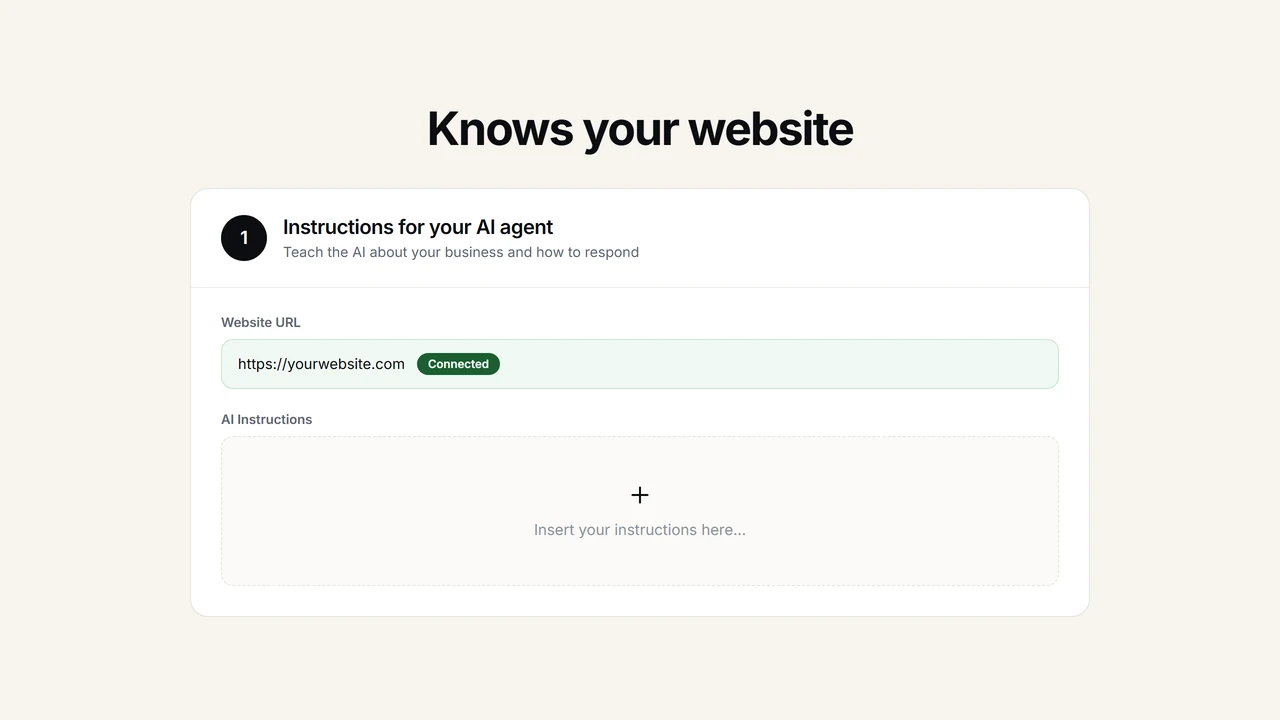
Shopify customer support chat is only useful if it actually knows your store. Asyntai crawls your shipping, returns, FAQ, and policy pages automatically — and you upload anything else that should inform a response. No canned answers, no generic fallbacks.
- Auto-reads policy and FAQ pagesShipping terms, return windows, payment methods, size guides — anything you've already published gets absorbed into the support knowledge base.
- Upload what the crawler can't seeInternal SOPs, edge-case return procedures, wholesale pricing, replacement part guides — add them as PDFs or pasted text.
- Custom escalation rules"Always collect the order number before answering shipping questions." "Escalate refund disputes over $500 to a human." You write the rules; the chat follows them.
The questions your team answers fifty times a day, handled instantly
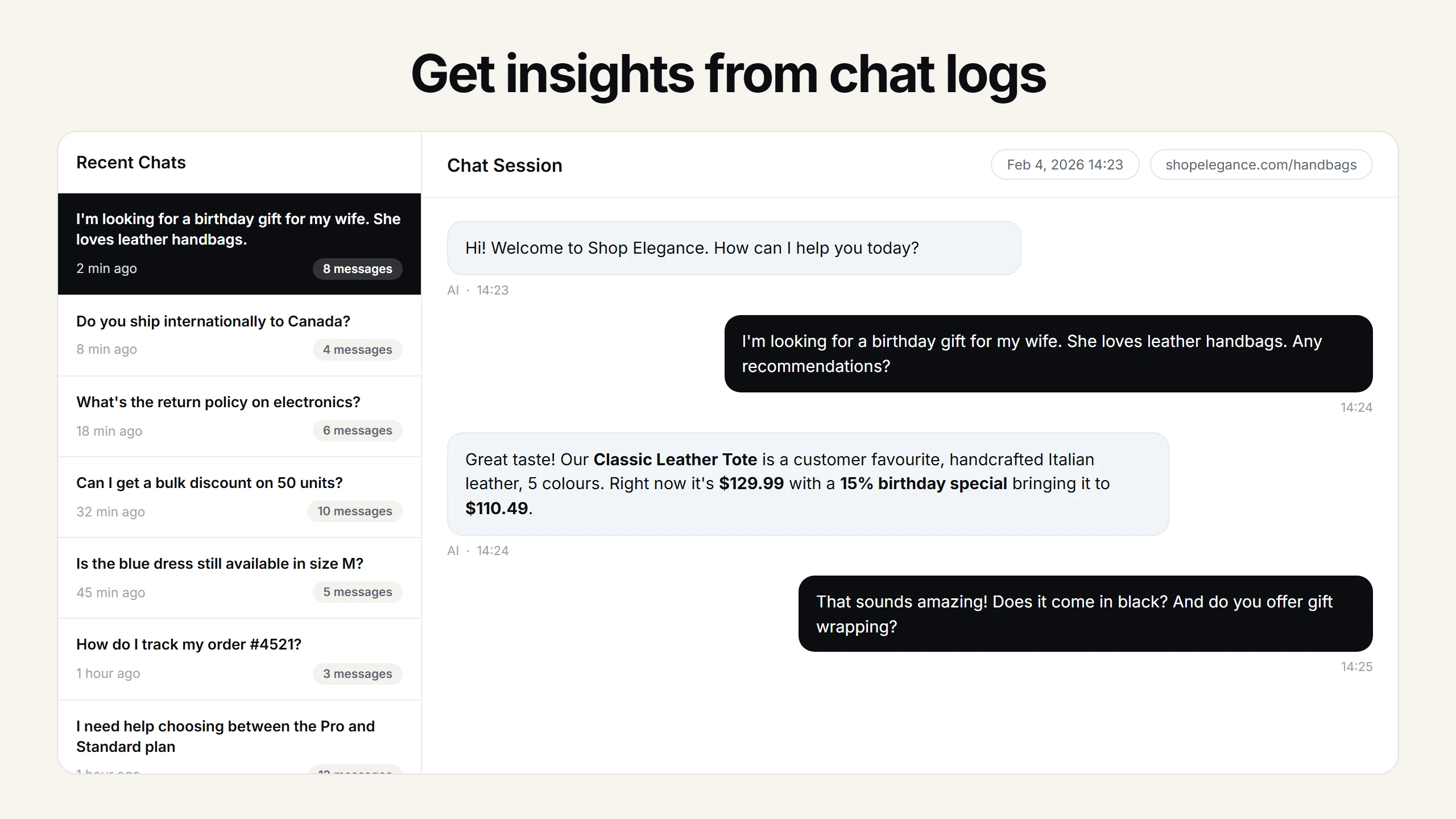
Most Shopify customer support volume is the same handful of questions — where is my order, can I return this, do you ship to my country, what's your size chart. Asyntai answers those in seconds, so your team only sees the tickets that actually need a human.
- 24/7 first responseCustomers get an answer at 3 AM on a Sunday — whether your team is asleep, off shift, or in a different timezone entirely.
- Escalation with full contextWhen the chat can't resolve the issue, it captures the shopper's email and the full conversation and hands it to your existing support inbox.
- Volume insightConversation analytics show which questions generate the most support load — so you know which policy page to rewrite first.
One script tag. No Shopify App Store install.
The support chat installs as a JavaScript snippet in theme.liquid — the same place you'd add a Google Tag. No App Store review, no broad store-data permissions, no extra plugin for your ops team to maintain.
- Sign up for a free Asyntai account and copy your personal snippet.
- In Shopify admin, go to Online Store → Themes → Edit Code.
- Open
theme.liquidand paste the snippet before the closing</body>. - Save. The Shopify customer support chat is live on every page of your store.
<script src="https://asyntai.com/widget.js"
data-id="your-store-id" async>
</script>
</body>
# Done. Test a support question in 30 seconds.
Shopify customer support chat — FAQs
What store ops teams usually ask before switching to AI-first support.
Can the chat answer specific order status questions?
Yes, via the User Context feature (Standard and Pro plans). Your Shopify store passes the logged-in customer's order data — status, tracking number, items, shipping address — to the widget through a JavaScript object before the chat loads. The AI then answers questions like "where is my order" or "when will my package arrive" using that context, without needing any App Store integration or extra permissions on your store.
What percentage of support tickets can the chat actually handle?
It depends on your store. For most Shopify stores, 60–80% of inbound tickets are content-answerable — shipping policies, return windows, product specs, sizing, payment methods, promotion details. Those are handled directly. With User Context enabled (Standard and Pro plans), order-status questions are also handled automatically, which covers another large slice of typical support volume. Genuine edge cases — complex refund disputes, custom bulk orders, carrier-lost shipments — escalate to your team with full conversation context attached.
Does the support chat work in other languages?
Yes. The widget UI is available in 36 languages, and the AI detects the shopper's language from their first message. French customers get French replies, Japanese customers get Japanese, German customers get German — without any translation plugin setup on your Shopify store.
How does escalation to a human actually work?
When a conversation hits something the AI can't resolve, it can ask for the shopper's email (and phone, if you want). Every escalation lands in your Asyntai dashboard, and if you turn on email notifications, the full transcript arrives in your inbox so your support team has the context before replying. There's no separate handoff tool to integrate.
Will it slow down my Shopify store?
The widget loads asynchronously after your theme renders, so it doesn't block page load. It's a single script tag, similar in weight to a Meta Pixel or Google Tag.
Can it answer from our specific return and shipping policies?
Yes. Asyntai crawls your public policy pages automatically, and you can upload any additional documents — an internal returns playbook, carrier-specific shipping tables, warranty procedures — as PDFs or pasted text. The chat treats all of it as one knowledge base.
What happens if we hit our monthly message limit?
The support chat pauses new replies until the next billing cycle or until you upgrade. You get email warnings before you actually hit the cap, so a Black Friday traffic spike doesn't silently cut off customer support mid-sale.
Can I run it on more than one Shopify store?
Yes on paid plans. Free: 1 site, Starter: 2, Standard: 3, Pro: up to 10. Each store gets its own separately trained support chat, which matters for brand holdcos or agencies running customer support across multiple Shopify properties.
Shopify customer support chat, explained properly
Most Shopify support inboxes tell the same story. A stack of tickets, 70% of which are some variation of "where is my order," "can I return this," "do you ship to [country]," or "what's your size chart for this shirt." A real human reads each one, opens the order in Shopify admin if needed, copies a shipping link, sends the reply, closes the ticket, and moves to the next identical question. This is the work a Shopify customer support chat is built to remove. Not all of it — the genuinely complex tickets still need a person — but the repetitive majority that silently eats your team's day.
The pattern of questions customers actually ask on a Shopify store is remarkably stable. Pre-purchase: sizing, fit, availability, shipping estimates, international duties, payment methods. Post-purchase: where is my order, shipping tracking, return and exchange process, warranty questions. Everything else — the angry refund dispute, the custom bulk order, the edge-case international return — is the long tail. A content-trained Shopify customer support chat handles the stable majority of pre-purchase questions perfectly, and the post-purchase questions where the answer lives in your policy pages. That's already a meaningful fraction of your total support load.
Order-status questions deserve a specific note, because they're usually the single largest chunk of Shopify support volume. Asyntai handles them through a feature called User Context (available on Standard and Pro plans). Your Shopify storefront passes the logged-in customer's current order data — status, tracking number, line items, shipping address, whatever you choose to share — into a small JavaScript object before the widget loads. The AI reads that context and answers "where is my order" or "when will it arrive" without any App Store app, without any permissions on your store beyond what your own theme already has, and without the chat needing to call Shopify itself. You keep control of exactly which customer data the chatbot sees, and the implementation is the same generic mechanism that works on any platform, not just Shopify.
Training the support chat to sound like your store is the first real setup task, and it's fast. Asyntai crawls your store URL and absorbs what's publicly visible: product pages, collections, FAQ, shipping page, returns page, terms, any policy content you've published. If there's content that lives internally rather than on the public site — a wholesale return procedure, a regional shipping table, a warranty document, an internal SOP for handling damaged items — you upload it as a PDF or paste it directly into the knowledge base. Custom instructions let you specify tone and escalation rules in plain English: "always suggest checking the spam folder before escalating missing tracking emails," or "for questions about international duties, link to the shipping FAQ and offer email follow-up." The Shopify customer support chat follows those rules across every conversation.
One of the quietest advantages of an AI support chat on Shopify is timezone coverage. Your store probably sells across regions — EU, US, sometimes Asia — and a customer who hits a question at 2 AM their local time will either get an answer on the spot or close the tab and forget about the purchase entirely. A human support team can't reasonably staff around the clock unless your volume justifies it, but the AI can. The compounding effect: fewer late-night tickets waiting in the queue in the morning, fewer abandoned carts that never came back, and a measurable reduction in the "I emailed two days ago and never heard back" review tone that drags down store reputation.
Multilingual customers are the other underrated gain. Your product pages might be in English, but a German shopper who asks a question in German and gets an English reply either has to translate in their head or gives up. With 36 widget UI languages and AI language detection, the same Shopify customer support chat responds in German to a German shopper, in Japanese to a Japanese shopper, and in French to a French shopper — from the same single setup, no translation plugin, no secondary configuration. For stores that use Shopify to sell across the EU or internationally, this is often where the AI pays for itself the fastest.
The install story is where a lot of Shopify support tools overreach. Shopify App Store apps ask for broad permissions over orders, customers, inventory, and checkout data, then bill you monthly through the Shopify marketplace on top of your plan. That is fine for some integrations but overkill for a customer support chat that mostly needs to read your content and answer questions. Asyntai is the other direction: paste one line of JavaScript into theme.liquid, similar to adding a Meta Pixel, and the widget loads from an external domain. No App Store install and no blanket permission prompt — the chat only sees the specific data your site chooses to pass through User Context, nothing more. If you want to remove it, delete the line. For ops teams that manage multiple stores or brand portfolios, this makes rollout dramatically simpler.
A Shopify customer support chat works best when it engages at the right moment, not when it nags every visitor. Asyntai's auto-trigger opens the widget after a configurable delay on pages where customers typically need help — the cart, the product page, the shipping FAQ itself. On mobile, the opening behavior is gentler (a chat bubble rather than a full-screen takeover), so you don't drive away a thumb-scrolling customer who was about to check out. The calibration matters: an overly aggressive chat widget increases bounce rate; a perfectly calibrated one catches the confused shopper right before they would have left the store.
When the chat genuinely can't resolve an issue, it captures the handoff properly. During any conversation, the AI can ask for the customer's email and, if configured, a phone number. The captured lead — plus the full conversation transcript — lands in your Asyntai dashboard, and if you turn on email notifications, your support team gets a real-time email the moment the escalation happens. Nothing custom to integrate. No webhook to maintain. The ticket your team receives already has the customer's question, the AI's attempted answer, and any order number or detail the shopper shared. That preamble saves your agents the 90 seconds they normally spend reconstructing context from a cold ticket.
What customers ask the support chat is, functionally, a live map of where your policies fail to be clear. If thirty shoppers this week asked "is shipping free for orders over $50," the answer is probably buried three clicks from the product page, and the cart banner could fix half those tickets. If international customers keep asking about duties, a visible duties-included badge in checkout solves it. If a specific product generates repeat sizing questions, the product page size chart needs an update. Conversation analytics make this visible from the dashboard: which questions are most common, which responses are most repeated, which topics generate the largest share of escalations. Over time, the Shopify customer support chat isn't just answering questions — it's pointing at the pages that need rewriting so fewer questions arise in the first place.
Pricing is set up to keep AI-first customer support viable at any store scale. The free tier includes 50 messages a month, enough to run a small store or pilot the idea on a single product category. Paid plans start at $39 per month for 800 messages, which is realistic for the typical pre-purchase and post-purchase volume of a mid-size Shopify store. Higher tiers handle heavy peak seasons — Black Friday, pre-holiday, product launches — where customer inquiries spike. Site limits scale with the plan (free 1, Starter 2, Standard 3, Pro up to 10), which matters for brand holdcos and agencies running support across multiple stores. Monthly caps send email warnings before the widget pauses, so a promotional spike doesn't silently kill your Shopify customer support chat mid-sale.
The question of when you still need human agents has a clean answer: at the same points you always needed them. A shopper who wants a refund you don't automatically grant, a customer who had a shipment lost by the carrier, an edge-case return that requires judgment, a wholesale negotiation — these still belong with a person. The goal isn't to replace your support team; it's to remove the repetitive 60–80% of their volume so the 20–40% that really needs a human gets proper attention. The AI plus a small human team, properly used, outperforms either in isolation. Support SLA improves, response times drop to seconds for common questions, and your actual agents stop burning out answering the same shipping question for the hundredth time this week.
Almost any Shopify store with more than trivial traffic benefits from automated support chat, but certain categories see the biggest return. Fashion and apparel brands benefit heavily from sizing and fit questions being answered instantly. Skincare and health brands reduce ingredient and compatibility questions. Home goods and furniture stores handle dimension and assembly questions on the spot. Dropshippers — where customers are least familiar with the products — lean on the chat to close trust gaps about shipping timelines and returns. Stores selling internationally win on the multilingual coverage alone. The pattern holds across verticals: wherever the majority of customer questions are answerable from content, a Shopify customer support chat removes them from the human queue.
Setup is genuinely fast. Paste the snippet into theme.liquid, point the AI at your store URL, let it crawl your policies, test a handful of support questions to make sure the answers match your voice, switch on auto-trigger, and go live. Most stores finish the full setup in under half an hour. From there, the Shopify customer support chat runs quietly in the background — answering questions, deflecting tickets, escalating edge cases, and generating the analytics that tell you which part of your store needs more clarity. You don't notice most of the work it does. You notice the support inbox getting quieter.