The Shopify AI assistant that shops with your customers
Asyntai is a Shopify AI assistant that greets shoppers, narrows down the right product, and handles the sizing, shipping, and stock questions that usually end in a bounced tab — in 36 languages, on every page of your store.
Try the Shopify AI assistant on your store for free
Drop in your storefront URL and watch a concierge-style AI walk through your catalog
Point at your catalog. Get a shopping concierge.
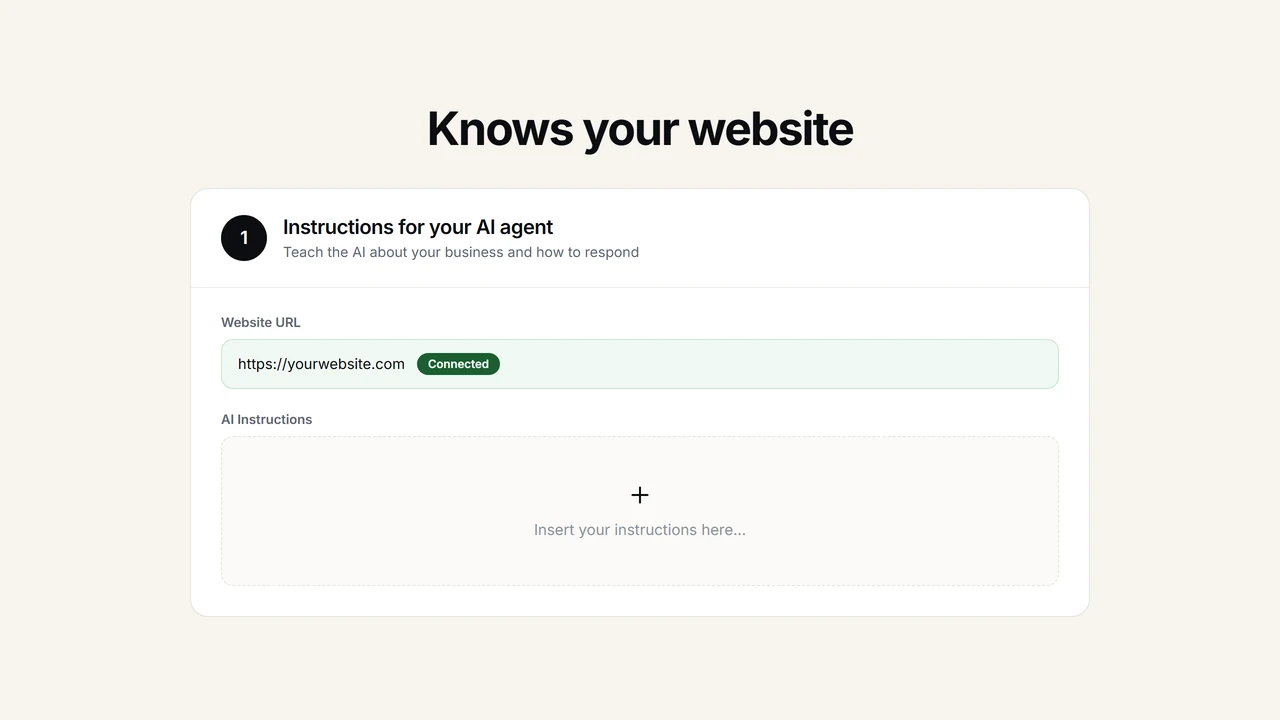
The Shopify AI assistant reads your product pages, collections, and policies the moment you connect the store — then turns that knowledge into guided shopping conversations. No decision trees, no keyword lists, no rigid flows. Just an assistant that actually understands what you sell.
- Guided product discoveryShoppers describe what they want in plain words and the AI surfaces matching SKUs, variants, and bundles from your catalog.
- Context that carries across messagesAsk about a jacket, then about matching pants, then about returns — the assistant remembers the thread instead of resetting every turn.
- Your voice, your rulesPlain-English instructions shape tone, upsell logic, and which collections get prioritized when a shopper is undecided.
Logged-in shopper? The assistant already knows them.
On Standard and Pro plans, User Context lets your Shopify theme pass the signed-in customer's name, recent order, or loyalty status to the assistant before the chat opens — so follow-ups about delivery dates or repeat purchases feel handled instead of restarted.
- Pre-loaded customer data via window.Asyntai.userContextA tiny snippet in theme.liquid hands the assistant what it needs to personalize — order status, name, segment — before a single message is typed.
- Lead capture during the conversationFor anonymous browsers, the assistant can request an email or phone mid-chat. Captured leads land in your Asyntai dashboard with optional email alerts for every new one.
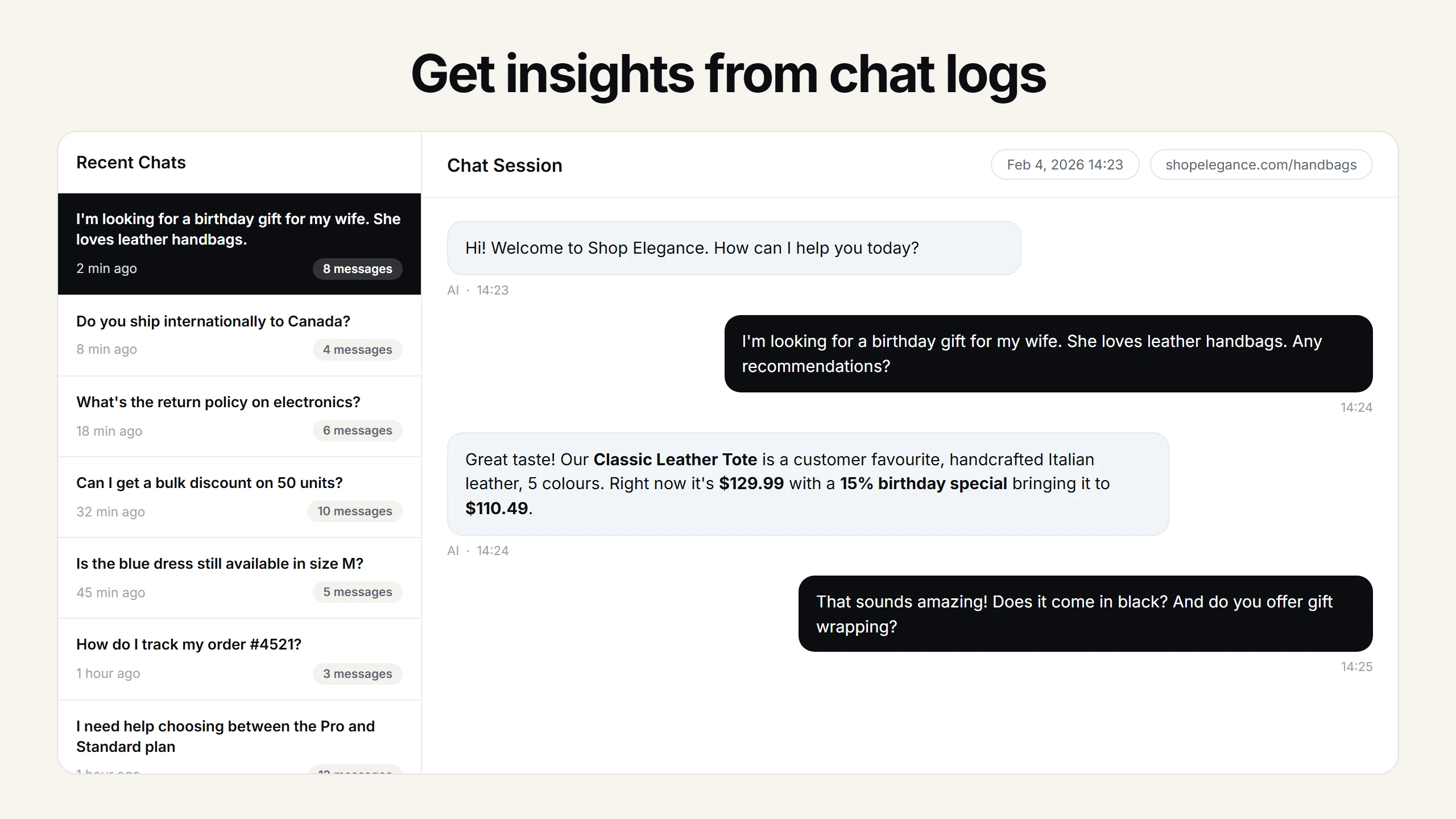
- Analytics that reshape your PDPsEvery conversation is logged and tagged. Patterns in shopper questions flag the gaps in your product descriptions, shipping pages, and size guides.
Install the assistant without the App Store
The Shopify AI assistant lives in a single async-loaded script. Paste it into theme.liquid once and it runs on every storefront page — product, collection, cart, checkout-lite, blog, everything — without requesting broad access to your orders or customers.
- Create a free Asyntai account and grab the snippet tied to your store ID.
- In Shopify admin, open Online Store → Themes → Actions → Edit Code.
- Open theme.liquid and paste the snippet just above
</body>. - Hit Save. The Shopify AI assistant is live on Dawn, Debut, Brooklyn, or any custom theme.
<script src="https://asyntai.com/widget.js"
data-id="your-store-id" async>
</script>
</body>
# Works with Shopify Markets and every theme.
Shopify AI assistant — FAQs
The questions merchants ask us before plugging it into a live store.
How is this different from a basic Shopify chatbot?
A chatbot answers. A Shopify AI assistant guides — it asks clarifying questions, narrows down the right SKU from a broad request, remembers earlier turns, and adapts to the shopper's language mid-conversation. The underlying model is LLM-based, so there are no scripted flows to build or maintain.
Do I have to install a Shopify App Store app?
No. Asyntai runs as a script tag in theme.liquid, which means the assistant never gets access to orders, customer records, or fulfillment data. There is also an Asyntai listing on the Shopify App Store if you prefer the native install path, but the lightweight tag install is what most merchants pick.
Can the assistant see who's logged in?
Only when you hand it that data. On Standard and Pro plans, your theme can set a window.Asyntai.userContext object before the widget loads — things like customer first name, latest order ID, or VIP tier. The assistant then personalizes replies for that signed-in shopper.
Which Shopify themes are supported?
Every theme. The assistant sits as an overlay on top of your storefront, so Dawn, Debut, Brooklyn, Sense, and any custom Shopify 2.0 theme all work identically. Shopify Markets storefronts are covered too — the assistant detects the shopper's language on its own.
What about shoppers who speak Japanese, German, or Arabic?
The widget interface ships in 36 languages and the AI itself replies in whichever language the shopper types. A buyer from Tokyo gets Japanese, a buyer from Frankfurt gets German, a buyer from Dubai gets Arabic — with no translation plugin and no extra configuration on your side.
What happens when shoppers go beyond my message allowance?
The free tier bundles 50 messages a month to try things out. Paid plans begin at $39 a month for 800 messages. When the allowance is used, the assistant pauses new replies until the cycle rolls over or you move to a bigger plan — and you'll see email warnings before that happens.
Can one account cover several Shopify stores?
Yes. Site limits are 1 on Free, 2 on Starter, 3 on Standard, and up to 10 on Pro. Each store has its own independently configured Shopify AI assistant, so a home-goods brand and a fashion brand under the same account don't share a knowledge base.
Where do captured leads end up?
Inside your Asyntai dashboard, complete with the full conversation transcript. If you enable email notifications, you'll also get a real-time message whenever the assistant captures a new email or phone number. No Klaviyo, HubSpot, or Salesforce auto-sync — you export or forward leads on your own schedule.
A practical guide to picking a Shopify AI assistant
Picture the top ten percent of your Shopify traffic on any given day — the shoppers who clicked an ad, read the headline, scrolled the hero image, tapped a variant, and paused. Those paused taps are where revenue is made or lost. A Shopify AI assistant exists because that pause is almost always a question: "does this fit the way I think it does", "will it actually arrive before the weekend", "is the color closer to the first photo or the third", "can I return it if it's wrong". The store does not have to answer perfectly; it just has to answer at all, in the language the shopper already typed, before the tab closes. Everything that follows is a guide to picking the right assistant for that job, not a sales pitch wearing a trench coat.
Start with the distinction that matters: assistant versus chatbot. A chatbot reacts to keywords and routes through pre-built flows, which ages badly the instant a shopper asks something phrased in a way the flow didn't anticipate. A Shopify AI assistant reasons over the content you give it — product catalog, collections, policies, uploaded size charts — and forms answers on the fly, in sentences, carrying the thread of a conversation from message to message. The difference feels subtle on a demo and enormous on a Monday morning when a shopper asks whether the linen dress in medium will fit a 168 cm frame who usually wears a Zara small. A keyword tree freezes. An assistant answers.
The first practical test is training speed. If the assistant needs a week of configuration before it can answer shopper questions competently, something is wrong. Asyntai's approach is the opposite end of that spectrum: paste the storefront URL, let the crawler read the catalog and policy pages, and watch the assistant answer product questions within minutes. If there are things the crawler cannot see — an internal sizing PDF, a supplier-only fabric guide, a wholesale pricing document — those get uploaded directly so the assistant treats them as authoritative. Custom behavior, like always defaulting to the bestselling SKU when a shopper is undecided or never quoting shipping before asking destination country, is written in plain sentences, not JSON.
Then comes the question most merchants skip until they're already live: what the assistant does with a logged-in customer versus an anonymous browser. A Shopify AI assistant that treats every session like a blank slate wastes the biggest advantage Shopify gives you. If a returning customer asks "where's my order", the assistant should already know their last order ID rather than making them paste it. The User Context feature on Standard and Pro plans solves this: your theme populates a small JavaScript object with whatever customer data you're comfortable sharing — name, recent order, loyalty tier — and the assistant folds it into the reply. Anonymous browsers get the standard discovery flow. Logged-in shoppers get something closer to recognition.
Proactive engagement is the next lever, and it's the one most stores underuse. A passive chat bubble in the corner of a product page waits politely for attention that never arrives. An auto-trigger opens the assistant after a short delay when a shopper lingers on a PDP, offers a one-line prompt, and invites the question the shopper was already about to abandon. Tuned well, this lifts the conversation rate on high-intent pages without feeling aggressive. Tuned badly, it annoys. Asyntai ships the auto-trigger as a configurable setting so you can experiment with timing and copy until it fits the rhythm of your store.
Languages are the quiet multiplier. If your Shopify Markets setup sends any meaningful fraction of traffic to non-English storefronts, the assistant's multilingual handling directly translates into fewer silent drop-offs. The widget interface ships in 36 languages and the AI replies in whichever language the shopper writes, regardless of the storefront locale. That detail removes an entire class of "why did they bounce" moments — a Portuguese shopper landing on the Brazilian storefront will get Portuguese answers without any translation plugin, extra account, or manual toggle. For brands scaling across Europe, Latin America, and Asia, language handling is the difference between treating international traffic as a real channel and as an expensive accident.
Every merchant eventually asks the install question: does this go through the Shopify App Store or not. Asyntai does have a Shopify App Store listing if you prefer that path, but the primary recommendation is the lightweight script install into theme.liquid. The reason is not speed of setup (both are quick); it's surface area. A script tag only sees what shoppers type into the chat. An App Store app, depending on the scopes it requests, can read orders, customers, inventory, and fulfillment history. When the assistant doesn't need any of that to do its job well, granting it feels like giving a house key to a visitor who only needed to ring the doorbell.
Performance is where a lot of assistants quietly ruin a store. The widget is served asynchronously, which means the Shopify theme renders first and the assistant loads after — your Largest Contentful Paint element is not waiting on a chat script. Being transparent about the rest: the widget bundle is heavier than the marketing-page average, closer in weight to a modern analytics suite than a Meta Pixel. For most Shopify stores this makes no practical difference because the load happens after the fold and the script is cached aggressively after the first page. For a store obsessed with every kilobyte, it's a tradeoff worth knowing about rather than pretending away.
Lead capture is the piece that turns unclosed conversations into revenue you can still chase. A shopper asks a question, gets a useful answer, and wanders off — not every session ends at checkout, and expecting it to is a mistake. The assistant can ask for an email or phone number during the conversation, either or both, configured to your preference. Every lead drops into your Asyntai dashboard with the transcript attached, so you can see not only who to follow up with but what they asked, what objections surfaced, and what the assistant actually said. Turn on email notifications and each new lead arrives in your inbox with the context already gathered. There's no Klaviyo sync or HubSpot pipeline — the dashboard is the source of truth and you export or forward from there.
Analytics on conversations, not just sessions, is what quietly upgrades the rest of your store. When the same shoe gets three "is it wide or narrow" questions a week, the product description needs a line on fit. When twenty European shoppers ask about delivery before adding to cart, the shipping policy deserves a callout on the PDP. When shoppers on the Australian storefront keep asking about duties, the checkout copy needs a reassurance. The Shopify AI assistant surfaces these patterns because every conversation is logged, not lost to an email thread. Read the logs once a week and your product pages, size guides, and shipping pages write themselves.
Pricing should let a growing store prove the assistant out without negotiating a contract. The free tier covers 50 messages a month, enough to trial the assistant on a slow week or a single product launch. Paid plans start at $39 a month for 800 messages, with Standard and Pro extending both the message allowance and the number of Shopify stores you can connect under one account — Starter caps at two stores, Standard at three, Pro at ten. Agencies managing multiple brands and holding companies running portfolios use the higher tiers for exactly that reason. If usage spikes beyond a plan's allowance, the assistant pauses new replies until the next cycle or an upgrade rather than silently overcharging.
When to keep a human in the loop is worth naming explicitly. A Shopify AI assistant handles the long tail of product discovery, sizing, shipping, returns, policy clarification, and multilingual back-and-forth exceptionally well because those are grounded in content you can give it. Disputes over a specific order, refund edge cases, or complex B2B negotiations are better handed off — and the assistant does that by capturing the shopper as a lead with the full chat context, so your support team picks up the thread warm rather than cold. The goal is not to automate every conversation. The goal is to stop losing eighty percent of shopper questions to silence because your store is small or the support inbox is asleep.
A quick word on category fit. Fashion and apparel see the biggest lift because fit and fabric questions dominate the hesitation that causes product-page bounces. Skincare and supplements benefit from ingredient questions resolved without a shopper needing to leave to read reviews. Home and furniture brands unblock carts with instant dimension, delivery-window, and assembly answers. Food, beverage, and specialty gift stores gain from gifting guidance and dietary questions. Across all of these, the common pattern is the same: shoppers with real questions, silence as the default answer, and a measurable gap between what could convert and what does.
The last piece of advice is the smallest: set the auto-trigger, write five custom-instruction lines that reflect how your best salesperson would talk, upload anything the crawler can't see, and then read the conversation log every Monday for a month. That is the entire workflow. A Shopify AI assistant is not a set-and-forget feature; it's a quiet colleague whose performance improves every time you glance at what shoppers actually asked and adjust the instructions accordingly. Shoppers stop hitting dead ends. Your product pages quietly get sharper. And the assistant earns its place on the storefront, one answered question at a time.