A Shopify AI app you install from the App Store, not from a snippet
Asyntai ships as an officially listed Shopify AI app. Click install, approve the scopes, and the AI is reading your catalog from inside Shopify admin — no theme edits, no developer, no copy-paste into theme.liquid.
Preview the Shopify AI app before you install it
Enter your storefront URL and watch how the AI app would handle a live shopper conversation
Two clicks in admin. The AI is already indexing.
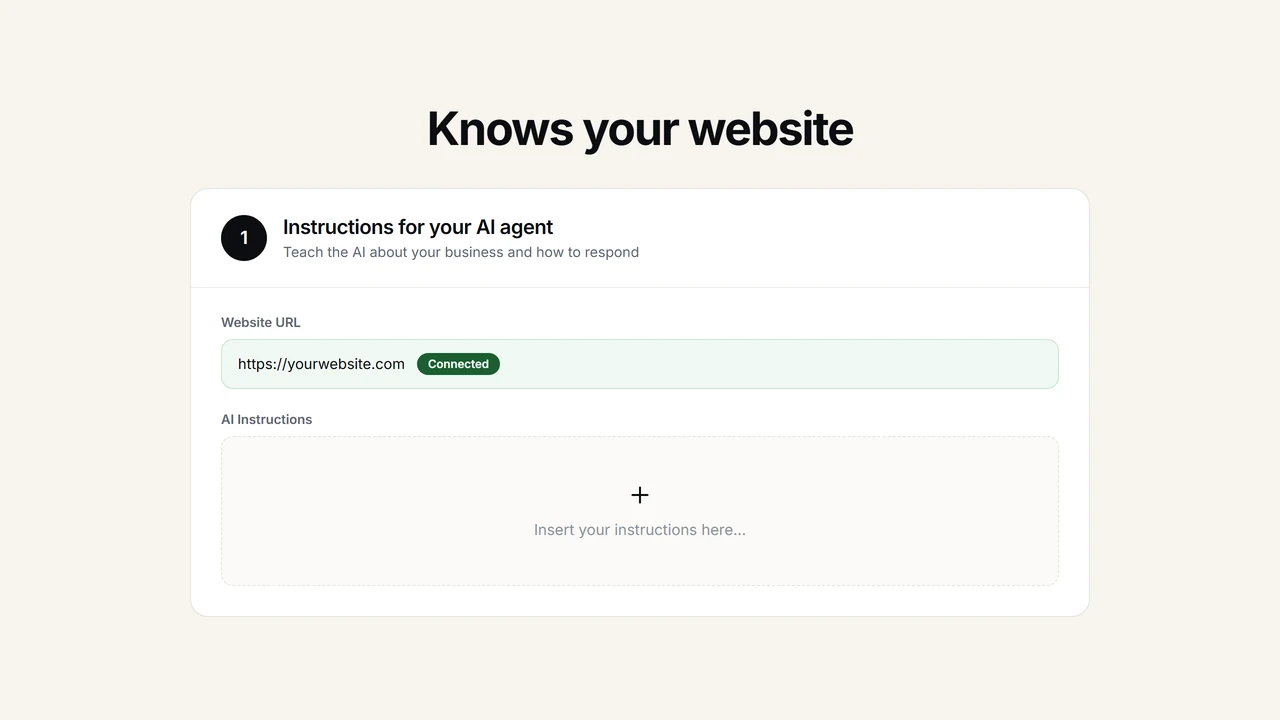
Asyntai is a React and Remix based Shopify AI app that lives inside your admin console. Authorize it from the App Store, and the embedded app reads your products, collections, and storefront policies directly through the Admin API — no crawler warming up, no URL paste-in, no middle step.
- Officially listed on the Shopify App StoreDiscoverable under Support → AI chatbots, reviewed by Shopify, and upgraded through the standard merchant update flow every store owner already recognizes.
- Catalog read through the Admin APIThe embedded app pulls product titles, descriptions, variants, inventory flags, and collection structure the moment you grant the read_products scope.
- Configured inside Shopify adminThe app's settings, training view, and conversation log render as an embedded Remix page — no second dashboard tab to juggle during store setup.
Why a Shopify AI app beats a rule-based chat app
The majority of chat apps on the Shopify App Store still rely on keyword flows, button menus, or canned response libraries. Asyntai is a generative-AI app — it reads your store content, reasons about the shopper's actual question, and writes a fresh answer every time, in whatever language the buyer typed.
- Open-ended questions, not menu clicksShoppers type the way they think — "is this heavy enough for winter", "what fits a 14-year-old who's tall" — and the AI app answers without a pre-built flow waiting to catch the exact phrase.
- Grounded in your actual store, not a generic modelReplies are constrained to your products and policies, so the AI app doesn't invent a discount code, a size, or a shipping window you never approved.
- Context across the full chatFollow-up messages don't reset. A shopper can ask about a jacket, pivot to a matching scarf, loop back to shipping, and the app keeps the whole thread.
Install path: App Store first, theme.liquid as backup
Every Shopify merchant lands in one of two camps. If you prefer the native install — listed app, scoped permissions, update-through-admin — you go through the App Store. If your theme team prefers the lighter script-tag route with zero admin scopes, the same widget is available as a theme.liquid snippet. Both paths produce the identical Shopify AI app experience on the storefront.
- Open the Shopify App Store, search for Asyntai, and click Install.
- Approve the read-only scopes the app requests and you land back in Shopify admin.
- The embedded Remix app opens, fetches your catalog, and starts indexing it in the background.
- Click the storefront preview, test a shopper question, and publish — the AI app goes live on every page.
[ Install from the Shopify App Store ]
# Approved scopes:
read_products # catalog indexing
read_content # policy pages
read_themes # widget embed
# Or use the theme.liquid snippet — same widget, zero scopes.
Shopify AI app — questions merchants ask before they install
App Store versus snippet, scopes, theme compatibility, and the rest of the practical stuff.
Is Asyntai actually listed on the Shopify App Store?
Yes. The Asyntai Shopify AI app has a live App Store listing, a standard app review, an admin install flow, and a public page where merchants can read the scopes and screenshots before approving it. The app itself is built on the Shopify Remix template with embedded admin pages, so the in-store experience matches what merchants expect from a native app.
App Store install vs theme.liquid snippet — which should I pick?
Pick the App Store install if you want the native update flow, scoped permissions, and all configuration inside Shopify admin. Pick the theme.liquid snippet if your dev team prefers no admin scopes at all and wants the widget treated as a pure front-end script. Both paths produce the same AI answers, the same 36-language support, the same dashboard analytics — only the install surface differs.
Which Shopify themes is the AI app compatible with?
Every Online Store 2.0 theme. Dawn, Debut, Brooklyn, Sense, plus any paid theme from the Shopify Theme Store and any agency-built custom theme. The widget is injected as an overlay and doesn't touch theme sections, cart drawers, or checkout, so nothing in your storefront layout has to move to accommodate it.
Does it work with Shopify Markets?
It does. Shopify Markets routes shoppers across country-specific storefronts, and the AI app runs on all of them from a single install. Language detection happens from the shopper's message, not the storefront locale, so a visitor on your .de market who types in English gets English replies, and one on your .com market typing in Japanese gets Japanese replies.
How is this different from the older AI chat apps in the App Store?
The older generation of Shopify chat apps is mostly rule-based — menus, keyword matching, scripted flows that break whenever a shopper phrases something off-script. Asyntai is LLM-backed, so the AI app generates responses from your actual catalog and policies rather than matching strings against a decision tree. There is no flow builder, no keyword list, and no menu tree to maintain.
What data does the app read from my store?
Product listings, collection structure, and policy content — the ingredients needed to answer shopper questions. It does not need, and does not request, write access to orders, customers, or fulfillment. If you prefer to grant zero scopes, the theme.liquid snippet version covers the same use case and reads nothing at all from admin.
What are the pricing and message allowances?
The free plan covers 50 messages a month for piloting. Paid tiers begin at $39 a month for 800 messages. If a given month goes over its allowance, the AI app pauses new replies until the cycle resets or you upgrade — and warning emails hit your inbox well before the cap.
Can the same account manage multiple Shopify stores?
Yes, with site limits that scale by plan: Free covers 1 store, Starter 2, Standard 3, and Pro up to 10. Each connected Shopify store trains its own isolated AI instance, so a beauty brand and an outdoor brand under the same account don't share product knowledge or conversation history.
Everything worth knowing about picking a Shopify AI app
The Shopify App Store catalog has grown into something close to a public works project. Tens of thousands of apps, thousands of them in the chat category alone, each promising some flavor of automation or AI or support deflection, and most of them indistinguishable from a screenshot. A merchant evaluating a Shopify AI app today is not choosing between "does this exist" and "does this not exist" — they are choosing between twenty listings that all claim intelligence, all show a slick hero video, and all take about an hour to install before the differences become obvious. This page exists to save that hour. Asyntai is a Shopify AI app with a real App Store listing, a real Remix-based admin experience, and a real set of constraints worth understanding before you click install.
The first fork in the road is whether the chat app is genuinely AI or whether the word is marketing paint over an old flow builder. A meaningful share of the "AI" apps on the App Store are rule-based tools with a generative label stapled on — you still draw decision trees, you still enumerate keywords, you still write canned replies for each intent, and the LLM only kicks in as a fallback when none of your flows matched. That hybrid architecture has a specific tell: the onboarding asks you to configure intents, upload an FAQ CSV, or pick from a template library. Asyntai's onboarding is the opposite. There are no flows to draw, no intents to define, no keywords to map. You install the Shopify AI app, it reads your catalog and policies, and it answers open-ended shopper questions from that content alone.
The second fork is the install surface. Shopify gives merchants two legitimate ways to add a chat widget to a storefront. The first is the App Store route: you click Install on the listing, approve the scopes the app requests, and the app appears as an embedded page in Shopify admin. Updates arrive through the standard app update flow, billing (when the merchant signs up) can route through Shopify if the vendor opts into it, and the admin UI renders inside the Shopify frame using Shopify App Bridge. This is the experience most merchants expect when someone says "Shopify app." The second route is the theme.liquid snippet: a JavaScript tag that gets pasted into your theme, loads the widget on every page, and requests zero admin scopes because it never calls the Shopify Admin API. Asyntai supports both. The widget that shoppers interact with is identical. What differs is who administers what, what permissions are granted, and where the settings live.
Picking between the two is mostly a question of team preference. Stores where the operations lead owns Shopify admin and the dev team is a shared resource usually prefer the App Store install — everything happens inside admin, theme edits are avoided, and the AI app shows up in the Apps list where other tools already live. Stores where a dev team controls theme deployment and prefers to minimize admin-granted scopes often prefer the snippet path, because a single line in theme.liquid is auditable, removable, and completely separate from any admin permission grant. Both camps get the same answer quality, the same training pipeline, the same conversation log, and the same language coverage.
Training is where most of the Shopify AI app's reputation on a given store will be decided in the first week. The App Store install reads your product catalog through the Admin API, which means every product title, variant, option, price, inventory status, and description becomes context for the AI. It also pulls your storefront policy pages, so shipping windows, return timeframes, and payment methods all get absorbed. For the content that doesn't live on the public store or in admin — internal size charts stored as PDFs, supplier-specific fabric notes, a wholesale price list, a care instruction doc that never made it onto the PDP — you upload those directly into the app's knowledge base from the embedded admin page. Custom instructions, written as regular sentences, cover voice and selling rules: "when a shopper seems undecided, suggest the bestseller in that collection", "always confirm destination country before quoting shipping", "never promise a restock date". The Shopify AI app treats all of this as one unified source of truth.
Language coverage is the feature that most consistently changes the math on whether the AI app is worth the install. The widget interface ships translated into 36 languages, and the model itself replies in whichever language the buyer wrote in, independently of the Shopify storefront locale or the Shopify Markets country routing. Stores running Shopify Markets across Europe, Latin America, or the Asia-Pacific region particularly benefit because a single install answers in German on the .de market, Japanese on the .jp market, Portuguese on a Brazilian routing, and English on the .com — without provisioning a separate chat tool per market or wiring up a translation layer. Multilingual coverage is included in every plan; there is no separate language module to buy.
One feature unique to the Asyntai Shopify AI app is User Context, a mechanism for passing logged-in shopper data into the widget from the storefront side. Available on the Standard and Pro plans, User Context lets your theme populate a window.Asyntai.userContext object with whatever attributes you want the AI to know about a signed-in shopper — first name, most recent order ID, VIP or loyalty tier, anything your Liquid templates already have access to. The AI then references that context in relevant replies: "hi Emma, your most recent order shipped yesterday and is scheduled for Wednesday delivery" rather than "I'd need your order number to look that up". User Context is the piece that turns a generic shopper-facing chat into something that recognizes returning customers without requiring the app to pull the data itself.
Lead capture is the other half of what turns the Shopify AI app into a revenue tool rather than just a deflection tool. Not every conversation with a shopper ends at checkout. Some end because the shopper needs to think about it, wants to compare elsewhere, or simply isn't in a buying mood this session. During any chat, the AI app can ask for an email, a phone number, or both — configurable per store — and the captured lead lands in your Asyntai dashboard with the full conversation transcript attached. Turning on email notifications sends the same transcript straight to your inbox in real time as each new lead is captured. There is no native Klaviyo, HubSpot, or Mailchimp auto-sync; you export from the dashboard or forward the emails into your existing follow-up workflow, because the design goal is a self-contained tool rather than one more integration dependency.
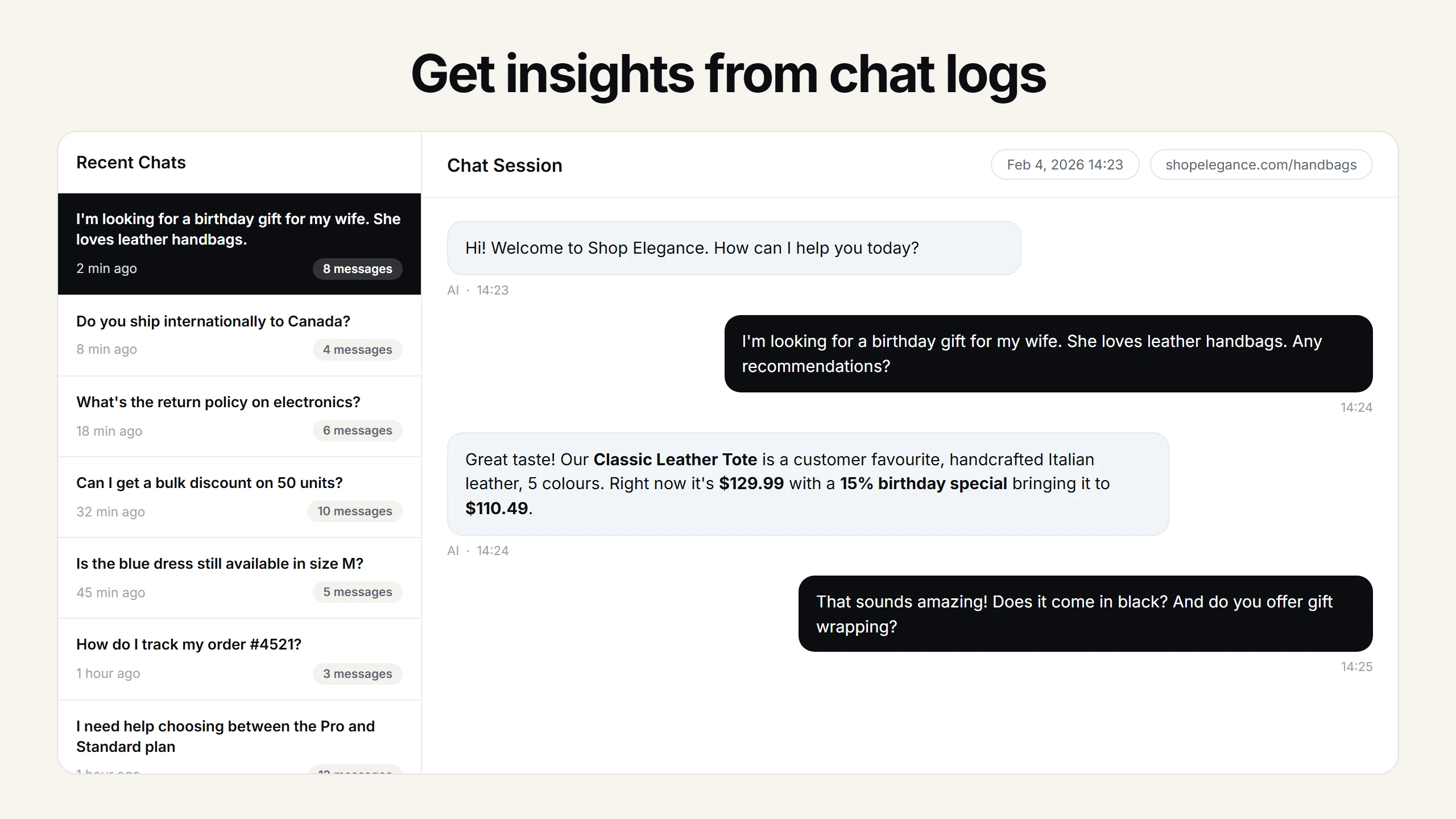
Analytics inside the Shopify AI app expose what shoppers are actually asking, which is where the tool quietly becomes a product-page diagnostic rather than just a support deflector. Conversations are logged and grouped in the embedded admin dashboard. Scan the log for a week and the patterns are loud: the same sizing question keeps appearing for a specific hoodie, so the size chart needs to be clearer; European shoppers keep asking whether duties are included at checkout, so the shipping page needs a visible statement; customers keep confusing two similar products, so the collection page needs better differentiation. The AI app handles the question in the moment, and the log tells you which pages to rewrite so fewer shoppers ask in the first place. It is the rare piece of software that gets more useful the more you read its output.
Theme compatibility deserves an explicit callout because it is where a non-trivial fraction of chat apps quietly fail. The Asyntai widget is rendered as an absolutely positioned overlay that lives outside the normal theme section stack, which means it works the same way on Dawn (Shopify's default), Debut and Brooklyn (the older vintage themes still running on plenty of established stores), Sense and Refresh (newer Online Store 2.0 themes), and any agency-built custom theme that follows the Online Store 2.0 contract. The widget does not touch the cart drawer, the checkout, the product section, or the header — it sits on top of the page, loads asynchronously after your theme renders, and keeps the merchant's theme customization exactly where it was. If you later migrate from one theme to another, the AI app keeps running without a reconfiguration step, because the app is not coupled to any particular theme's section schema.
Pricing is designed so a small Shopify store can validate whether the AI app earns its install before committing a dollar. The free tier includes 50 messages a month, which is enough to test the AI app on a single product launch, a new storefront, or a slow week of real traffic. The Starter plan at $39 a month bumps the allowance to 800 messages, which tends to cover the pre-purchase and post-purchase chat volume of a typical independent Shopify brand. Standard and Pro widen both the message allowance and the number of Shopify stores that can be connected under one account — useful when a holding company runs multiple brands or an agency operates the AI app on behalf of client stores. Site limits are one site free, two on Starter, three on Standard, and up to ten on Pro. If a month goes over its allowance, the AI pauses new replies and sends email warnings before the cap is hit so a viral product moment does not silently cut off the chat mid-traffic-spike.
A question worth asking before installing any Shopify AI app is where the responsibility sits when the AI gets something wrong. Asyntai's design choice on this point is conservative: the model is grounded in the content you give it, and it is instructed to decline rather than invent when a shopper asks something the knowledge base does not answer. A shopper who asks about a product that is not in your catalog gets a polite deflection and an offer to capture their email for follow-up, not a hallucinated product description. A shopper who asks about a promotion you never ran will not be told about one. The AI app is tuned to under-commit rather than over-commit, because a chat that fabricates policies is worse than no chat at all on a Shopify store.
When you lay out the complete picture — real App Store listing with an embedded Remix admin app, optional snippet install for teams that want zero scopes, catalog and policy training out of the box, 36-language coverage, User Context for signed-in shopper personalization, conversation-driven lead capture, analytics that double as a product-page audit, full Shopify Markets compatibility, and pricing that starts free — the Shopify AI app stops looking like one more chat widget and starts looking like an actual retail associate that happens to live on every page of the store. Install takes minutes. The AI starts answering shoppers within the same session. And after a month of running it, the question merchants ask is usually not whether to keep the app but what else it can answer from.