Self service support your customers will actually choose
Asyntai gives visitors the one thing research keeps proving they want: a way to solve their own problem, right now, without opening a ticket. We translate your content into a conversational self-serve layer that answers in plain language across 36 languages.
Preview self service support on your own content
Drop in your site URL and watch the AI answer the questions your customers would have asked support
Give people the answer, not a queue number
The frustration customers describe in every satisfaction survey isn't with self service — it's with self service that doesn't work. Buried search, stale articles, dead-end FAQs. Asyntai flips that experience on its head by turning the content you've already written into an assistant that understands questions the way a human would and responds on the spot.
- Zero-wait resolutionQuestions get answered the moment they're asked, regardless of whether it's 3am on a Sunday or peak shopping traffic on Black Friday. No holding, no ticket ID, no callback promised for later.
- Conversational, not hierarchicalVisitors ask in their own words instead of clicking through nested categories hoping the right topic is three menus deep. The AI interprets intent and surfaces the exact piece of content that matches.
- Respected, not redirectedWhen a customer genuinely needs a human, the assistant offers one without gatekeeping. Self service here means empowering — never trapping — the visitor.
Turn the knowledge you already own into a self-serve engine
You've already paid for the content. Help articles, onboarding guides, policy pages, return windows, troubleshooting steps, pricing nuances, warranty terms. Most of that knowledge sits in places customers never reach. Self service support only works when the path from question to answer is one sentence long.
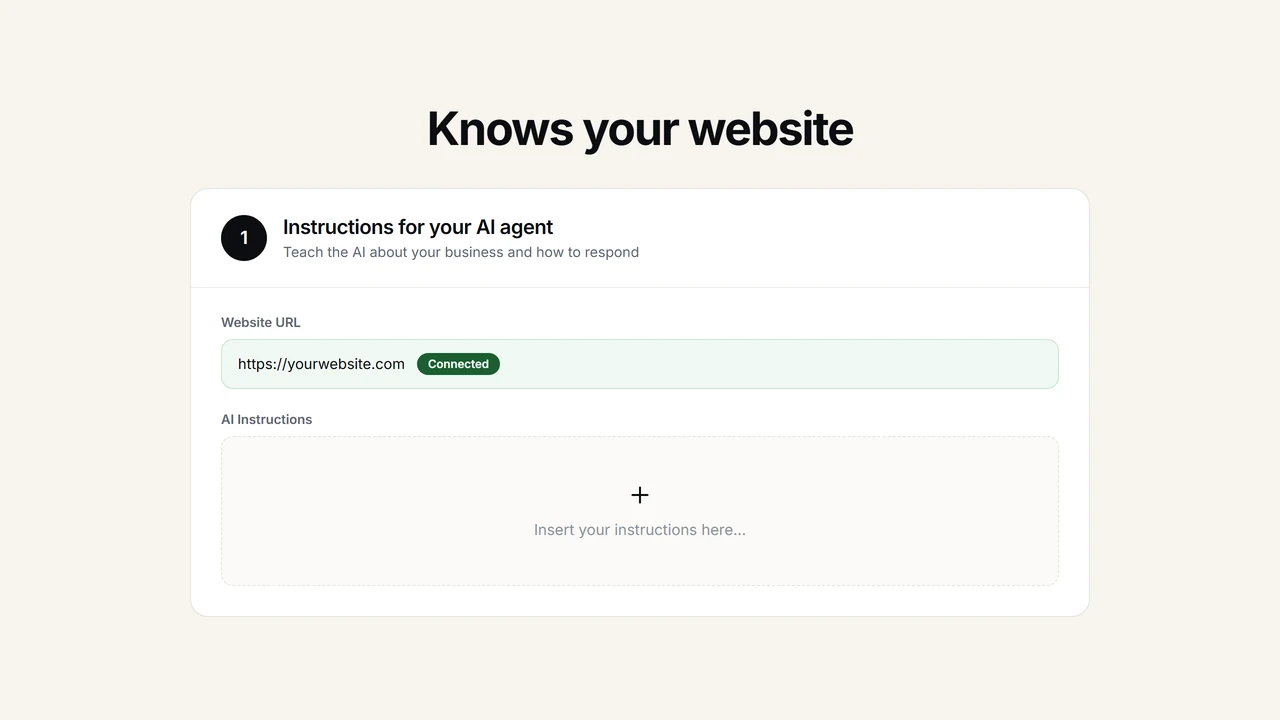
- Point at your help center URLAsyntai pulls in every public article, FAQ entry, policy clause, product spec, and pricing detail you've already published — then keeps the conversation grounded in that source of truth.
- Add the pieces that were never publicInternal onboarding docs, vendor handbooks, region-specific rules — upload them as PDFs or paste the text directly. Self-serve answers stop depending on whether a customer stumbles into the right article.
- Escalation rules in plain EnglishUse custom instructions to tell the assistant when to hand off — sensitive refund amounts, account ownership changes, contract negotiations — so self service never oversteps where judgment is required.
Launch self service in the time it takes to finish a coffee
You don't need a dedicated project to put self-serve in front of customers. One snippet on your site, one sweep of your existing content, one afternoon of tuning escalation rules, and self service support is live for every visitor across every page.
- Create your free Asyntai workspace and grab the personalized widget snippet.
- Drop the snippet inside your site template's
<head>— whether that's through a CMS field, a tag manager, or a direct template edit. - Feed Asyntai your help center URL plus any private PDFs or text that belong in the answer base.
- Write a short list of custom instructions covering tone and when to offer a human, preview a few real questions, flip it live.
<script src="https://asyntai.com/widget.js"
data-id="your-site-id" async>
</script>
</head>
# Snippet placed. Self-serve answers everywhere.
Self service support — common questions before rollout
The things product, support, and CX leads usually want confirmed before trusting self-serve to customers.
Why does self service support succeed with Asyntai when our old help center didn't?
Traditional help centers ask customers to do two hard jobs at once: guess the right category, then guess the right article title. Most give up at step one. Asyntai removes both steps by letting people describe their problem in natural language and responding with the specific answer drawn from your articles. The content is the same; the path to it is radically shorter. That shorter path is usually the difference between a 20% self-serve rate and a 70%+ one.
Will customers actually prefer self-serve over talking to a person?
Most will, for the tickets that make up the bulk of inbound volume. Surveys consistently show that for routine questions — order status, reset flows, pricing, refund windows, compatibility — buyers want resolution faster than a human queue can deliver. They'll wait for a human when the issue is emotional, disputed, or high-stakes. Asyntai handles the first category cleanly and hands off the second, which is exactly what satisfied customers say they want.
Does the assistant ever make something up if the answer isn't in our content?
The assistant is anchored to the knowledge you give it. When a question lands outside the scope of your crawled site and uploaded documents, it says so plainly and offers to capture the customer's details for your team instead of improvising. You reinforce that behavior with custom instructions specific to areas where accuracy matters most — quote ranges, legal language, medical or regulated guidance.
How is this different from a standard knowledge base search bar?
Keyword search returns a list of articles and expects the customer to read and synthesize. Self service support through Asyntai returns the answer itself — one concise paragraph pulled from the relevant article, phrased in response to the exact wording the customer used. It also keeps the conversation going, so a follow-up question doesn't require starting a new search. It's the difference between getting a library index card and getting an actual answer.
What languages are covered for international self-serve?
The widget interface renders in 36 languages, and the assistant replies in whichever language the visitor types. Someone typing in Polish receives Polish, someone typing in Thai receives Thai, someone typing in Arabic receives Arabic — all without any language routing logic on your side. For brands where a meaningful share of traffic lives outside your primary market, that reach is a noticeable lift on its own.
How do we personalize self-serve answers for logged-in customers?
Standard and Pro plans include User Context, which lets your site push signed-in customer data into a JavaScript object the widget reads before loading. You decide what flows in — membership tier, subscription renewal date, last order number, loyalty status. The assistant then answers questions like "when does my plan renew" or "is my order still on track" using that context, no backend integration required.
What does self service support cost compared to adding a support hire?
Pricing starts at $39 per month for 800 assisted messages, with a free tier offering 50 messages for evaluation. That sits well below the fully loaded cost of a single support seat, and each resolved self-serve conversation carries essentially zero marginal cost once the subscription is in place. For growing teams, the math usually favors expanding the self-serve layer before expanding headcount.
Can we run self-serve on more than one web property?
Yes, scaled by plan. Free covers one site, Starter two, Standard three, and Pro up to ten. Every property has its own trained assistant, its own answer base, and its own set of escalation rules — handy for agencies, multi-brand retailers, and companies running separate self-serve hubs for distinct products.
Self service support, rethought for people who hate waiting
There's a number that shows up in almost every customer experience study run in the past decade, and it's always higher than support teams expect: the share of customers who actively prefer solving a problem themselves over speaking to a person. Depending on the methodology it lands somewhere between sixty and eighty percent. The same studies usually surface a second, less flattering number — the share of customers who try self-serve first, give up, and then contact support in a worse mood than they would have if they'd just opened a ticket to begin with. Both numbers coexist because self service support, as most companies have implemented it, fails at the moment customers actually need it. Asyntai exists to close that gap, not by adding yet another help center, but by making the one you already have genuinely useful at the point of need.
Start with why self-serve breaks. Traditional help centers rely on a three-step contract with the visitor. First, guess which of six or twelve categories your question belongs to. Second, skim a list of article titles hoping one matches. Third, read the article and hope the answer is in the specific paragraph that applies to your situation. Each step introduces friction, and the dropout compounds. A visitor who leaves after step one is a ticket on the way. A visitor who leaves after step two is frustrated before they even describe the problem. The percentage of help center sessions that end with the visitor actually finding what they came for is often under a quarter. The content is usually correct; the interface around it is what fails.
The alternative that Asyntai represents isn't a flashier help center. It's replacing the click-based navigation entirely with a conversational layer that accepts the question however the customer wants to phrase it. A shopper asking "do you ship to Portugal and how long does it take" doesn't need to locate a Shipping category, scan for an International article, and skim for their country. They just ask. The assistant pulls the relevant piece of your shipping policy, the relevant carrier note, and the relevant estimated-delivery range, and composes a two-sentence answer grounded in your content. The visitor reads it, their question is resolved, and they move on. That entire flow is self service support — but the customer experienced it as getting help.
Empowerment is the word that comes up repeatedly in research about what satisfied customers want, and it's worth taking seriously because it points at a design principle rather than a marketing slogan. Empowered customers feel they're in control of their own resolution path. They chose to ask a quick question. They got a quick answer. They didn't have to explain themselves to a stranger, sit in a queue, or repeat their details. When a company delivers that experience consistently, customer satisfaction scores climb not because the support team got better but because more customers stopped needing the support team at all — in the best possible way.
There's a tempting objection that self-serve risks feeling cold or impersonal, but the data on this keeps pointing the other way. For routine problems, customers describe self-serve as respectful of their time. For sensitive problems — billing disputes, cancellations with unhappy context, account ownership changes — they want a person, and they want that person quickly. A well-designed self-serve layer should detect that distinction and escalate on the second category without being asked. Asyntai lets you set that line with plain-language custom instructions: escalate anything involving a damaged shipment, escalate any refund above a threshold, escalate anything with the words "complaint" or "frustrated," escalate custom contract questions. The assistant obeys and hands the conversation off with transcript and context attached. The customer doesn't feel dumped into a queue. They feel passed to the right person.
Building the knowledge foundation is lighter than most teams assume. You don't write a new knowledge base. You don't maintain dual systems. Asyntai points at the help center URL you already publish, walks through your public articles, ingests FAQ entries, absorbs pricing and policy pages, and starts referencing that material in its first conversation. For the private side — internal procedures, unpublished regional rules, vendor-specific warranty handling, anything that belongs in an answer but never made it into a blog post — you upload PDFs or paste raw text. From that point forward the self-serve layer knows what your tenured team knows. When your content updates, a re-crawl refreshes the assistant's view. Nothing about that loop requires engineering time.
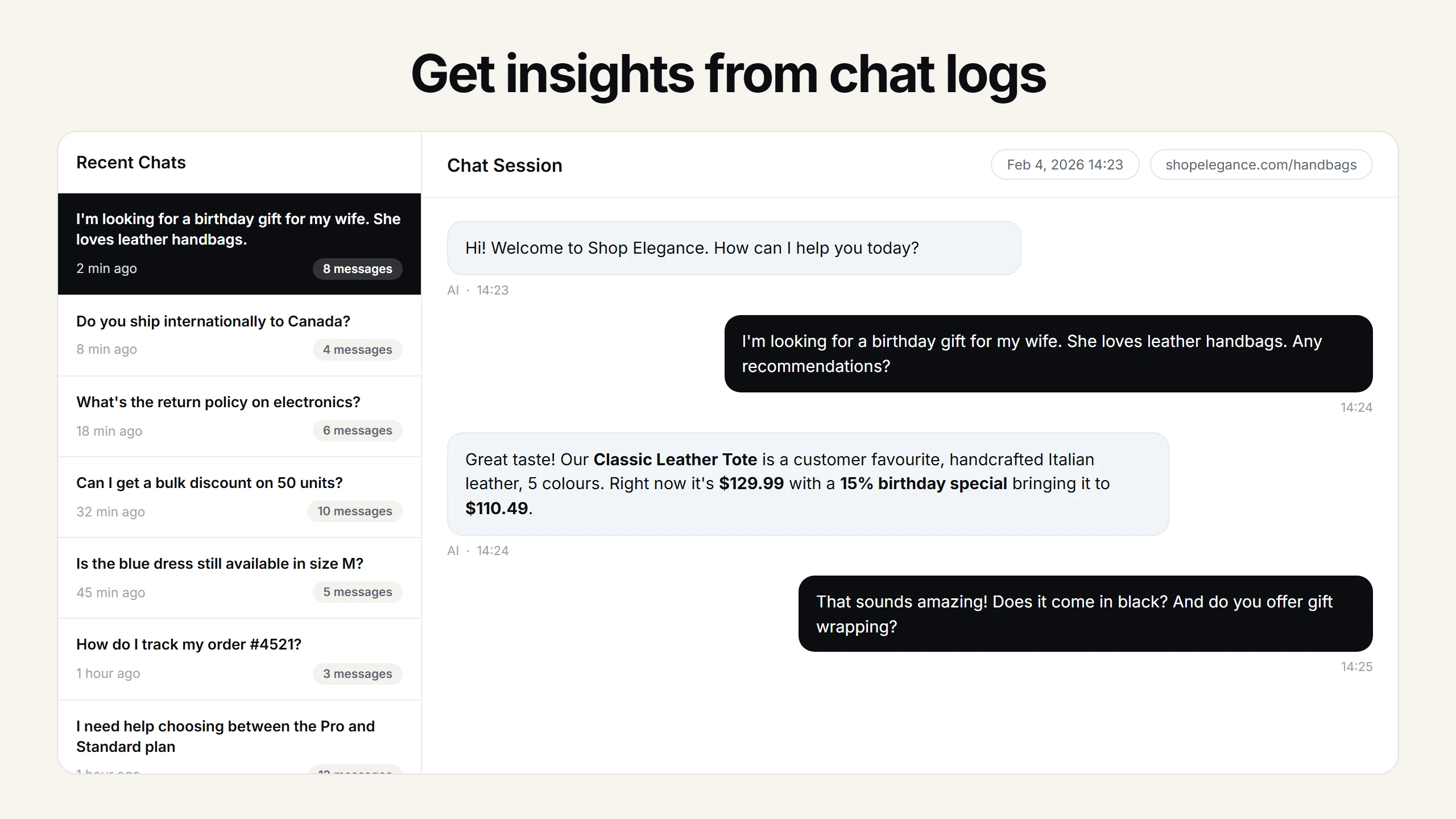
One result of conversational self-serve that surprises teams is the diagnostic value. Every question the assistant receives is a small piece of evidence about where your documentation isn't pulling its weight. If hundreds of visitors each month ask a variation of the same question, that question is either missing from your help center or buried where no one finds it. Asyntai surfaces these patterns through conversation analytics in the dashboard — grouped by topic, sorted by frequency, split by language. Over a few weeks the pattern becomes a roadmap for what to write next or what to clarify on existing pages, which in turn makes the self-serve layer even more effective. The system quietly teaches you what your customers are really confused about.
International self-serve is a category where the economics of automation become most obvious. Staffing a human support team fluent in German, Japanese, Portuguese, Thai, and Arabic around the clock is the kind of investment only very large companies can absorb, and even then it's one of the harder corners of the org chart to recruit for. Asyntai's widget renders in 36 languages and the assistant replies in whichever one the visitor uses from their first message. A customer in Osaka at 2am gets a coherent Japanese response drawn from the same English source content your team wrote. The language barrier, which traditionally meant either a slower response or no response, just stops being a barrier.
Logged-in personalization is where self service support starts to feel like a concierge rather than a FAQ. With User Context on Standard and Pro plans, your application pushes a small amount of customer data into a JavaScript object before the widget loads — whatever you want the assistant to know, nothing you don't. Common fields are first name, subscription tier, renewal date, recent order ID, loyalty level. The assistant uses them to answer questions like "is my order ready to ship yet" without pulling any data itself. Because the data is pushed from your code rather than fetched via API, you keep clean control over exactly what the self-serve layer can see and share.
The pricing conversation tends to go quickly once teams see how the math behaves in practice. Asyntai opens with a free 50-message allotment for initial testing, then starts paid tiers at $39 per month for 800 messages. That's a significant volume of resolved self-serve conversations at a cost well below a fraction of a single support seat. For teams whose ticket volume is growing faster than their budget can justify new hires, the numbers usually settle the question. Adding self service support first, then layering humans on top of whatever remains, leaves the support team doing the work that actually needs them — and leaves customers happier, because more of their issues are resolved in the first minute rather than the first business day.
Reducing ticket dependency is the phrase that captures what good self-serve actually produces at the organization level. It doesn't mean eliminating tickets. It means tickets stop being the default path for every question. The routine volume — resets, order lookups, policy lookups, basic how-tos — flows through the self-serve layer at zero marginal cost and near-zero wait. The tickets that reach humans arrive with context, a transcript, and a clearer shape, so agents spend less time triaging and more time solving. Over the course of a year, teams describe the shift as a change in what the job feels like. Less firefighting, more actual customer work. Fewer Monday-morning queue explosions, more time on the hard cases that benefit from real attention.
Multi-property brands get tier-based scaling built in. Free plans host one site, Starter handles two, Standard three, Pro up to ten. Each site is trained separately, with its own knowledge base and its own escalation rules — an obvious fit for agencies running self-serve for multiple clients, retail groups with several storefronts, or SaaS companies where each product line has distinct documentation. Usage warnings arrive by email before any cap is reached, so a surge in traffic doesn't quietly shut self-serve off at the moment customers most need it.
There's a broader cultural point worth making, because it shows up in every team that rolls self-serve out successfully. Self service support works when the company treats it as a way to respect the customer's time, not a way to avoid the customer. The moment the assistant starts feeling like a wall between the visitor and the team, trust erodes quickly. The moment it feels like a shortcut to the answer, trust builds. Asyntai is designed around that second posture. Custom instructions let you set the tone. Escalation rules let you draw the line between automated and human. The widget never hides the option of talking to a person — it just answers fast enough that, most of the time, the visitor doesn't need one.
The rollout is short enough that most teams finish it in a single sitting. Sign up, paste the snippet, point at your content, upload any private documents, write a handful of escalation rules, send yourself some real customer questions in preview mode, and publish. From there the self-serve layer runs on its own — resolving the routine volume, forwarding the exceptions, surfacing the patterns that should feed your next documentation refresh. Customers get the answer they came for. Your team gets its focus back. And the part of support that always felt like an uphill climb against queue depth quietly starts flowing downhill instead.