The Odoo AI chatbot that answers from your real Odoo content
Asyntai brings grounded, reasoning-style AI chat to Odoo sites. The chatbot indexes every public Odoo page, blends in your uploaded PDFs, and replies in the visitor's own language — served through a native Odoo module for 16.0, 17.0, 18.0, and 19.0, or a JS snippet for Odoo Online.
See the Odoo AI chatbot running on your site
Drop in an Odoo website URL — we'll show you how intelligent, site-aware AI chat feels on your own pages
Reasoning-grade AI that actually understands your Odoo site
Scripted decision trees and intent-matching bots struggle the moment a visitor phrases something unexpected. Asyntai's Odoo AI chatbot uses a modern large-language-model reasoning layer constrained to your own content — so answers sound intelligent, stay on-topic, and never invent facts your Odoo pages don't contain.
- Grounded generation, not guessworkEvery reply is anchored to what your Odoo website, policies, and uploaded docs actually say. If the answer isn't in your material, the chatbot says so and offers to hand off rather than hallucinate.
- Handles paraphrased questions"Do you deliver down here in Valencia?" and "Shipping options for eastern Spain?" resolve to the same shipping policy — no keyword lists, no regex to maintain.
- Intent-aware follow-upsThe AI tracks what's already been discussed in the conversation, so "and the smaller model?" after a product comparison doesn't reset context the way a scripted bot would.
A true Odoo module with the AI intelligence living on our side
The heavy AI reasoning runs on Asyntai's infrastructure; the Odoo side stays light. You get the convenience of an Apps-list install and an in-Odoo admin screen, without pinning GPU-heavy models to your Odoo.sh tenant or on-premise box.
- Module for 16.0 through 19.0A dedicated build per supported Odoo release means the asyntai_chatbot addon slots into whichever Odoo version your instance currently runs.
- One-click OAuth connectHitting "Get started" inside the Odoo app launches a sign-in popup to Asyntai; once approved, the site ID is stored by the module with no API keys to paste around.
- JS-snippet fallback for Odoo OnlineSince the Odoo Online SaaS tier blocks custom modules, we expose the same AI chatbot as a JavaScript tag injectable through the Website module's header — identical behaviour either way.
Get the Odoo AI chatbot live on your site
Getting intelligent chat onto an Odoo website takes four moves. Nothing in here is unusual for anyone who has touched the Odoo addons folder before.
- Pull the module bundle down from inside your Asyntai account, choosing the directory that lines up with your Odoo major release (16.0, 17.0, 18.0, or 19.0).
- Extract it into the addons path your Odoo config points at, bounce the Odoo server, then head to Apps, trigger Update Apps List, type "Asyntai" into the filter, and press Install.
- Open the Asyntai AI Chatbot entry in the app launcher and hit Get started. The OAuth popup lands on asyntai.com — sign in (or register), and the module captures the site binding on its own.
- The AI chatbot is now serving every Odoo Website page. Upload documents, refine instructions, and watch conversations from the Asyntai dashboard at asyntai.com/dashboard.
→ Pick build (16.0 / 17.0 / 18.0 / 19.0)
→ Drop into /addons/
→ Bounce Odoo → Update Apps List → Install
→ "Get started" → OAuth to asyntai.com
# AI answers now running across your Odoo Website.
Odoo AI chatbot — questions we get asked
Technical and commercial points Odoo teams usually want cleared up before committing to an AI chat layer.
How is this "AI" different from a normal Odoo livechat bot?
Odoo's built-in livechat bot is rule-driven — you define triggers and scripted replies. The Asyntai AI chatbot is built on a reasoning language model that reads your Odoo content and composes new answers on the fly, constrained to your material. That means no decision trees to maintain, and paraphrased or unexpected questions still get coherent responses. The two can coexist, but most Odoo teams that switch stop editing scripts altogether.
Does the AI actually see my Odoo product catalogue and pages?
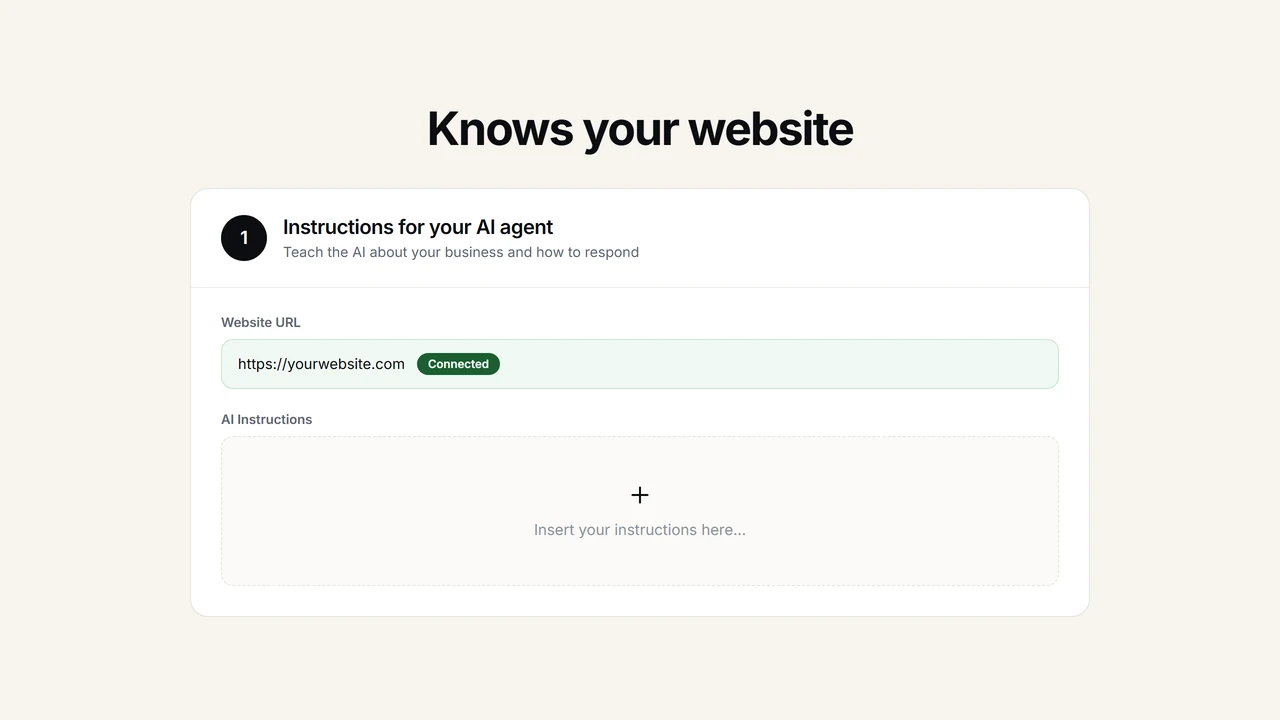
Yes. As soon as the module is connected, Asyntai crawls the public Odoo website — front pages, About, eCommerce product and category pages, blog posts, policy pages, contact — and indexes all of it. For anything not published (partner pricing, internal specs, NDA material) you upload the file or paste text into the dashboard, and the AI uses that too when composing replies.
Which Odoo releases is the AI chatbot tested against?
The module archive ships separate builds for Odoo 16.0, 17.0, 18.0, and 19.0. If you're on a heavily forked Odoo version where the module doesn't behave, switch to the JavaScript snippet distribution — the AI layer is identical regardless of how the widget is loaded onto the page.
Can it run on Odoo.sh, on-premise, and Odoo Online?
Odoo.sh and self-hosted Odoo both support custom modules, so the asyntai_chatbot addon installs directly. Odoo Online (the hosted SaaS offering) does not permit custom addons; for those tenants we expose the chatbot as a JS tag that drops into the Website module's header injection area. Same AI, same answers, just a different delivery mechanism.
Is the Website module required?
Yes — the chatbot attaches to the Odoo Website module, so an Odoo instance running only ERP, CRM, or accounting without Website enabled won't have a front-end for the widget to appear on. Enabling Website is the only prerequisite beyond the Asyntai module itself.
Does it speak more than one language?
The widget ships with 36 languages localized for the interface, and the reasoning model infers each visitor's language straight from their opening message. A Hungarian visitor to a German Odoo site gets Hungarian answers; a Portuguese visitor to a French-language site gets Portuguese. Your Odoo translation matrix and the chatbot's language coverage no longer have to match.
Will it personalize answers for signed-in Odoo portal users?
On Standard and Pro plans, the User Context feature lets your Odoo theme push logged-in portal data — name, company, tier, open invoices — into a window.Asyntai.userContext object before the chat widget initialises. The AI treats that payload as authoritative context, so a portal user asking about their own orders gets account-aware replies without any backend API call.
How does pricing map to my Odoo deployment size?
Plans gate the number of connected Odoo sites and monthly message volume. Free covers 1 site and 50 messages to try the AI out; paid tiers go up from there, with 2 sites on Starter, 3 on Standard, and up to 10 on Pro. A representative paid point is $39/month for 800 messages. Multi-company Odoo groups and agencies running Odoo for multiple clients typically land on Standard or Pro for the site-count headroom.
Why AI chat specifically makes sense on Odoo websites
There is a reason the "AI" in Odoo AI chatbot matters more than just a marketing adjective. Odoo websites skew toward two visitor profiles that older rule-based chat tooling handles badly. The first is the B2B technical buyer — someone arriving from a distributor directory, a partner listing, or a LinkedIn referral, already a few questions deep into evaluating whether your product fits a specific engineering context. The second is the international browser — someone whose language may or may not be among the ones your Odoo i18n translations cover, asking about shipping, compatibility, or pre-sales logistics. Both profiles punish scripted bots quickly. The technical buyer phrases questions in ways your intent library never anticipated. The international browser doesn't speak the language your decision tree was authored in. A modern reasoning model, bounded to your own Odoo content, handles both comfortably where rule-based flows stall.
Grounded generation is the feature that makes the AI side of this workable in production. A raw language model pulled from a vendor's API will happily invent plausible-sounding product specs, delivery promises, or refund policies — which on an Odoo eCommerce site translates to commercial exposure within minutes. Asyntai's approach pins the reasoning layer to a retrieval index built from your Odoo site plus whatever private documents you upload. When a visitor asks something, the model drafts a reply only after consulting the indexed material; if nothing relevant turns up, the reply acknowledges the gap and offers a handoff rather than fabricating. That guardrail is the difference between AI you can leave running unattended on a live Odoo site and AI that needs a human editor watching every transcript.
Rolling out that AI capability onto an Odoo stack is where the module matters. Odoo administrators and integrators live inside a culture of addons — installable via the Apps screen, configurable on the standard res.config.settings surface, cleanly removable when a project wraps up. Asking an Odoo team to paste a random JavaScript tag into a theme header file feels structurally wrong in that environment, even when it would technically work. The asyntai_chatbot module fits the expected pattern. It appears in Update Apps List, installs with a click, adds a dedicated app to the Odoo launcher, exposes settings inside the familiar admin UI, and removes itself cleanly on uninstall. For the subset of Odoo tenants where custom modules aren't allowed — primarily Odoo Online — we ship the same AI under a JS snippet delivery, so no Odoo hosting choice locks a team out of the product.
The version matrix deserves attention because Odoo's internal APIs do drift between major releases. A module that works against Odoo 17.0's website controllers won't necessarily load under 19.0's updated routing, and the reverse is also true. Rather than shipping one "universal" build that probably breaks somewhere, the Asyntai archive carries a separate, tested module per supported release: 16.0, 17.0, 18.0, and 19.0. The installation instructions tell you to pick the folder matching your major version — a 60-second choice that saves the debugging work of chasing API drift errors later. Teams running heavily customized Odoo forks or unusual minor versions that aren't in the matrix can still use the JS snippet path; the chatbot's answer quality is identical regardless of how the widget gets onto the page.
Indexing your content happens automatically on first connect. Once the OAuth popup closes, Asyntai fires off a crawl across every reachable page on your Odoo Website — home, About, services, product pages, category trees, blog posts, contact, legal, terms, every public URL the Website module serves. The crawler converts each page into an embedded representation and stores those in the retrieval index that will feed answers from that moment on. Re-crawls run on a cadence so that adding a new product or editing a policy flows into the chatbot's knowledge without any manual "retrain" step. For the 20–40 per cent of your content that isn't public — partner-specific pricing sheets, manufacturing tolerances, support SLAs that only exist in signed contracts — the dashboard accepts PDF uploads and pasted text, and the same retrieval pipeline indexes that private material the same way.
Custom instructions sit alongside the retrieval layer and shape how the AI actually replies. These aren't prompt-engineering incantations; they're plain sentences. "For enterprise inquiries above 500 units, always invite the visitor to request a custom quote." "Never commit to same-day delivery — always frame it as 'typically'." "If a visitor mentions regulated industries, flag that the technical team will verify compliance before shipping." The AI weighs each instruction every time it drafts a reply, so behavioural tone, commercial hedging, and escalation rules stay consistent across every conversation without you rewriting a script tree. It is the closest equivalent to briefing a new junior salesperson — you tell them how the company talks, and they hold that line.
Multilingual coverage is where the AI angle pays off most visibly on international Odoo sites. Odoo's own i18n tooling lets you translate site content into a chosen set of languages, but that set is always bounded — translation work costs money, so you stop at your priority markets. An AI chatbot built on a multilingual foundation has no such bound. Asyntai carries 36 interface locales and the reasoning layer picks up a visitor's language off their opening line, producing native-language replies regardless of whether your Odoo pages have been localised into that tongue. A Greek visitor to a German-only Odoo site still gets Greek answers drawn from your German content. That asymmetry — your content in a few languages, the AI replying in many — is what turns Odoo sites serving 10 or 15 markets into something that actually feels localized at the conversation level.
Personalization for logged-in Odoo portal users runs through the User Context feature. Asyntai's widget exposes a window.Asyntai.userContext object; the Odoo theme fills it in before the widget initialises, with whatever portal data you choose to surface. Name, company, plan tier, last invoice status, active support contract, region — you decide. The AI uses that context when drafting replies, so an enterprise customer asking about support response times gets an answer pegged to their actual SLA tier rather than the generic public copy. None of this requires wiring up a permissioned API from Odoo to Asyntai — you control what goes into the context object, and nothing else is readable. On Standard and Pro plans, this account-aware behaviour is on by default; on lower tiers, the chatbot operates in anonymous mode.
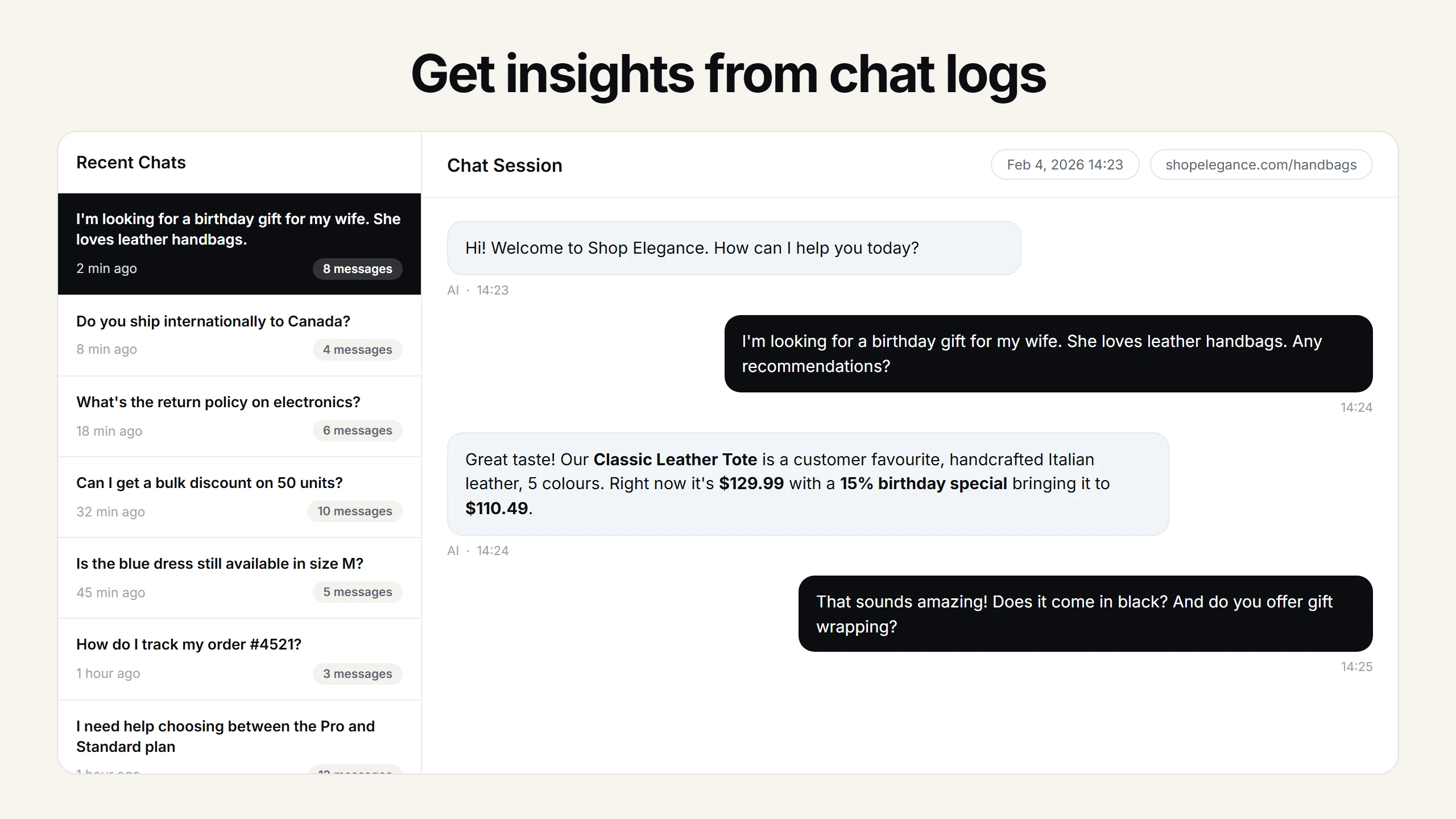
When an AI chatbot can't close out a conversation on its own — a scoping discussion too complex for the indexed material, a genuine enterprise pricing negotiation, a regulated industry question requiring human judgement — the lead capture flow kicks in. The AI asks for email and relevant business context, assembles the full transcript, and drops the lead into your Asyntai dashboard. Optional email notifications push the transcript to a sales inbox in real time. Odoo-native teams typically pipe that notification email into an Odoo CRM inbound alias, which creates a lead record automatically; the AI effectively becomes the top-of-funnel that populates your Odoo pipeline without a human watching the chat queue.
Multi-site Odoo is where the AI scaling story lands. One Odoo instance often serves multiple brands, regional subdomains, or client deployments under a multi-company configuration. Asyntai attaches independently to each site — separate knowledge bases, separate instructions, separate widget branding — with plan tiers defining how many sites one account can handle: free tier at 1, Starter at 2, Standard at 3, Pro at up to 10. An agency running Odoo for a portfolio of clients can centralize AI chat delivery on a single Pro account and still keep each client's chatbot fully siloed in terms of knowledge base and tone.
Intelligence, grounded to your own Odoo content, delivered through a native module where the Odoo platform allows it and through a JS snippet where it doesn't — that is the shape of the Asyntai Odoo AI chatbot. The AI is what makes it worth installing; the Odoo module is what makes it sit comfortably inside the platform your team already administers. Install from addons, connect in a click, let the crawler learn your site, upload anything private, write a handful of custom instructions, and the chatbot starts carrying the visitor-facing layer on every page of your Odoo Website — in every language your visitors happen to arrive in.