A no code chatbot for people who aren't going to open a code editor
Asyntai ships a no code chatbot you can put live between two cups of coffee. Sign up, tell it the URL it should learn, paste one snippet or click a plugin button, and type rules the way you'd brief a new hire. That's the whole workflow.
Point the no code chatbot at your site and watch it read
Drop your URL below — you'll see exactly what a visitor gets before you've written a single config file
Two ways in, both count as "no code": paste a line, or tick a box in your CMS
Every team has one person who owns the website and zero people who want to touch production code. The no code chatbot is built around that person. One short JavaScript snippet goes into the place your CMS already calls "header" or "custom code" — or you skip the snippet entirely and install the native plugin for your platform. Either route lands the same widget live on every page of the site.
- Snippet route for any CMS or builderIf your platform lets you paste anything into a site-wide header (Webflow, Ghost, Squarespace, Framer, custom PHP, a static HTML file in a Git repo you'd rather not touch), the snippet route works. Copy, paste, save, done — nothing to compile, nothing to deploy.
- Native plugin for WordPress, Shopify, WooCommerce and friendsFor platforms with a plugin marketplace, there's a dedicated Asyntai plugin. Install it from inside your admin panel, paste your site ID, click activate. No FTP, no theme editor, no risk of breaking the layout.
- Zero touch afterwardsOnce the snippet or plugin is in place, every future change — colors, welcome line, instructions, crawled pages — happens inside the Asyntai dashboard. The installed code never needs to be reopened, re-pasted, or redeployed.
If you can write a memo, you can train a no code chatbot
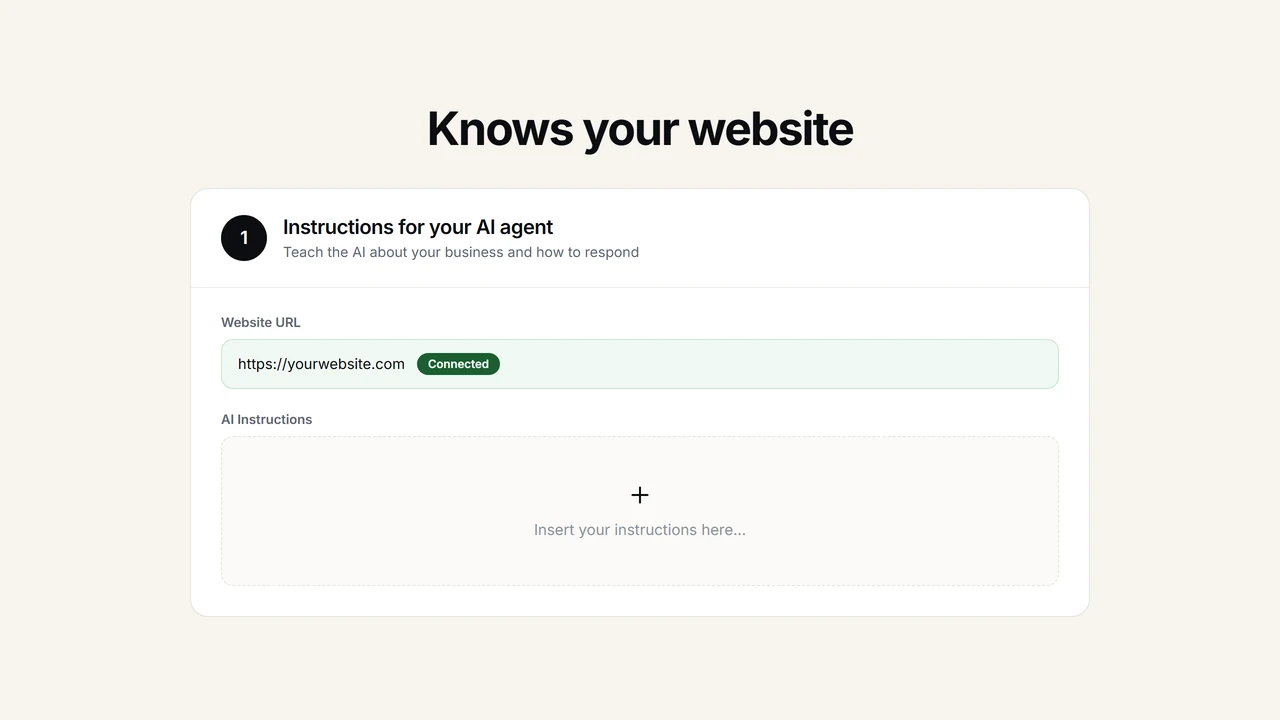
Most "no code" platforms still force you into something that's technically no code but emotionally very code — dragging nodes, filling JSON-looking fields, mapping intents to entities. Asyntai skips that layer entirely. The chatbot learns by crawling a URL you give it, and you steer it with short paragraphs of plain English that read like guidance notes for a junior teammate.
- Auto-learn from a URL, no Q&A listType your homepage address in the training field and the crawler walks through your pages — services, FAQs, pricing, blog posts, policies. You don't have to write a single sample question or expected answer; the pages themselves become the knowledge base.
- Instructions written like briefing notes"Sound friendly but never pushy." "If a visitor asks for a refund, send them to [email protected]." "We don't take bookings over chat — always link to the Calendly page." Sentences like that go straight into the instructions field; there's nothing to escape, quote, or wrap in curly braces.
- Everything stays editable foreverChange of hours, a new service line, a holiday promotion — open the dashboard, rewrite the paragraph, hit save. The chatbot uses the updated wording on the very next conversation, with no waiting, no redeploy, no new model to retrain.
What a no code install actually looks like, step by step
For the snippet route, the whole install is one line you already know how to use: a <script> tag pasted into the site-wide header section of your CMS. If you've added Google Analytics before, this is the same motion. If you haven't, it's lighter than that.
- Create a free account and type the URL you'd like the chatbot to read.
- Copy the snippet shown on the dashboard (or install the WordPress / Shopify / WooCommerce plugin if you prefer that).
- Paste the snippet into your site's header field — usually labelled "Custom code", "Header scripts", or "Tracking".
- Back in the dashboard, write two or three sentences telling the chatbot how to behave, preview a conversation, and flip it live.
<script src="https://asyntai.com/widget.js"
data-id="your-site-id" async>
</script>
# that's the entire developer portion of the project.
No code chatbot — what non-technical teams want to check first
Straight answers for solo founders, marketers, and ops leads who'd rather not escalate this to an engineer.
I genuinely cannot code. Will I get stuck somewhere?
The pinch-points people normally hit — writing prompts, modelling intents, configuring API keys, deploying containers — aren't part of this flow at all. The chatbot crawls your URL on its own, you give it instructions in plain sentences, and the only "code" you ever see is a pre-written snippet that you copy and paste as a single block. If you've ever added a tracking pixel through your CMS, you already have the hardest skill this requires.
My website is on WordPress / Shopify / WooCommerce — is there a plugin so I don't even have to paste?
Yes. Native plugins exist for the major CMS and commerce platforms, including WordPress, Shopify and WooCommerce. Install the plugin through your platform's normal plugin store, drop in the site ID you got at signup, and activate. The snippet is handled for you behind the scenes, and future updates come through the plugin's own update button.
How do I teach it our business without sitting down and writing a prompt?
Two inputs, both in plain language. First, the crawler reads the pages you already have — meaning whatever you've published on pricing, products, services, policies, and blog posts is immediately the source of truth. Second, the instructions field takes short guidance written the way you'd brief a new colleague over Slack. Nothing in either step resembles a prompt in the technical sense.
Our site changes all the time. Do I need an engineer to push updates into the chatbot?
No. The dashboard has a "re-crawl" action that re-reads your published pages on demand, and you can schedule automatic re-reads too. Whenever you update the website — new service, new FAQ, new policy — trigger a re-crawl from the dashboard, and the chatbot picks up the change the next time it answers. No engineering ticket involved anywhere in the cycle.
What about speaking to visitors who aren't in English?
The widget ships with 36 languages built in. Visitors who open chat in Portuguese, Polish, or Thai get the interface and the replies in their own language without you having to install a translation plugin or keep a separate version of the instructions. You write your rules once, in whichever language suits you, and the chatbot handles translation as part of each answer.
Where do the leads go when the chatbot can't close the loop itself?
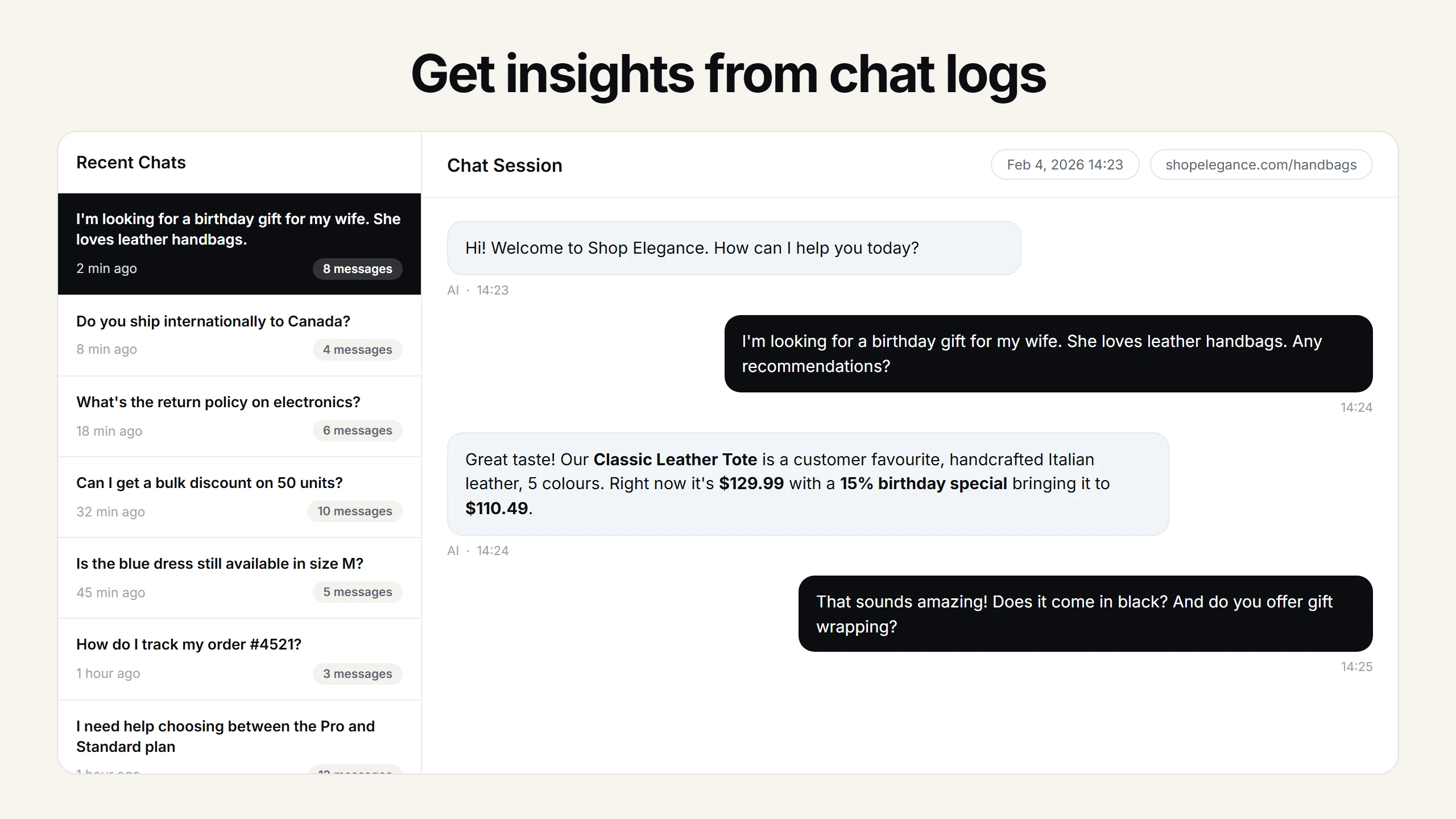
Whenever the conversation reaches a point the chatbot shouldn't answer on its own — a complicated refund, a custom quote, a bug report — it collects the visitor's name together with their email and the full chat transcript, and surfaces it inside the Asyntai dashboard. You can also switch on email notifications so the same transcript hits your inbox in real time. No extra CRM connector required for day one.
Can the chatbot recognise logged-in users on our site?
On Standard and Pro plans, yes — through User Context. Your site sets a small window.Asyntai.userContext object before the widget loads with whatever profile fields you want the chatbot to know about, such as the visitor's name, subscription tier, or account status. Non-technical teams usually ask their existing developer or theme vendor to wire this snippet in once; after that, the dashboard controls the rest.
What does it cost if I just want to see whether it works?
The free tier covers 50 messages a month on a single site with no card on file, which is enough for a small website to pilot the chatbot for a few weeks. The first paid tier is $39 a month with 800 messages and two sites, and the higher tiers scale up to three and ten sites respectively for teams running several brands or client accounts.
No code chatbot — a field note for the person who has to make this work
If you're reading this page, there's a decent chance the chatbot project has landed on your desk because nobody else wanted it. You're the operations lead, or the marketing manager, or the founder who's been wearing every non-engineering hat for six months, and the message in the thread was some version of "we should probably get a chatbot on the site." Nobody is going to hire a developer to do it. Nobody is going to build a flowchart. The thing needs to exist, it needs to behave, and it needs to not become a maintenance tax that lands on you every Monday. That's the constraint the no code chatbot category exists for — and the gap between tools that say "no code" and tools that actually are no code turns out to be wider than the marketing copy suggests.
The earlier generation of "no code" chatbots did honestly try to remove code from the experience, and they replaced it with a visual flow-builder instead. You'd open a canvas, drag a node onto it, connect arrows, fill in trigger conditions, add fallback branches, test the path. On paper, no code. In practice, the mental model demanded was exactly the mental model of programming, just with colourful boxes; anyone who's ever untangled a flowchart that grew for six months without a refactor knows what the end state looks like. That style of builder still exists, still calls itself no code, and still bounces a large share of non-technical users back to step one. The problem was never the keyboard; the problem was being asked to think like an engineer.
What changed is the arrival of chatbots that learn from your existing content instead of asking you to describe it. Point the system at the URL of your website, and the crawler reads your pages the way a new hire would — pricing page first, then services, then the FAQ, then the blog posts that explain the nuances. That crawl becomes the chatbot's knowledge base. No intent trees, no sample questions, no "utterance variations" to fill in. If the answer lives somewhere on your published site, the chatbot will find it and phrase it back to the visitor in natural language. If the answer lives in a policy document that isn't public, you upload the PDF and the chatbot treats it exactly the same way. For the person responsible for the project, this is the load-bearing difference: you stopped needing to explain the business to a tool, and started pointing the tool at the business.
Writing custom instructions is the other place a traditional "no code" setup quietly turns into coding. Old tools wanted you to pick from a dropdown of personality sliders, or fill in fields labelled "fallback_response_low_confidence", or structure your rules as an if/else ladder. Modern tools accept plain sentences: "Keep answers under three sentences unless somebody asks for detail." "Always finish a pricing question by offering a demo link." "Never mention competitor names, even if a visitor asks directly." Each of those goes into the instructions textbox as-is, and the chatbot treats them the way a capable colleague would treat written guidance — reading them before every reply, and applying the relevant ones in context. There's no syntax to get wrong because there's no syntax to write.
Installation is the moment most non-technical owners brace themselves for, and it's usually the moment the project actually gets easier rather than harder. The snippet version of the install is a single script tag pasted into whatever your CMS calls the header section. If your site runs on WordPress, Shopify, or WooCommerce, the snippet version is replaced with a plugin click — the chatbot turns up inside your plugin marketplace, you install it like you'd install anything else, and you paste the site ID into one field. For platforms like Webflow, Squarespace, Ghost, Framer and the various landing-page builders, the snippet is short enough that site owners frequently ship it live between meetings. The one assumption the install makes is that you can find your platform's "custom code" or "header scripts" option, which is the same lever you already used to install analytics.
The part non-technical operators worry about more than install is ongoing maintenance — the fear that they'll flip the chatbot live, feel briefly triumphant, and then spend every week fielding questions about how to update it. The answer in the no-code-first model is that ongoing edits stay inside the dashboard forever. Want to change the welcome line to match a seasonal promotion? Edit the welcome field, hit save. Adding a new product category next Tuesday? Click re-crawl after the page publishes, and the chatbot picks it up. Tone is off? Open the instructions paragraph and reword the sentence that's producing the wrong vibe. None of these operations reopen the code you pasted during install; the snippet is a pipe that carries whatever you configure upstream, and you never touch it again.
Multilingual coverage is an under-reported win of this shape of tool, because it tends to happen automatically rather than as a feature you had to build for. Asyntai's widget ships with 36 languages in the interface and auto-detects which language a visitor is typing in the moment they send their opening line. A Spanish-speaking visitor lands on your mostly-English website, opens the chat, types in Spanish, and gets a Spanish answer. You didn't translate the website. You didn't maintain a second instructions set. You didn't install a "translations" add-on. The multilingual behaviour sits inside the chatbot layer, which means the same non-technical owner who installed the snippet also, inadvertently, made the site usable for visitors in three-dozen language markets.
Personalisation for known users is the one place where a light developer touch occasionally helps, and the no-code-first design acknowledges that honestly. On Standard and Pro plans, the User Context feature lets your site pass a small object of logged-in user information to the widget before it loads — name, subscription tier, account status, whatever you'd like the chatbot to be aware of. Setting up that push is a one-time task that your platform's theme vendor or existing developer can do in an hour; afterwards, the non-technical owner manages the rest of the chatbot entirely from the dashboard. Teams that don't want to wire this at all simply skip it and run the chatbot in anonymous-visitor mode, which is what the free and Starter plans expect.
Escalation is worth walking through because a no code chatbot that can't hand off to a human ends up creating work rather than saving it. Asyntai resolves this through a lead-capture step that activates whenever the chatbot shouldn't answer on its own. Visitor name, email address, and the complete chat transcript are bundled together and pushed into the Asyntai dashboard; real-time email alerts carry the identical bundle into whatever inbox you use for leads. The ops person who owns the chatbot picks up the conversation context at a glance and replies directly — no switching between tools, no hunting for the original message. On day one, this replaces the need for any external CRM connector; on day thirty, teams with a dedicated helpdesk usually wire the emails into their normal inbox rules without needing to touch Asyntai at all.
Pricing is straightforward in a way that matters for this audience, because no-code buyers almost always don't have budget signoff for a quote-based enterprise tool. The free tier runs 50 messages a month on one site with no card required — enough for a small website to prove the chatbot out. The first paid plan is $39 a month for 800 messages across two sites, which covers most small and mid-sized businesses with healthy organic traffic. Higher plans add a third and then a tenth site, which is the relevant lever for agencies and operators running multiple brands. There's no seat-based pricing hiding underneath; the same dashboard is used whether one person or five run the chatbot.
The honest summary for the person who has to make this work: the no code chatbot category has matured into something that a non-technical owner really can ship solo, and the specific path is shorter than most first-time buyers expect. Point it at your URL. Write two or three sentences of guidance. Paste the snippet or install the plugin. Send a few real questions through to check the voice. Flip it live. That sequence takes longer to read than to execute, and from there the work becomes occasional dashboard edits rather than ongoing engineering requests. For solo founders, for marketers without developer backing, for ops leads who already have too many tools on the plate, that shape of ownership is the entire point — and the reason "no code" stopped being a label and started being a real category.