Moodle chatbot that tutors learners and cuts support tickets inside your LMS
Asyntai drops a Moodle chatbot directly onto course pages, dashboards, and login screens — grounded in your course materials, policy docs, and Moodle help articles, so learners get immediate answers about deadlines, grading, quizzes, and forum etiquette without waiting for instructor office hours.
Preview the Moodle chatbot answering from a sample course site
Enter your Moodle URL and the assistant will extract visible course descriptions, syllabus excerpts, and help content to build a trial conversation.
Answers the six questions every Moodle course page generates, before the ticket is filed
Anyone who has run a Moodle site knows the repeating inbound pattern from learners — "where do I submit?", "why can't I see the quiz?", "is this the final draft or the rough?", "what does the grade category weighting actually mean?", "how do I unenroll from a course I joined by mistake?", "my forum post won't save, what now?". A Moodle chatbot that reads both your course content and the platform's own behaviour resolves those at first contact. Asyntai ingests your course catalog, activity descriptions, and uploaded study guides, then pairs them with Moodle-flavoured help logic so the assistant speaks the learner's language and the LMS's language at the same time.
- Course-material groundingUpload syllabi, lecture notes, assignment briefs, rubric PDFs, and reading lists — the assistant cites the right week's material when a learner asks "what chapter do I need for Tuesday's quiz?" rather than sending them back to hunt through the topic outline.
- Platform-aware helpGive the assistant the generic Moodle user documentation alongside your institution's customisations — theme-specific navigation, local enrolment keys, SSO provider, so instructions for learners match the exact buttons they're looking at, not a generic screenshot from elsewhere.
- Instructor offloadingRepetitive "I submitted but it says draft" or "my Turnitin receipt didn't arrive" queries that used to reach the teaching team first now resolve on the course page — teaching staff see only the genuinely novel problems.
Thirty-six languages, student-context awareness, and round-the-clock availability for distance learners
A typical Moodle deployment serves a mix of on-campus students, distance learners, continuing education enrolees, and corporate trainees completing compliance modules. Their time zones, first languages, and digital comfort levels vary widely. A Moodle chatbot that only works in English during business hours misses the cohort that most needs help — the remote worker finishing an SCORM module at 11 p.m., the incoming cohort whose English is a second language, the lifelong learner trying a formal LMS for the first time. Asyntai answers in whichever language the question arrives in and never clocks out.
- Auto-detected language repliesA learner types a question in Portuguese; the reply comes back in Portuguese, citing the same source material your English learners get — one Moodle instance, one content base, thirty-six conversational surfaces.
- Optional logged-in contextOn Standard and Pro plans the widget accepts a userContext payload (window.Asyntai.userContext) — so your Moodle theme can pass through the learner's course enrolments, current week, or cohort, letting the assistant give replies that know which course is being asked about without the learner naming it.
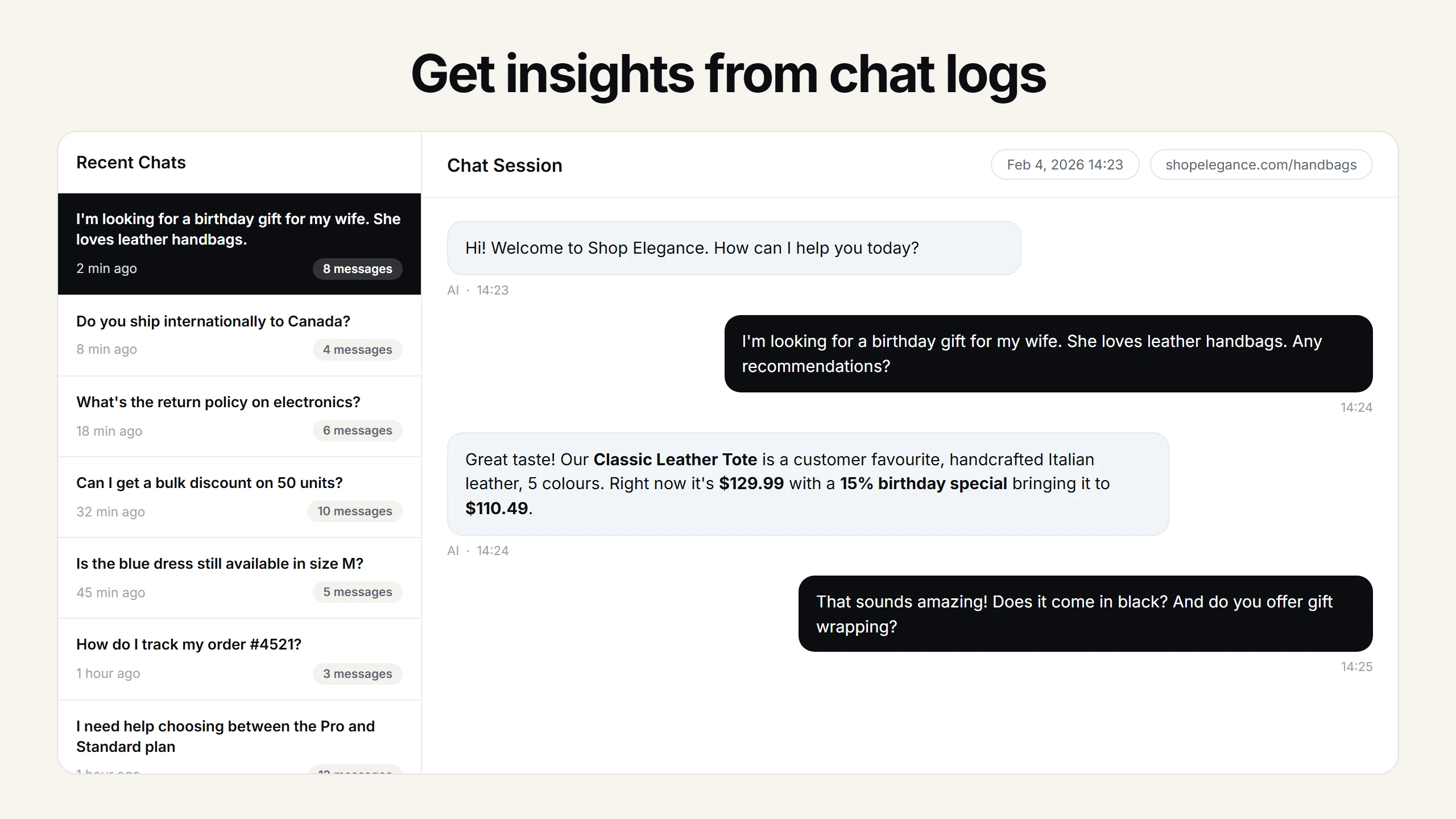
- Transcript plus optional email to the dashboardWhen a question is out of scope — extension requests, accommodation queries, pastoral issues — the learner can drop their email and the full transcript lands in the Asyntai dashboard for the right staff member to pick up on their next shift.
Install the Moodle chatbot with the native plugin or a single script tag
Two supported install routes. If you want the assistant to appear as a block inside courses and on the site home with Moodle-native configuration, use the Asyntai plugin for Moodle (shipped in the plugins directory of this repo and installable via the standard Site administration → Plugins flow). If you'd rather embed the floating chat bubble globally across your Moodle theme, paste the widget snippet into your theme's footer template. Both options point to the same dashboard account and the same trained knowledge base.
- Grab the Asyntai Moodle plugin ZIP (or the widget snippet) from your dashboard after creating a free account — the free tier covers 50 messages, enough to pilot across a single course.
- Plugin route — upload the ZIP via Site administration → Plugins → Install plugins, then open the Asyntai settings page and paste your site ID.
- Snippet route — paste the script tag into your theme's footer Mustache template (or the footer region of the Boost or Classic child theme you run).
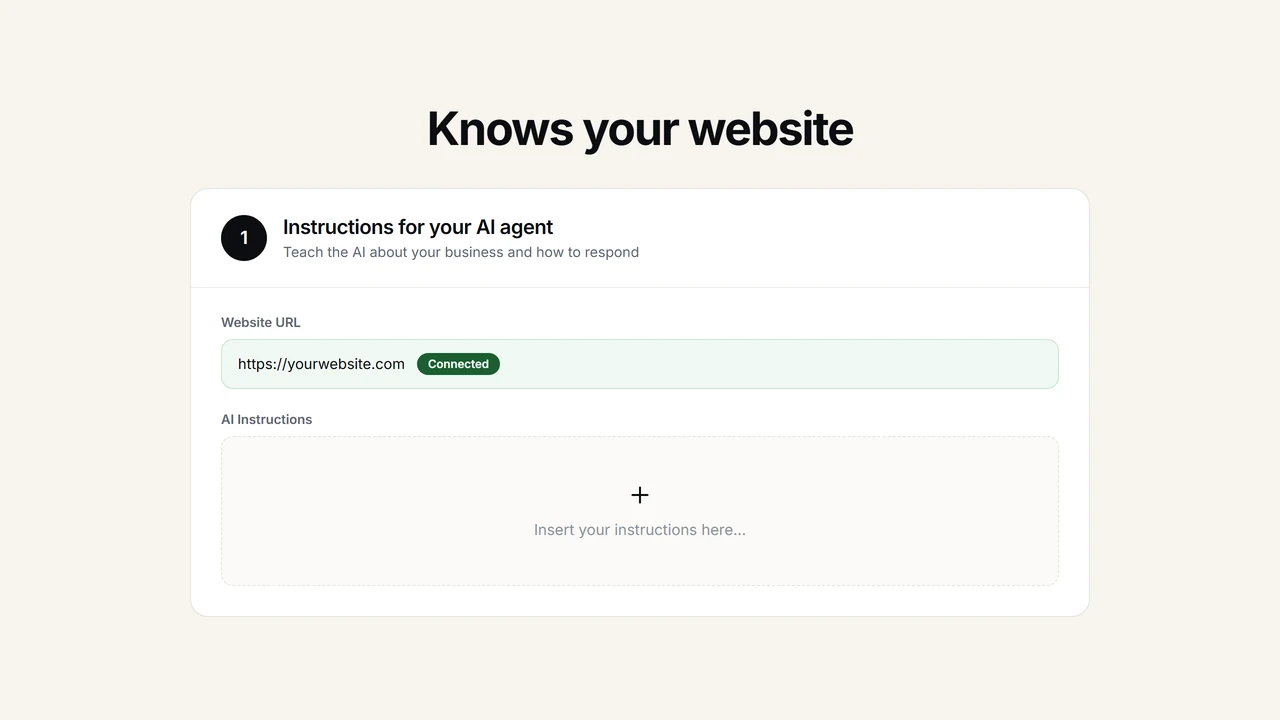
- Feed the assistant: upload syllabus PDFs, course guides, and institutional policy files, then point the crawler at any public Moodle pages you'd like indexed.
<script src="https://asyntai.com/widget.js"
data-id="your-moodle-site-id" async>
</script>
# Moodle chatbot now live across courses, dashboard, and login page.
Moodle chatbot — what LMS admins and course leads ask before rolling it out
Practical questions from people who already run a Moodle site and want to know how the assistant will behave inside it.
Is there an actual Moodle plugin, or is this a generic JavaScript widget pointed at Moodle?
Both exist. The native plugin ships in the Asyntai repo under /plugins/moodle/asyntai and follows the standard Moodle plugin structure — version.php, db directory, lang pack, AMD module, settings page. That lets you place an Asyntai block inside courses, configure the site ID through Site administration, and respect Moodle's capability and role system. Separately, the universal snippet install works on any Moodle theme that lets you edit its footer template, which is handy for Boost child themes or heavily customised builds where you'd rather not introduce a plugin. Most deployments use the plugin on production; pilots often start with the snippet because it takes thirty seconds.
Will the chatbot show up on course pages the way learners expect a help tool to appear?
Via the plugin, yes — the Asyntai block sits in the side region alongside Calendar, Upcoming events, and the other Moodle blocks learners already scan. Via the snippet, the floating bubble appears bottom-right on every Moodle page the theme renders, which means courses, the dashboard, site home, enrolment pages, and the login screen all carry the same assistant. You can hide it on specific page types if needed through the widget's visibility rules.
Can it actually answer course-specific questions, or only platform-generic stuff?
Course-specific, provided you give it course-specific content. Upload the syllabus, the weekly learning outcomes, the assignment briefs, the marking rubric, and the recommended readings, and the assistant can reply to "what's the word count for the mid-semester essay" or "does the Tuesday lab count toward the attendance grade" with the answer that's actually in the brief. Without that source material loaded, it falls back to generic Moodle help behaviour, which is still useful for navigation questions but won't know your course content.
What about privacy — learners are logged into the LMS when they use this?
Anonymous chatbot traffic from public course catalog pages or the login screen contains no protected data — a visitor asking about enrolment deadlines is not yet a student of record. Inside authenticated course pages, nothing gets passed to the assistant unless you explicitly push a userContext payload from your Moodle theme; without that, the widget sees the conversation and nothing else. If you do pass userContext to enable personalised replies, treat it like any other third-party integration that receives learner-related data: scope the payload to the minimum needed (usually course shortname and current week is plenty), document the processing, and make sure your privacy notice reflects it. All traffic runs encrypted end to end and stored data is encrypted on disk.
Does the Moodle chatbot work across multiple Moodle sites we operate?
Each Moodle instance with its own domain counts as a site slot under your plan. Free covers a single slot; Starter lifts the cap to two, Standard to three, Pro to ten — so an organisation juggling a staff training Moodle, a separate partner Moodle, and a separate customer Moodle can plug all three in on Pro without stacking accounts. Sub-branded learning environments that share a single Moodle codebase behind one domain are treated as one site.
How does pricing match LMS usage patterns, which spike around term start?
Billing is driven by chatbot message volume rather than learner seat count, which lines up well with how inbound help demand actually flows in Moodle environments — quiet in reading weeks, intense at term start and around assessment deadlines. The free plan's 50 messages is enough to pilot with a single cohort. The entry paid tier opens at $39 monthly with a 800-message allowance; a large deployment servicing a busy LMS typically sits above that on a higher tier. Scaling up or down between cycles is a setting change rather than a contract renegotiation.
Can the chatbot tell learners how to reset their Moodle password or fix a login issue?
Yes for the self-service portion — it can walk a learner through the reset flow specific to your site, explain how SSO works if you run it, and surface the local IT helpdesk contact for account lockouts. What it cannot do is perform a privileged reset itself; those stay in Moodle's administration flow where they belong. The point is that the 70% of login questions that are really "I forgot which email I enrolled with" get handled without a support ticket, and the 30% that need privileged action escalate with full context.
What happens if a learner asks something the assistant genuinely shouldn't answer — academic integrity, grade appeals, wellbeing?
Custom instructions let you configure decline-and-route behaviour for sensitive topics explicitly. A rule such as "If a learner asks about suspected plagiarism flagging, do not comment on specifics; share the academic integrity policy link and route to the programme team" is straightforward to set in the dashboard. The escalation then captures the transcript and an optional email, and the right human gets notified on their next shift — no risky freelancing from the assistant on topics it shouldn't touch.
Moodle chatbot — how it actually changes life inside an LMS
The everyday texture of running a Moodle site is less about dramatic outages and more about attrition from small friction. A cohort of four hundred learners generates a steady drip of help requests — someone can't find the link to the Zoom session, someone submitted to the wrong assignment slot, someone forgot whether forum participation counts toward the final grade, someone's quiz timed out mid-attempt. None of those is a crisis. Each is thirty seconds of teaching staff or LMS admin time. Multiply by a thousand over a semester and the result is a support workload that quietly eats hours which should have gone to actual teaching. A Moodle chatbot sitting on the course page is a different shape of solution from a ticketing system: it short-circuits the friction at the moment it happens, on the page where it happened, in the language the learner uses.
What makes Moodle specifically different from a generic website help bot is the structure of the content. A Moodle course isn't a flat set of URLs — it's a hierarchy of topics, activities, resources, and gradebook entries, with cross-references to forums, calendars, and competency frameworks. Learners often don't know the right noun for what they're looking at. They say "the quiz thing" when they mean a H5P interactive, "the submission box" when they mean an Assignment activity, "the chat" when they mean a forum thread. A chatbot answering from your actual course materials learns those idiolects because the learners' messages contain them. After a few dozen conversations the assistant recognises that a particular cohort calls the weekly reading set "the packet" and responds accordingly without anyone writing a rule for it.
The distance-learning use case is where Moodle chatbot value accumulates fastest. A large share of Moodle enrolees complete their coursework outside of any synchronous teaching time — evenings, weekends, long-haul commutes, night shifts that end at dawn. The traditional LMS support model assumes a learner can send an email to a tutor and wait eighteen hours for a reply. For someone trying to finish a mandatory compliance module before the end of the quarter at 2 a.m., eighteen hours is three quarters of the time they had left. The assistant absorbs the navigation, policy, and content-location questions that would otherwise block progress, and only the genuinely subjective or escalation-grade questions wait for a human reply the next working day.
Admin-side value is harder to notice day to day but accumulates in the ticket queue. Moodle administrators running a site of any significant size triage a recurring mixture: enrolment key problems, role assignment mistakes, gradebook category confusion, recovery of deleted courses, cron issues, broken third-party integrations. Among those, a meaningful slice of tickets are really learner questions that got misdirected — the learner didn't know where else to turn, so they emailed the site admin directly. A visible chatbot on the learner-facing surfaces captures those at the front door. Admin tickets shrink to the tickets that are genuinely admin-grade, which is the shape of queue administrators actually want.
Instructors benefit in a slightly different dimension. The teaching team's pain point isn't usually volume in the aggregate — it's timing. The twenty-four hours before an assignment deadline generate a flood of logistical questions that a well-prepared brief should already have answered but that students read only when they finally sit down to submit. Those last-minute questions crowd out the substantive intellectual questions the instructor would actually like to engage with. A chatbot that reads the brief and answers the logistical part ("what file format is accepted", "is the bibliography inside the word count", "can I submit after the deadline with a late penalty") preserves the instructor's attention for the substance. The assistant's role is deliberately limited: it explains the rules as written; it doesn't decide extensions, grade anyone, or speculate about marking.
Internationalisation is unavoidable for any Moodle operator who takes on more than a single-country audience, and thirty-six languages of support is the feature that unlocks that audience cleanly. A company rolling out compliance training to staff across twenty countries can't reasonably build a separate help channel per language. A university running an online master's programme recruits globally and has learners finishing modules in Lagos, São Paulo, Mumbai, and Kuala Lumpur. The Moodle LMS itself supports language packs for the interface, but the help conversations — the place where learners describe their actual problems in their own words — has traditionally been English-only or expensively staffed. The assistant collapses that cost: the learner types in whichever language feels natural, the reply comes back in the same language, the underlying content base stays in its source language and doesn't need to be re-authored per market.
Quiz and assignment logistics deserve special mention because they generate disproportionate support traffic during assessment windows. Moodle's assessment activities have a lot of configurable knobs — attempts allowed, time limits, question behaviour, review options, grading methods, marking workflow — and the settings chosen by the course designer aren't always obvious to the learner. "Why can't I see my mark yet?" is the single most common assessment-window question at most institutions, and the answer usually lives in the review options setting that the learner can't see. A chatbot drawing on both the generic Moodle behaviour and the specific course's chosen configuration can answer that in one turn with the reason and the date the marks will be visible. That one class of question alone often justifies the deployment for a teaching team running large-cohort summative assessments.
Forum moderation is a second area where the chatbot quietly reduces load. Moodle discussion forums are where learners ask content questions publicly, and the expected etiquette is that instructors or teaching assistants answer — eventually. Response latency on forums directly shapes the learner's perception of the course. A chatbot can read the forum post (when configured to), identify whether it's a content question with an answer already present in the course materials, and respond with a grounded reply that points to the relevant resource. Instructors review and approve or refine; routine lookups stop being their work. Novel pedagogical discussions remain the human's job, which is where the human adds the value nobody else can.
Data accumulates into a useful picture over a term. The transcript log is not a behavioural panopticon — individual learner conversations aren't something to pore over — but in aggregate it's a direct-from-the-learner report on which bits of the course confused people and in what order. Weeks where questions spike about a particular topic are a signal that the content for that topic needs rewriting. Recurring questions that the course materials don't address at all are a gap worth filling. Support ticket systems don't give you this cleanly because they mix platform problems with content problems; the chatbot log separates them because the chatbot's scope is already scoped to content and navigation. Over successive runs of a course, instructors iterate the materials toward the places the learners actually got stuck.
Rollout tends to work best in stages rather than a big-bang deployment. A sensible starting point is a single pilot course with an instructor who is willing to notice what's happening — typically a large first-year module or a module with a historical track record of support-heavy weeks. The plugin goes in, the syllabus and brief get uploaded, the assistant runs on the pilot course block for the duration of a single teaching period. At the end of the pilot, a review of the transcript log tells you which categories of question the assistant handled well, which categories produced confused or wrong replies (where content grounding needs strengthening), and where escalation rules should tighten. From that evidence, expansion to the rest of the curriculum is a question of copying settings rather than designing from scratch.
The longer-term fit between an AI chatbot for Moodle and an institution's LMS strategy is something operators tend to under-appreciate at the point of first deployment. A modern LMS is not just a content delivery mechanism; it's an operational system that also has to handle enrolment, assessment, compliance reporting, and learner communications. The support layer around that system has traditionally been an afterthought — a shared inbox somewhere, a few FAQ pages that nobody updates, a tutor list that assumes everyone has the same working hours. Replacing that afterthought with a trained, language-aware, always-on assistant changes the experience of being a learner on the platform. The learner stops feeling that help is something they have to earn by waiting; it becomes a baseline expectation, which frees them to engage with the thing the LMS is actually meant to be for, which is learning.