Helpdesk chatbot that keeps the easy tickets out of your queue
Asyntai offers a helpdesk chatbot that catches repetitive tickets before they ever reach your helpdesk — reads your docs, answers users 24/7 in 36 languages, and escalates complex cases to your support inbox with full context already captured.
Try the helpdesk chatbot on your site
Drop in your help center or product URL and see how the chatbot would handle real user tickets
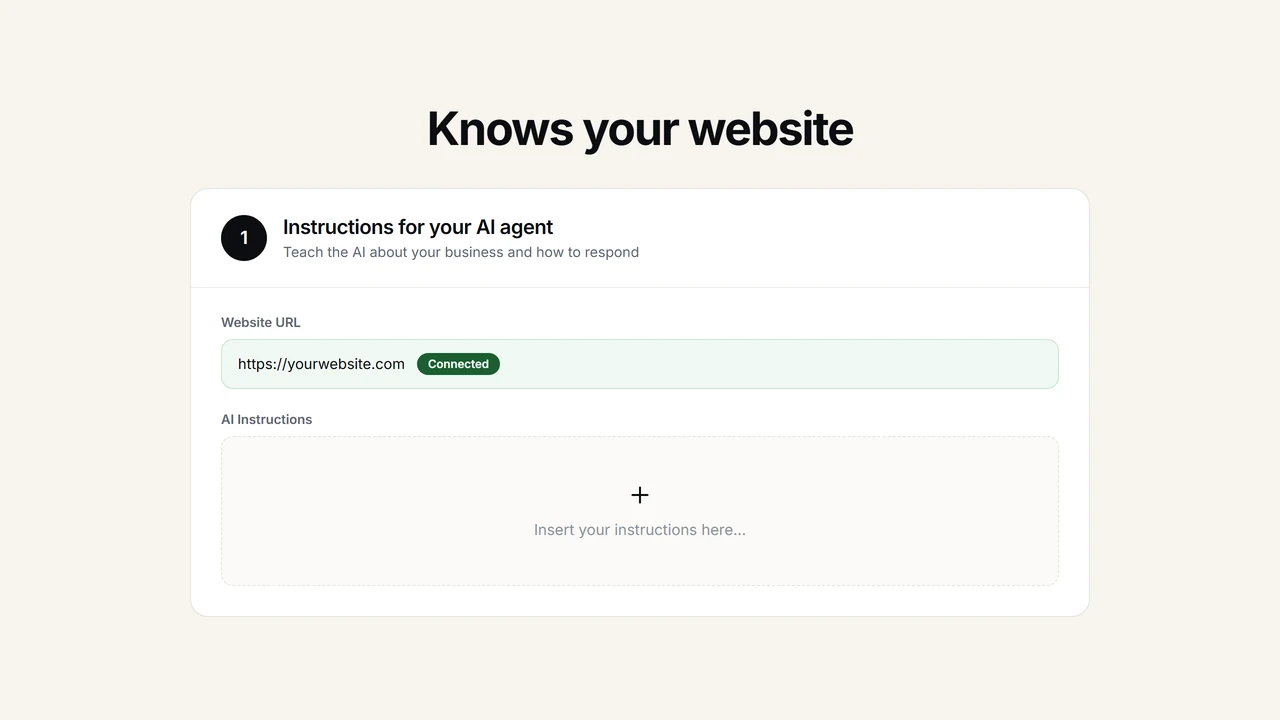
Reads your help center and runbooks — so tickets get resolved, not routed
A helpdesk chatbot is only worth running if it genuinely resolves the tickets it catches. Asyntai ingests your help center, public docs, internal runbooks, and custom instructions — so the AI's first response is a real answer, not a polite deflection back to the queue.
- Crawls your public help centerZendesk Guide, Intercom Articles, Help Scout Docs, Freshdesk Freshworks Knowledge Base, custom docs — any crawlable helpdesk content becomes part of the chatbot's working knowledge.
- Absorbs internal runbooksStaff-only procedures, tier-specific handling playbooks, product-team SMEs documents — uploaded as PDFs or pasted text, used alongside public docs when answering.
- Deflection rules in plain English"Always try to self-serve password resets before escalating." "Route billing disputes above $500 to a human." "Never promise a refund window without checking plan tier." You write the rules; the chatbot follows them.
When a ticket needs a human, it arrives with the conversation already attached
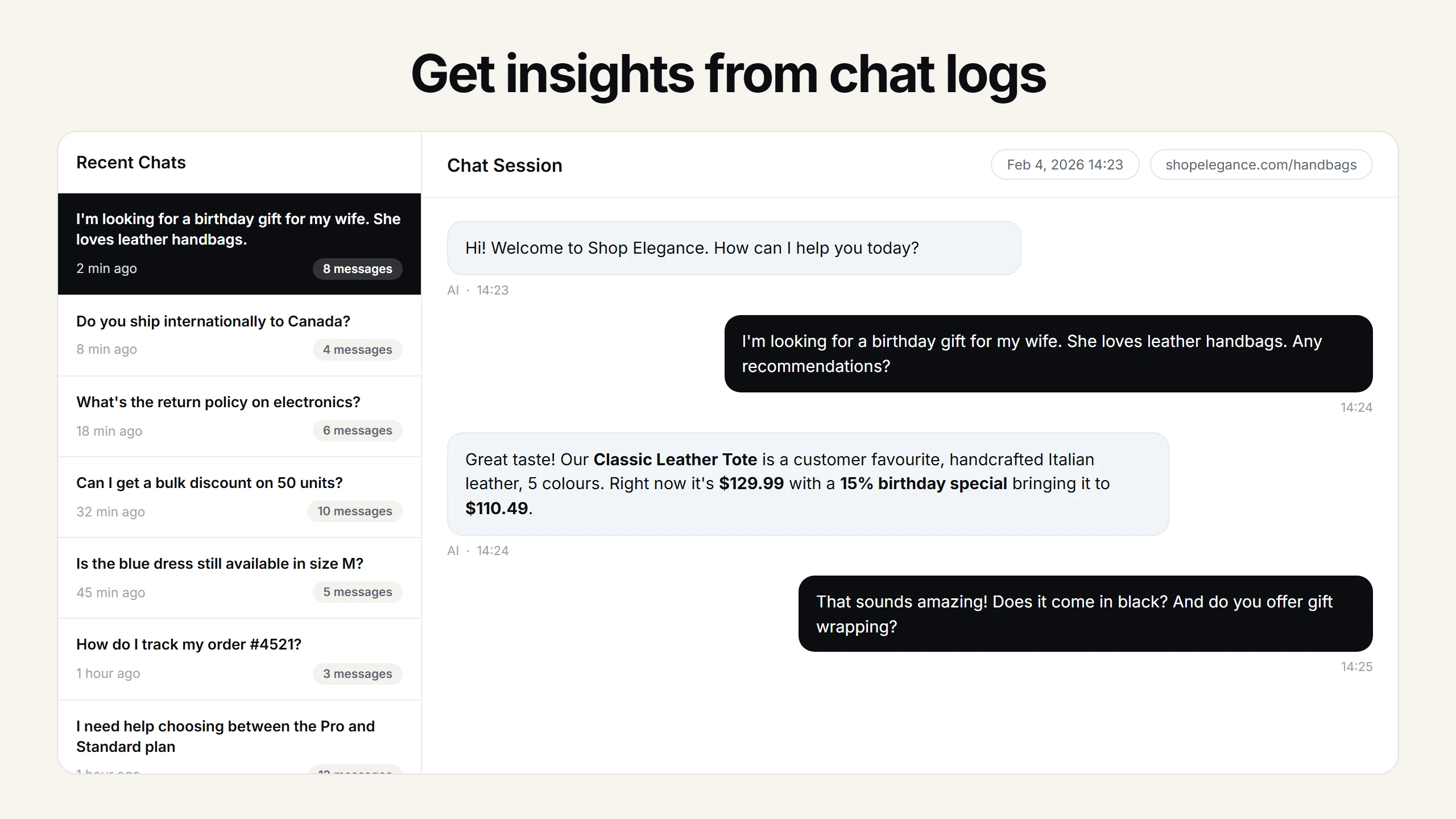
The helpdesk chatbot handles the tickets it can resolve on its own and hands the rest to your existing support inbox — Zendesk, Intercom, Freshdesk, Help Scout, Front, Jira Service Management, or plain email — with the user's contact and the full chat transcript included.
- Captures the handoff contextName, email, optional phone, and the complete conversation the chatbot already had — so your agent doesn't start from scratch on the ticket.
- Real-time inbox deliveryTurn on email notifications and every escalated ticket lands in your team's shared inbox the moment it happens, full transcript included.
- Works with any helpdesk that accepts emailForward the notification to your helpdesk's ticket email address, and the conversation becomes a properly threaded ticket in Zendesk, Freshdesk, or wherever you already route support email.
Install the helpdesk chatbot in an afternoon
Rolling out a helpdesk chatbot doesn't need to be a Q3 project plan. Asyntai installs as a single JavaScript snippet on your website, product app, or help center. Paste, train, switch on.
- Sign up for a free Asyntai account and copy your personal helpdesk snippet.
- Paste it into the
<head>of your product app, help center, or main site. - Point Asyntai at your help center URL and upload internal runbooks the chatbot should reference.
- Write a few plain-English escalation rules, test with real tickets, go live.
<script src="https://asyntai.com/widget.js"
data-id="your-site-id" async>
</script>
</head>
# Deflecting repetitive tickets from every page of your app.
Helpdesk chatbot — FAQs
What support leaders and ops teams typically want to confirm before rolling the chatbot in front of their helpdesk.
Does this replace our helpdesk (Zendesk, Intercom, Freshdesk, Help Scout)?
No — it sits in front of your helpdesk as a pre-ticket deflection layer. Users hit the chatbot first; the chatbot resolves the tickets it can answer from your content, and escalates the rest to your helpdesk with full conversation context attached. Your agents keep using Zendesk or whatever helpdesk you already have.
How does the handoff to our helpdesk actually work?
The chatbot captures the user's email and the full conversation, then sends you a real-time email notification with the transcript. If you forward that notification to your helpdesk's ticket intake email ([email protected] or a similar address routed into Zendesk/Freshdesk/etc.), the conversation becomes a threaded ticket in your existing system. This is a deliberately simple integration pattern — no API keys to configure, no OAuth flow, works with any helpdesk that accepts email-based ticket creation.
What percentage of tickets can the chatbot actually deflect?
It depends on your ticket mix. Teams with extensive public documentation and a high share of content-answerable tickets — password resets, billing questions, product how-tos, policy questions — often see 50–80% of inbound ticket volume handled by the chatbot without escalation. Teams with more complex per-account support needs see lower deflection, but still enough to meaningfully reduce queue pressure.
Can the chatbot handle account-specific questions?
Yes, via User Context on Standard and Pro plans. Your product app passes logged-in user data — account tier, plan, subscription status, organization role — into a JavaScript object before the widget loads. The chatbot uses that context to give account-aware answers, without needing any API integration with your backend.
Can we use the helpdesk chatbot internally for IT or HR support?
Yes. Internal helpdesks — IT support, HR questions, facilities, finance — follow the same pattern. Install the chatbot on your intranet or internal tool, upload your internal runbooks and SOPs, and the chatbot answers employee questions directly instead of routing them to your IT queue. The content stays private because uploaded documents are not public.
Does it support multiple languages?
Yes — 36 languages. The widget UI is localized, and the AI detects each user's language from their first message. A French user gets French replies, a German user gets German, a Japanese user gets Japanese — even if your help center and runbooks are written in English.
How does pricing compare to our helpdesk's per-agent cost?
Asyntai prices on conversation volume, not agent seats. 50 messages per month free, $39 per month for 800 messages, scaling from there. Your helpdesk continues to bill per agent, but you need fewer agents because the chatbot handles the deflected ticket volume. Most teams find the combined cost lower than adding another helpdesk seat.
Can I run the chatbot across multiple products or brand sites?
Yes on paid plans. Free: 1 site, Starter: 2, Standard: 3, Pro: up to 10. Each site gets its own separately trained helpdesk chatbot with its own content, escalation rules, and escalation destination email — useful for multi-product companies, agencies handling support across clients, or enterprises with separate regional helpdesks.
Helpdesk chatbot — what it deflects, what it escalates, and why that matters
Every helpdesk queue has a shape, and it's almost always the same shape: a flat base of repetitive, content-answerable tickets that any well-written help article could answer, a middle band of specific account or configuration issues that need an agent to look up a record, and a small top of genuinely complex cases that require real judgment. The flat base is where all the cost sits. A support agent earning $50,000 a year handles maybe 50 tickets a day at full utilization; if 70% of those tickets are password resets, billing questions, or "how do I find X" queries that could have been answered by a help article, you're paying the agent to be a very expensive search interface to your own documentation. A helpdesk chatbot sits directly over that flat base. It reads the same documentation, answers the same questions instantly, and lets the agent focus on the middle and top of the queue where their time actually matters.
The architecture of an effective helpdesk chatbot is worth drawing clearly. It operates as a pre-ticket layer — the first thing users encounter when they come looking for help. A user who would have submitted a ticket saying "I can't find my invoice" instead starts a chat with the widget. The chatbot, drawing on your help center and billing docs, answers directly with where to find invoices and how to download them. No ticket is ever created. The user got their answer faster than any helpdesk SLA could have matched, and your agent's queue stayed clear. For the user who does have a problem the chatbot can't resolve — an actual dispute, an unusual account state, a bug in an edge case — the chatbot captures their email and conversation, and the escalation lands in your existing helpdesk inbox already contextualized.
Training the helpdesk chatbot on your actual support knowledge is the first real setup task, and Asyntai handles it without manual curation. You give the AI your help center URL — whether it lives in Zendesk Guide, Intercom Articles, Help Scout Docs, Freshdesk's Freshworks Knowledge Base, GitBook, a custom docs site, or a Notion page — and the AI crawls every article it can reach, absorbing the content into a single knowledge base. For content that isn't in the public help center — internal escalation playbooks, tier-specific handling procedures, engineering-only runbooks, product-team SME documents — you upload those as PDFs or paste them as text. The chatbot uses both layers when answering, which is often where it pulls ahead of a pure knowledge-base search. It can answer "how do I export my account data" from a public article, and "why does my data export fail for very large datasets" from an internal runbook that explains the relevant workaround.
Custom escalation rules are what let the helpdesk chatbot work safely in front of a real support team. Without them, an over-confident AI can try to resolve things it shouldn't — a refund dispute, a legal complaint, a complex enterprise negotiation — and produce a worse outcome than escalation would have. Plain-English instructions let you draw the boundaries. "Never commit to a refund amount without manager approval." "Always escalate issues involving account security to the security team." "For enterprise customer tickets, offer a human handoff immediately." "Never debate contract terms — route to the account manager." The chatbot respects these boundaries and uses its judgment within them. It handles the tickets it should, and it escalates the ones it shouldn't.
The handoff to your existing helpdesk is the one architectural detail that matters most for support teams evaluating a helpdesk chatbot. Many chatbot tools build their own ticketing system bolted on, which means introducing a second surface your agents have to check. Asyntai takes the opposite approach — the chatbot has no ticketing system of its own. When an escalation happens, it sends an email notification to a configured address. You point that email at your helpdesk's ticket intake — typically [email protected] or a similar alias already routed into Zendesk, Freshdesk, or whatever tool you use — and the escalated conversation arrives in your existing support queue as a normal email-originated ticket, with the full chatbot transcript as the ticket body. Your agents keep using the tool they already know; you just get fewer tickets and cleaner context on the ones that do arrive.
Account-aware answers matter more for helpdesk chatbots than for most other categories, because so many support questions depend on the user's specific state. "Can I downgrade my plan" has a different answer depending on whether they're mid-annual-contract or on monthly billing. "When does my renewal process" requires their actual renewal date. "Is this feature available on my plan" requires knowing their plan. User Context on Standard and Pro plans solves this. Your product app passes logged-in user data — plan, renewal date, account status, feature flags, role within the organization — into a JavaScript object before the widget loads. The chatbot uses that context to answer accurately: "Your Pro plan renews on January 15. You're on monthly billing, so you can downgrade anytime before the next renewal." No backend API integration required; your app pushes what the chatbot needs.
Multilingual coverage is the feature that makes international support sustainable for teams with English-only help centers. Writing and maintaining help articles in eight languages is a real commitment — translation budgets, content drift, version skew, localized screenshots. Most companies can't justify it. But their users are global, and an English-only helpdesk leaves non-English users either struggling through English content, machine-translating in their heads, or escalating to an agent because self-serve didn't work. The Asyntai helpdesk chatbot supports 36 languages in the UI and the AI detects the user's language from their first message. A German user asking about billing in German gets the answer synthesized from your English billing docs, delivered in German. The documentation stays English as the source of truth; the chatbot becomes the multilingual layer on top.
Internal IT and HR helpdesks benefit from the same model, often more than external customer helpdesks. Every company has a stream of internal tickets that are content-answerable — "how do I reset my laptop password," "how do I submit a vacation request," "how do I access the VPN," "what's the process for a new hire." These tickets pile up on IT, HR, and facilities teams, and they're almost all covered by an internal wiki or SOP document somewhere. The helpdesk chatbot, deployed on the company intranet or a Slack integration layer, catches those tickets before they reach the IT queue. Uploaded internal runbooks stay private. The chatbot's answers stay accurate. The internal support team gets meaningfully more time for the real cases that actually require human attention.
Measurement is where the helpdesk chatbot produces ROI legibility that support leaders can defend. Ticket volume into your helpdesk drops — this is the easy metric to point at. First-response time drops because the chatbot answers instantly for the deflected tier. Average handle time on escalated tickets drops too, because agents receive pre-contextualized tickets rather than starting cold. Deflection analytics in the Asyntai dashboard show exactly which questions the chatbot is handling, which articles get cited most frequently, where the chatbot is hitting gaps in your knowledge base, and which escalations your agents could have avoided with better documentation. The chatbot becomes a self-improving loop: the gaps it surfaces become the articles you write next, which expand what it can deflect in the future.
Pricing structures the economics in a way that favors teams growing support volume without growing headcount. Asyntai's free tier includes 50 messages a month, enough to pilot the chatbot on a small support operation. Paid plans start at $39 per month for 800 messages, which handles the deflected ticket volume of most mid-sized support operations. Higher tiers scale up for larger volume. Your existing helpdesk keeps charging per agent seat, but the agent count you actually need drops because the chatbot handles the deflected tier. For teams where support cost is growing faster than revenue, adding a helpdesk chatbot is usually the cleanest way to break the trend without cutting service quality.
The support operations that benefit most from a helpdesk chatbot share a specific profile. SaaS companies with significant self-serve usage — trial users, freemium users, low-ARPU paid users — win because a very high share of their tickets are content-answerable and don't justify human time. Ecommerce operations with content-driven tickets (shipping, returns, sizing, policy) see massive deflection. API and developer products, which tend to get dense technical questions that are answered in docs, benefit enormously. Internal IT operations at mid-sized companies win on the volume of repetitive access, password, and VPN tickets. HR helpdesks at large companies win on benefits and policy questions. Enterprise customer support tends to see lower deflection percentages because their ticket mix skews to genuinely complex cases, but even there the chatbot meaningfully reduces the routine volume that otherwise eats senior-agent time.
Rolling the helpdesk chatbot out doesn't require changing how your team works. Paste the snippet into your product app or help center header. Point the AI at your docs. Upload internal runbooks. Write a handful of escalation rules that capture where the chatbot should and shouldn't try to resolve. Set the escalation notification email to route into your existing helpdesk's ticket intake. Test a handful of real scenarios. Switch on. From there, the chatbot handles the deflected tier of your ticket volume quietly — reducing queue pressure, improving first-response time, giving your agents more context on the escalations they do see, and surfacing the documentation gaps that would otherwise keep generating the same tickets forever.