A custom chatbot for your website, shaped around your brand and your content
Asyntai gives you a custom chatbot for any website — tailored colors, a tailored avatar, tailored tone rules, and answers drawn from your own pages instead of a generic model. Every knob you'd expect is exposed in a live-preview dashboard, no development time required.
Spin up a custom chatbot on your own website
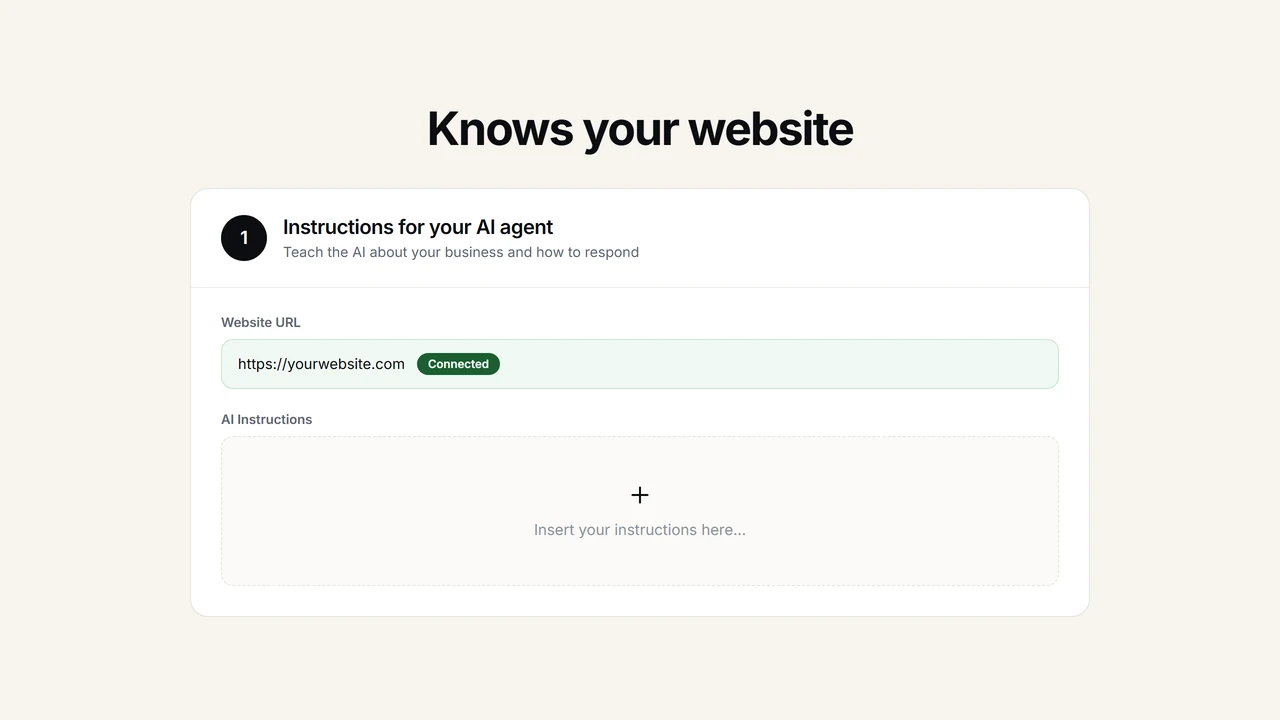
Drop in your URL and we'll start the tailoring — content, branding, behavior, all drawn from your site
A custom chatbot is only useful if it's actually custom — tailored to what your site sells, says, and stands for
Off-the-shelf bots answer from whatever a foundation model happened to learn during training. A custom chatbot for your website pulls from the exact pages, documents, policies, and pricing you've written — so the replies sound like you and cite material you actually own.
- Indexed from your own URLsPoint the bot at your domain and it ingests the pages you choose — product catalogs, service menus, how-tos, policies — then composes answers rooted in those sources rather than invented filler.
- Private documents as source materialUpload spec sheets, onboarding manuals, price lists, warranty terms, and internal FAQs. The custom chatbot cites them the same way it cites your live pages, keeping confidential material out of public crawl paths.
- Plain-English behavior instructionsWrite directives the way you'd brief a new hire: "Route any refund request to a human," "Never estimate lead times without knowing the postcode," "Mention the loyalty program when someone asks about discounts." The bot follows those instructions consistently across every visitor.
Every surface detail is customizable, from the launcher bubble to the voice the bot speaks in
Most "custom" chatbots let you pick a primary color and call it a day. Asyntai exposes the full styling surface — corner placement, avatar image, welcome copy, input hint, and an adjustable voice that ranges from formal and technical through warm and casual — so the chatbot reads as part of your site rather than a bolted-on widget.
- Visual styling without CSSSwap the accent color, anchor the launcher left or right, set the avatar to your logo or a mascot, write the opening line yourself, and pick placeholder copy that matches how your visitors describe things. Everything previews live as you edit.
- Voice and tone you can dial inPick the register that suits the audience — formal for legal, warm for wellness, technical for developer tools, casual for consumer goods — and the chatbot carries that voice across every reply, in every language it answers in.
- Custom welcome lines and outbound CTAsGreet first-time visitors with one message, returning leads with another, and mobile visitors with a shorter line. Attach a call-to-action — "Book a tour," "See the sample," "Start a free trial" — that fits the page the visitor arrived on.
Wire your custom chatbot into any website with a single tag
Installation is intentionally boring: a JavaScript snippet goes into the <head> section of whichever template renders your pages. No CMS lock-in, no platform-specific plugins required, no build-step configuration. The bot loads asynchronously and never blocks your page from rendering.
- Register for an Asyntai account (the free tier covers 50 messages monthly) and grab the snippet from your dashboard.
- Paste it inside the
<head>of your site — via a theme header field, a tag manager, or directly in your layout file. - Supply the URLs the chatbot should learn from and upload any private documents it ought to reference when responding.
- Open the customization dashboard, tune colors, voice, rules, and welcome copy, rehearse a handful of sample conversations, then publish.
<script src="https://asyntai.com/widget.js"
data-id="your-site-id" async>
</script>
</head>
# Bot picks up your custom brand + rules on next page load.
Custom chatbot for website — what people ask before building one
The questions we hear most from teams weighing a tailored chatbot against a generic one.
What makes Asyntai qualify as "custom" versus a cookie-cutter chatbot?
Two axes: the source material the bot draws from, and the personality it presents. On the source side, your chatbot is grounded exclusively in pages and documents you supply — never a shared knowledge pool with other tenants. On the personality side, every visible element (color, corner, avatar, opening line, input hint, voice, CTA) is configurable in the dashboard. The result is a chatbot that sounds like your team wrote it, because functionally your instructions did.
Can I tailor the way the chatbot speaks — the voice, not just the wording?
Yes. The voice is governed by a short written brief, similar to a brand voice guide. Tell the bot to stay formal and use industry terminology, or to be disarmingly casual, or warm and reassuring, or terse and efficient — and those characteristics carry through every response. The same brief also tells the bot what to avoid, so you can keep it from using phrases your brand would never use.
How granular can the custom behavior rules get?
As granular as you want. Rules are written in plain English and can cover content restrictions ("never discuss our pricing for enterprise tier publicly"), escalation triggers ("hand off to a human anytime a lawyer is mentioned"), conversion nudges ("after answering a feature question, suggest booking a call"), regional qualifiers ("ask for country before quoting shipping"), and more. Rules persist across every conversation the chatbot holds on the site.
Can the welcome message and buttons vary per page or visitor type?
Welcome lines and CTAs are part of the customization layer, and you can write different ones for different audiences. Logged-in customers on the Standard or Pro tier can also see personalized greetings through window.Asyntai.userContext — pass name, tier, or recent activity from your frontend and the chatbot greets each person as the right kind of visitor.
Do I need a developer to build or maintain this custom chatbot?
Only for pasting the snippet once. Everything else — training, branding, rules, voice, escalation paths, welcome copy — happens through the dashboard without touching code. Marketing, support, and ops teams run ongoing maintenance themselves, and updates take effect immediately rather than waiting on a release cycle.
What about languages — will the custom chatbot stay on-brand in every market?
The interface ships localized in 36 languages and the bot answers in whichever language the visitor writes. Your customization — tone, rules, escalation logic — applies across all of them, so a German visitor gets the same branded experience as an English-speaking one. One install, consistent custom behavior everywhere.
Where do custom escalations end up when the chatbot can't finish the job?
Wherever you want them routed. Default behavior captures the visitor's name and email along with the full transcript and delivers them to your Asyntai dashboard plus an email inbox you nominate. Teams typically plug that email into their existing helpdesk or CRM so handoffs reach the same queue as organic support requests.
What's the price for a custom chatbot at this level of tailoring?
Free plan: 100 messages a month and one website, enough to pilot. Paid plans begin at $39 monthly for 800 messages with two-site support. Higher tiers cover heavier traffic and more sites — Standard includes three, Pro covers up to ten — which suits agencies and multi-brand operators running different custom configurations per site.
What "custom" really means for a website chatbot
Calling a chatbot "custom" used to mean a service agreement, a six-week build, and a bill that started in the five figures. Agencies would stand up a bespoke conversational flow, hand-author intents, and charge ongoing retainers for flow maintenance whenever the product copy shifted. That approach fit a particular era of the tooling, where a chatbot was a deterministic state machine and making it reflect your brand took serious engineering hours. The word "custom" attached to that era; it survives in marketing copy but not in the underlying technology. Today, a custom chatbot for your website is something a single person configures in an afternoon using a dashboard, and the customization surface covers every element a visitor actually notices.
The starting point for any worthwhile custom chatbot is your own content. If a bot were allowed to answer from whatever its foundation model memorized in general training, it would confidently invent your pricing, your product specs, and your return window — and the inventions would sound plausible. The modern approach, and the one Asyntai uses, is to ground every answer in content you supply. Point the chatbot at your own URLs and it ingests the pages as source material; upload PDFs and text files and it treats those the same way. When a visitor asks a question, the bot answers from that corpus. Anything outside the corpus gets handed to a human rather than fabricated. This is the single biggest functional difference between a custom bot answering from your material and a generic chat layer sitting on top of a foundation model.
Branding is the layer most site owners think of first when they hear "custom," and it's where many platforms stop. A check-the-box approach lets you pick a primary color and swap the avatar, then leaves the rest looking like every other bot on the web. A more serious customization surface covers the launcher's corner placement, the avatar image, the opening greeting, the placeholder in the input box, the accent color, and the visual density — all of which combine to determine whether the chatbot reads as part of your brand or as a third-party overlay. Asyntai exposes each of those knobs through a dashboard that shows a live preview, so you adjust what you see instead of pushing changes blindly and reloading to check.
Voice is the most underrated axis of customization and the one that separates a custom chatbot from a polished generic one. The same words arranged by a formal legal assistant read very differently than the same words arranged by a cheerful wellness concierge. Asyntai treats voice as configurable through a brief — a paragraph or two describing how the bot should sound, what register to use, which phrases to lean into, which to avoid. The bot applies that brief to every response in every language it handles. A solo founder running a B2B SaaS site can specify "clear, concise, slight engineering edge, never salesy" and watch the chatbot hold that register across a pricing inquiry, a technical feature question, and a refund conversation in sequence.
Behavior rules extend the customization past surface traits into conversation logic. A rule is any instruction you want the bot to enforce across every exchange: what topics to stay off, when to escalate to a human, which products to cross-sell, what disclaimers to attach, how to handle ambiguous queries. Asyntai accepts these as plain prose — no scripting language, no JSON schemas — and the underlying model follows them with surprising fidelity. The practical effect is that a chatbot trained purely on your pages also behaves like your team would: it knows to ask for destination before quoting shipping, it declines to commit to timelines that require warehouse input, it offers a demo when a visitor asks about pricing tiers. Rules persist across the chatbot's lifetime and can be rewritten any time without retraining.
Welcome messaging and calls to action are the parts of the chatbot that sit closest to conversion, and they deserve the same customization attention. The default greeting a chatbot ships with — some variation of "hi, how can I help?" — is functional but bland. A tailored greeting references your actual value proposition, invites the specific question the page is designed to answer, and closes with an offer that fits the visitor's likely intent. Asyntai lets you write the greeting, the sub-line beneath it, and the action button text yourself, and you can differentiate by audience when you pass logged-in visitor data into the chatbot (available on the Standard and Pro tiers through the userContext JavaScript hook). A returning enterprise lead can be greeted by name with a reference to their last conversation; a first-time anonymous visitor gets the introductory line instead.
Escalation is where many custom chatbots fail quietly. A bot that reaches the end of its knowledge and simply says "I don't know" leaves the visitor worse off than they'd have been without the chatbot. The custom alternative is to specify exactly what happens at that point — which questions trigger a handoff, what contact details to collect, where the transcript gets routed, and what tone the chatbot uses while passing the baton. Asyntai captures name, email, and the full conversation transcript, then surfaces all three in your dashboard and your nominated email inbox in real time. Teams typically plug that email into their existing support or CRM workflow so handoffs land where their human queue already lives.
Multi-site customization matters more than it seems at first. Agencies and multi-brand operators often need genuinely different chatbots on different properties — the knowledge base, the voice, the escalation paths, the welcome copy should be distinct per site rather than forced into one generic configuration. Asyntai scopes every configuration per site, so each domain you connect has its own knowledge base, its own style, and its own rules. Plans cap the number of sites per account (one on free, two on Starter, three on Standard, and ten on Pro), which covers most agencies' active rosters and lets multi-brand teams keep every chatbot truly custom to the brand it represents.
Languages are a customization dimension site owners frequently forget about until a visitor from another market writes in. Asyntai handles 36 languages in the interface and answers visitors in whichever language they start the conversation in. The important detail for custom deployments is that your brand rules, voice brief, and escalation logic apply across every language — a French visitor gets the same personality and the same handoff routing as an English one, just in French. You don't maintain 36 separate configurations; you maintain one, and the chatbot renders it faithfully across the entire surface.
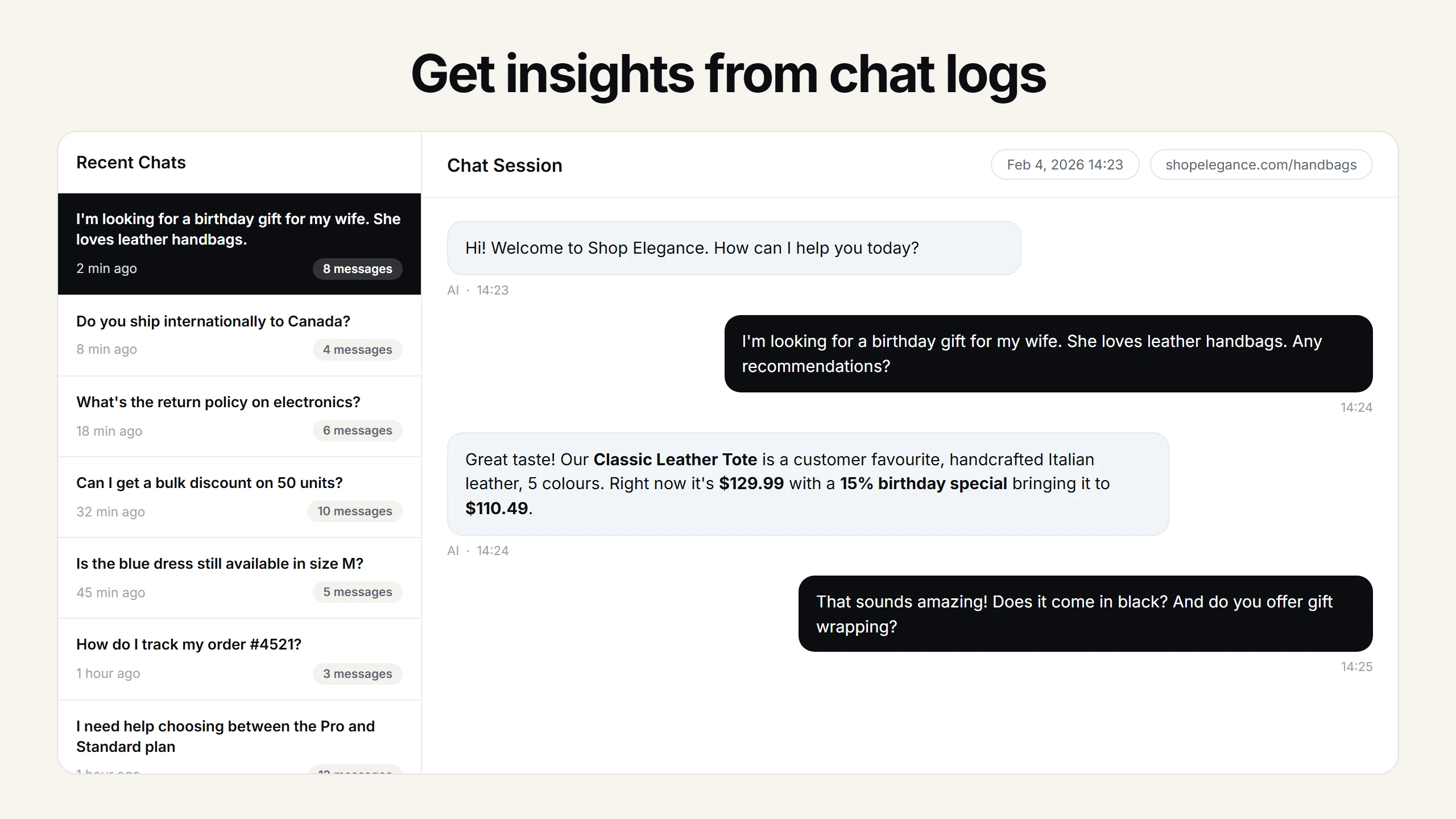
Analytics close the loop on custom chatbot deployments in a way that generic analytics tools don't. The dashboard surfaces which questions come up, which get answered confidently, which trigger handoff, which pages generate the most chat traffic, and what the visitor's language distribution looks like. Over a few months, those patterns turn into a prioritized editing list for your website: the questions the chatbot keeps getting are the questions your pages aren't answering well enough on their own. Teams who take the analytics seriously end up with better-performing pages and a chatbot that handles a shrinking proportion of repeat questions because those questions no longer get asked — the visitor found the answer in a rewritten page instead.
Pricing on Asyntai matches the shape of usage rather than the number of seats. The free tier gives you 50 messages a month and a single website — enough to test drive the customization on a small site. Paid plans begin at $39 monthly for 800 messages, and higher tiers stretch into significant volume territory for busy sites. Per-seat live chat licensing scales painfully as teams grow; per-message pricing scales with the thing that actually varies, which is how much the chatbot is used. For organizations where the majority of visitor questions are content-answerable (so most conversations never touch a human), the math almost always favors the custom chatbot route.
Setup is the part that surprises people who've built custom conversational experiences the old-fashioned way. You register, copy your snippet, drop it into your site's header, point the chatbot at your URL, upload the documents you want referenced, and open the customization panel. From there you pick the color, the corner, the avatar, the welcome line, and the CTA; paste a voice brief that sounds like your brand; write five or ten behavior rules; preview a few sample conversations; and publish. An hour-and-a-half after starting, the chatbot is live, answering in your voice, enforcing your rules, and escalating the cases you don't want it to touch. The "custom" in custom chatbot for your website is no longer a procurement exercise — it's a dashboard session, and anyone on your team can run it.