Chatbot widget that fits any website and knows your content
Asyntai offers a fully customizable chatbot widget — embeds on any site via a single script tag, drawing on your pages and documents, and answers visitors in 36 languages around the clock.
Try the chatbot widget on your website
Paste your site URL and see how the widget would actually greet and answer your visitors
A widget that looks like part of your site, not a bolt-on from another era
Every piece of the chatbot widget UI is configurable: color, position, welcome message, avatar, tone of voice, mobile behavior. Changes preview live in the Asyntai dashboard, so you can dial in exactly how the widget appears before it goes live.
- Brand-matched stylingSet the primary color, corner position (left or right), launcher icon, avatar, welcome line, and input placeholder — all from your dashboard with live preview.
- Mobile behavior you controlOn phones, the widget can open as a smaller chat bubble rather than a full-screen takeover, so it doesn't scare away thumb-scrolling visitors.
- Voice set in plain EnglishCustom instructions shape how the chatbot widget actually talks — warm vs formal, concise vs detailed, how it greets, when it offers to escalate. No decision-tree editor needed.
The widget speaks for itself because the AI knows your site
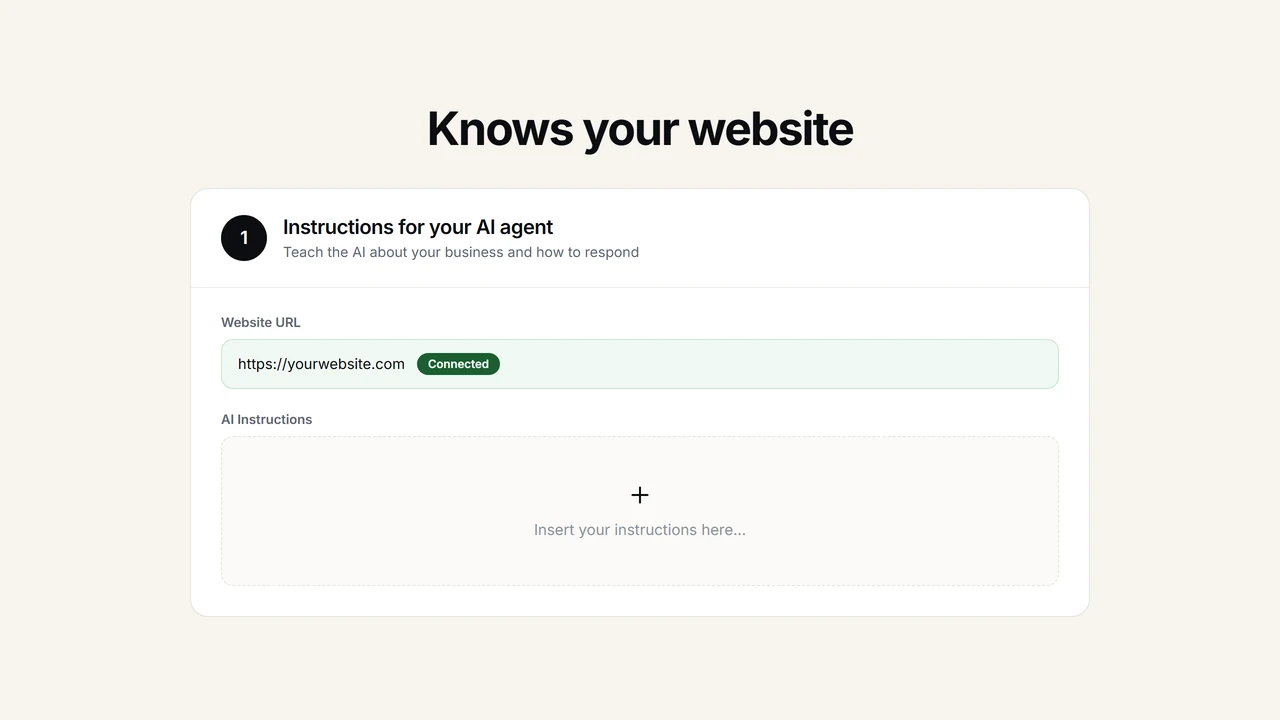
A chatbot widget is only as useful as its knowledge. Asyntai auto-crawls your website, combines it with anything you upload privately, and follows the rules you write — so every answer through the widget is grounded in your actual content.
- Auto-crawls your sitePages, blog posts, products, pricing, policies — absorbed into a single knowledge base. No manual Q&A curation required.
- Uploaded documents and instructionsInternal pricing sheets, product specs, SOPs, onboarding guides — added as PDFs or pasted text, blended with the site crawl.
- Personalization via User ContextOn Standard and Pro plans, your site can pass logged-in visitor data into the widget for personalized greetings and context-aware answers.
Embed the chatbot widget in one line of code
The chatbot widget embeds via a single JavaScript snippet, the same way you'd add a Meta Pixel or Google Tag. Paste it in the <head> and the widget is live on every page.
- Sign up for a free Asyntai account and copy your personal widget snippet.
- Paste the snippet into your site's
<head>— via your CMS header settings, a header plugin, or directly in the template. - Point Asyntai at your website URL and upload any private documents you want the widget to reference.
- Customize colors, position, and voice, test a few conversations, and switch the widget live.
<script src="https://asyntai.com/widget.js"
data-id="your-site-id" async>
</script>
</head>
# One line. The widget is now on every page.
Chatbot widget — FAQs
What teams evaluating a chatbot widget typically confirm before installing.
Does the chatbot widget work on any website platform?
Yes. Because it's a JavaScript snippet, the widget installs the same way on WordPress, Shopify, Wix, Squarespace, Webflow, Ghost, HubSpot CMS, custom-built sites, and any CMS that allows script tags in the header. We also have dedicated plugins for many popular platforms if you prefer a native install flow.
Can I match the widget's appearance to my brand?
Fully. Primary color, launcher position (left or right), launcher icon, avatar, welcome message, input placeholder, and tone of voice are all configurable from the Asyntai dashboard with live preview. Changes take effect immediately without needing a redeploy.
How does the widget behave on mobile?
On phones, you can choose whether the widget opens as a smaller chat bubble (less intrusive) or as a full-screen overlay (more conversational). Asyntai defaults to the bubble on mobile because full-screen openings tend to increase bounce rate on small screens.
Will the chatbot widget slow down my site?
The widget loads asynchronously after your page has rendered, so it doesn't block the initial paint or interfere with Core Web Vitals measurement. It behaves like any other third-party widget on your site — Meta Pixel, Google Tag Manager, analytics scripts.
Can I control when the widget opens proactively?
Yes. Asyntai supports an auto-trigger that opens the widget after a configurable delay, with separate behavior for desktop and mobile. You can also restrict auto-trigger to specific pages — open on pricing and product pages, stay quiet on blog posts — through custom instructions.
Does the widget speak multiple languages?
Yes. The widget UI is localized into 36 languages, and the AI detects the visitor's language from their first message. A French visitor gets French replies, a German visitor gets German, a Japanese visitor gets Japanese — from the same single widget installation.
What happens when the visitor asks something the widget can't answer?
The widget captures the visitor's contact details — email, optionally phone — along with the full conversation transcript, and delivers it to your Asyntai dashboard. Email notifications send the transcript to your team's inbox in real time, so the handoff to a human is clean.
Can I run the widget on multiple websites?
Yes on paid plans. Free: 1 site, Starter: 2, Standard: 3, Pro: up to 10. Each site gets its own widget configuration — colors, content, behavior rules — so the same Asyntai account can power different branded widgets across a portfolio.
Chatbot widget — what it is, what to look for, and how it earns its spot
The chat bubble in the corner of a website is a small piece of UI with an outsized job. Visitors notice it within the first two or three seconds of landing on a page, and most of them form an opinion about the site's service layer before they ever click it. A chatbot widget that feels like part of the brand signals a competent, well-run business. A widget that looks like it came from 2014, overlaps other page elements, or takes over the entire screen on a phone signals the opposite. The practical question for anyone shopping for a chatbot widget isn't whether to have one — most decent sites need one — but whether the widget fits properly into the site's design and actually answers the questions visitors ask.
The widget itself is really two separate things stitched together: the front-end UI piece that the visitor interacts with, and the AI or rule engine behind it that decides what to say. Most widget vendors focus almost entirely on one side or the other. UI-heavy products offer beautiful customization but a decision-tree chatbot that breaks on unexpected phrasing. AI-heavy products answer well but drop into your site looking like a generic widget template. Asyntai's chatbot widget is built to handle both sides — the appearance controls are detailed enough to match almost any brand, and the AI reads your site content so the answers are actually grounded rather than generic.
Customization is the first place teams evaluating a chatbot widget typically want to see specifics. On the appearance side, Asyntai exposes the full set of dials most brands care about: a primary color for the widget's accents and message bubbles, a position choice (left or right corner), the launcher icon, an optional avatar image for the assistant, the welcome line that appears when a visitor opens the chat, the input placeholder text, and a tone setting that shapes how the AI actually writes. Every change previews live in the dashboard, so you don't deploy, look at the result, and deploy again — you see exactly what visitors will see before committing.
Mobile behavior is where a lot of widgets quietly fail. On desktop, a chat widget that opens as a proper pane in the corner feels like a conversation starter. On mobile, the same "proper pane" often becomes a full-screen takeover that covers the product or service page the visitor was trying to read, triggering an immediate bounce. Asyntai lets you choose how the widget behaves on phones separately from desktop — open as a smaller, dismissible chat bubble by default, or open as a full overlay if that's what your audience prefers. The default is the less intrusive option because most measurable bounce rate on mobile chat widgets comes from overly aggressive opening behavior.
The AI behind the chatbot widget is the other half of the decision. A well-designed widget connected to a poorly trained AI is still a frustrating experience. Asyntai points the AI at your site content directly — you paste the URL, the crawler reads your public pages, your products, your blog posts, your policy content, and builds a knowledge base from all of it. You then layer in private content via PDF upload or text paste: internal SOPs, pricing sheets, partner lists, process documentation that isn't public. Custom instructions in plain English shape how the AI uses that knowledge: "always recommend a consultation when pricing questions come up," "never commit to project timelines without scope discussion," "if a visitor asks about a competitor, focus on our strengths rather than comparisons." These instructions apply to every conversation the widget handles, in every language.
Auto-trigger behavior is where the chatbot widget crosses from passive to active. A widget that waits silently in the corner gets clicked maybe five percent of the time. A widget that opens proactively at the right moment — after the visitor has been on a pricing page for twenty seconds, or has scrolled through half a long services page, or has paused in the cart — catches the questions that would otherwise become silent bounces. Asyntai's auto-trigger handles this with a configurable delay, separate settings for desktop and mobile, and the ability to restrict proactive opening to specific pages. On a SaaS site, you might open on the pricing page and stay quiet on the blog. On an ecommerce store, you'd open on product pages and the cart. The calibration matters: too aggressive and you hurt bounce, too passive and you miss the moment.
Performance is a real concern for anyone who has watched a site's PageSpeed score tank after adding a heavy widget. The Asyntai chatbot widget loads asynchronously after your page has rendered, which means it doesn't block the critical path and shouldn't affect your Largest Contentful Paint or First Contentful Paint measurements. It behaves like any other async third-party script on your page — Meta Pixel, Google Tag Manager, analytics tools — in terms of when it executes and how it integrates. For teams running performance-sensitive sites, this matters: the widget adds a capability without obviously degrading the experience of visitors who never open it.
Languages used to be the feature that separated enterprise-grade chatbot widgets from everyone else. Basic widgets offered a single language UI and whatever language the human agent or rule tree was configured for. More capable widgets offered localized UI but still single-language replies. Asyntai handles 36 languages in the widget UI — the buttons, placeholders, system messages all localize — and the AI detects the visitor's language from the message they type. A French visitor gets French replies, a German visitor gets German, a Japanese visitor gets Japanese, from the same installation with no translation plugin or secondary configuration. For sites with international traffic, this alone is often the decisive feature.
Personalization for logged-in visitors is where the User Context feature comes in, available on Standard and Pro plans. Your site can pass known visitor data into a JavaScript object before the widget loads — name, account tier, subscription status, recent activity, order history, any relevant context. The widget uses that context to give personalized replies: "welcome back, Maria — I see you're on the Pro plan." Nothing is pulled from your system; you push exactly what you want the widget to know. For SaaS products with logged-in users, ecommerce stores with customer accounts, or membership sites, this turns a generic widget into a context-aware assistant.
Lead capture is usually what justifies the chatbot widget in the business case. Most visitors who have a real question and don't get it answered leave silently; they don't fill in the contact form because it's too long, and they don't email because the friction is too high. The widget catches those visitors mid-conversation. When the AI can't fully close the question, it asks for an email — or phone number, configurable per site — and every captured lead lands in your Asyntai dashboard with the full transcript. Email notifications route the same transcript to your team's inbox in real time, so a lead isn't just a name but a contact with documented context about what they were asking. That context typically doubles follow-up conversion relative to an anonymous form submission.
Multi-site management is a quiet benefit that matters more than people expect. If you're running a portfolio of brands, multiple product lines, or client sites as an agency, each site usually needs its own branded widget with its own content training and its own behavior rules. Asyntai handles this through site-level plan scaling: free supports one site, Starter two, Standard three, Pro up to ten. Each site gets a separate chatbot widget with its own knowledge base, its own custom instructions, and its own visual styling. For agencies especially, this means one account can power different-looking widgets across every client site, with conversations and leads separated cleanly.
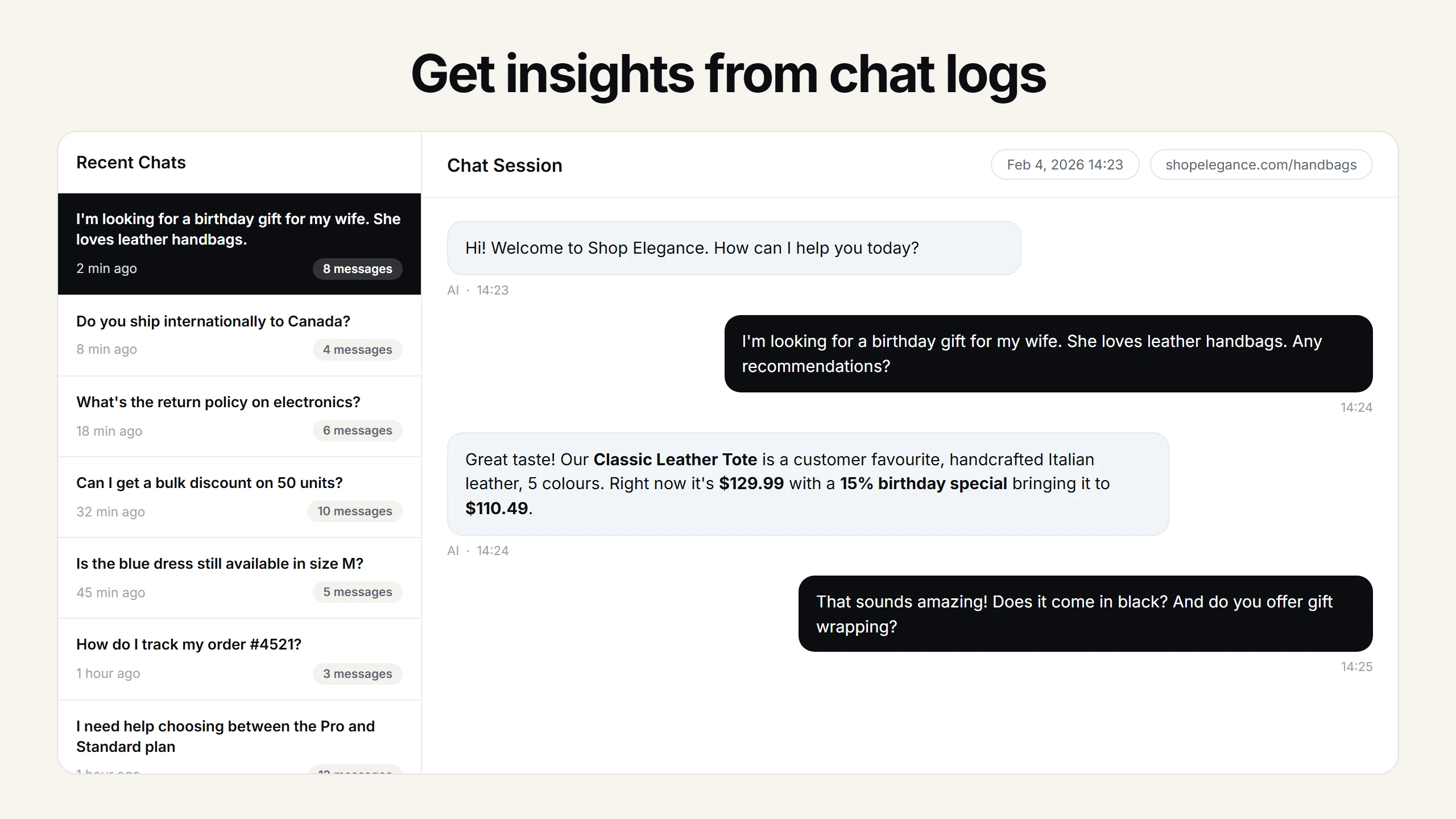
What visitors ask the chatbot widget becomes a feedback signal most teams never had before. A well-run widget shows you exactly which questions come up most, which pages drive the most chat volume, where in the site visitor confusion concentrates, and what language mix your actual audience uses. Conversation analytics in the Asyntai dashboard surface these patterns grouped by frequency and topic, so instead of guessing why bounce rate on a specific page is high, you see the actual questions visitors type when they pause there. Over a few months, that signal becomes a prioritized edit list for your site — the pages that need rewriting, the FAQs that need expanding, the information that's buried and should be promoted.
Pricing for the chatbot widget is structured to match how teams actually grow usage. The free tier includes 50 messages per month, which is realistic for a small site piloting the widget or running it on a single landing page. Paid plans start at $39 per month for 800 messages, covering mid-sized sites with healthy traffic. Higher tiers exist for volume sites — high-traffic blogs, ecommerce during peak season, SaaS companies with active trial flows. Email warnings arrive before you actually hit your message cap, giving runway to upgrade before the widget pauses in a moment that matters. Compared with per-seat pricing on traditional live chat tools, where costs scale with team size, the per-conversation model tends to be much more favorable for teams whose chat is primarily AI-answered.
The teams that benefit most from a well-designed chatbot widget are usually the ones whose traffic is spread across time zones or peaks outside office hours. SaaS companies with global trial funnels, ecommerce brands shipping internationally, service businesses whose prospects browse in the evenings, content sites with SEO reach across multiple countries — all gain the most from a widget that works 24/7 in 36 languages without a staffing model behind it. Teams whose chat traffic is narrowly concentrated during business hours and requires nuanced human handling for every case might lean toward a human-agent live chat tool instead, though most of them find that a hybrid — AI widget for first response, humans for escalations — is the better fit once they've tried both.
Adding the chatbot widget to a site is the least interesting part of the process. Paste a snippet into the header. Point the AI at your URL. Upload anything private that the widget should reference. Customize the appearance in the dashboard. Write a handful of plain-English instructions. Test a few real conversations. Go live. Most teams finish the setup inside an afternoon and spend the following week tuning the voice based on real visitor conversations. From there, the widget runs quietly — answering questions, capturing leads, generating analytics, and turning the bottom corner of every page on your site into a working customer-facing layer you didn't have before.