Chatbot SaaS that skips the servers and the science project
Asyntai is a cloud-hosted chatbot SaaS — flat monthly subscription, no infrastructure to run, no model to fine-tune, live on your site the same day you sign up.
Try the chatbot SaaS on your own URL
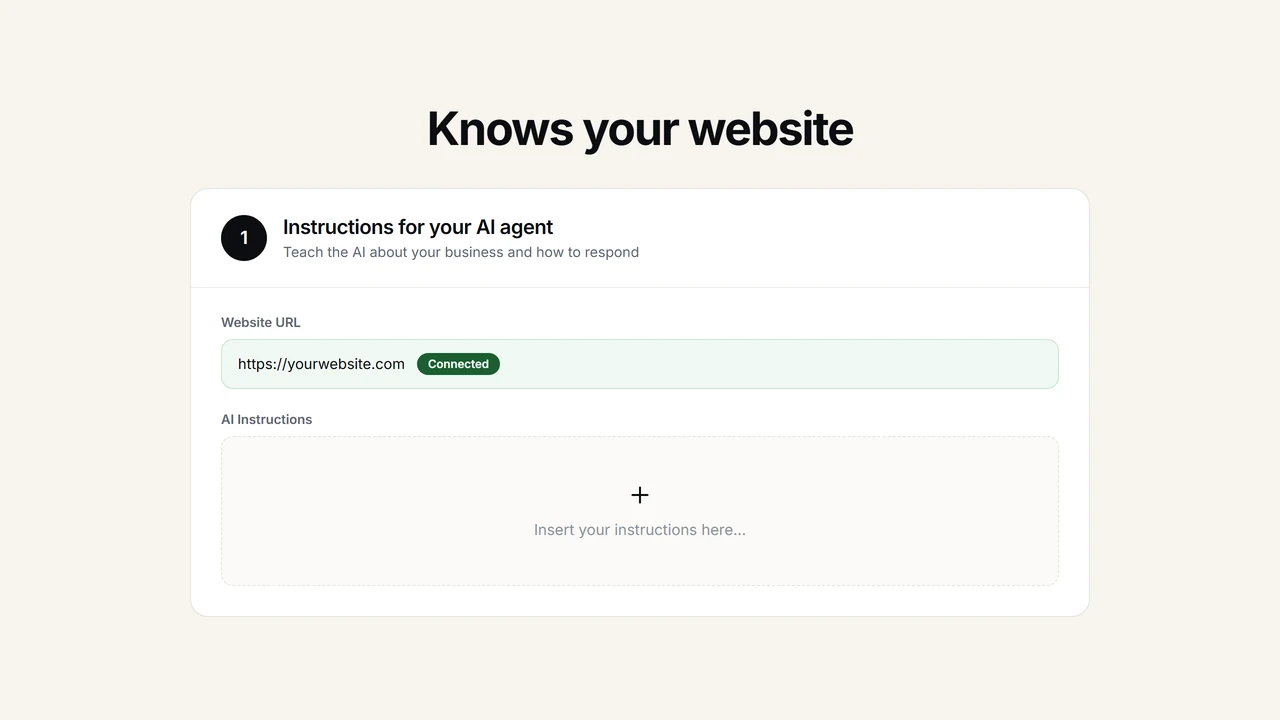
Drop your website address below and watch how our hosted platform reads the content and starts answering
Pay a predictable monthly bill, not a DevOps salary
Running a chatbot in-house means GPUs, vector databases, prompt engineers, and an on-call rotation nobody signed up for. As a SaaS, Asyntai rolls all of that into one subscription line item that your finance team can forecast against without surprises.
- Flat monthly rates, not per-seatPricing scales with conversation volume, not headcount — so hiring ten more support teammates doesn't blow up the contract, and your AI layer stays the same cost.
- Zero infrastructure overheadNo containers to patch, no embedding pipelines to babysit, no model weights to rotate. The hosted platform handles every layer from retrieval to response generation.
- Upgrades ship automaticallyModel improvements, new dashboard features, and reliability work reach your tenant without a migration window or change-management ticket.
A hosted platform that goes live in hours, not sprints
Traditional open-source chatbot stacks take weeks to stand up: ingest jobs, retrieval tuning, guardrail prompts, a frontend to build. Asyntai's SaaS collapses that into sign-up, paste a script, upload a couple of documents, go live.
- Sign up and ship the same dayMost accounts have a working chatbot on a production site inside an afternoon — no procurement cycle, no staging environment, no implementation partner needed.
- No fine-tuning requiredThe platform grounds responses in your crawled site and uploaded PDFs at query time. You skip the training dataset, the labeling budget, and the ML ops learning curve.
- Dashboard ownership from day oneCopy, colors, rules, and analytics live in a browser dashboard your whole team can log into — product, support, marketing — without shipping a deploy.
Go live on the chatbot SaaS in one script tag
Because it's a pure SaaS, there's nothing to install on your side — no runtime, no dependencies. A single snippet in the <head> is the entire deployment, and the hosted platform does the rest.
- Create a free Asyntai tenant — no card, no sales call, just an email.
- Paste the tenant-specific snippet into your site header via your CMS, a tag manager, or a native plugin if you're on WordPress, Shopify, WooCommerce, Magento, Joomla, Drupal, or Odoo.
- Feed the platform your URL plus any PDFs or text blocks you want folded into the knowledge base.
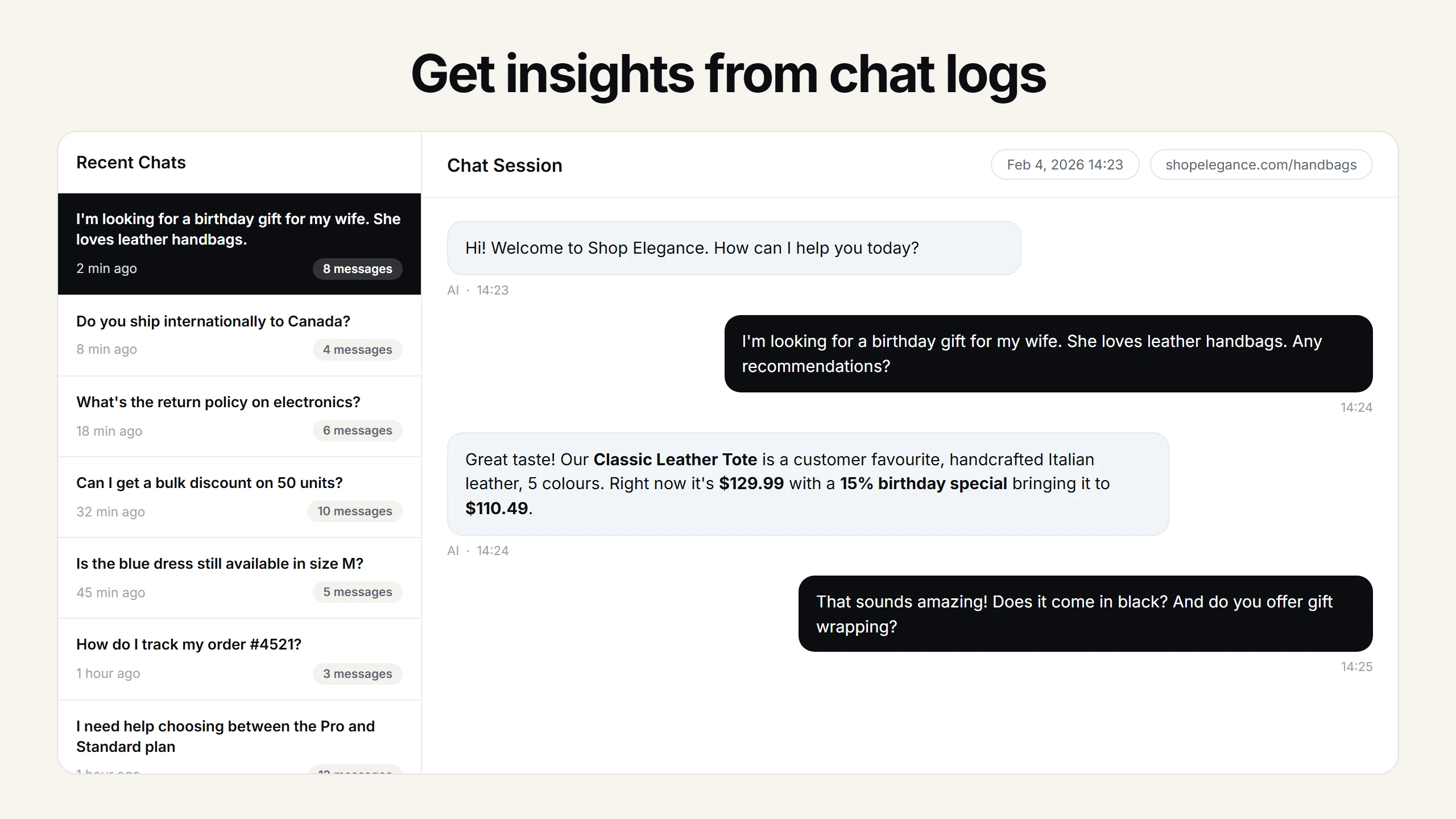
- Review the first few live conversations, adjust tone and auto-trigger rules, and let the SaaS run itself.
<script src="https://asyntai.com/widget.js"
data-id="your-tenant-id" async>
</script>
</head>
# Hosted tenant. No servers on your side.
Chatbot SaaS — FAQs
Questions founders and product leads raise while comparing hosted chatbot providers against DIY alternatives.
What does "chatbot SaaS" mean in practical terms?
It means the platform runs on the vendor's cloud and you rent it per month. You don't install anything heavier than a browser snippet, you don't operate GPUs, and you don't maintain a retrieval pipeline. Asyntai hosts every moving piece — the knowledge base index, the model calls, the dashboard, the analytics store — and bills one predictable line per month.
How is the subscription structured?
Tiers are based on monthly message volume rather than seats or agents. The free tier covers 50 messages for pilots and tiny sites. Paid subscriptions begin at $39 per month for 800 messages, with higher tiers for heavier traffic. Because billing tracks usage rather than team size, adding teammates to the dashboard never changes the invoice.
Do we need to fine-tune or train a model?
No. The platform uses retrieval-augmented generation against the content it has indexed from your site crawl and uploaded documents, so there's no training set to prepare, no labeling exercise, and no ML ops timeline. If the knowledge shifts, you re-crawl or swap out the source document and the chatbot adapts on the next query.
Can we self-host if compliance demands it?
Asyntai is delivered only as a cloud-hosted SaaS — we do not ship a self-hosted build. Teams with strict on-premise requirements typically aren't our best fit, but most compliance conversations we have are comfortably solved by our SaaS with the usual data-handling guarantees rather than a full on-prem deployment.
How quickly can a team go from sign-up to live?
The fastest path we see is under an hour: create the tenant, paste the snippet, point the crawler at the marketing site, approve the initial knowledge base, and let the widget accept live traffic. A more polished rollout with dashboards shared, tone calibrated, and auto-trigger rules set usually wraps up inside a single working day.
How does the SaaS handle multiple brands or properties?
One subscription scales across properties according to plan: Free covers one site, Starter two, Standard three, and Pro stretches to ten. Each property sits in its own configuration — separate knowledge base, separate styling, separate lead inbox — while still rolling into one monthly bill.
Which languages ship out of the box?
Thirty-six languages are supported for the chatbot UI and replies, with the platform auto-detecting the visitor's language from their first message. No translation plugin or separate locale setup is needed — a SaaS tenant in English can serve a Portuguese or Korean visitor without any extra configuration.
Where do captured leads end up?
Qualified contacts show up in your Asyntai dashboard with the full transcript attached, and optional email notifications forward the same record to a team inbox in real time. There is no automatic push into Klaviyo, HubSpot, or another CRM — if you want leads in a CRM, you export them or wire the email notification into your own intake flow.
Chatbot SaaS — how the hosted model changes the buying decision
A few years ago, putting a smart chatbot on a website meant choosing between two uncomfortable paths. One option was buying enterprise live chat software with an "AI add-on" bolted on, priced per seat and built around staffing a support team. The other was assembling an open-source stack yourself: a language model behind an API, a vector database to hold embeddings, a retrieval pipeline, a guardrail layer, a frontend widget, a dashboard, and a tiny DevOps practice to keep it all running. Chatbot SaaS is the category that grew up to fill the gap between those two — a hosted platform you rent by the month, built specifically so that a small team can ship an AI chat layer without standing up infrastructure.
The shift matters because the economics underneath a chatbot have changed more dramatically than most buyers realise. When the bottleneck was hiring and scheduling human agents, per-seat pricing made sense; every seat corresponded to a person who could only handle one conversation at a time. Once the AI can handle the majority of first-response traffic, per-seat becomes a tax on growth. Adding three teammates to the dashboard shouldn't triple the invoice when none of them are actually answering more conversations — the AI is. A SaaS platform designed around this reality bills on what's really scarce, which is compute and conversation volume, and treats dashboard users as a flat commodity.
Evaluating a chatbot SaaS against a do-it-yourself build tends to surface the same handful of categories. Total cost of ownership is the big one, and the DIY side almost always looks cheaper on the first spreadsheet: open-source retrieval framework free, embeddings a few dollars per million tokens, vector database on a cloud free tier. When the spreadsheet expands to include engineer time — writing the ingestion pipeline, tuning the retriever, building the admin UI, keeping the model adapter current as vendors shift APIs — the numbers move. A senior engineer spends two to four weeks on a first cut, more weeks polishing, then an ongoing fraction of their time keeping the thing alive. The hosted platform, by contrast, is a line item you can forecast out twelve months.
Deployment speed is the other category where the gap is sharper than buyers expect. A careful DIY build moves in sprints: data ingest one week, retrieval quality another, guardrails after that, the frontend and dashboard a couple more, and then the hardening work that nobody wants to estimate. A chatbot SaaS collapses that into a sign-up page. With Asyntai, the tenant exists within seconds of the first email confirmation, the hosted widget snippet can be pasted into a staging site inside ten minutes, and the first real conversation happens the same afternoon. That doesn't make the DIY path wrong — some teams genuinely need the control — but for a founder or a product lead trying to ship a conversational layer this quarter, the time-to-value difference is usually the whole argument.
The other thing a hosted platform quietly removes is the reliability burden. Someone has to be on call for the chatbot: someone to notice when an index rebuild runs out of disk at two in the morning, to re-architect around a model provider's rate-limit change, to catch a guardrail regression when a newer model handles system instructions differently. In a SaaS arrangement, the vendor carries all of that. When you're choosing between a DIY chatbot and a SaaS tenant, what you're really choosing is whether your own team holds the pager or the vendor does.
Subscription predictability becomes a feature when you zoom out to a year of operating. Teams running DIY chatbots often discover that their monthly bill is surprisingly volatile: model API spend drifts upward with usage, the vector database tier upgrades itself silently, a noisy crawler run spikes token consumption, and the finance team gets a line item they can't plan around. A flat-rate SaaS subscription bounds the downside. Asyntai's paid tier opens at $39 a month including 800 messages, with larger volumes priced in steps above that; if traffic climbs beyond the included allowance, the vendor warns by email well before anything gets cut off, so a budget-owner has runway to upgrade cleanly rather than explain a surprise overage.
Plan structure inside a chatbot SaaS tends to matter more than buyers realise during a trial. The free tier with Asyntai is a real product, not a demo — 50 messages a month, all the core features, no credit card — which lets a pilot run long enough to generate honest conversation data before anyone has to make a purchase decision. The paid tiers then scale along two axes that match how businesses actually expand: message volume, and number of distinct properties. Free covers a single site; Starter unlocks two; Standard carries three; Pro reaches ten. A holding company with eight brands can sit on a single account without renegotiating a contract every time a new property lights up.
One of the stronger arguments for the SaaS model is the rate at which the hosted platform improves without the customer touching anything. A chatbot's quality is a moving target; what looked state-of-the-art twelve months ago now feels slow and blunt because the underlying models keep getting better. On a DIY stack, every one of those improvements is an integration project. On a hosted platform, the upgrade reaches the tenant when the vendor ships it. Dashboard features, new language coverage, retrieval refinements, auto-trigger tuning, analytics views — they arrive without a migration, and the tenant gets the benefit of everyone else's deployment effort rolled in for free.
Language coverage is a specific place where the SaaS model pays off compared with most DIY setups. Getting a bespoke chatbot to answer reliably in Japanese, German, Portuguese, and Arabic is a non-trivial engineering exercise once you account for tokenizer differences and localized UI strings. Asyntai ships with 36 languages, with detection handled at the message level; a French visitor gets a French reply from the same tenant that served an English visitor a moment earlier — effectively impossible to replicate cheaply at a DIY level within a normal product timeline.
Personalization is another area where the platform earns its keep without adding operational weight. Logged-in visitors rarely want a generic greeting; they want the chatbot to know they're a paying customer on a specific plan with a particular support history. The User Context capability on Asyntai (unlocked from the Standard tier upward) accepts a JavaScript object from your site that hands relevant visitor facts to the chatbot before a conversation begins. The merchant or publisher decides exactly what to pass — no system is queried behind the scenes — and the chatbot uses that information to open a conversation that feels aware rather than blind. Building the same pattern on a DIY stack is straightforward; keeping it working as the underlying prompt templates evolve is the real cost.
The data flow around captured leads is worth understanding clearly before a commitment. Every lead the chatbot qualifies lands in the Asyntai dashboard with its transcript, and optional email notifications push the same record to a shared inbox the moment it happens. The platform does not automatically sync into Klaviyo, HubSpot, or any other CRM — teams that want contacts inside a CRM either export from the dashboard on a schedule or wire the email notification into whatever intake workflow they already run. That explicit boundary is deliberate: it keeps the product scope tight and keeps the SaaS invoice free of per-integration add-ons that nobody uses more than half the time.
Installation freedom is one of the understated advantages of a SaaS-delivered chatbot. Because the product is a single hosted snippet rather than a platform-specific binary, it installs the same way on WordPress, Shopify, WooCommerce, Magento, Joomla, Drupal, Odoo, and any CMS that allows script tags in the header — and Asyntai also ships native plugins or apps for most of those ecosystems when teams prefer a first-party install. A site that migrates from one stack to another doesn't lose its chatbot configuration; only the install method changes while the tenant, knowledge base, lead history, and analytics stay intact. For agencies and holding companies that routinely refactor the underlying tech stack, that portability saves meaningful friction.
Performance expectations for a SaaS-hosted widget land in roughly the same territory as any other async third-party script. The Asyntai snippet loads asynchronously, so it doesn't block the initial render or affect the paint timing metrics that SEO teams care about. We intentionally avoid promising specific byte-size or Core Web Vitals numbers because the honest answer depends on the visitor's device, network, and what else your page is loading — but in practical terms, adding the widget should feel like adding a tag manager, not adding a framework.
The audience that benefits most from chatbot SaaS tends to share a few traits. Enough traffic to justify a conversational layer, a product complex enough that visitors ask real questions, a small team where no engineer wants to own a retrieval pipeline on top of their day job, and often international reach or off-hours traffic where staffed live chat doesn't make sense. For that profile, the hosted model usually wins the evaluation by default; the only reason to go DIY is when compliance, data residency, or proprietary retrieval logic genuinely demands it.
The last thing worth saying about chatbot SaaS is that choosing one is reversible in a way that choosing a DIY stack isn't. A tenant can be spun up, tried seriously for a month, and evaluated against concrete metrics — resolution rate, leads captured, cost per conversation — before the commitment deepens. If the vendor doesn't fit, the snippet comes out of the header and the site reverts to its previous state in a single deploy. That low switching cost is the practical side of the SaaS promise, and it's why most teams now reach for a hosted chatbot platform before the open-source toolkit.