A chatbot plugin that actually fits the platform you already use
Asyntai publishes a native chatbot plugin for thirty-plus platforms — Shopify, WooCommerce, Magento, Joomla, Drupal, Odoo, TYPO3, Craft, Strapi, Ghost, Sanity, Contentful and more. Pick the one that matches your stack, install it in a few clicks, and let the AI learn your content from inside the CMS you already manage.
See how the chatbot plugin reads your site
Drop in any URL and watch the AI answer sample questions using the page content, before you install anything
One chatbot engine, a plugin shaped for every stack
A chatbot plugin only feels native when it belongs to the platform it runs on. That's why Asyntai doesn't ship a single generic wrapper — we maintain a growing catalogue of platform-specific packages, each built to respect the install pattern teams already know. The underlying AI, dashboard and pricing stay identical; only the delivery changes.
- Native packages for 30+ platformsWordPress, Shopify, WooCommerce, Magento, OpenCart, Joomla, Drupal, Odoo, TYPO3, Concrete CMS, October, Grav, Statamic, MODX, Umbraco, Strapi, Ghost, Kirby, Bludit, Craft, e107, Bagisto, Sylius, Dolibarr, Medusa, BigCommerce, DatoCMS, Sanity, Contentful — all downloadable from your Asyntai dashboard.
- Universal snippet as a fallbackRunning something exotic — a custom Rails app, a Webflow project, a static Astro build? A two-line JavaScript snippet gives you the same chatbot without waiting for a dedicated package.
- Shopify App Store listing for merchantsIf you're on Shopify and prefer the App Store route, the Asyntai chatbot is listed there too — install it through the marketplace flow you already trust for Shopify apps.
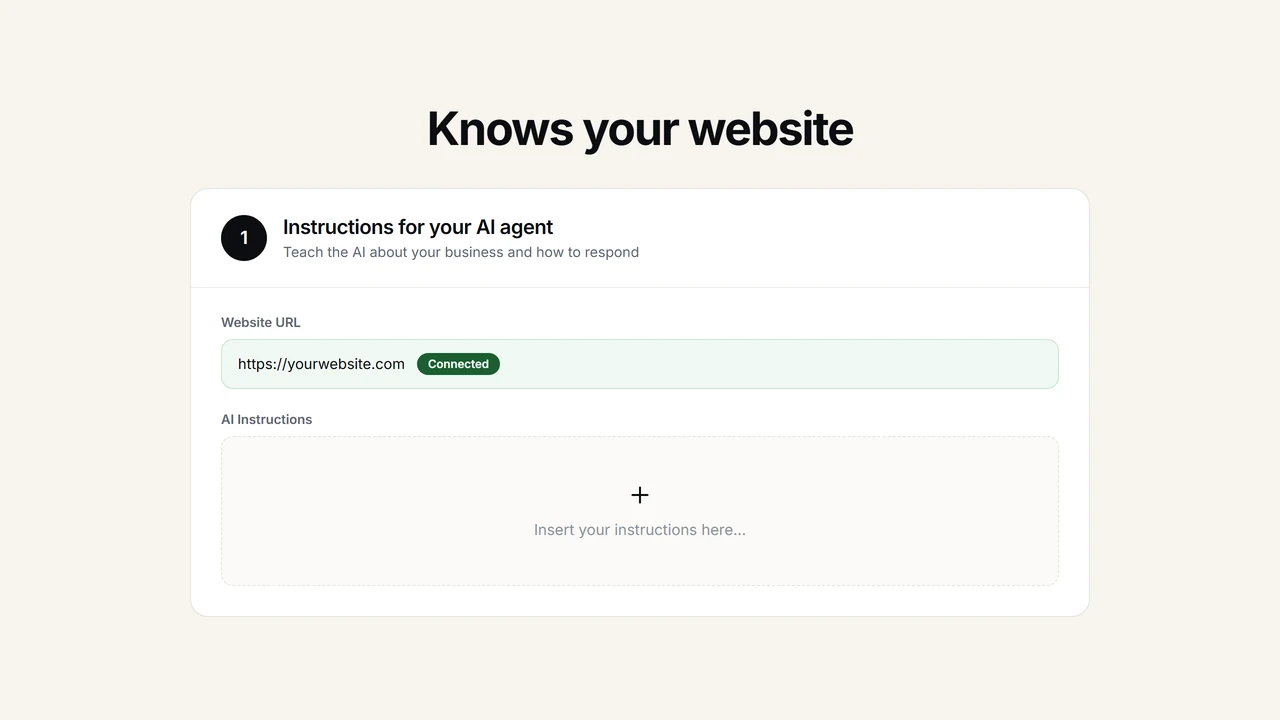
The plugin hands your content to the AI automatically
The whole point of a chatbot plugin living inside your CMS is access. Once it's connected, Asyntai reads the URLs, catalogues, and resources your platform exposes and folds them into a private knowledge base. The AI stops sounding like a generic assistant and starts sounding like someone who has been on your team for a year.
- Auto-crawls whatever the plugin can reachPages, articles, blog entries, category trees, product listings, knowledge-base articles — whichever content type your platform surfaces, the plugin pipes it back to the training layer.
- Ecommerce catalogues stay freshOn WooCommerce, Magento, Shopify, OpenCart, Bagisto, Sylius, Medusa and the rest, the product feed updates continuously so price changes and new SKUs show up in chat without any manual re-upload.
- Drop in PDFs and docs for anything privateInternal FAQs, policy documents, spec sheets and onboarding guides can be uploaded through the Asyntai dashboard to complement whatever the plugin crawls publicly.
Installing the chatbot plugin, start to finish
The exact clicks differ by platform, but the shape of the install is the same everywhere: grab the plugin from your Asyntai dashboard, load it into your CMS, link it to your account, and you're live. Below is the generic path — your platform's documentation page walks through the specific flow, whether that's a Shopify App Store install, a Drupal module enable, or a Strapi plugin config.
- Create a free Asyntai account and open Dashboard → Plugins. Download the package for your platform, or copy the universal snippet if no dedicated plugin exists yet.
- Install the package through your platform's standard route — plugin upload, extension manager, module enable, marketplace install, or ZIP extraction into the right directory.
- Open the Asyntai settings panel inside your admin area and click Connect. A popup links the install to your account and stores the site ID for you.
- Customise the widget from your Asyntai dashboard — colours, position, welcome message, language defaults, lead capture triggers — while the plugin carries on training.
→ asyntai-plugin.zip (or universal snippet)
→ Install through your CMS
→ Connect account (OAuth popup)
# Plugin is live, training starts,
# the AI begins answering in 36 languages.
Chatbot plugin — questions we hear often
Answers for teams shopping around for a plugin that won't force them to change stacks.
Which platforms currently have a dedicated chatbot plugin?
At the time of writing, roughly thirty: WordPress, Shopify, WooCommerce, Magento, OpenCart, Joomla, Drupal, Odoo, TYPO3, Concrete CMS, October CMS, Grav, Statamic, MODX, Umbraco, Strapi, Ghost, Kirby, Bludit, Craft CMS, e107, Bagisto, Sylius, Dolibarr, Medusa, BigCommerce, DatoCMS, Sanity and Contentful — with more being added as demand appears. Each one is maintained separately so the install matches what admins of that platform expect.
My platform isn't in the list — am I stuck?
No. The universal JavaScript snippet works on anything that renders HTML in a browser: bespoke frameworks, static generators, Webflow, Framer, Squarespace, old CMSes, SPA front-ends. You paste two lines into your template and the chatbot behaves exactly the same as it does through a native plugin. If you'd like a dedicated package for a platform we don't yet cover, let us know — demand drives the roadmap.
Where do I download the plugin from?
The Asyntai dashboard is the single source. Sign in, open the Plugins tab, pick your platform and you'll get either a ZIP file or a direct link to the relevant marketplace listing. Shopify is also available through the official Shopify App Store for merchants who prefer that route. Most other plugins are distributed directly rather than through CMS marketplaces.
Is the plugin the same across all these platforms?
The AI brain, dashboard, pricing and 36-language support are identical. What changes is how the plugin integrates — a Drupal module exposes configuration through the Drupal admin, a Strapi plugin registers itself with the Strapi panel, a Magento extension slots into the Magento admin tree, and so on. Behaviour on the public site is the same: the same widget, the same answers, the same analytics.
Does installing the plugin slow my site down?
The plugin loads the widget asynchronously after your page is interactive, so it doesn't block your first paint or push content around. We don't publish synthetic performance numbers here because they'd depend on your server and theme; we'd rather you measure on your own site. What we can say is that the plugin adds one small async script to the page, and removing it is a one-click uninstall.
How many sites can one plugin license cover?
Site allowance follows the plan tier — Free covers a single site, Starter unlocks a second, Standard adds a third, and Pro stretches that ceiling up to ten. Each site runs its own chatbot with its own training — the plugin on each install points at a different site ID under the same Asyntai account, so agencies managing several brands keep everything tidy from one login.
What about personalising answers for logged-in visitors?
On Standard and Pro plans, the plugin exposes a window.Asyntai.userContext object your theme or template can populate before the widget loads. Whatever you push in — name, membership tier, recent orders, account status — is used by the AI for personalised replies, without the plugin reaching back into your CMS database on its own.
Where do the leads and conversations end up?
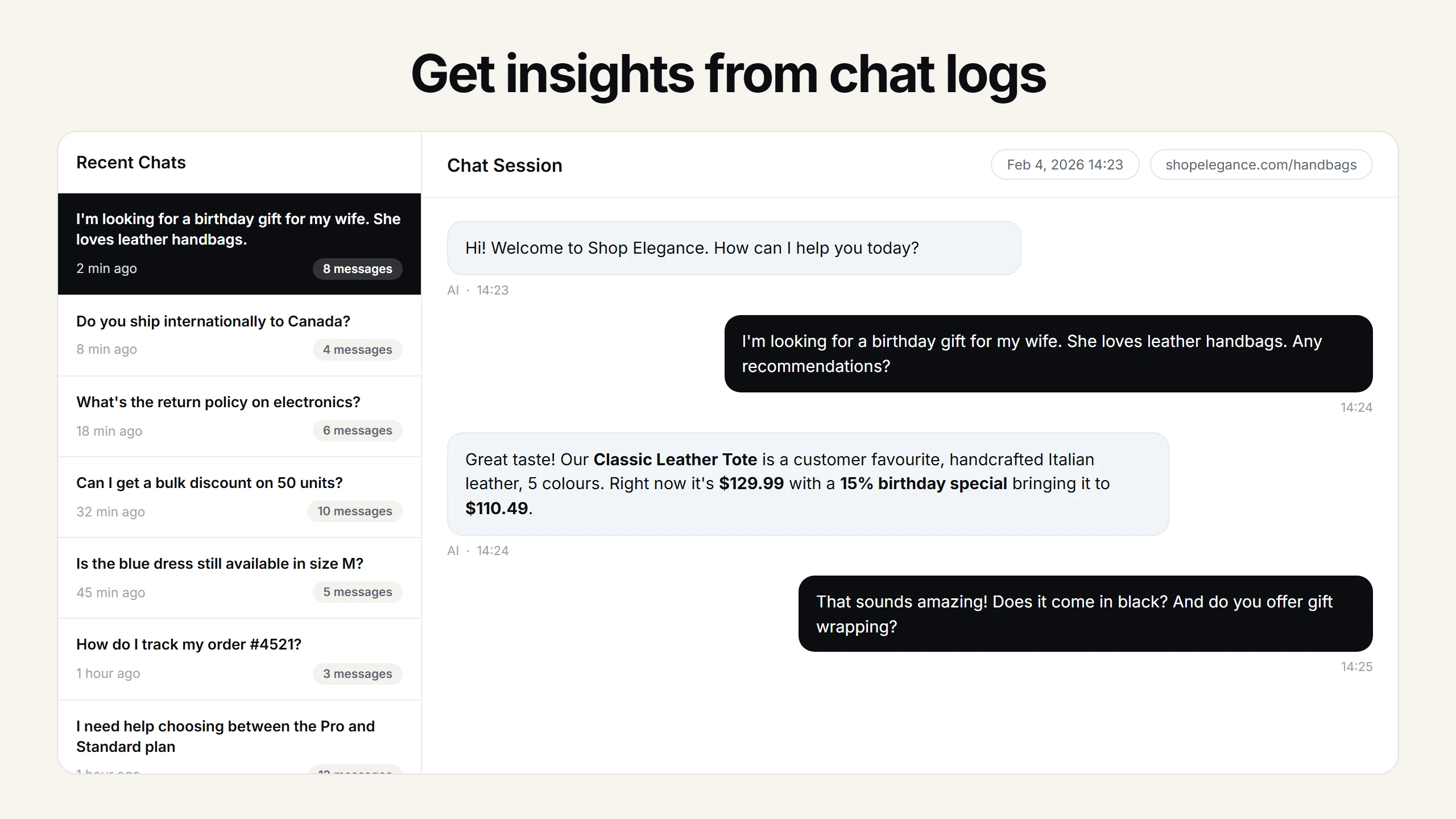
Every chat is logged to your Asyntai dashboard, grouped by visitor and searchable by topic. If the AI captures an email or phone number during a conversation, that becomes a lead record attached to the transcript. Switch on email alerts and a copy of each transcript arrives in your inbox as chats are happening, ready to forward into whatever CRM or pipeline you already use.
Chatbot plugin — how Asyntai does it across thirty platforms
"Chatbot plugin" is one of those phrases that hides a lot of variation. For someone running a Shopify store it means an App Store listing with a one-click install button. For a Drupal site it means a module enabled through the extension manager. For a headless Strapi back-end it means a plugin that shows up in the admin panel and configures how the widget is served on the decoupled front-end. For a Ghost publication it means something different again. The word is shared, the mechanics are not, and a chat vendor that ships only a WordPress plugin is quietly excluding huge swathes of the web.
Asyntai took the opposite route on purpose. Rather than picking a single favourite CMS, the team builds and maintains a catalogue of native chatbot plugins — thirty of them and counting — across traditional CMSes, ecommerce engines, headless content platforms and back-office suites. The list as of this writing covers WordPress, Shopify, WooCommerce, Magento, OpenCart, Joomla, Drupal, Odoo, TYPO3, Concrete CMS, October CMS, Grav, Statamic, MODX, Umbraco, Strapi, Ghost, Kirby, Bludit, Craft CMS, e107, Bagisto, Sylius, Dolibarr, Medusa, BigCommerce, DatoCMS, Sanity and Contentful. For anything outside that list — custom Rails stacks, Astro builds, Laravel apps, static Hugo sites, Webflow projects, bespoke in-house frameworks — a universal JavaScript snippet gives you the same chatbot with a two-line paste into your template.
What stays identical across all of these is the part that actually matters. The AI is the same engine, served from the same infrastructure, with the same answer quality. The Asyntai dashboard is the same web app whether you arrived through the Magento extension manager or the Shopify App Store. The pricing is the same: 50 free messages a month, then paid plans starting at thirty-nine dollars for 800 messages. Language coverage is the same: thirty-six UI languages, automatic detection of whichever tongue the visitor opens the chat in, and replies written in that same language without any manual toggle. What changes is the experience of installing and configuring — and that's precisely where a chatbot plugin has to feel native rather than bolted on.
Take a Drupal site as an example. A Drupal admin doesn't want to paste a blob of JavaScript into a block template, fight the cache, and hope the theme doesn't override it on the next update. They want a module in the extensions list, a settings page at admin/config/services, the usual permissions tab, and compatibility with the Drupal cache layer. The Asyntai Drupal plugin is shaped around those expectations. A Magento merchant wants an extension that shows up in the admin tree under Stores → Configuration, respects Magento's cache invalidation rules, and reads the product catalogue through Magento's own APIs rather than scraping the front-end. The Asyntai Magento extension does that. A Strapi team running a headless content back-end wants a plugin registered in Strapi's admin, with role-based access to the Asyntai settings and content-type aware training. The Asyntai Strapi plugin is built for that. None of these feel like warmed-over WordPress code with the labels changed.
For ecommerce stacks specifically, the value of a native plugin compounds. A chatbot that only reads your public blog posts can tell visitors what you wrote about, but it can't tell a shopper whether a specific SKU is in stock, what the price is today, what variants exist, or which product from the catalogue matches the description they just typed. The Asyntai plugins for WooCommerce, Magento, Shopify, OpenCart, Bagisto, Sylius, Medusa and BigCommerce all sync the catalogue — titles, prices, images, variants, stock where the platform exposes it — so the AI can answer product questions and surface product cards directly inside chat. When a shopper asks "do you have this in blue and size medium?", the plugin has already given the AI enough data to answer yes or no without guesswork.
For content-first stacks — Ghost, Statamic, Kirby, Grav, Craft, Bludit, DatoCMS, Sanity, Contentful — the shape of the training is different but the principle holds. The plugin either crawls the rendered site, reads exported JSON/GraphQL content, or subscribes to webhooks when an entry is published, depending on what the platform makes available. Either way, the AI ends up with an accurate picture of what's on the site, and it stays in sync when new articles ship. For a publication, that means a chatbot that can answer "what have you written about X" with real article links. For a documentation site, it means the plugin surfaces the right docs page in response to a natural-language question instead of sending the reader to a static search box.
The install mechanics, while platform-specific, share a common spine. You sign up for a free Asyntai account. You open the Plugins tab of the dashboard. You pick your platform from the grid and either download the package or follow the link to the relevant marketplace listing — Shopify App Store if you're going that way. You install the package through whatever your platform's standard flow is: plugin upload, extension manager, module enable, ZIP extraction. Inside your admin area, you find the Asyntai settings panel and click Connect. A popup opens, confirms you're logged into Asyntai, and stores the connection on your behalf. The site ID gets written to the plugin automatically. No API keys to copy, no manual credential shuffling, no typos in hidden config files. From there, training begins, the widget appears on your site, and you move to customisation in the dashboard.
One aspect of shipping a chatbot plugin that's easy to under-appreciate is what happens when you want to uninstall. With a pasted JavaScript snippet, removal turns into a scavenger hunt — which theme file did it go into, did a developer duplicate it into a second template, is it cached anywhere? With the plugin model, removal is boring: disable the plugin, delete it, done. The widget disappears from every page it was serving, the admin panel entry vanishes, and the cache clears on the next request. Teams that change marketing tools every eighteen months or that audit their plugin stack regularly appreciate this far more than a sales page tends to convey.
For agencies and multi-brand operators, the plugin-plus-universal-snippet combination becomes particularly pragmatic. Imagine running five client sites across three different CMSes. A purely snippet-based chat vendor forces the agency to onboard five different clients to five different dashboards, or to paste snippets into each client's theme and hope the client's developer never strips them out. With Asyntai, the agency installs a native plugin on whichever clients run WordPress, Shopify, Drupal or Magento, uses the universal snippet for the bespoke Rails build, and manages every site from one Asyntai login — the multi-site limits on the Starter, Standard and Pro plans (two, three, and up to ten sites respectively) are designed with that pattern in mind. Each site trains independently so the chatbot on site A answers from site A's content, not some mixed-up composite.
Customisation is intentionally separated from installation. The plugin itself handles three jobs: connecting to Asyntai, piping content to the training layer, and loading the widget on the public site. Everything else — welcome message, colour palette, widget position, suggested questions, smart lead-capture rules, custom instructions that steer the AI's tone, PDF uploads, team members, analytics — lives in the Asyntai dashboard. This split exists because cramming every configuration option into a CMS admin page produces either a mess or a crippled feature set. The plugin owns the parts that belong in the CMS; the dashboard owns the parts that belong in a proper web app. The seam is invisible to end users.
Multilingual behaviour deserves its own mention because it reshapes how a chatbot plugin is chosen. Sites that draw visitors from multiple countries can't afford an English-only chat — organic traffic in 2026 is global by default, and a visitor who asks a question in Portuguese and gets a reply in English usually leaves. Asyntai covers thirty-six widget UI languages — everything from Arabic, Hebrew and Hindi through the major European ones (French, German, Spanish, Italian, Portuguese, Dutch, Polish) to the Nordic set, the CEE languages, and the Asian set (Japanese, Korean, Thai, Vietnamese, Malay, Indonesian, simplified Chinese) alongside English — and the AI spots the language of the first incoming message on its own. There is no separate translation plugin to configure, no locale toggle to wire into your theme. Whatever language a visitor types in, that's the language the chatbot answers in.
Leads are where many teams ultimately measure the plugin against its cost. Every conversation the chatbot has is logged against a visitor record in the Asyntai dashboard. When the conversation includes an email address or phone number — either because the visitor volunteered it or because the AI asked politely at a sensible moment — that record becomes a lead. Flip on email alerts and the same details arrive in your inbox the moment the conversation wraps. Because the lead comes with the full chat transcript, follow-up stops being a cold email and becomes a reply to an actual conversation. Sales teams tend to close these faster than generic form-fill leads, which is exactly why chat-captured leads are worth the plugin install.
Personalisation for logged-in visitors is handled without the plugin needing elevated access to your CMS database. On Standard and Pro plans, the plugin exposes a window.Asyntai.userContext hook. Your theme or template fills that object with whatever you want the AI to know about the logged-in user — name, plan, last order, roles, membership expiry — and the AI uses the context to tailor replies. A WooCommerce shopper asking about their latest order can be answered specifically. A Moodle student asking about their current course progress can be answered specifically. An Odoo customer asking about an open ticket can be answered specifically. The plugin itself stays narrow; the personalisation layer sits in your own code where you already control what data flows out.
Analytics become a quiet editorial engine once the chatbot has been running for a while. Every question is stored, grouped, and counted. Weeks into the install, patterns surface: the five recurring objections that keep appearing before a purchase, the documentation pages that can't cope with what visitors actually want to know, the product category that raises more questions than the rest combined, the feature that reliably confuses newcomers. Each of those is a prompt to fix the underlying content — rewrite a page, add a section, clarify a policy — and a few months later the chatbot is handling fewer repeats because the site itself got better. The plugin pays off twice: once by answering each visitor, and a second time by making your content sharper over the course of a quarter.
Pricing is kept simple so the decision to install the plugin isn't gated by a quote. A free plan covers up to 50 messages a month, which is enough for a personal blog or a tiny services site to judge whether the chatbot is useful. From there, the Starter plan at thirty-nine dollars a month covers 800 messages and two sites — a comfortable fit for most SMB sites. Standard and Pro scale message volumes and site allowances upward for agencies and larger operators. Usage is tracked, warnings go out before any limit bites, and upgrades happen without touching the plugin itself. The install doesn't need to be redone when a plan changes; the plugin keeps running, only the dashboard numbers move.
Putting the pieces together: a chatbot plugin is only useful if it fits the platform it runs on, learns from the content it finds there, speaks the languages your visitors actually use, and turns the conversations it has into leads and insight. Asyntai ships that combination as a native package across more than thirty platforms, and as a universal snippet for everything else. Wherever your site lives — behind a WordPress admin, a Magento back office, a Shopify store, a Drupal module manager, a Strapi panel, a Ghost dashboard, a Sanity Studio, a Contentful space, or a bespoke stack of your own — the install path is short, the training is automatic, and the chatbot that ends up on your site talks like it belongs there.