The best chatbot for small business is the one you can actually afford to run
Small business owners don't need an enterprise suite with a dedicated implementation manager. You need a chatbot that installs before lunch, speaks every language your customers write in, and costs less than hiring one part-time hour a week. Here's what to look for — and where Asyntai fits.
See how Asyntai answers questions for a small business like yours
Drop in your website URL and watch the chatbot field the exact questions your customers ask every day
Four things to check before you pick a chatbot for a small business
Enterprise review sites rank chatbots on features that only enterprises use. For a small business, the decision is simpler and the stakes are different. Before comparing vendors, nail down what "best" has to mean for an owner-operator, a family shop, or a five-person services firm.
- Price that stays predictableLook for flat monthly pricing tied to message volume, not seat counts or "contact tiers" that quietly escalate. If the pricing page requires a sales call, it's not built for small business.
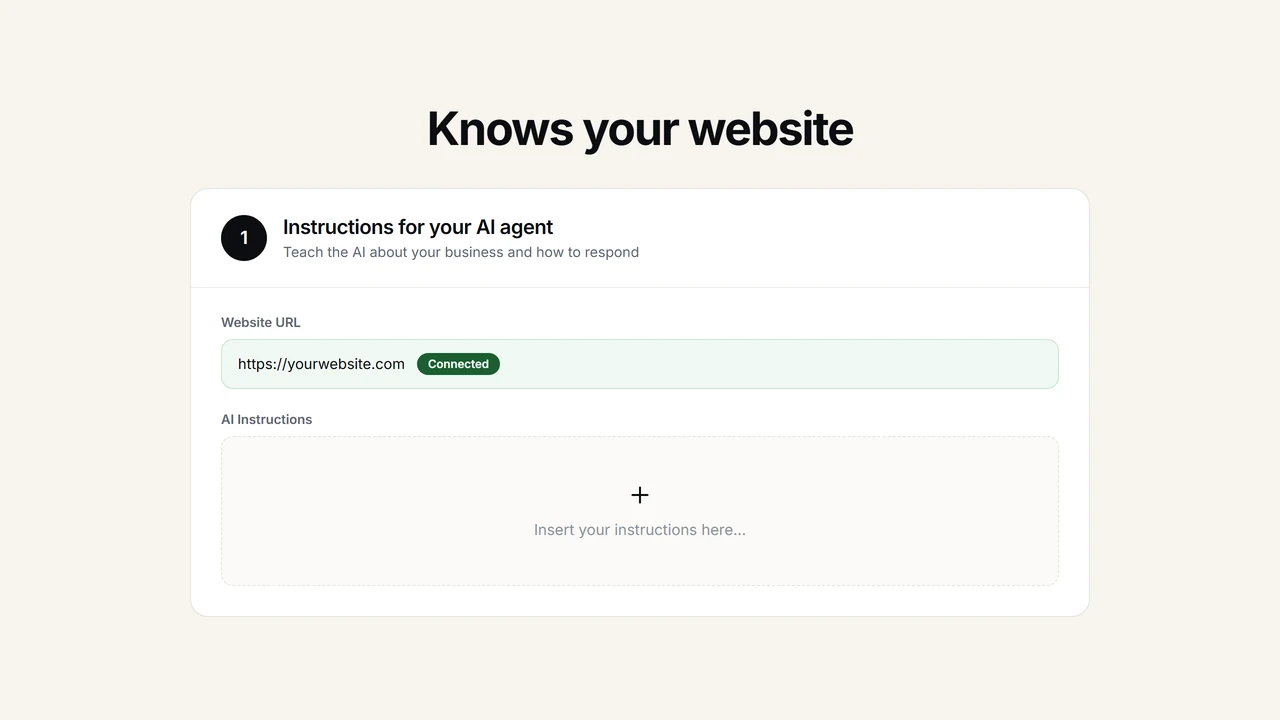
- Setup you can do aloneNo developer, no agency, no "implementation partner." Paste a snippet, point the bot at your site URL, write a few plain-English instructions — that's the bar.
- Answers that match your actual contentThe chatbot should learn from the pages, PDFs, and policies you already have. If it needs intent trees and decision flows authored from scratch, you'll never finish building it.
- Coverage when you're not at the deskSmall business owners are on a job site, at the register, picking up kids. The whole point of a chatbot is that it covers the hours you can't, in the languages your customers bring.
Why Asyntai reads as the best chatbot for small businesses specifically
Tidio, Intercom, Chatbase, Drift, HubSpot, Crisp — there's a long list of chatbot vendors, and several are excellent for their target buyer. The question is: which one is designed for the small business buyer, with no IT department, no procurement process, and no appetite for surprise invoices? That's the shape Asyntai is built around.
- Owner-operator onboardingSign up, paste the snippet, type your site URL. The chatbot trains itself from your public content in minutes. No workshop, no onboarding call required.
- Small business pricing realityFree tier covers 50 messages per month for anyone still testing. Paid plans start at $39 monthly for 800 messages — a realistic number for a small business without enterprise traffic.
- Run up to ten sites on ProFree: 1 site. Starter: 2. Standard: 3. Pro: up to 10. Useful if you run a main store plus a side project, or if you're an agency managing a handful of client sites.
- Languages without hiringYour customers write in 36 different languages and the chatbot replies in the same language. You don't need a bilingual hire just to answer "is this in stock."
From signup to live chatbot in one afternoon
A small business doesn't have time for a six-week rollout. Asyntai is designed so the owner can install it personally between other tasks, using the same CMS they already manage their website in. Snippet install works everywhere; native plugins exist for the platforms small businesses actually run on.
- Create a free account and grab your personal chatbot snippet from the dashboard.
- Add the snippet to your site's
<head>— via your CMS header settings, a plugin, or direct template edit. - Give the chatbot your website URL so it reads your pages, pricing, and policies on its own.
- Upload any private docs, add a few custom rules, test with real customer questions, publish.
<script src="https://asyntai.com/widget.js"
data-id="your-site-id" async>
</script>
# Chatbot live across every page — no dev needed.
Best chatbot for small business — FAQs from owners
The questions small business owners actually ask during chatbot evaluation, answered plainly.
How does Asyntai compare to Tidio or Chatbase for a small business?
Tidio is a strong classic live chat product with a chatbot layer added on — good if you want a mixed human-and-bot inbox and you have someone available to type replies. Chatbase is a lean document-Q&A chatbot — good if your use case is strictly answering from a PDF. Asyntai sits in the middle: AI-first by default so the small business owner isn't chained to an inbox, but still answering from your actual site and private docs, with lead capture and optional email handoff when a human needs to step in. Pick based on whether your team plans to sit at a chat inbox all day (Tidio) or not (Asyntai).
Is this affordable on a tight small business budget?
Free for 50 messages a month, which covers a surprising number of small sites outright. Paid usage kicks in at $39 monthly, which includes 800 messages. To frame it: that's roughly the cost of one evening of takeout for the whole team, and it covers every language your customers use, around the clock. Compared with per-seat live chat tools that charge each agent $30 to $80 a month for business-hours-only coverage, the math usually lands clearly in favor of AI-first chat for a small business.
What if I already pay for Intercom or a similar enterprise tool?
Intercom is excellent for venture-backed SaaS companies with dedicated support teams. For a small business under twenty people without a full-time support hire, it's usually overbuilt. Owners who switch from enterprise chat to Asyntai typically cite three reasons: the total cost, the setup complexity, and the amount of feature surface they never used. That said, if your team genuinely uses the CRM, ticketing, and campaign side of an enterprise tool, don't rip it out — Asyntai can sit alongside as the AI-first answer layer while you keep the rest of the stack.
We're not technical. How much setup is realistic?
If you can edit a page on your website, you can install Asyntai. For WordPress, Shopify, Wix, Squarespace, and similar platforms, the install is a copy-paste into a header field or a one-click plugin. The AI trains itself from your site URL, so there's no spreadsheet of Q&A pairs to write. A non-technical owner usually has the chatbot live and answering real questions within a single afternoon.
Does it work if most of our customers speak a language other than English?
Yes. Thirty-six languages are covered, and the chatbot detects the visitor's language from their first message — so an Arabic customer gets Arabic, a Polish customer gets Polish, and you didn't have to configure anything. For small businesses serving local diaspora communities, tourist-heavy areas, or international online orders, this removes the need to hire a multilingual assistant just to cover the chat channel.
What happens when the chatbot can't answer?
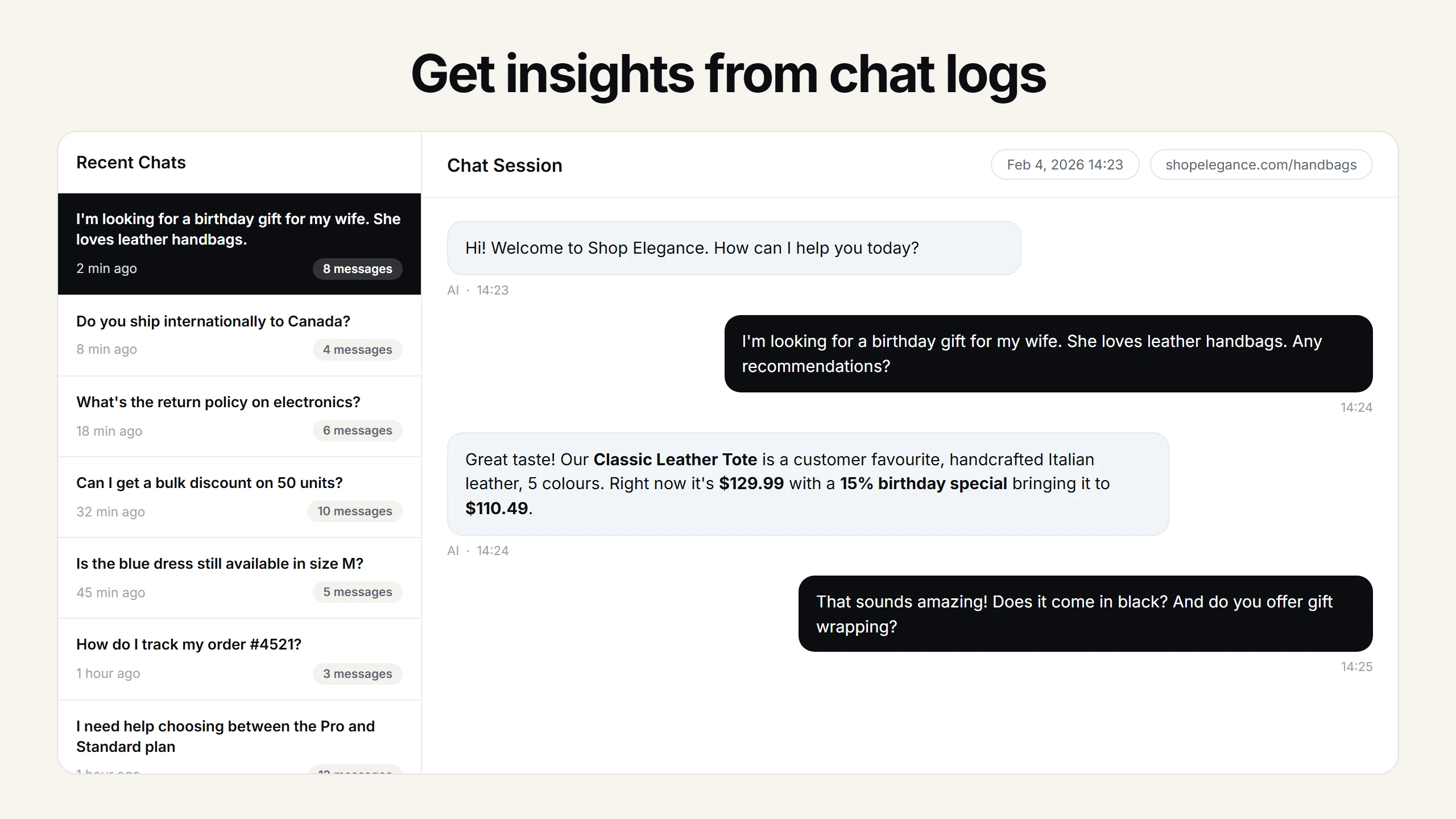
Instead of giving up, the chatbot asks for the visitor's email, captures the full conversation, and saves the lead in your Asyntai dashboard. Optional email notifications can deliver every captured conversation to your inbox in real time. You reply from your phone between other work — the customer gets a human answer, and you never had to be glued to a chat screen waiting for questions.
Can the chatbot personalize replies for logged-in customers?
On Standard and Pro plans, yes. Your website passes the signed-in visitor's info — name, plan, order, account status — into a JavaScript object called window.Asyntai.userContext before the widget loads. The chatbot then greets them by name and answers questions about their specific account without any backend integration work. Useful for membership sites, small SaaS products, and any store where returning customers expect to be recognized.
Can one Asyntai account cover multiple small businesses I run?
On paid plans, yes. Free accounts support one site; Starter handles two; Standard handles three; Pro supports up to ten. Each site has its own separate chatbot, so a boutique's chatbot never mixes knowledge with a consulting practice's chatbot even when they live under the same owner account.
Best chatbot for small business — the honest buyer's guide
A small business owner searching for the "best chatbot" isn't running a procurement RFP. There's no committee, no implementation budget, no quarterly software review meeting. The decision usually has to happen between other work — after a busy morning, before pickup, during a slow hour on a Tuesday. So the evaluation criteria that matter for an enterprise simply don't translate. Forget SOC 2 appendices and SSO policy controls for a moment; the small business criteria are closer to: can I install this today, will it pay for itself within a couple of months, and will it stop being a chore the moment I walk away from it.
Let's name the field honestly. Tidio, Intercom, Chatbase, Drift, HubSpot Chat, Crisp, LiveChat, Zendesk, Freshchat, ManyChat — that's the shortlist most owners will bump into. Each of these tools is good at something. Tidio grew up as a small-business live chat and has layered AI on top. Intercom is the enterprise-SaaS gold standard and prices accordingly. Chatbase is a focused document-Q&A chatbot built on top of GPT-class models. Drift is oriented at B2B sales teams. HubSpot Chat is bundled into the broader HubSpot CRM suite. Crisp is an indie-friendly inbox with multichannel features. LiveChat and Zendesk are classic ticketing-adjacent products. ManyChat is a marketing-flow automation tool rather than an answer engine. Recognizing that they're different shapes, not direct substitutes, is the first honest step of a comparison.
For a small business, the right shape is almost always "AI-first answer engine with human handoff." Here's why. A small business doesn't have three support agents rotating through a chat inbox. Often there's one owner and maybe a part-time helper. Tools that assume constant human availability — classic live chat — don't fit that staffing reality. Tools that assume a marketing automation engineer — ManyChat-style flow builders — don't fit either. What works is a chatbot that handles the first response on its own, knows the site inside and out, captures a lead when it can't help, and lets the owner reply asynchronously from the phone when a real human answer is needed. That's the Asyntai shape, and it's why the product reads specifically as built for small businesses, even though it scales up cleanly.
The pricing math is worth doing out loud, because small business decisions stand or fall on it. Per-seat live chat tools typically run $30 to $80 per agent per month. Give one agent eight hours of daily coverage on the chat widget and you're at around $40 a month for weekday business hours in one language. To extend to 24/7 coverage across two or three time zones, you're stacking multiple seats — call it $150 to $300 a month for genuinely always-on human chat, and still only in English. Asyntai at $39 a month for 800 messages covers twenty-four-hour chat across thirty-six languages, with humans stepping in only when a conversation escalates. For most small businesses this isn't a close comparison — the AI-first option is meaningfully cheaper and covers the hours that matter most.
Setup complexity is where a surprising number of small business chatbot projects die. A shop owner signs up for a tool with an ambitious flow-builder, maps out a decision tree on the weekend, gets thirty percent through, and then a sale happens, a supplier calls, a kid gets sick, and the project is abandoned with the chatbot half-configured. Avoiding this pattern means picking a tool where the default state of the chatbot — right after install, with no custom work — is already useful. Asyntai auto-trains from your site URL on the first training pass; even before you write any custom instructions, the chatbot is fielding product, pricing, and policy questions using the same information your website already publishes. The customizations you layer on later are improvements, not prerequisites.
Training effort in practice looks like this. Sign up, paste your homepage URL, let the chatbot ingest for a few minutes. Open the preview, ask it five questions a real customer would ask — about products, hours, prices, shipping, returns. Note anything it gets wrong or awkward. Add private pricing PDFs, an internal FAQ document, or your terms of service as uploads. Write two or three sentences of custom instructions covering how you want the chatbot to sound, what it should offer, and what it should never do. Retest with the same five questions. For most small business sites, this entire loop takes under an hour and delivers a chatbot accurate enough to put live.
Languages are the dimension where small businesses routinely underestimate their own reach. A neighborhood barbershop in Berlin serves customers writing in Turkish and Russian. A boutique in Miami gets questions in Spanish, Portuguese, and Haitian Creole. A B&B in the Alps fields queries from French, German, Italian, Dutch, and Japanese visitors. Tools that require you to either staff a multilingual human or pay for a translation module treat this as an expensive edge case. Asyntai treats it as the default: thirty-six languages supported, detection from the visitor's first message, no additional configuration. For a small business with any international or mixed-language customer base, this single feature can be the deciding factor on its own.
Multi-site handling matters more to small business owners than enterprise review sites usually acknowledge. A lot of small operators run two or three sites — a main storefront and a side project, a shop and a blog, a services brand and a separate portfolio. Enterprise chat tools charge per site or per workspace; the costs stack fast. Asyntai bundles multiple sites into each paid tier directly: Starter handles two sites, Standard handles three, Pro stretches to ten. Each site gets its own chatbot so knowledge never mixes between unrelated brands. For agency owners or serial founders, a single Pro plan often replaces what would have been three or four separate chat subscriptions.
Lead capture is the revenue side of the equation and it's where a lot of free chatbot trials reveal their limits. A chatbot that only answers questions — without ever converting — is a utility, not a growth tool. The best chatbot for small business has to close the loop: when a visitor shows interest, the bot naturally asks for the contact method, captures the whole conversation, and surfaces the lead to the owner without requiring anyone to be sitting at a dashboard. Asyntai does this with configurable prompts inside the conversation, captures the lead into your dashboard, and can push a real-time email notification with the full transcript attached so you can respond from wherever you happen to be.
Personalization for logged-in customers is a feature small businesses generally assume they can't afford. Enterprise tools pitch it as a premium integration project. Asyntai offers the same capability through a simple JavaScript object — window.Asyntai.userContext — that your site populates before the widget loads. Your own code decides what the chatbot should know about the current user: their name, their plan, their most recent order, their upcoming booking. The chatbot greets them appropriately and answers account-specific questions without requiring you to wire up a backend integration with your user database. This feature ships on Standard and Pro plans and is one of the largest gaps between Asyntai and lower-tier chatbot tools at similar price points.
Reliability and uptime are things owners don't want to think about but do notice when they break. A chatbot widget that fails to load during a busy campaign costs real money and trust. Asyntai serves the widget from a fast CDN path, fails gracefully when anything goes wrong, and doesn't block your site's rendering while it initializes. For a small business that can't afford a midnight support incident, boring infrastructure is a real feature even if it never shows up in a marketing comparison chart.
Honest limits: Asyntai is not the right fit for every small business. If your chat operation is genuinely a human-first service channel — a luxury concierge brand, a high-touch agency where part of the value is that humans personally answer every note — a traditional live chat tool like Crisp or Tidio might read better. If your chatbot use case is strictly a document Q&A with no lead capture, no personalization, and no interest in custom instructions, a leaner tool like Chatbase might do the job at a lower floor price. And if you're an enterprise operation with complex ticketing, SLA compliance, and ITSM workflows, Asyntai isn't trying to replace Zendesk. The honest fit for Asyntai is the wide middle where a small business wants meaningful AI capability, lead capture, multi-language coverage, and customer personalization — without paying enterprise prices for features they'll never use.
Reading the shortlists, review articles, and "best chatbot" listicles across the internet, one pattern stands out: almost none of them are written from the small business owner's perspective. They rank tools by feature count, integration breadth, or enterprise brand recognition — metrics that a five-person team doesn't actually use. The genuinely best chatbot for a small business is the one that gets installed, stays installed, pays for itself within a quarter, and quietly frees up the owner's time. Asyntai is built to that specification deliberately: small business pricing, small business setup, small business staffing reality, and a feature set that matches the problems small business owners actually have. If your next step is a real test, the free tier gives you 50 messages to see how it handles your specific traffic — no sales call required.