The best chatbot for ecommerce depends on which trade-offs you're willing to make
There is no single best chatbot for every store. There's the one that fits your platform, your catalog depth, your language mix, and your monthly budget. This page breaks down the honest trade-offs across the named options merchants shortlist — and marks the cases where Asyntai is clearly the right pick, plus the cases where it isn't.
Stress-test the chatbot against your own storefront
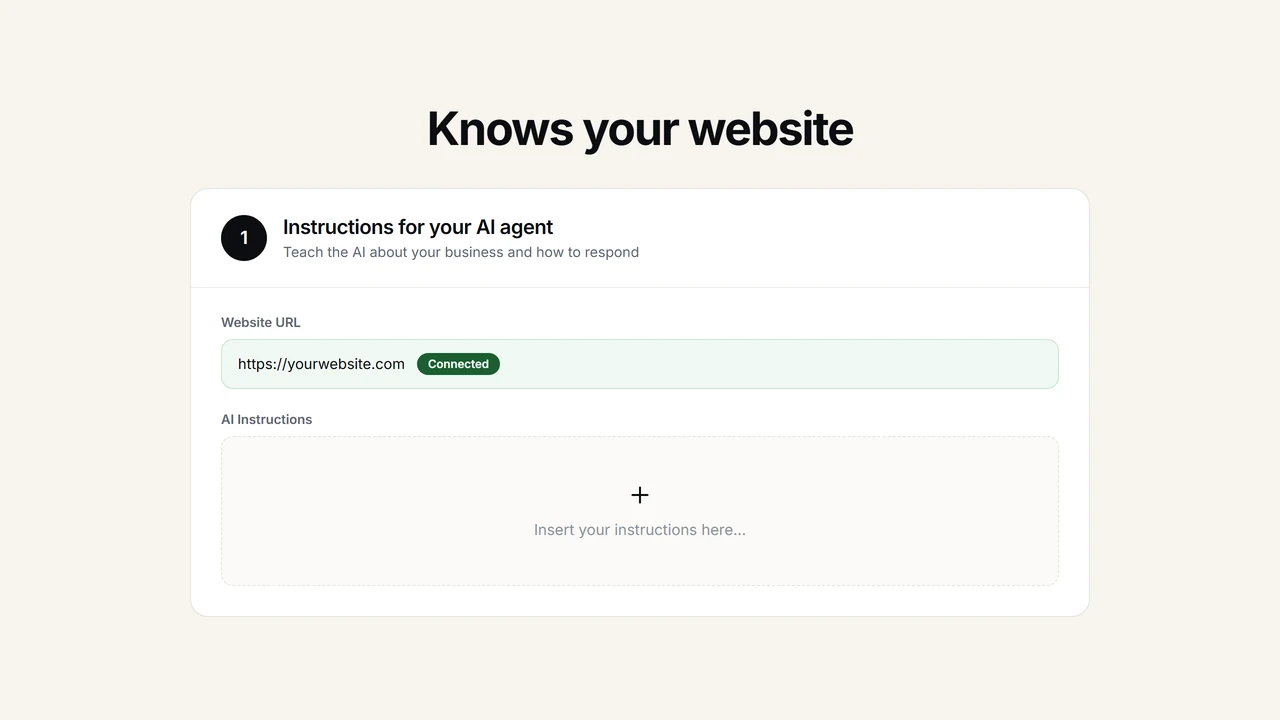
Paste your store URL and see how the assistant would handle your real product and policy questions before you commit to anything
Five questions to settle before you pick any ecommerce chatbot
Comparison pages online tend to rank chatbots by feature lists and G2 badges. Neither reflects how a merchant actually makes this decision. Before reading any named comparison — including ours — write down the answer to these five questions. The shortlist narrows itself.
- How deep does catalog awareness need to be?A single-SKU brand needs less depth than a 4,000-variant fashion catalog. Ask whether the chatbot reads variant structure, live stock, price changes, and collection hierarchy — or just crawls public product descriptions once.
- Which platform is the cart actually on?A Shopify-native app is ideal on Shopify and irrelevant on WooCommerce. A WooCommerce REST integration is a real differentiator on WooCommerce. A pure snippet works on both but may skip platform-specific hooks. Match the tool to the platform.
- What does the language mix look like honestly?If ninety percent of sessions are English, a single-language tool is fine. If a quarter of your traffic writes in Spanish, French, or German, a chatbot that only translates its UI while still replying in English is a silent conversion drag.
- Who installs and maintains the chatbot?If a dev-less founder is doing it between other jobs, an intent-tree builder will sit half-built forever. If there's a dedicated CX ops person, a richer configuration surface becomes usable. Be honest about who owns the work after launch.
- Is the pricing tied to agent seats, conversations, or resolutions?Seats punish you for having teammates. Resolutions punish you during busy seasons. Conversation volume is the most predictable model for an owner-operated store. Check which one the vendor uses before the trial ends.
Where each ecommerce chatbot genuinely wins — and where it doesn't
Every option on a serious merchant's shortlist has a home turf. Here is a short, specific read on the tools most commonly compared against Asyntai, and the shape of store each is built around. None of this is an attack on anyone — it's the honest terrain of the market.
- Shopify Inbox and Shopify MagicFree inside the Shopify admin, tight with the rest of Shopify's tooling. A sensible default for a Shopify merchant who wants a starter chat experience without a third-party install — but shallow outside the Shopify universe and limited on multilingual depth.
- Tidio and GorgiasMature helpdesk-and-chat suites. Gorgias leans toward ticketing for mid-market Shopify brands with support teams; Tidio serves smaller stores with mixed live-chat and bot needs. Excellent if you're buying a full inbox; heavier than needed if you only want an AI answer layer.
- Intercom and ChatbaseIntercom is the enterprise SaaS standard — powerful, priced for funded teams, overbuilt for a small or mid-size store. Chatbase is a lightweight document-Q&A bot — great for narrow FAQ use cases, thin on ecommerce-specific behaviors like variant-aware recommendations or tracking handoff.
- Octocom, Manifest AI, and AsyntaiOctocom and Manifest AI are both AI-first storefront assistants aimed at Shopify. Asyntai sits in the same AI-first category but is cart-agnostic, with a genuine WooCommerce REST API sync, 36-language UI, and multi-site bundling (1/2/3/10 by plan) that the Shopify-first tools don't cover.
The install path, compared honestly
The best chatbot for ecommerce is the one that actually gets deployed. Asyntai ships three install paths — a universal JavaScript snippet, a Shopify App Store listing, and a WordPress plugin that installs the AI chatbot for WooCommerce — and all three produce the same chatbot behavior once live. Pick whichever matches your platform's native habits; the outcome is identical.
- Open a free Asyntai account and copy the snippet that's generated for your store.
- Install via whichever path matches your stack: JavaScript snippet into
<head>, the Shopify App Store listing, or the WordPress plugin for WooCommerce stores. - Point the training crawler at your storefront URL; on WooCommerce, authorize the read-only REST keys for live variant and stock sync.
- Draft a handful of merchandising rules in plain English, run the simulator against a few real shopper questions, then publish the widget to live traffic.
<script src="https://asyntai.com/widget.js"
data-id="your-store-id" async>
</script>
# Or install via Shopify App Store / WordPress plugin.
# Behavior is identical across all three paths.
Best chatbot for ecommerce — merchant comparison FAQs
Direct answers to the questions store owners ask mid-evaluation, without the marketing gloss.
How does Asyntai compare to Shopify Inbox on a Shopify store?
Shopify Inbox is a solid default if you want a free chat tool bundled with your admin, with Shopify Magic adding generative replies. The ceiling is lower than a dedicated AI-first assistant: multilingual replies are shallower, behavior rules aren't configurable in plain English, and the bot's understanding stops roughly at your public product pages. Asyntai replaces the AI answer layer with a deeper trained model (your site plus your private docs), runs across 36 languages natively, and supports custom merchandising rules. The workflow fit is: keep Inbox if your staff is in the Shopify admin all day and needs the native inbox; switch to Asyntai if your team wants the AI handling first responses itself, with the owner only jumping in on escalated cases.
How does this compare to Gorgias or Tidio for a mid-size store?
Gorgias is a helpdesk with chat bolted on — if you already run a ticket-based CX team and want the chat layer to feed tickets, Gorgias is the right shape. Tidio is a more SMB-friendly inbox with AI features added. Asyntai is the inverse of both: AI-first answer engine, human handoff as a lead-capture event rather than a ticket queue. Pick Gorgias or Tidio if you want a proper helpdesk. Pick Asyntai if you want the chatbot to carry most conversations on its own without an inbox workflow behind it.
What about Intercom? We got a quote and it was expensive.
Intercom is built for funded SaaS companies and mid-to-large support teams — the feature surface assumes a CX ops hire and a product analytics budget. On ecommerce specifically, most stores never use the campaign builder, the product tours, or the more elaborate automation graph. You're paying for the top quartile of the product even if you only use the bottom third. Asyntai at $39/month for 800 messages covers the chat-answer slice of what a store actually needs from Intercom, without the rest of the stack.
Isn't Chatbase cheaper for a simple FAQ use case?
Yes, for a strictly document-Q&A chatbot with no ecommerce-specific behavior, Chatbase can be cheaper on the floor plan. What it skips: live catalog sync with variant structure (we handle this on WooCommerce via REST), the multi-site bundling, per-page auto-trigger tuning, the lead-capture-with-transcript flow, and the User Context mechanism for logged-in buyers. If all you need is a PDF reader chatbot, Chatbase fits. If you want something that behaves like a store assistant, the comparison changes.
How does Asyntai compare to Octocom or Manifest AI?
Octocom and Manifest AI are both AI-first ecommerce chatbots focused primarily on Shopify. They're good at what they do inside that ecosystem. Asyntai's distinctions: we're explicitly cart-agnostic (same widget on Shopify, WooCommerce, BigCommerce, Magento, custom headless); we publish a real WooCommerce REST API sync rather than only supporting Shopify natively; our widget UI localizes into 36 languages where Shopify-focused tools often trail on European and Asian language coverage; and our plan structure bundles up to 20 sites on Pro, useful for multi-brand operators that single-store tools charge per-install for.
Which categories of store is Asyntai genuinely best for?
WooCommerce stores where the REST sync gives us live variant and stock accuracy that snippet-only crawlers can't match. International stores with material traffic outside a single language. Multi-brand operators running two to ten stores who don't want to pay per install. Owner-operated stores where a plain-English rule engine beats a flow-builder nobody will finish configuring. AI-first stores where the expectation is that the chatbot, not a human inbox, handles the bulk of routine questions.
Where is Asyntai NOT the best chatbot for ecommerce?
Enterprise retailers with custom on-prem requirements, contractual on-prem hosting, or regulated-sector data residency constraints — we're a SaaS product, not a deployable stack. Very large support operations that already standardize on Gorgias or Zendesk for ticketing and want chat to feed that queue — the Asyntai model is AI-first answer engine rather than ticket producer. Brands whose chat must always reach a human agent within seconds as a core promise of the brand (luxury concierge, high-touch fine jewelry) — a traditional live chat team often fits the brand posture better than an AI-first assistant.
What's the fastest honest way to make this call?
Start both shortlisted products on their free tiers, install on the same store, point each at the same URL, and stress-test with ten identical real shopper questions from your last week of support tickets. You'll know within thirty minutes which one actually understands your catalog and which one is improvising. Our free tier gives you 50 messages; that's enough for the comparison to be conclusive.
Best chatbot for ecommerce — a merchant's buying guide
Evaluating an ecommerce chatbot in 2026 has the same texture as evaluating a point-of-sale system a decade ago. Every vendor demos well. The screenshots look capable. The feature matrices read the same from ten paces away. Yet the actual fit — whether a tool will survive installation, the first busy season, the owner's patience — varies wildly by store shape. Merchants who pick purely on marketing sites usually regret it by month three. Start instead with your own store's realities and let the shortlist fall out of that analysis.
The first variable is cart platform. Shopify is a closed ecosystem with strong native tooling, a formal app store review process, and a well-defined permissions model. WooCommerce is an open-source WordPress extension with total flexibility and a REST API that a chatbot can actually talk to. BigCommerce, Magento, and fully headless stacks each have their own shape. A chatbot that wins as a native Shopify app may be a second-class citizen on WooCommerce, and vice versa. Before anything else, decide whether you want deep native integration on one platform or even-keeled coverage across several — that single decision culls half the vendor list immediately.
The second variable is catalog depth. A candle brand with forty SKUs and three scents behaves differently from a fashion house with eight hundred styles across size, color, and fit dimensions. In the first case, a chatbot that simply reads your public pages is probably sufficient. In the second, you need structured variant awareness or the assistant will confidently invent stock states and get shoppers angry. Asyntai handles this on WooCommerce specifically through a read-only REST API sync that pulls variations, prices, and stock flags directly — the sort of structural hookup that pure website-crawler chatbots cannot replicate no matter how good their language model is. On non-WooCommerce stores, the crawler-based model still absorbs public product pages, and for most sub-500-SKU catalogs that is enough.
Language posture is the third variable and the one merchants most consistently misread. Store analytics typically show traffic by country rather than by typed language, which hides the question until you see it directly. Install a chatbot that prompts visitors in English only, and your German, Spanish, and French visitors will type their questions in their own language anyway — and the chatbot's reply quality will silently determine whether those sessions convert. Asyntai's UI ships in 36 languages and the AI replies in whatever language the shopper writes, which for international stores routinely pays back the subscription in a single month of recovered conversions. Most Shopify-first tools localize poorly outside a handful of Western European languages; Intercom and Gorgias lean heavily on English as the default conversational language; Chatbase is fundamentally a single-language document Q&A. If you have meaningful non-English traffic, this dimension alone narrows the shortlist quickly.
The fourth variable is installation reality. A chatbot that requires a developer to integrate is one a solo merchant will never finish setting up; the same applies to anything with a flow-builder authored from scratch. The honest test is the time between signup and real shopper questions being answered correctly. For Asyntai, that's usually under an hour: paste the snippet or install the plugin, point the crawler at the store URL, wait a few minutes for ingestion, test five realistic questions, tune an instruction or two, publish. Intent-tree tools often take days or weeks on the same loop. Factor your own time at the realistic hourly rate — the tool with the cheaper monthly fee but expensive install effort usually isn't cheaper overall.
The fifth variable is the pricing model itself, and it's where merchants get quietly burned. Seat-based pricing models are shaped for teams that grow their headcount alongside their chat volume — fine for a VC-funded CX organization, terrible for a three-person store. Resolution-based pricing charges you per successful bot-handled conversation, which sounds reasonable until a sale or product launch doubles your traffic and the bill follows. Conversation-volume pricing — what Asyntai uses — is the most predictable model for an owner-operator: you know the cap, you know the price, you know you'll get a warning email before you hit it. Our free tier includes 50 messages a month; the entry paid plan is $39 for 2,500; plans step up from there for active DTC brands and portfolio operators.
Now the named comparison, walked through honestly. Shopify Inbox is the default starter on Shopify and costs nothing inside the admin. If you're a tiny Shopify store and you just want a chat window with minimal AI, it's the reasonable first pick. Its ceiling is low: shallow multilingual behavior, limited custom instruction surface, no private-doc training of the kind that gets you into real merchandising specificity. Brands that outgrow Shopify Inbox usually outgrow it within the first major season, typically because a shopper asked a question that the inbox assistant couldn't handle and the owner realized the public chat was leaving money on the table.
Tidio and Gorgias are helpdesk-shaped. Gorgias is the heavier, Shopify-mid-market-oriented product — closer to Zendesk than to a lightweight chatbot, with ticketing, automation rules, and a support-team-first workflow baked in. Pick Gorgias if you have a CX hire and a real ticket volume and you want chat to feed that operation. Tidio is more SMB-friendly, with a long history as a live-chat widget and AI layered on more recently. Pick Tidio if you want a proper human-inbox experience with bot-assisted replies and your team is going to sit at the inbox actively. The mismatch with Asyntai isn't quality — both are legitimate products — it's shape: Asyntai assumes the chatbot is carrying most of the weight and humans only appear via lead-capture escalation, while Tidio and Gorgias assume humans are structurally in the loop.
Intercom and Chatbase anchor the opposite ends of a different axis. Intercom is the premium enterprise SaaS suite — excellent product, priced for companies that can justify five-figure annual commitments and dedicate an ops engineer to configuration. For venture-backed SaaS it's often the right pick; for mid-market ecommerce it's usually overbuilt. Chatbase is the minimalist end — a lean GPT-powered document Q&A chatbot with a clean setup flow. If your use case is genuinely just "answer from this PDF," Chatbase is elegant. On an ecommerce store where you want variant awareness, tracking handoff, per-page opener tuning, multi-site support, and multilingual defaults, it runs out of surface area quickly.
Octocom and Manifest AI are the closest peers to Asyntai philosophically — both are AI-first ecommerce assistants with merchandising-oriented behavior. The practical differences: both are primarily Shopify-focused, which is perfectly fine for Shopify-only merchants; Asyntai is cart-agnostic with an explicit WooCommerce REST sync that addresses the WooCommerce market directly rather than as a secondary afterthought. Asyntai's 36-language UI covers markets the Shopify-first tools commonly leave thin. And our plan structure (Free 1 site, Starter 2, Standard 3, Pro 10) bundles multi-site coverage that per-install pricing elsewhere charges for separately. None of this makes the Shopify-first options bad — it makes them better fits on Shopify-only, single-brand, single-language stores, which is a real and valid buyer persona.
Beyond the direct comparison, there are decisions that don't show up on feature matrices but meaningfully shape long-term fit. The User Context mechanism is one of those. Asyntai exposes a window.Asyntai.userContext object that your storefront populates before the widget loads — name, plan, recent order, tracking number, whatever you want the chatbot to know about the logged-in buyer. The chatbot reads that object and speaks to it. No store permissions granted to our side, no broad API integration maintained, no data leaves your site unless you pass it deliberately. This mechanism is gated to Standard and Pro plans, and it's often the feature that takes a chatbot from impressive-demo to genuinely-useful-on-post-purchase-questions. Tools that require a full backend integration to achieve the same outcome either charge enterprise prices for it or don't expose it at all.
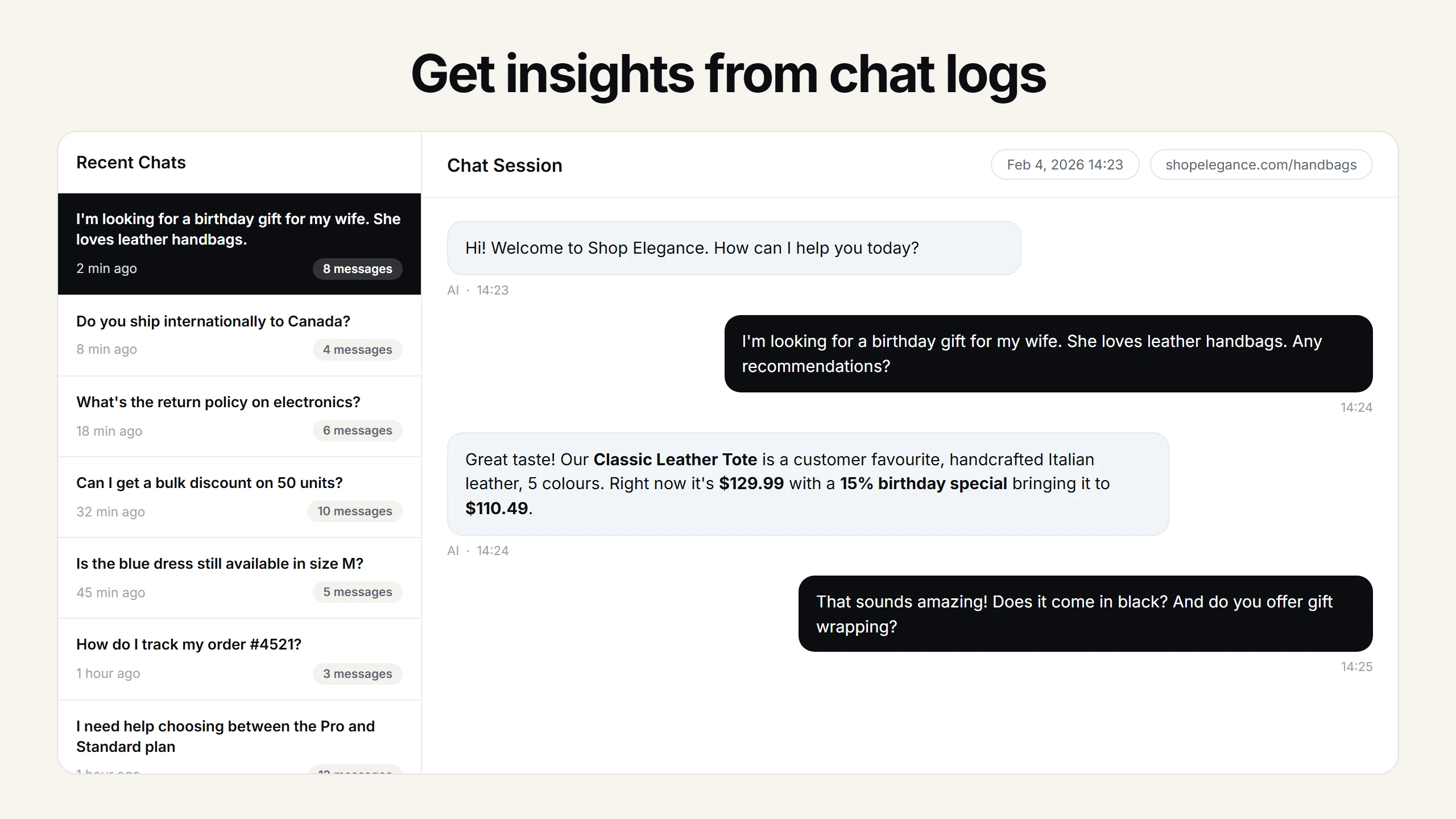
Lead capture is the other under-discussed dimension. When the chatbot genuinely can't resolve a conversation — a bulk wholesale request, an unusual damaged-shipment complaint, a specific wedding-order question — the graceful exit is asking for the shopper's email, saving the full transcript, and routing the lead to the owner. Asyntai does exactly this: the lead lands in your dashboard with transcript attached and, if you've enabled the email notification, an inbox copy arrives in real time. We deliberately don't push those leads into Klaviyo or Mailchimp automatically; marketing automation is yours to control. Some merchants see this as a feature gap; most see it as restraint — you choose who gets emailed, when, and about what, rather than a chatbot firing drips behind your back.
Finally, be honest about where Asyntai isn't the answer. If you're running a support operation with ten-plus CX agents, tight SLA compliance, and a ticket-first workflow, a proper helpdesk like Gorgias or Zendesk will fit better — our model is answer-engine, not ticket-producer. If you have a contractual requirement for on-prem hosting, custom data residency arrangements, or a procurement process that requires vendor security reviews running into months, we're a fast-moving SaaS and that mismatch will frustrate everyone involved. If your chat value proposition is fundamentally "a human is always waiting for you" — luxury concierge, high-ticket white-glove service, certain wellness verticals where the human touch is part of what you're selling — a traditional live chat tool is often a better brand fit than any AI-first assistant, ours included.
The most productive thing a merchant evaluating the best chatbot for ecommerce can do is install two of the shortlisted tools on the same store, on the same day, and ask each one the same ten real-shopper questions pulled from last month's contact-form submissions. The differences become obvious within half an hour — catalog accuracy, multilingual handling, tone control, escalation behavior all reveal themselves under real-question pressure in a way that no vendor demo can show. Our free tier gives you 50 messages to run that test against Asyntai; most of the other tools listed here offer a similar sanity-check path. Whichever shortlist you end up with, the honest comparison is always the one you run on your own storefront, not the one summarized on a comparison site.