The best AI chatbot for business depends entirely on which business you run
A Fortune 500 insurer, a 40-person SaaS company, and a growing ecommerce brand all need different things from an AI chatbot. "Best" is not a single vendor — it's a shortlist filtered by budget, integrations, governance needs, and how fast your team can realistically go live. Here's an honest map of the market and where Asyntai earns a spot on it.
See an AI chatbot handle your business questions in real time
Paste your company website and watch the chatbot answer the buyer, prospect, and customer questions that usually land in your inbox
Six dimensions that actually separate AI chatbot vendors
Review roundups tend to grade every chatbot on the same generic feature grid, which hides the dimensions that really decide a purchase. Before calling any vendor, rank these six factors by importance to your specific business — the answer reshuffles dramatically depending on your weighting.
- Answer quality on your actual contentGeneric benchmarks are meaningless. Run the same twenty customer questions through each shortlisted vendor and judge grounding, tone, and hallucination rate on your own site.
- Data security postureWhere does the vendor store conversations, which subprocessors see them, and can you delete a record on request? Regulated industries add encryption, residency, and contractual requirements on top.
- Training time to usefulnessSome tools auto-train from a URL in minutes; others require weeks of intent authoring. Your first useful production day is often the real cost comparison, not the sticker price.
- Multilingual breadthIf any meaningful slice of your traffic is non-English, a chatbot that covers only five languages quietly ignores that audience. Count the languages and test detection quality.
- Integration depthCRM, help desk, CMS, commerce platform — map what the chatbot must talk to before signing. Too shallow and it sits in a silo; too deep and you're buying a platform migration.
- Pricing model honestyPer-seat, per-conversation, per-contact, per-resolution, or flat usage tiers each produce different bills at scale. Model your expected volume before a demo, not after.
The mid-market business sweet spot Asyntai was built for
Asyntai doesn't claim to be the best AI chatbot for every business on earth. It's built deliberately for the mid-market gap between one-person shops and Fortune 500 deployments — growing teams that need real AI capability, predictable pricing, and fast deployment without an enterprise procurement cycle. Here's what that actually looks like in the feature set.
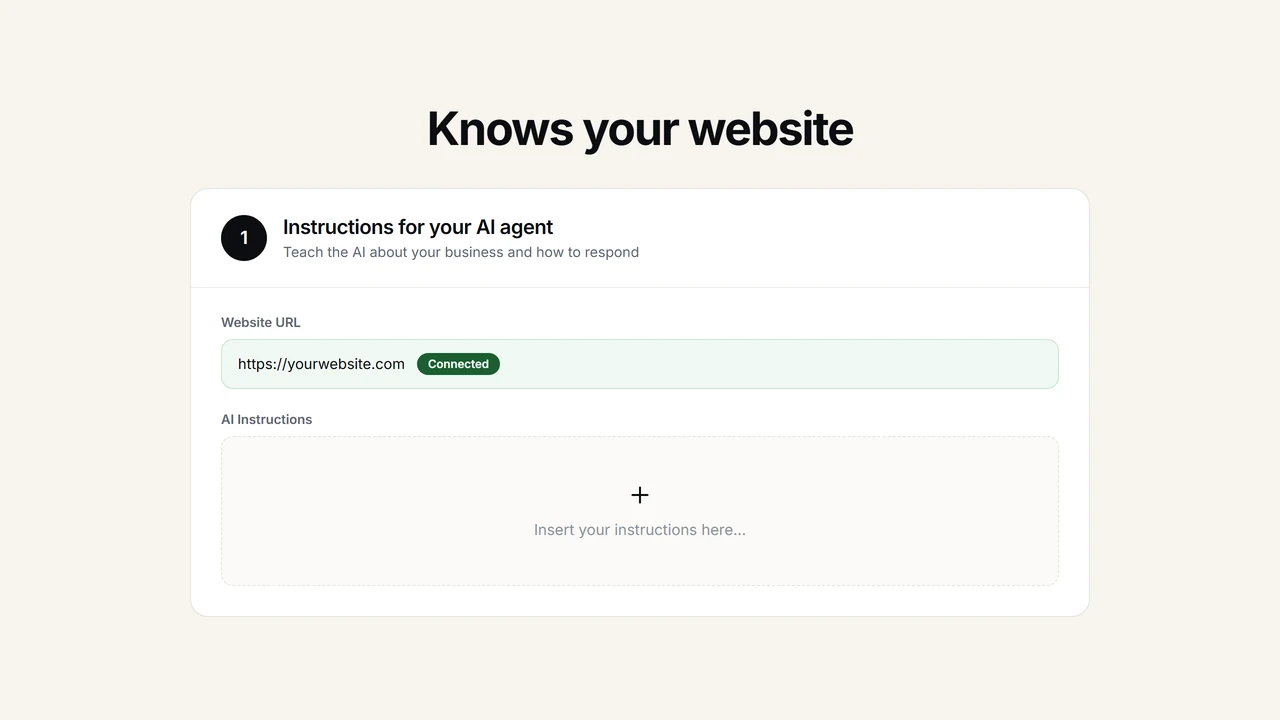
- Content-grounded by defaultPoint Asyntai at your site URL, attach internal PDFs, and the chatbot builds its knowledge from your real documentation — not a generic LLM guessing what your product does.
- Transparent usage pricingFlat monthly tiers based on message volume. Paid plans open at $39 per month for 800 messages, the free entry covers 50 messages, and there's no per-seat tax as your support team grows.
- Portfolio-friendly multi-siteOne plan covers multiple brands — 1 site free, 2 on Starter, 3 on Standard, and up to 10 on Pro — so a mid-sized business running several web properties doesn't pay for each one separately.
- Thirty-six languages out of the boxAutomatic language detection on every incoming message means a French prospect, a Japanese partner, and a Portuguese customer each get answered in their own language without a single translation setting.
From procurement approval to live business chatbot within a day
Enterprise chatbot rollouts famously take quarters. Mid-market deployments often get stuck in that same trap — long onboarding, professional services engagements, workshops. Asyntai is tuned for a faster path: a technical contributor on your team can install, train, and publish the chatbot in a single working session. The snippet drops into any CMS, and native plugins are available for the platforms most businesses actually run.
- Open an Asyntai account, confirm the plan that fits your projected traffic, and copy the snippet from the dashboard.
- Paste the snippet into the global
<head>of your business site, WordPress header hook, Shopify theme file, or whatever CMS you manage. - Enter your website URL in the training panel and let the chatbot ingest public content; upload private PDFs separately for internal pricing or policy docs.
- Write custom instructions covering your brand voice, escalation rules, and forbidden topics, run twenty test questions, then publish.
<script src="https://asyntai.com/widget.js"
data-id="your-business-id" async>
</script>
# Same snippet powers marketing site, docs portal, and checkout.
Best AI chatbot for business — questions from evaluators
The questions procurement teams, support leaders, and founders raise when they're narrowing a chatbot shortlist.
How does Asyntai stack up against Intercom and Drift for a growing business?
Intercom and Drift are excellent at what they were designed for — Intercom as a full customer communications suite with ticketing, product tours, and marketing flows, Drift as a B2B sales acceleration tool aimed at enterprise revenue teams. Their pricing and implementation timelines reflect that scope. Asyntai deliberately occupies the narrower AI-answer-and-capture niche, which is why a business still in the $1M to $50M revenue range usually finds Asyntai faster to adopt and an order of magnitude cheaper to run. If you already use Intercom for the rest of your stack and only need AI answer capability, Asyntai can live alongside it as the pre-ticket layer.
Where does Chatbase or similar document-QA tools land in this comparison?
Chatbase pioneered the "upload a PDF, get a chatbot" pattern and remains a clean option for narrow document Q&A. The trade-offs show up when a business needs lead capture, custom instruction rules, logged-in user personalization, and multi-site handling — capabilities that are first-class in Asyntai but minimal or missing in document-only tools. If your use case really is "answer from one PDF" with no growth plans, a lean tool covers it. If your business is expected to scale, start with a platform that stretches with you.
Is Tidio still the obvious pick for smaller businesses, and where does Asyntai win?
Tidio grew from classic live chat into a hybrid chatbot product and remains a strong option when your plan is to staff a human inbox most of the day. Asyntai inverts the default — AI-first, human handoff when needed — which matches businesses that don't want to rotate teammates through a chat queue. The second major gap is languages: Asyntai's thirty-six-language coverage with automatic detection is broader, and that gap widens once you factor in how the AI responds natively in each of them.
What about HubSpot or Zendesk chatbots bundled with bigger suites?
If your business already runs the full HubSpot or Zendesk stack and the bundled chatbot module is included in your current tier, it's a sensible starting point — free marginal cost. The friction shows up when the bundled chatbot's AI quality, grounding, or multilingual handling falls short of specialized tools. Businesses often keep HubSpot or Zendesk for CRM and ticketing while layering Asyntai on top of the website as the AI answer surface, with the captured transcripts forwarded into the existing ticket queue by email.
What about data security and where conversations are stored?
Asyntai stores conversations and training documents in its managed cloud and does not pass customer chat content to unrelated third parties. The live-conversation flow does route a user's message through a language-model provider to generate replies, which is standard across every AI chatbot on the market today. Businesses in lightly regulated industries typically find this posture sufficient; businesses with strict residency, on-prem, or HIPAA-scoped requirements will want to validate the specifics against their compliance checklist before rolling out to production.
How fast can the chatbot answer from a real business knowledge base?
The first training pass from a site URL usually completes within minutes. Private document uploads — PDFs, policy files, internal pricing sheets — ingest on the same timeline. What takes longer is the quality loop: running a realistic question set through the chatbot, noting awkward answers, tuning custom instructions, adding missing source documents, and retesting. For a typical mid-market business, expect an afternoon to reach a publishable state and another week of casual refinement after going live.
Does it recognize signed-in users across web apps and membership sites?
On Standard and Pro plans, your page populates a JavaScript object named window.Asyntai.userContext with whatever signed-in user information you choose to expose — name, subscription plan, recent order, renewal date, account status. The chatbot folds that context into replies without requiring a backend integration with your user database. For SaaS, membership, or account-driven businesses, this closes the personalization gap that usually separates bundled enterprise chatbots from leaner standalone tools.
Where is Asyntai honestly not the best AI chatbot for a business?
Two scenarios read as a poor fit. First, genuinely enterprise-scale deployments with $50,000-plus annual budgets, dedicated implementation managers, and deep integration requirements across ten internal systems — that's the Intercom, Zendesk, or Salesforce Einstein zone. Second, heavily regulated industries that require on-prem deployment, specific residency guarantees, or audited compliance frameworks above the SaaS baseline — those buyers should shortlist vendors built for that profile. If your business sits outside both groups, Asyntai usually lands on the final three.
Best AI chatbot for business — an honest buyer's guide
Any guide that claims a single vendor is the universally best AI chatbot for business is selling something. Businesses span too wide a range for a one-size ranking to hold up — a 12-person agency, a 400-person ecommerce brand, a 3,000-seat insurance carrier, and a boutique B2B SaaS company are all "businesses," yet their chatbot requirements barely overlap. What an honest guide can do is sketch the shape of the decision, name the leading vendors by the shapes they fit, and show you where on that map a given product actually earns its place. That's the lens this page uses.
Begin with who the shortlist genuinely is. Intercom dominates mid-market and enterprise SaaS support stacks and comes bundled with product tours, outbound campaigns, and a proprietary ticketing surface — the breadth is real and the price reflects it. Drift is pitched at B2B revenue teams that want to route qualified accounts to sales reps in real time rather than just answer questions. Tidio grew up as a small-business live chat platform and layered chatbot features on top. Chatbase is a focused document-grounded chatbot tool popular for narrow use cases. HubSpot includes a chatbot module inside its marketing-and-sales suite that's mostly useful if you already run HubSpot. Zendesk's Answer Bot and conversational AI offerings sit inside its ticketing platform and make sense for Zendesk-first shops. Crisp is an indie-friendly shared inbox with chatbot capabilities leaning toward SMB. Each of these tools is strong inside its intended lane and awkward outside it.
The question any evaluator eventually has to answer is: which lane is my business in? Revenue, headcount, vertical, existing stack, compliance posture, and internal technical capability all feed into that answer. A business with strong existing CRM integrations, dedicated admins, and a willingness to absorb a multi-quarter rollout should genuinely consider Intercom or Drift. A business running a single PDF knowledge base with no plans to grow should probably pick a lean document-QA tool. A business anchored inside HubSpot or Zendesk's broader suite should test the bundled module first. The middle — a growing business that needs meaningful AI answer capability without enterprise budgets or month-long onboarding — is exactly where Asyntai is built to win.
Pricing deserves more scrutiny than most buyers give it, because every vendor uses a different unit of measure. Per-seat pricing penalizes growing support teams; every new hire increases the chatbot bill even when the chatbot itself isn't doing more work. Per-contact pricing, favored by marketing-first suites, can balloon when email list growth is decoupled from chat volume. Per-resolution pricing sounds elegant but depends on the vendor's own definition of "resolution," which is rarely transparent. Per-conversation or per-message pricing lines up the cleanest with value delivered — you pay for the chat traffic you actually get. Asyntai runs on that last model: $39 per month for 800 messages, a free tier for 50 messages to test before spending, and no additional seat fees regardless of how many teammates log in to review conversations.
Answer quality is the dimension that most demos obscure. Every vendor can cherry-pick examples where their chatbot looks brilliant; the relevant question is how each chatbot performs on your content. Build a bake-off set of questions drawn from your real support inbox — a mix of easy product FAQs, medium-difficulty pricing and policy questions, and a handful of genuinely hard ones like "can you process a refund for an order placed four months ago through a discontinued payment method?" Feed the same set to each shortlisted vendor. Score grounding (does the answer cite real information from your docs?), tone (does it sound like your brand?), hallucination rate (does it invent features or policies?), and escalation behavior (does it admit limits cleanly when it should?). After that exercise, vendor comparisons get sharp fast.
Training time and internal lift deserve the same scrutiny. A chatbot that requires six weeks of intent authoring and dialog-tree construction before it produces usable answers is a fundamentally different commitment from one that auto-ingests a website URL in minutes. For a mid-sized business, the implicit salary cost of those six weeks often exceeds a full year of chatbot licensing fees — yet review grids rarely capture that hidden expense. Asyntai's URL-plus-uploads training model was designed specifically to compress that timeline. Most teams reach a publishable first version the same day they install.
Multilingual coverage matters more for businesses than for casual site owners, because business traffic tends to internationalize earlier than people realize. A B2B SaaS company with customers in 14 countries. An ecommerce brand that started shipping internationally and didn't fully translate the site. A services firm with bilingual local markets. Chatbots that support only five or ten languages silently leave those visitors unanswered. Asyntai covers 36 languages, detects the incoming language automatically from the first user message, and replies natively without requiring a language toggle. For any business with meaningful non-English traffic, this alone can shift the shortlist.
Integration depth is the area where every mid-market buyer has to make a choice. The deepest integrations — native CRM object sync, bi-directional help desk ticket creation, embedded product analytics — are usually reserved for the heaviest enterprise tools and priced accordingly. Shallower integrations, like transcript forwarding by email or webhook-triggered lead capture, cover the most common workflows at a tiny fraction of the cost. Asyntai leans deliberately toward the shallower end: lead capture feeds the dashboard, optional email notifications push full transcripts into any existing inbox or help desk that ingests email, and the window.Asyntai.userContext pattern lets your site pass signed-in user data into chats without wiring up a CRM integration project. For businesses that want AI answer capability alongside an existing stack rather than a replacement platform, this posture is a good match.
Multi-site handling is often overlooked during evaluation and then becomes a deciding factor after purchase. A growing business frequently runs more than one web property — a main marketing site, a separate documentation portal, a standalone app login page, a regional subdomain, an acquired brand. Enterprise chatbots typically charge per site or per workspace, which multiplies costs without multiplying value. Asyntai includes 1 site on the free tier, 2 on Starter, 3 on Standard, and up to 10 on Pro — a single subscription that scales across a portfolio. Each site gets its own chatbot with separate custom instructions, separate knowledge bases, and separate analytics, so the marketing site's chatbot doesn't mix data with the documentation portal's.
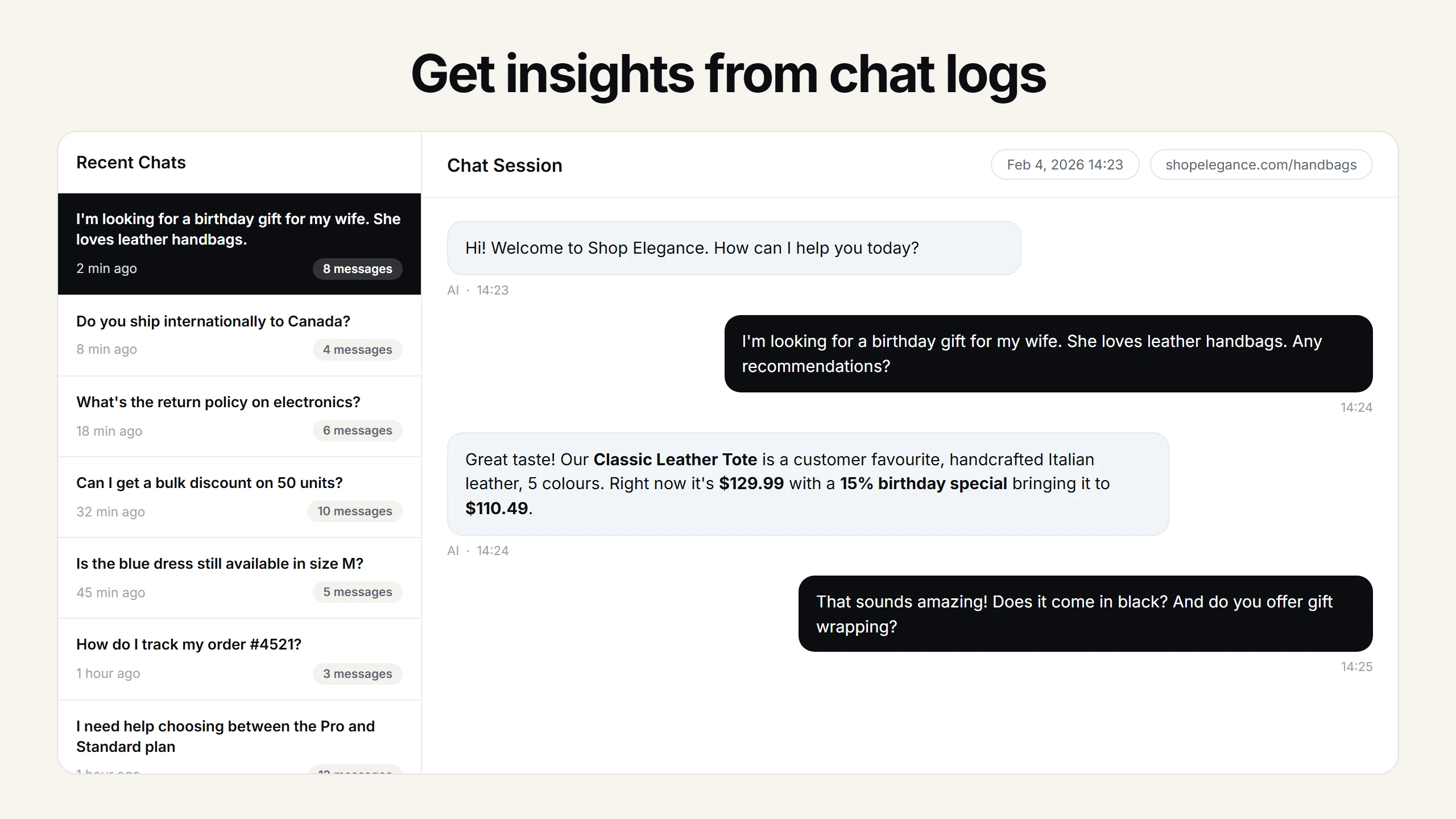
Lead capture and pipeline contribution are the revenue side of the chatbot equation. A chatbot that only answers questions is useful; a chatbot that also identifies qualified prospects and captures their contact details is materially more valuable to a business with a real sales motion. Asyntai's lead capture runs inside the conversation flow: when a visitor signals intent, the chatbot asks for name and email, optionally phone, surfaces the lead in the dashboard, and — if the toggle is on — pushes a real-time email notification with the full conversation transcript to any address. Sales and support teams can respond with full context already loaded, which dramatically reduces the time-to-first-reply metric that influences close rates.
Personalization for signed-in users is a feature growing businesses increasingly expect from their chatbot. A logged-in customer asking "when does my subscription renew?" should get a real answer rather than a generic policy page. Enterprise chatbots expose this through expensive CRM integrations; Asyntai exposes it through window.Asyntai.userContext, a simple JavaScript object your page populates with whatever user data you want to expose — account status, plan, renewal date, recent order, support tier. The chatbot folds that context into replies for Standard and Pro plans. For SaaS businesses and account-driven ecommerce, this is often the feature that separates a tool worth keeping from one that feels limited three months in.
Where Asyntai deliberately is not the best AI chatbot for a business worth calling out plainly. Enterprises with $50,000-plus annual chatbot budgets, dedicated implementation partners, and strict procurement frameworks that require specific compliance certifications should shortlist vendors built for that scale — the tooling and the relationships that come with enterprise pricing are part of the value for those buyers. Heavily regulated businesses needing on-premise deployment, specific data residency guarantees, or audited compliance above standard SaaS baselines should look at specialists in their vertical. Businesses whose entire chatbot use case is human-first, high-touch live chat — concierge services, luxury brands, white-glove agencies — will get more out of traditional live chat products rather than an AI-first tool like Asyntai.
That leaves the wide middle where most growing businesses actually live: real AI answer quality, multilingual coverage, logged-in personalization, multi-site support, lead capture, transparent usage pricing, and same-day deployment without a professional services engagement. That is the lane Asyntai is built for, and if your business fits that description, the shortest path to a real comparison is to install the free tier on a staging page, point it at your own content, and see how the answers land against whatever other vendors you're weighing. The bake-off takes an afternoon; the decision gets a lot clearer afterward.
The practical takeaway from the market map is that "best AI chatbot for business" is a shortlist, not a single name. Write down your six evaluation dimensions, weight them against your business reality, and test the top three candidates on your actual content. If budget predictability, fast deployment, multilingual breadth, and mid-market pricing are near the top of your list, Asyntai tends to make the final cut. If your priorities are deep CRM integrations, enterprise procurement support, or on-prem deployment, that final cut will look different. Either way, the honest path is a real test with real questions — not a shortlist compiled from generic review grids.