Automated customer support that doesn't feel automated
Asyntai offers AI-powered automated customer support that reads your policies and help content, resolves repetitive tickets instantly, and hands the genuinely complex ones to your team — with full context already attached.
Try automated customer support on your site
Enter your site URL and see how the AI would actually handle your inbound support questions
Reads what your support team wrote — and stops them repeating it
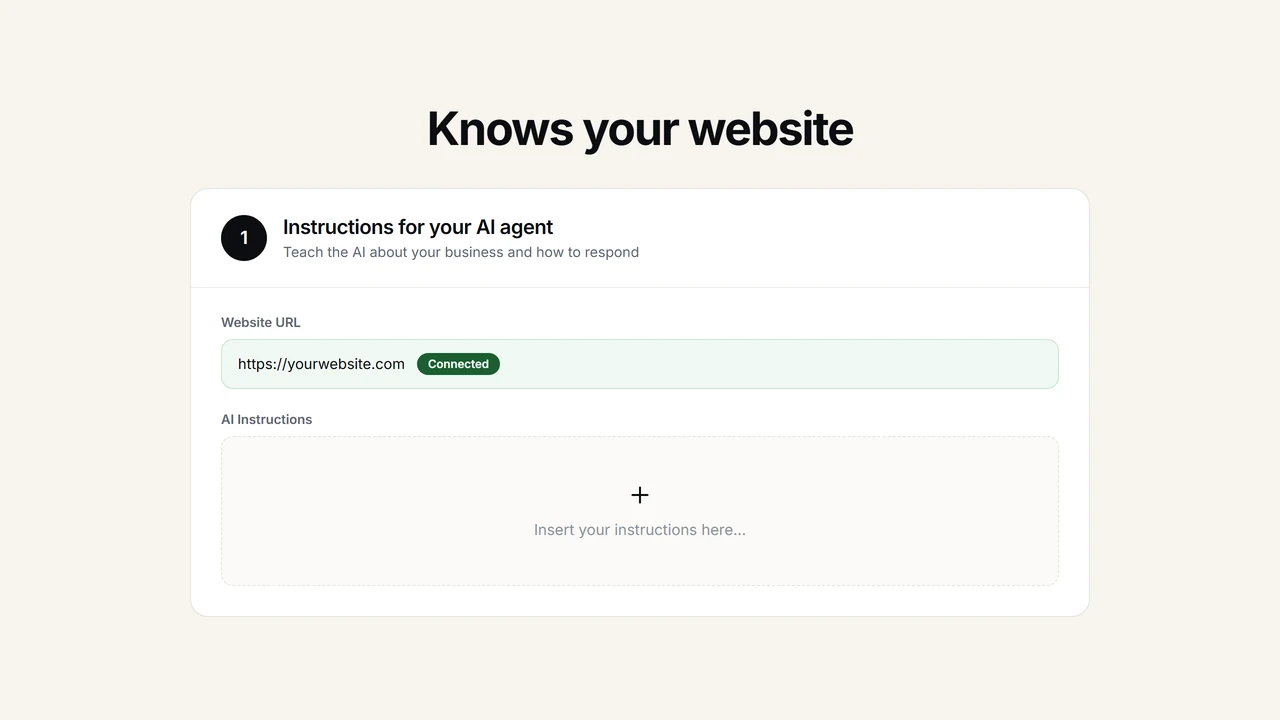
Automated customer support only works if the AI knows your product as well as a tenured agent. Asyntai crawls your help docs, policies, and product pages, then combines that with anything private you upload — so every automated reply matches what your team would have said manually.
- Auto-crawls your help center and docsPublic help articles, pricing, policies, FAQs, product pages — all absorbed into the AI's working knowledge within minutes.
- Upload internal proceduresSOPs, warranty policies, edge-case handling, carrier-specific rules, region-specific terms — add them as PDFs or paste as text.
- Consistency guaranteedUnlike a rotating support team, the AI never forgets a policy or answers "version 2" of a question differently. The automation stays on-brand across every conversation.
Handles the repetitive volume. Escalates the rest cleanly.
Good automated customer support isn't about pretending every ticket can be solved by AI. It's about handling the majority that can — and making the handoff flawless for the ones that can't.
- Resolves common volume instantlyPassword resets, billing questions, shipping status, return policy, product specs — the repetitive majority of tickets get answered in seconds.
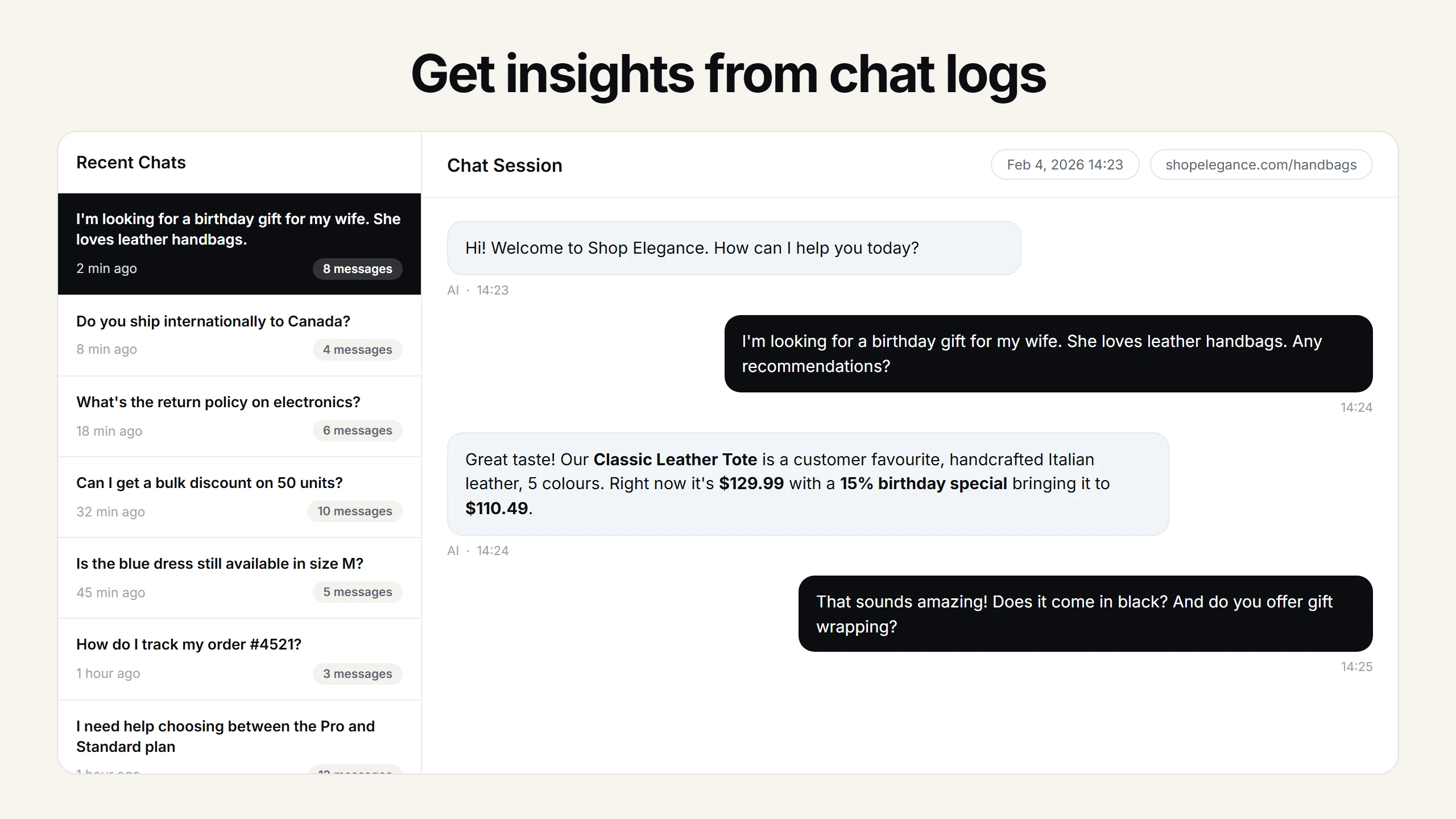
- Escalates with context intactWhen the AI can't close a ticket, it captures name, email, and the full conversation. Your team gets the full thread in their dashboard and inbox — not a cold "start over" ticket.
- Works alongside your existing stackAsyntai sits on your website as a first-response layer. Complex cases still flow to your help desk, CRM, or email the way they always have.
Deployed in an afternoon, not a quarter
Traditional support automation projects take months — integrations, workflow mapping, agent training, a rollout plan. Asyntai takes one script tag and a knowledge base upload. Paste, train, go live.
- Sign up for a free Asyntai account and copy your personal snippet.
- Paste the snippet into your website's
<head>— via your CMS header settings, a header plugin, or the template directly. - Point Asyntai at your site URL and upload any private support documents.
- Write a handful of custom instructions about escalation rules, test the bot, and switch on.
<script src="https://asyntai.com/widget.js"
data-id="your-site-id" async>
</script>
</head>
# One line. Live on every page.
Automated customer support — FAQs
What ops, support, and founder teams usually ask before rolling out automation.
What percentage of our support tickets could the AI actually automate?
Most businesses see 60–80% of their inbound tickets fall into categories the AI handles well: shipping status, return policies, product details, sizing, billing questions, password and account basics, pre-purchase questions. The specific percentage depends on how content-answerable your ticket volume is. Complex refund disputes, custom quotes, and sensitive complaints still route to humans — and should.
Does this replace our current help desk (Zendesk, Intercom, Help Scout)?
No. Automated customer support from Asyntai sits on your website as a first-response layer, deflecting the questions that would have become tickets in your help desk. When the AI can't resolve something, the escalation — full conversation context attached — is delivered to your support team's inbox, from which you can continue in whatever help desk you already use.
Can it look up specific customer data for personalized answers?
Yes, via the User Context feature on Standard and Pro plans. Your website passes logged-in customer data — name, account tier, order status, subscription status, whatever you choose — into a JavaScript object before the chat loads. The AI uses that context to answer questions like "where is my order" or "what's my renewal date" without needing any API integration.
How does the AI stay accurate as our products and policies change?
You re-crawl your site whenever there's a significant update — a new product line, a changed return window, a revised pricing page — and the AI's knowledge refreshes. Uploaded documents can be replaced at any time. Custom instructions update instantly. There's no retraining cycle or model fine-tuning on your side.
Does it support multiple languages for international customers?
Yes. The widget UI is available in 36 languages, and the AI detects each customer's language from their first message. A German customer gets German answers, a Japanese customer gets Japanese, a Portuguese customer gets Portuguese — all automatically, with no translation setup required.
What about complex tickets — will the AI try to answer something it shouldn't?
You set the escalation rules in plain English. "Never commit to a refund amount without human approval." "Escalate any complaint involving a damaged shipment." "Don't quote custom project pricing — offer a call instead." The AI follows those rules and hands off rather than guessing.
What happens if we exceed the monthly message limit?
The automated support pauses new replies until the next billing cycle or until you upgrade. Email warnings arrive before you actually hit the cap, so an unexpected traffic surge doesn't silently disable customer support during a peak moment.
Can we deploy this across multiple brand websites?
Yes on paid plans. Free: 1 site, Starter: 2, Standard: 3, Pro: up to 10. Each site gets its own separately trained support AI with its own knowledge base and escalation rules — useful for agencies, brand portfolios, or multi-product SaaS companies.
Automated customer support, explained without the hype
Every support team eventually runs into the same unfair math. Ticket volume grows roughly linearly with your user base, but the number of truly unique tickets doesn't grow anywhere near as fast. A new customer arriving today asks the same questions a customer asked last week, which are almost identical to the questions asked a month ago. You end up paying skilled human time to answer the same set of questions over and over, with the only real variable being how quickly the queue builds up before someone starts drowning. Automated customer support is the response to that math — not in a handwavy "AI will solve everything" sense, but in a concrete one: the repetitive majority of tickets can be answered by a well-trained AI, the complex minority still deserve humans, and the trick is making the split clean.
The first honest question to settle is what "automated" actually means in this context. A decade ago, automated customer support meant macros and canned replies — a human agent still handled every ticket, but templated text speed up the typing. Five years ago it meant decision-tree chatbots, which produced the dreaded "I don't understand" loop the moment a customer phrased something unexpectedly. What Asyntai does is different from both. The AI reads your actual help content — docs, policies, product pages — understands what each customer is actually asking in natural language, and composes a response grounded in your content. Not a template, not a canned reply, not a scripted flow. An answer that would have been written by a trained agent, delivered in seconds.
The economics only make sense when you name what gets automated and what doesn't. A realistic breakdown of most companies' support volume looks like this: roughly 60–80% of tickets are content-answerable — shipping policy, return windows, product specifics, pricing questions, password resets, billing basics, feature availability. These are the tickets where the answer already exists somewhere on your site, and the customer just didn't find it. The AI handles these perfectly, at a cost per resolved ticket measured in cents rather than dollars. The remaining 20–40% are judgment calls: complex refund disputes, custom quote requests, sensitive complaints, multi-step account issues, actual edge cases. These still route to human agents — but now they arrive with full context from the AI's initial conversation, so the agent isn't starting from scratch.
Training the automation layer is the part most teams overestimate. You don't curate thousands of Q&A pairs. You don't write flowcharts. You point Asyntai at your website URL, and the AI crawls your help center, FAQ, pricing pages, policies, and product content. That alone gets most teams 70% of the way to useful answers on day one. For content that isn't public — internal warranty procedures, carrier-specific shipping rules, region-specific terms of service, an operational playbook that never made it into a help article — you upload PDFs or paste text directly into the knowledge base. Custom instructions handle the rest: escalation thresholds, tone, when to offer a human, what to never commit to without approval. Those rules apply to every conversation in every language. An afternoon of setup gets most teams to production-grade automated customer support.
Consistency is the quiet benefit that rarely gets mentioned in pitches. A support team of fifteen people will answer the same policy question slightly differently across fifteen conversations — not because any agent is wrong, but because they each absorbed the policy document differently, remember slightly different edge cases, and bring slightly different moods to different tickets. Automated customer support collapses that variance. The AI pulls from one knowledge base every time. If the return window is 30 days, it's 30 days in every answer, in every language, at every hour. For businesses where policy inconsistency causes downstream disputes — fintech, healthcare-adjacent, insurance, regulated industries — that consistency isn't a nice-to-have. It's the feature.
International support volume is another category where automation changes the economics dramatically. Hiring a support team that covers French, German, Japanese, Spanish, and Portuguese to a professional standard is expensive. Hiring that same coverage 24 hours a day is prohibitive for most companies that aren't enterprise-scale. The Asyntai widget supports 36 languages in the UI, and the AI detects the customer's language from their message — so a German customer asking in German gets a German reply, automatically. For companies whose international segment is growing faster than their hiring can keep up with, this single capability often justifies the automation layer on its own.
Customer-specific automated support — the kind that can answer "where is my order" or "when does my plan renew" — used to require deep integrations, API permissions, and a quarter of engineering time. Asyntai takes a lighter path through the User Context feature, available on Standard and Pro plans. Your site passes logged-in customer data into a JavaScript object before the widget loads — name, tier, subscription status, order history, anything you choose. The AI uses that context to answer personalized questions. You control exactly what the automated support layer sees, because the data is pushed rather than pulled. No OAuth flows, no permission prompts, no data access beyond what your own code chooses to share.
The escalation step is what separates adequate automation from good automation. When a customer asks something the AI shouldn't answer — a custom refund request, a complaint about a damaged shipment, a complex account reconciliation — it needs to know that and hand off without the customer feeling abandoned. Asyntai does this through smart lead capture: the AI asks for the customer's name, email, and optionally phone number, captures the full conversation transcript, and delivers everything to your Asyntai dashboard. If you enable email notifications, the same transcript arrives in your support team's inbox in real time. Your team picks up the conversation already aware of the customer's context, and whatever help desk or email workflow you already use handles the rest. The handoff is invisible from the customer's perspective.
What customers ask the automated support is, in practice, an X-ray of your documentation. Every recurring question points at something your help center isn't communicating clearly. If forty customers this month asked the same question about renewal dates, your billing page needs a restructure. If international customers keep asking whether a specific feature works in their region, your pricing page needs a geographic clarification. Conversation analytics in the Asyntai dashboard make these patterns visible — not as scattered tickets in a help desk queue, but grouped by topic, frequency, and language. Over time, automated customer support does more than deflect tickets: it tells you which pages to rewrite so fewer tickets need deflecting at all.
The pricing math is where most support ops teams find the business case. An internal agent costs $35,000–$80,000 per year depending on region, or roughly $15–$40 per hour including overhead. Outsourced support runs $4–$15 per resolved ticket depending on complexity. Automated customer support from Asyntai starts at $39 per month for 800 messages — which, at typical resolution rates, translates to a fraction of a cent per resolved ticket. For teams measuring cost-per-ticket, the automation layer doesn't compete with a human agent on every case; it removes the cheap-but-numerous repetitive cases from the queue entirely, so the human cost per remaining ticket drops naturally.
Site-level tier scaling matters for teams running support across multiple brands or products. Free supports one site, Starter two, Standard three, and Pro up to ten. Multi-brand retailers, agencies managing client support, SaaS companies with several product lines — each gets its own separately trained automated support AI with its own knowledge base and escalation rules. When usage approaches the monthly message cap, email warnings arrive before the automation pauses, so a sudden traffic surge or product launch doesn't silently cut off first-line support at the moment it's most needed.
The categories that benefit most from automated customer support are predictable but worth naming by type of pain. SaaS companies win on pre-sale pricing questions, trial-to-paid conversion, and basic account self-service that doesn't need agent time. E-commerce operations win on shipping, returns, product, and sizing questions — which historically eat the most support hours in retail. Service businesses win on qualification and scope questions that stall prospects before booking. Enterprises in regulated industries win on consistency — the same policy question answered the same way every time, in every language. Anywhere the ratio of repetitive to complex tickets is high, the automation layer has strong economics.
A reasonable objection to all of this is that some tickets deserve a human no matter what, and customers can tell when they're being fobbed off to a bot. Both points are true. The way automated customer support earns trust instead of burning it is by not pretending to handle what it can't, and by making the handoff to a human feel seamless rather than like a restart. Custom instructions — "offer a human for any billing dispute over $200", "escalate any tone-of-voice escalation to the manager queue", "never quote custom pricing without a call" — let you draw the line between automated and human precisely. The AI respects the line. The handoff arrives with the transcript, the context, and the customer's email. Your human team handles the 20–40% that deserves them, and they have time to do it well because they aren't buried in password reset tickets.
Deploying automated customer support used to be a quarter-long implementation project. It isn't anymore. Paste a snippet into your site header, let the AI crawl your help content, upload a few internal procedures, write two or three custom instructions, test a handful of scenarios, go live. Most teams are in production inside an afternoon. From there, the automation quietly runs — answering the repetitive majority, capturing the handoffs for your team, surfacing the patterns that should shape your next round of documentation, and changing the unfair math of support from "linear ticket growth, linear hiring" into something that actually scales.