The AI support tool that thins out your ticket queue before it fills up
Asyntai is a lightweight AI support tool you bolt onto the site you already have. It reads your help content, picks off the easy questions before they ever reach your inbox, and hands the messy ones to whatever help desk you are using today.
Point the support tool at your site and watch it work
Drop a URL in the box and the tool will spin up a preview AI that answers from what it finds
Most AI support tools fail the same way. Here is the checklist.
The category is crowded and the quality curve is brutal. A useful AI support tool has to satisfy a short but stubborn list of criteria, and most options in the market stumble on at least two of them. Here is what we optimize for, and how to evaluate any tool you are comparing.
- Grounded in your content, not the model's guessesIf the tool cannot crawl your actual help center and upload your private PDFs, it will hallucinate. Asyntai pulls from your site plus whatever documents you attach — nothing else.
- Sits alongside your help desk, does not try to replace itYou already pay for Zendesk, Freshdesk, Intercom, or Help Scout. A support tool that demands you migrate is a project, not a tool. Asyntai emails the unresolved cases into whatever inbox you already read.
- Installs in minutes, not quartersOne JavaScript snippet. No CRM integration, no workflow builder, no implementation consultant. If the evaluation takes longer than the install, the tool is the wrong shape.
- Priced per conversation, not per seatSeat-based pricing penalizes growing teams. Message-based pricing lines up with value delivered — $39 per month covers 2,500 resolved conversations on the Starter plan.
A tool, not a platform — the distinction matters
Support platforms want to own everything: tickets, customer data, macros, routing, reporting, the works. A support tool is narrower on purpose. Asyntai does one job — answer the deflectable questions on your website — and respects the tools you already use for the rest.
- Drop-in compatibility with your current workflowYour agents keep working inside Zendesk, Freshdesk, Intercom, Help Scout, Front, or plain email. Escalated transcripts arrive as emails, which every help desk can parse into tickets.
- No forced data migration or re-platformingYour customer history stays where it is. The tool reads your public docs and private uploads. It does not demand access to anything else.
- Scoped surface area, predictable behaviorBecause the tool does not try to be a CRM, a ticketing system, and an analytics suite at the same time, its behavior stays predictable across edge cases. Fewer moving parts, fewer surprises.
From discovery to live tool in one sitting
A tool should feel like a tool — something you grab, try, and either keep or discard the same day. Asyntai is built for that rhythm. The install is a copy-paste. The knowledge is a URL. The decision is yours within a few hours of signing up.
- Sign up, grab your snippet, and drop it into the
<head>of whatever CMS powers your site — Shopify or WordPress or Webflow or Wix or Squarespace or a hand-rolled framework, it does not matter. - Give the tool your site URL so it can crawl your help content, and upload any private PDFs or paste in procedures it should also know.
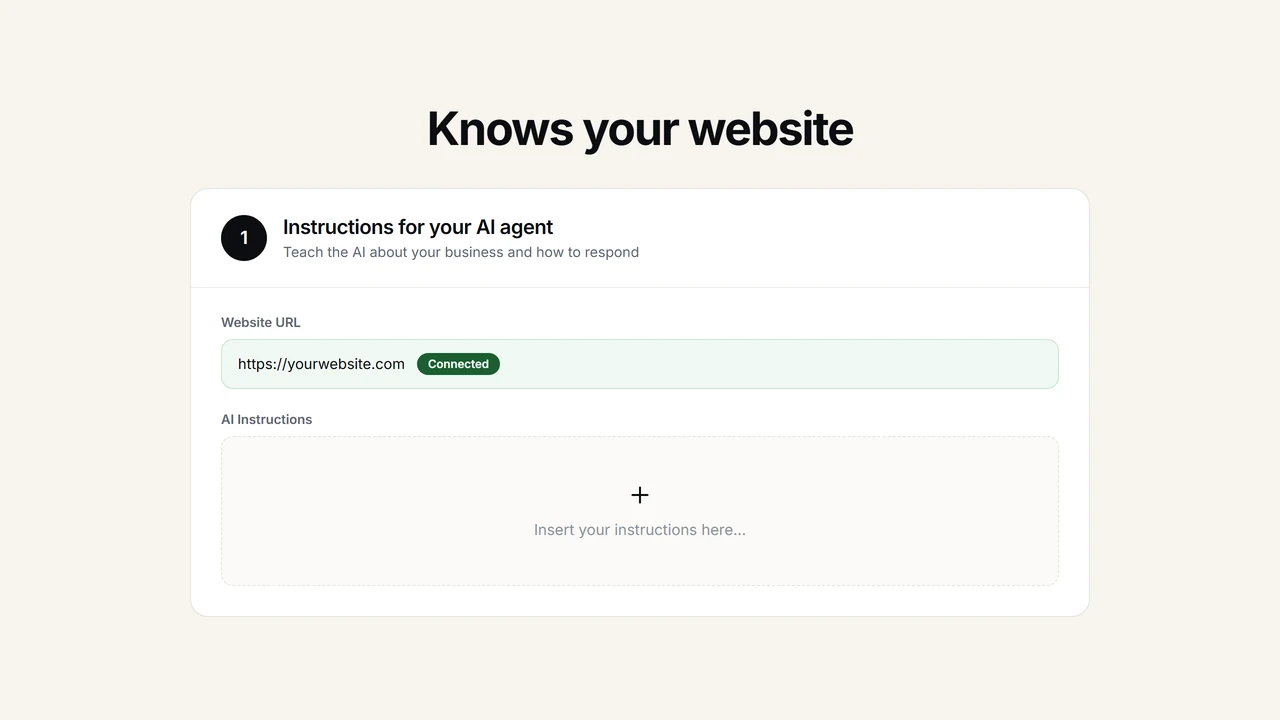
- Write a few plain-English instructions about tone and escalation rules, and the tool starts answering immediately.
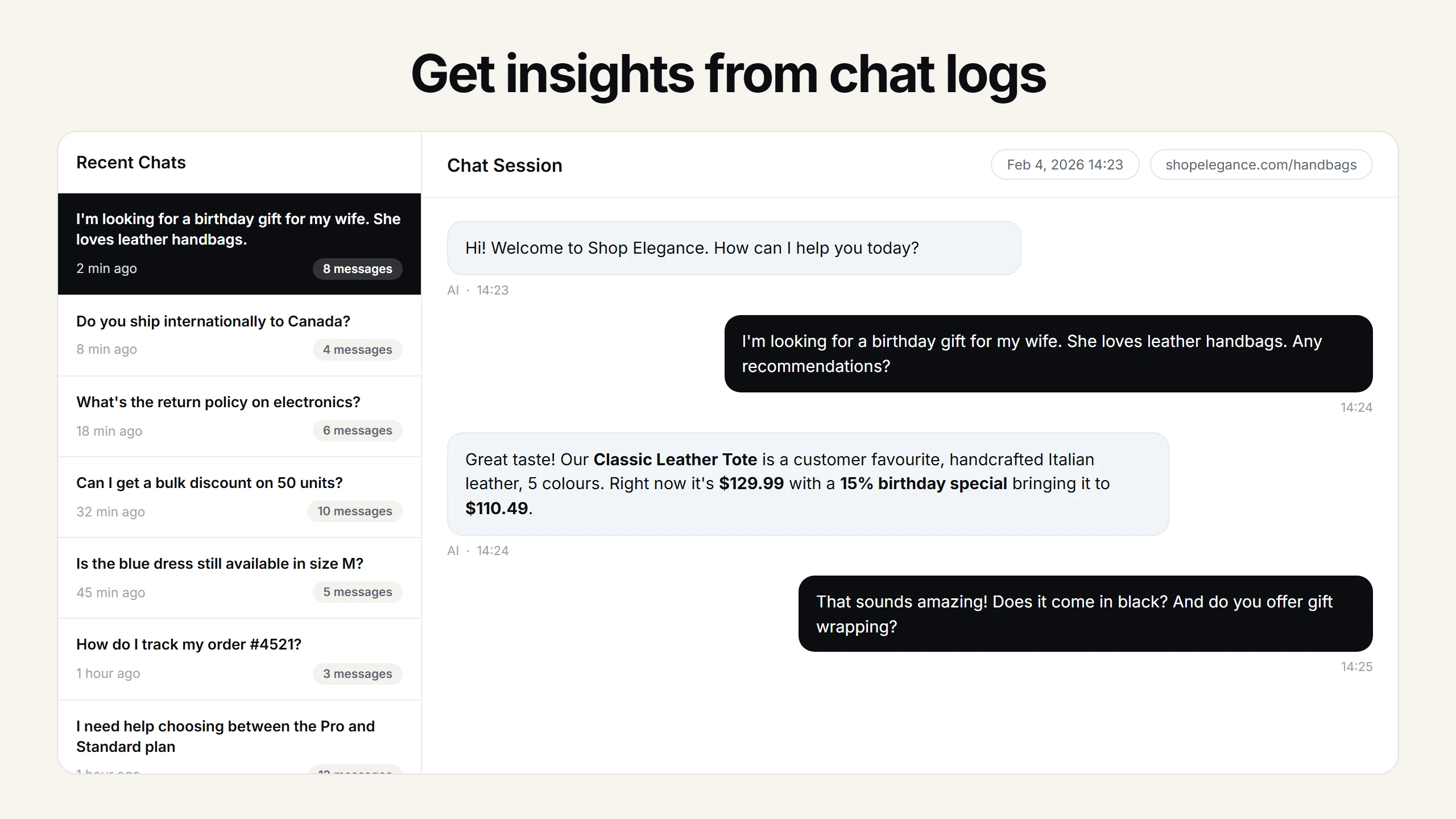
- Watch the conversations roll in, tweak the prompt, and promote to production when it feels right.
<script src="https://asyntai.com/widget.js"
data-id="your-site-id" async>
</script>
</head>
# Tool installed. Zero platform change.
AI support tool — questions we hear during evaluation
The practical questions buyers ask when they are picking a tool rather than switching a platform.
How is an AI support tool different from an AI support platform or an AI agent?
The labels overlap, so here is the practical split. A platform wants to be the center of your support stack — it owns tickets, macros, reporting, and routing, and usually asks you to migrate. An agent tends to imply autonomous task execution, often with heavy API integrations. A tool is narrower on purpose: one capability, one install, one line in the bill. Asyntai is squarely in the tool camp. It deflects repetitive website questions and leaves the rest of your stack untouched.
Will it work if we already use Zendesk or Freshdesk or Intercom or Help Scout?
Yes — that is precisely the intended shape. The tool sits on your website as a pre-ticket layer. When it cannot resolve something, it captures the conversation and emails it to whichever address your help desk listens on. Zendesk, Freshdesk, Intercom, Help Scout, Front, and plain shared inboxes all accept email-to-ticket, so the escalation becomes a normal ticket in whichever system you already run.
What kind of questions does this tool actually answer well?
Anything documented. Shipping windows, return policies, warranty terms, pricing structure, product specs, feature availability, account self-service basics, billing mechanics, integration compatibility, troubleshooting steps that already live in a help article. If the answer exists somewhere on your site or in an uploaded document, the tool will find it and phrase it in the customer's language. Anything undocumented — custom quotes, sensitive complaints, account reconciliation — gets escalated rather than guessed at.
How do I evaluate whether this tool is better than a competitor?
Install both, use the same site URL, and throw the same thirty questions at each tool. Score on four axes: factual accuracy against your docs, tone match to your brand voice, willingness to escalate when stumped, and install friction. Asyntai's free tier gives you 50 messages — more than enough for a side-by-side benchmark. Tools that refuse a free evaluation, or that need a sales call before you can see output, are telling you something.
Does the tool handle non-English visitors without extra configuration?
Out of the box. The widget UI is translated into 36 locales, and the model behind it flips reply language to track whoever is typing. A visitor writing in Korean gets Korean answers. A visitor writing in Portuguese gets Portuguese. You do not have to translate anything or toggle a setting — language detection fires on every inbound message.
Can we feed it logged-in user context for personalized answers?
Yes, via the window.Asyntai.userContext hook offered on the Standard and Pro plans. Your page code writes whatever fields you choose into that variable before the chat initializes — plan tier, order ID, renewal date, account status, or anything else. The tool consumes that snapshot and uses it to answer personal questions without opening API access to your customer database. The data path is one-way and scoped entirely by you.
What does it cost, and how does the message meter work?
Free gets you 50 messages to try the tool. Starter is $39 per month and includes 800 messages. Standard and Pro sit above that with higher message caps and more sites. A "message" counts one AI reply. When you approach the cap, you get email warnings; when you exceed it, the tool pauses replies rather than silently over-billing you. No per-seat pricing, no annual minimums for the smaller plans.
How many different websites can one account cover?
Free gives you 1, Starter allows 2, Standard adds a third, and Pro opens it up to 10 properties. Each property is a distinct tool instance with a separate crawl, separate uploads, separate custom prompts, and a separate conversation log. Handy for agencies, portfolio retailers, or SaaS companies running a marketing site plus a docs site plus a support portal as independent entities.
Picking an AI support tool without getting burned
The phrase "AI support tool" is doing a lot of work in 2026. A year ago it mostly meant a chatbot with a GPT wrapper; now it could mean any of fifteen different shapes, from autonomous ticket-resolving agents that plug into your CRM to single-page widgets that answer FAQs. Before you pick one, it helps to be precise about what kind of thing you are actually shopping for, because the wrong shape will either solve a problem you do not have or fail to solve the one you do.
Start with a scoping question: are you looking for a platform, a tool, or an agent? A platform wants to be the central system of record for your customer support — Zendesk, Freshdesk, Intercom, Help Scout, Gorgias all play that role. You migrate to a platform. You configure it. You train your team on it. You probably do not want a second platform. An agent is something more autonomous: it takes actions on your behalf, often chains API calls, and usually lives inside a platform or CRM. A tool is narrower. It does one thing, attaches to what you already run, and earns its keep by removing friction rather than replacing infrastructure. Asyntai is a tool.
The tool framing matters because it sets realistic expectations. A support tool does not own your tickets, your SLA reporting, or your agent scheduling. It does not replace your help desk, your CRM, or your conversational QA stack. What it does is intercept the questions on your website before they become tickets anywhere — answer the ones it can, capture the ones it cannot, and push the capture into whatever you already use. The value is narrow and measurable: fewer repetitive tickets hitting your inbox, shorter queue for the cases that deserve a human.
How do you evaluate one AI support tool against another? The honest answer is a bake-off, because demos lie and feature lists do not tell you how the model actually sounds on your content. Pick three candidates. Install each one on a staging page or a sandbox environment. Feed each the same site URL and the same batch of private documents. Throw the same thirty questions at each — a mix of "easy" (return policy), "medium" (does this feature work with our tier), and "intentionally stumpable" (a scenario nothing in the docs covers). Score on four things. First, factual accuracy — does the answer match your actual documentation, or has the model hallucinated detail that sounds plausible but does not exist? Second, tone — does it sound like your brand, or is it unmistakably a bot trying to sound human? Third, escalation behavior — when asked something it should not answer, does it hand off cleanly or try to bluff? Fourth, install friction — how long did it take to get from signup to live on a page? Tools that require a sales call before you see output, or that refuse a free trial, are not meeting the bar of "tool" at all.
Grounding is the single biggest quality predictor. An AI support tool that cannot ingest your actual content will fake answers. The question to ask each vendor is concrete: can your tool crawl my help center today, and can I upload private PDFs that never go on my public site? If either answer is no, the tool will leak hallucinations into customer conversations. Asyntai auto-crawls your website on signup, re-crawls whenever you ask, and accepts PDF uploads or pasted text for internal procedures. Custom instructions sit on top of all that and set escalation rules, tone, and forbidden topics in plain English.
The second major differentiator is where the tool sits in your stack. A support tool that demands a migration is not really a tool. It is a platform pretending to be a tool until you sign the contract, at which point you discover you need to retrain your agents, re-import your macros, and rebuild your reporting. Asyntai is explicit about staying out of that territory. It lives on your website as a pre-ticket layer. When it escalates a chat, the conversation record appears inside your Asyntai dashboard — and, if you flip the email toggle on, it also forwards to whichever address your help desk already ingests. Zendesk, Freshdesk, Intercom, Help Scout, Front, Gmail, any email-to-ticket system you use — they all accept the handoff as a normal email. No integration project. No re-platforming. No training your team on a new UI.
International coverage is where tools separate quickly on price. Buying human support agents across multiple languages is expensive; buying them 24 hours a day is out of reach for most small teams. An AI support tool with native multilingual ability changes that math. Asyntai delivers the widget interface across 36 locales and identifies the customer's typing language on every message. A question arriving in Hungarian gets a Hungarian answer. A question arriving in Thai gets a Thai answer. None of it requires a translation toggle or a separate configuration per language. For teams whose international long tail has been growing faster than their hiring, that one capability can justify the tool on its own.
Personalization is the feature most buyers underestimate during evaluation. A support tool that can only field generic questions — "what is your return policy" — is useful but limited. A support tool that can also resolve order-level queries like tracking status or renewal timing is an order of magnitude more valuable. Asyntai handles this through window.Asyntai.userContext, a JavaScript variable your page script fills in before chat boots. You push whatever fields you want — name, plan, most recent order ID, renewal date, account status — and the tool folds that context into conversations with logged-in visitors. The pipeline is one-way, scoped to what you push, and activated on Standard and Pro. It sidesteps CRM integration entirely while still unlocking personalized answers.
Escalation quality is the quiet differentiator that shows up weeks after rollout. Any AI support tool can answer easy questions. What separates a good tool from a mediocre one is how it handles the hard ones. A bad tool tries to answer everything, bluffs when it should not, and produces the "I don't understand" loop that drives customers to leave angry reviews. A good tool knows its limits, asks for contact details the moment a question crosses into human territory, and hands the whole transcript to a real person without making the customer start over. Asyntai's escalation captures name, email, optional phone, and the entire conversation. You see the lead in your dashboard. You see it in your inbox if you enabled email notifications. Your agent replies with full context already loaded, not a cold ticket.
Pricing models matter more than most buyers realize up front. Per-seat pricing sounds familiar because that is how help desk platforms charge, but for an AI support tool it creates a perverse incentive — every new support hire raises your bill whether the tool is doing anything different. Per-conversation pricing lines up more honestly with value delivered: you pay for answered messages, not for seats. Asyntai charges $39 a month for the Starter plan, which buys 800 AI replies. If the tool handles 2,000 conversations in that window, you spent about two cents per conversation. The free entry tier ships with 50 messages, which is enough to run the bake-off against competing tools without spending anything.
Multi-site coverage is worth verifying on any tool you evaluate, because the gap between "one site" and "ten sites" decides whether the tool works for agencies, portfolio retailers, and larger multi-brand setups. Asyntai's property count goes 1 on the free tier, 2 for Starter subscribers, 3 under Standard, and 10 on Pro. Each property runs as an independent tool — a dedicated crawl, a dedicated document set, a dedicated set of custom prompts, a dedicated conversation log and analytics view. A marketing site and a documentation portal can adopt completely different tone, different escalation rules, and different knowledge bases while sharing one account.
One test you can run during evaluation is to look at the tool's own conversations. A vendor confident in their tool will let you poke at a live demo without booking a meeting. A vendor whose product quality is weak will hide it behind a sales process, a pilot agreement, or an NDA. Install the free tier, point it at your own site, and ask it questions your actual customers ask. If the answers are grounded in your content, match your voice, and escalate cleanly when stumped, you have a tool worth deploying. If the answers feel generic, hedge a lot, or invent details that are not on your site, move on to the next candidate.
Finally, think about reversibility. A tool you can remove in thirty seconds by deleting a script tag is a very different commitment from a platform migration you will be living with for three years. Asyntai is the former by design. Uninstalling is the same operation as installing, in reverse. If the tool stops earning its keep, you pull the snippet and move on. That reversibility is part of what makes it a tool in the first place — low friction to adopt, low friction to leave, and low friction to run in parallel with whatever support stack you already have.
The practical path through all of this is shorter than it sounds. Sign up for the free tier. Paste the snippet into your site. Let the tool crawl your help content and upload anything private. Write three custom instructions. Run a handful of real questions through it. If the answers are grounded, the tone is right, and the escalation behaves, keep it. If not, pull the snippet. That is the tool contract — earn your keep or get removed — and it is a fair deal for both sides.