AI for your Shopify store, without a stack of apps
Asyntai adds one AI layer to your Shopify storefront that covers shopping guidance, support answers, product recommendations, and lead capture — answering from your catalog, live in under an hour, free for the first 50 messages.
See what AI looks like on your Shopify store
Paste your storefront URL and watch the AI layer pull from your own catalog in seconds
AI that does more than chat, on a store that needs more than a widget
Most "AI for Shopify store" pitches are a chat box with a rebrand. Asyntai is honest about what it is: a conversational AI layer that handles the four storefront jobs shoppers actually hit — finding the right item, getting a support answer, asking for a recommendation, leaving contact details when they're not ready to buy. One install covers all four.
- Shopping guidance that narrows the catalogShoppers describe what they want in their own words and the AI pulls matching products, variants, and bundles straight out of your Shopify catalog.
- Support answers drawn from your policiesShipping, returns, warranty, payment methods — the same AI handles the questions your support inbox used to absorb, without a separate helpdesk tool.
- Honest scope, stated upfrontThis is conversational AI that answers from your store. It isn't Shopify Magic-style AI for writing product descriptions or generating images — those are different tools with different jobs.
The two jobs that turn browsing into revenue
A storefront that only answers questions leaves money on the table. The AI layer surfaces relevant products mid-conversation and — when a shopper isn't ready to buy that session — asks for a way to reach them later. Both pieces land in the same dashboard with the full transcript attached.
- Product suggestions pulled from your own catalogWhen a shopper describes a need, the AI recommends specific SKUs from your Shopify store — not generic advice, never fabricated products.
- In-conversation lead captureConfigure the AI to ask for an email, a phone number, or either. Captured leads drop straight into your Asyntai dashboard, with optional email alerts when a new one arrives.
- Personalization via User ContextStandard and Pro plans let your theme pass signed-in shopper data through
window.Asyntai.userContext, so replies can reference a returning buyer's name, recent order, or tier.
Pick the install route that matches how your team works
Two legitimate paths add AI to a Shopify store. Drop the snippet into theme.liquid and skip admin scopes entirely, or grab the Asyntai listing from the Shopify App Store if you prefer the native install flow. Same AI layer on the storefront either way — the difference is purely where your team does the work.
- Register a free Asyntai account — your personal snippet, already paired to your store ID, is waiting on the setup page.
- In Shopify admin, head to Online Store → Themes → Edit Code.
- Paste the snippet into
theme.liquidjust above the closing</body>tag. - Save — the AI layer is now running on Dawn, Debut, Brooklyn, Sense, or whatever custom theme your store uses.
<script src="https://asyntai.com/widget.js"
data-id="your-store-id" async>
</script>
</body>
# Prefer the App Store route? Same widget, native install.
AI for Shopify store — the honest Q&A
The questions merchants raise once they get past the marketing copy.
When you say "AI for Shopify store," what does that actually cover?
Conversational AI on your storefront. One layer handling four things a shopper might do: search for a product by describing it, ask a support question grounded in your policies, request a recommendation inside a collection, or leave contact details for follow-up. It does not cover AI-generated product descriptions, AI image editing, AI SEO rewrites, or AI for back-office automation — those are adjacent categories and Asyntai doesn't pretend to do them.
How is this different from Shopify Magic?
Shopify Magic is Shopify's native AI toolkit, mostly aimed at merchant-side tasks — generating product copy, summarizing analytics, drafting emails, editing imagery. Asyntai is aimed at the other side: the shopper-facing surface of your store. Magic helps you produce the catalog. Asyntai helps the catalog talk back to shoppers when they land on a product page and have a question.
Which Shopify themes does the AI work on?
Every theme. The widget renders as an overlay outside the theme's section tree, so Dawn, Debut, Brooklyn, Sense, Refresh, any premium theme from the Shopify Theme Store, and any bespoke custom theme all host it identically. Upgrading themes later doesn't break the AI layer.
What languages does the AI handle?
Thirty-six on the widget UI, and the model replies back in whatever language the shopper chose to write in. A Greek-speaking visitor reads Greek answers, a Korean shopper reads Korean, an Arabic shopper reads Arabic — all from one deployment, and nothing to wire up on the translation side.
Can the AI see logged-in Shopify customers?
Only when your theme explicitly tells it to. On Standard and Pro plans, User Context is the opt-in mechanism: your Liquid templates populate window.Asyntai.userContext with whatever attributes you're comfortable sharing — first name, most recent order ID, membership tier — and the AI references those in replies. Anonymous shoppers get a standard flow with zero personal data attached.
Where do captured leads actually go?
Into the Asyntai dashboard with the complete chat transcript on each record. Turn on email notifications and every new lead also arrives in your inbox in real time. There's no auto-sync to Klaviyo, Mailchimp, or Shopify customer segments — you export or forward leads into whatever follow-up workflow you already run.
What does pricing look like?
The free plan ships with 50 messages per month so you can prove the AI out on real storefront traffic before paying a cent. Paid tiers open at $39 monthly for 800 messages. If a billing cycle runs past its allowance the AI pauses replies rather than charging overage fees, and warning emails hit your inbox before the cap lands. Site limits: 1 store free, 2 on Starter, 3 on Standard, 10 on Pro.
Is the AI grounded in my store, or does it hallucinate?
Grounded. Replies draw from your crawled catalog, your policy pages, and any PDFs or text you upload. When a shopper asks something outside that scope, the AI declines politely and — if you've turned on lead capture — offers to take their email so a human can follow up. It's tuned to say "I don't know" rather than invent a promotion or a product that isn't on your store.
What "AI for a Shopify store" should and shouldn't mean
The phrase "AI for Shopify store" has been stretched across so many marketing pages that it has almost lost its shape. It sometimes means a chatbot, sometimes a product-description generator, sometimes a recommendation engine, sometimes an analytics summarizer, sometimes a merchant-side drafting tool, and on a handful of pages it somehow means all of those at once — a single app that claims to do everything from rewriting your metadata to answering shopper questions to forecasting inventory. That claim is nearly always thin in one or more directions. This page takes a narrower stance: what should "AI for a Shopify store" reasonably look like on the shopper-facing side of the storefront, where the AI meets a visitor who is hesitating on a product page, and what should be left to other tools entirely.
Start with the honest scope. Asyntai is a conversational AI layer. It reads the content of a Shopify store and replies to shoppers using that content, in whatever language the shopper typed. It is not a copywriter — Shopify Magic, ChatGPT, Jasper, and half a dozen purpose-built tools handle product-description generation better, because that is their specific job. Asyntai does not touch your metafields, does not rewrite your blog posts, does not auto-generate category pages, and does not edit product images. It also does not operate on the merchant side of Shopify admin, the way an inventory-forecasting or fraud-scoring tool would. It lives on the storefront. It answers visitors. That is the one thing it is built to do well, and the reason it can avoid the jack-of-all-trades trap that sinks most "AI for ecommerce" apps.
The storefront-facing side of a Shopify store has roughly four jobs that benefit from conversational AI, and most pitches conflate or over-specialize one of them. The first is shopping guidance — a shopper knows roughly what they want but hasn't picked the SKU yet, and they need help narrowing. The second is support — a shopper has a specific question about sizing, shipping, returns, ingredients, compatibility, or payment, and the answer is already on the store somewhere but they aren't going to hunt for it. The third is recommendation — a shopper is browsing without a clear target and wants suggestions based on their context, a gift they're looking for, an occasion they're planning around. The fourth is lead capture — a shopper is interested but not buying today, and the store needs a way to reach them later. A proper AI layer handles all four from the same install, because on a real storefront these jobs overlap inside a single conversation that starts with a question and ends with a purchase, a lead, or a closed tab.
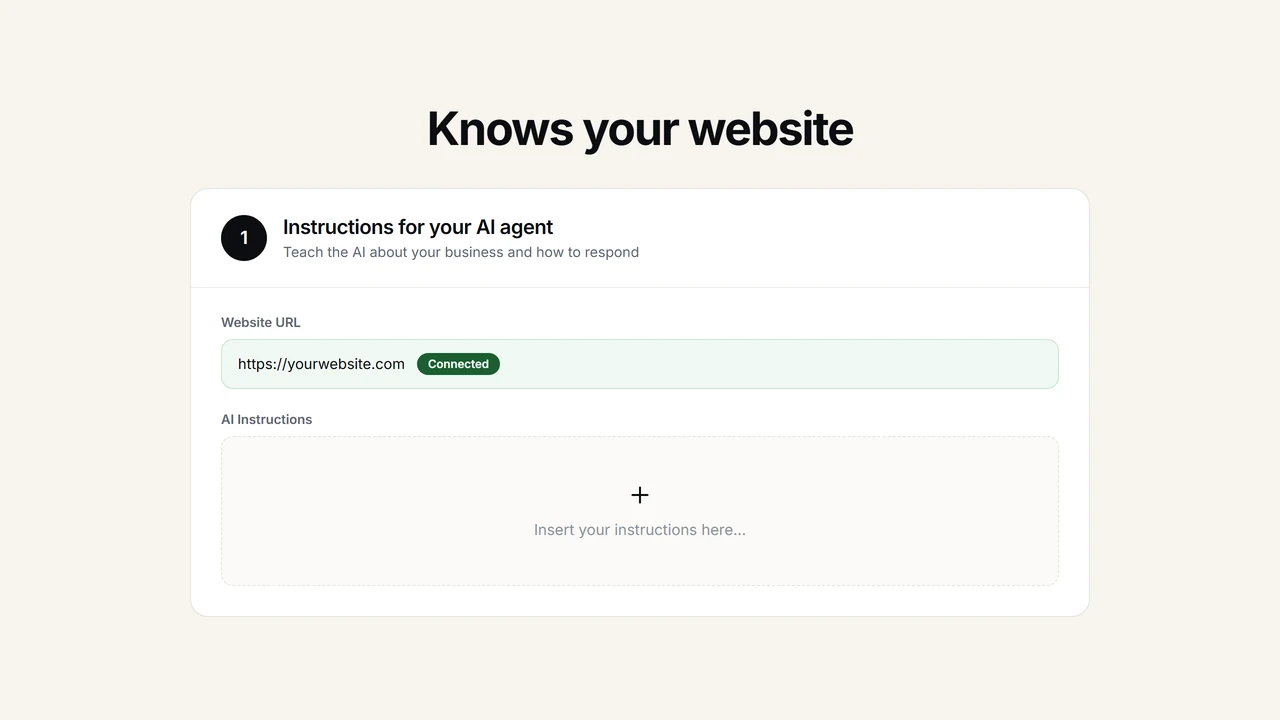
Grounding the AI for a Shopify store is the part that has historically been over-engineered by vendors who wanted configuration to feel like a product feature. Asyntai's approach cuts the other way. Connect your storefront URL and the crawler reads your product pages, collections, and policies. Upload any content that isn't on the public store — internal size guides, supplier sheets, B2B pricing, care instructions that never made it onto a PDP — as PDFs or pasted text. Write two or three behavioral rules in plain English: which collection to default to when a shopper is undecided, whether the AI should suggest a bundle, when to always collect destination country before quoting shipping. That is the full setup loop. There are no intents to define, no flows to draw, no keywords to tag, no QA pairs to enumerate. The AI reasons over the material it has and produces fresh replies per conversation.
Language handling is where a Shopify store gains the most for the least effort. The widget interface ships pre-translated for thirty-six locales, while the model infers the visitor's native tongue from whatever they first type, separately from the storefront locale or any Shopify Markets country mapping. A visitor on the .de market typing in English gets English answers. A visitor on .com typing in Thai gets Thai. A visitor on .fr asking in Arabic gets Arabic. For a Shopify brand shipping globally, this collapses a former translation project into one install with zero extra licenses, zero per-language modules, zero secondary logins. It is also where the "AI" label earns its keep most visibly — a rule-based chatbot cannot reliably handle thirty-six languages, and a human support team almost never can without a team of that size to match.
Personalization on Shopify is the feature most merchants want but few set up properly. A logged-in customer who has bought from your store before should not be treated like an anonymous first-time visitor — if they ask "where is my order," the AI should already have the order context rather than making them paste a number. Asyntai addresses this via User Context on the Standard and Pro tiers: your Liquid template fills a compact JS object containing whichever customer attributes you choose to expose, and the AI references those fields in its replies. The mechanism is opt-in per field, which matters because you control exactly what crosses the boundary — a name and an order ID, nothing else, or a richer profile including tier and preference, whichever you configure. Anonymous shoppers don't trigger anything; only the signed-in session carries context across.
The install question — App Store listing versus theme.liquid snippet — splits merchants cleanly along team lines. If the operations lead runs your Shopify admin and keeps code changes to a minimum, the App Store route feels native: click install in the marketplace, approve the read scopes the app requests, and the embedded Remix admin page opens inside Shopify. If your dev team prefers to minimize admin-granted scopes and control every storefront-side script through theme deployment, the snippet route is cleaner: one line in theme.liquid, zero admin permissions, auditable via the theme history. Both paths produce the same AI layer on the storefront, the same thirty-six languages, the same conversation analytics, the same dashboard. The difference is administrative, not functional, and the choice is rarely as consequential as it feels during procurement.
A specific clarification on what Asyntai does not integrate with, because vague answers on this point waste merchant time. Asyntai does not push captured leads automatically into Klaviyo, Omnisend, Mailchimp, HubSpot, Salesforce, or Shopify's native customer segments. It does not write back to Shopify metafields. It does not create draft orders on a shopper's behalf, and it does not attempt to place items into a cart programmatically during a chat. Each lead lives in the Asyntai dashboard with the complete conversation attached, and if you turn on email notifications the same record arrives in your inbox the moment the AI captures it. Forwarding to your email platform or CRM is a manual pass-through, by design — the tradeoff is a tool that stays focused and stable rather than a tool that tries to auto-sync with everything and breaks whenever one of the downstream integrations changes its API.
Recommendations are worth a separate note, because this is one area where "AI for Shopify store" can either be a genuine feature or a gimmick dressed in buzzwords. The recommendation surface inside Asyntai is conversational, not algorithmic in the personalized-ranking sense. A shopper describes a need — "a minimal gold chain under $80 for my sister" — and the AI pulls matching candidates from the crawled catalog, explains briefly why each one fits, and answers any follow-up about sizing or shipping without breaking context. What Asyntai does not do is maintain a persistent behavior model per shopper or serve collaborative-filtered recommendations based on what similar visitors bought. For that kind of recommendation, a dedicated tool like Shopify's own product recommendations API or a purpose-built personalization engine is the right pick. Asyntai's recommendation behavior is scoped to the current conversation, which is the scope shoppers usually mean when they ask for "help finding something."
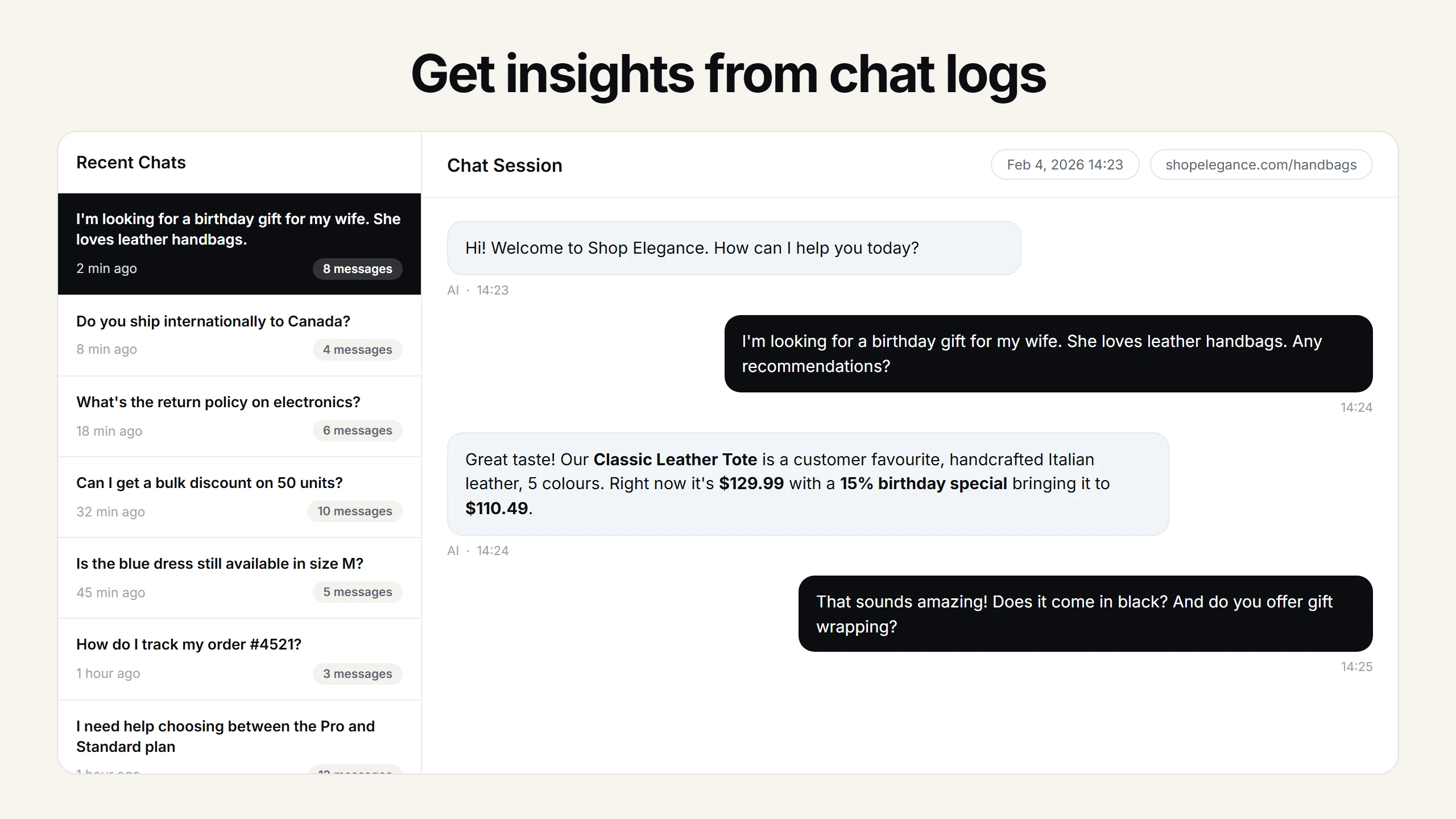
Analytics inside the AI layer closes the feedback loop that most Shopify merchants already wish they had. Every conversation is logged, grouped, and browsable from the dashboard, and the patterns that emerge after a week of real traffic are almost always more useful than what Google Analytics surfaces on the same store. Repeat questions about a product's fit point at a size chart that needs an update. Repeat questions about duties at checkout point at a shipping page that needs a clearer statement. Repeat gift-related conversations during a specific month point at a curation opportunity — a "gifts under $100" collection your storefront doesn't yet have. The AI handles the question in real time, and the log tells you which parts of the store are quietly generating the same repeat question and deserve a copy or structural fix. Over a month, the merchants who actually read the log end up with a quieter inbox and a sharper storefront.
Pricing is set deliberately so a small Shopify store can prove the AI layer earns its place before any monthly cost shows up on a statement. The free plan covers 50 messages per month, which is enough to pilot the AI on a quiet storefront or a single product category. The first paid tier is $39 per month for 800 messages, which tends to absorb the pre-purchase plus support volume of a mid-size independent Shopify brand. Standard and Pro expand both the monthly quota and the count of Shopify storefronts wired to one account — Standard tops at three stores, Pro at ten — which is the tier range that actually matters if a parent company operates a handful of brands or an agency runs the AI across a portfolio of client storefronts. When a store exceeds its allowance, the widget pauses rather than silently charging a surcharge, and warning emails arrive well before the cutoff so a viral product moment or a Black Friday spike doesn't turn into a mid-traffic blackout.
A fair question at this point: is AI really the right framing for this kind of tool, or is it just the current marketing vocabulary for something that could have been called "a smart chat widget" five years ago? The answer, from the merchant's perspective, depends on what you want out of it. If the tool is a fancier button tree — keyword matching, rule-based flows, pre-written replies — the "AI" label is a stretch and the underlying tech matters less than the ease of configuration. If the tool is a language-model-backed system that reasons over your catalog and produces fresh replies in thirty-six languages without any flow to maintain, the AI label is accurate and the difference on a real storefront is large. Asyntai is the second kind. The tradeoff is a tool that occasionally requires you to constrain it with clearer custom instructions, rather than one where you hand-write every possible answer and complain when shoppers phrase things in ways you didn't predict.
The decision to add AI to a Shopify store eventually comes down to a tradeoff every merchant can weigh on their own terms. A real conversational AI layer costs between nothing and a modest monthly fee, handles a meaningful fraction of shopper-facing work your team was previously absorbing or losing to silence, ships in thirty-six languages, installs in an afternoon, and lives alongside whatever other tools already run on your store without replacing any of them. The tradeoff is that it is one specific type of AI for one specific job — storefront conversation — and not a universal engine that auto-generates your marketing, your copy, your pricing, and your forecasting. Narrowing the definition is what lets the tool actually work. The merchants who get the most out of Asyntai are the ones who install it with that narrow scope in mind, let it do the storefront job well, and pick separate purpose-built tools for the other parts of their stack.