AI FAQ generator that writes answers in the chat, not on a static page
Asyntai runs as a live AI FAQ generator — every chat reply is a freshly synthesized FAQ-style answer sourced from your site content, and the conversation log hands you a ranked list of the FAQ topics your visitors are actually asking about.
Generate FAQ-style answers on your own site
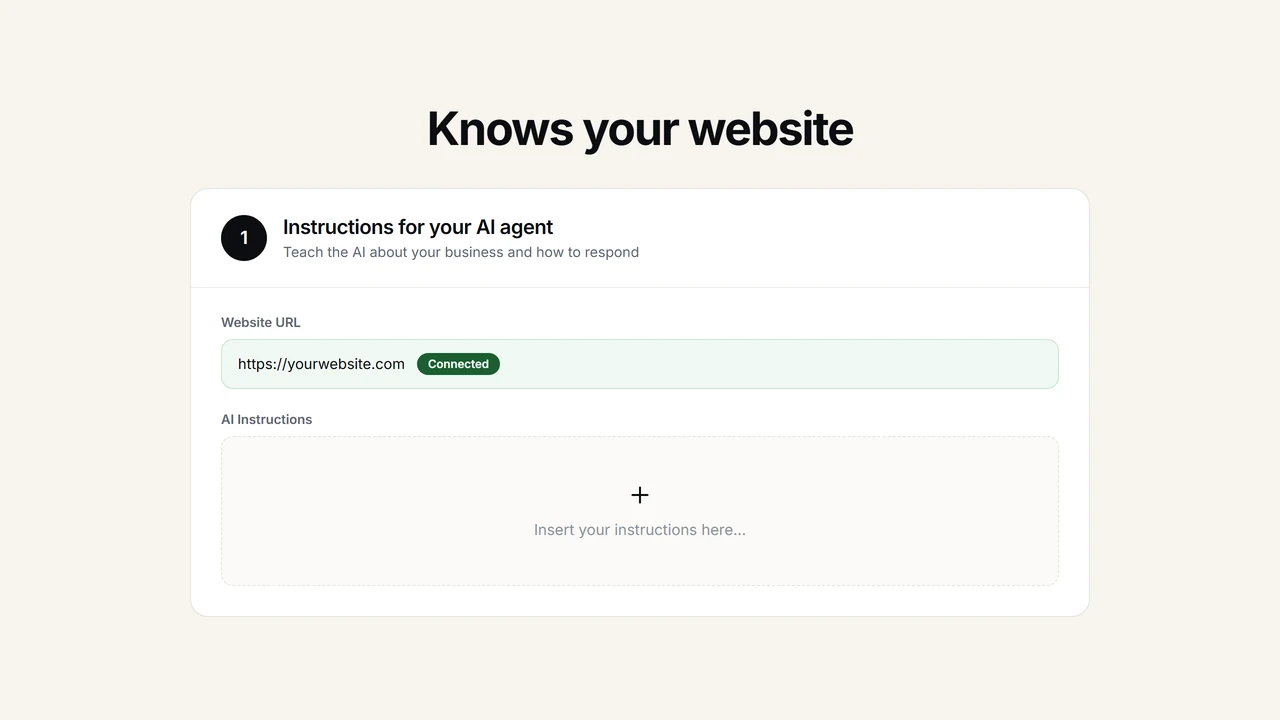
Drop in your URL and the AI FAQ generator will start answering visitor questions using what it reads on your pages
Every reply is a fresh FAQ entry, synthesized the moment a visitor asks
Instead of publishing a static FAQ page and hoping visitors find the one paragraph they need, the AI FAQ generator produces the exact answer per question — phrased conversationally, grounded in your own content, and adjusted to how the visitor actually framed their question. Being honest: Asyntai does not output a standalone FAQ webpage you publish. It generates FAQ-grade answers inside the chat bubble, on demand.
- Auto-crawls your site URLPoint Asyntai at the root of your domain and it pulls product pages, policy pages, about pages, shipping notes, feature descriptions — the raw material the generator composes FAQ answers from.
- PDF and text uploads for anything off-sitePricing sheets, spec documents, return policies, partner terms — drop the files in and the generator can cite them in answers the same way it cites your web pages.
- Custom instructions shape the toneTell the generator to answer in bullet points, cap replies at two sentences, always suggest a next step, or escalate specific topics — the FAQ style bends to match your brand voice.
The questions your visitors ask reveal the FAQs you forgot to write
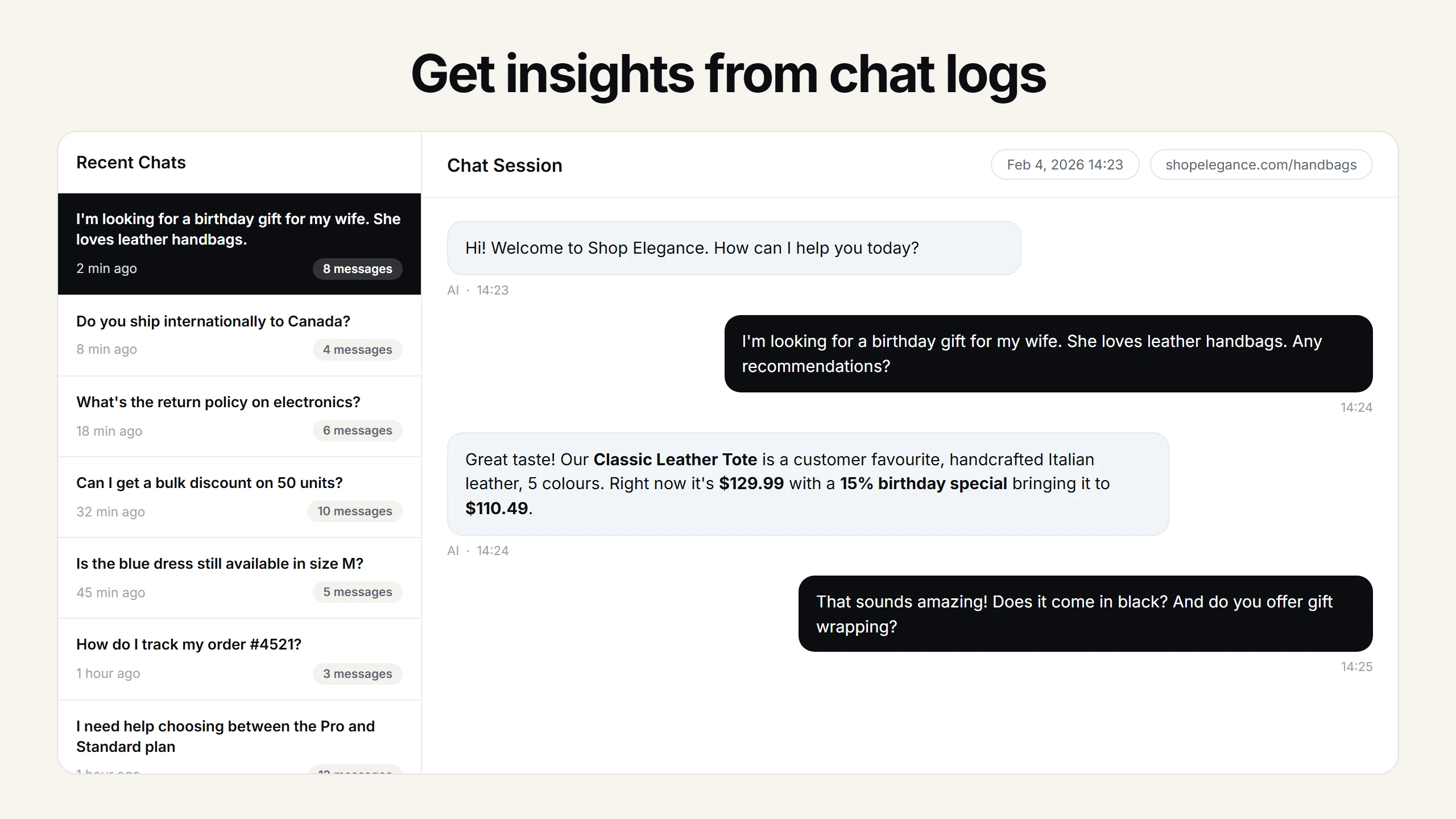
A traditional FAQ page is a guess — someone on the content team lists what they assume visitors wonder about. The AI FAQ generator closes that loop. Every real question a visitor types is logged, grouped, and surfaced as a candidate topic, so you discover the FAQ subjects your audience actually cares about rather than the ones you imagined.
- Recurring questions float to the topWhen dozens of visitors ask about delivery to a specific country, warranty length, or a product compatibility detail, the pattern shows up in your conversation analytics instead of disappearing into individual tickets.
- Unanswered questions become a content backlogIf the generator had to reply with "I don't have that detail," you know your source content is missing a section — and you have the visitor's exact phrasing to write against.
- Answers travel in 36 languagesVisitors phrase questions in their own language, the generator answers in the same language using your source content, and the logged topic is still identifiable across languages for gap reporting.
Get the AI FAQ generator running in an afternoon
The generator ships as a single script tag. Paste it into your site's header, point Asyntai at your URL, and within minutes the chat bubble is fielding FAQ-style questions using your own pages as the answer source. No page builders, no FAQ schema tooling, no taxonomy setup.
- Create a free Asyntai account and grab the embed snippet from the setup screen.
- Paste the snippet into the
<head>of your site — through your CMS theme, a header injection plugin, or the template file directly. - Enter your site URL so the crawler can index pages, and upload any PDFs that hold off-site information.
- Open the custom instructions box, describe how you want FAQ answers phrased, and publish.
<script src="https://asyntai.com/widget.js"
data-id="your-site-id" async>
</script>
</head>
# FAQ-style answers now live on every page of the site.
AI FAQ generator — common checks before you launch
The questions product owners and content leads usually raise when evaluating this approach.
Does Asyntai produce a standalone FAQ page I can publish?
No — and this matters to be clear about. Asyntai is not a content generator that spits out a block of FAQ markup you then paste onto a page. It is a live AI FAQ generator that composes each answer in the chat the moment a visitor asks a question, sourced from your actual site and uploaded files. If you need static FAQ HTML for SEO purposes, use a different tool. If you want every visitor to get a tailored, conversational answer drawn from your content, this is what the widget does.
Where does the generator get the source material for its answers?
Two places. First, the crawler reads your site — product pages, landing pages, shipping and returns sections, policy pages, about content, blog posts if you include them. Second, uploaded files: PDFs of price sheets, spec documents, manuals, or pasted text blocks for anything that doesn't live on a public page. The generator treats both as one reservoir when composing a reply.
How does the "FAQ gap discovery" actually surface in the dashboard?
Every visitor conversation gets logged in full. When you review the log, repeat themes become obvious — the same question phrased twenty different ways, or a category of question the chat had to punt on because source content didn't cover it. That list effectively becomes your content backlog: the FAQ topics your visitors are telling you they need answered, ranked by how often they come up.
Can I control the format of the FAQ-style replies?
Yes, through custom instructions. You can tell the generator to keep replies under a certain length, to use bullet points for procedural answers, to add a closing line that points to the contact page, or to always confirm next steps. You can also instruct it to refuse certain topics and redirect to a human — useful for legal, medical, or financial boundaries where a generated answer shouldn't be the final word.
What languages does the generator cover?
Thirty-six languages. A visitor can type in Polish, Thai, or Vietnamese and the generator will answer them in that language even if your source content is only in English. The language handling happens inside the model — you do not need to maintain parallel translated content for each language to benefit from multilingual FAQ coverage.
What happens when the generator cannot answer confidently?
Two things. First, the visitor sees an honest reply rather than a fabricated answer — the generator is instructed to flag gaps rather than invent. Second, if the visitor shares contact details, the unfinished conversation is saved to your dashboard and can also be sent to an email you specify, so a human can follow up with the correct information and the topic goes on the "FAQ to write" pile.
Can the generator personalize answers for logged-in users?
Yes, on Standard and Pro plans. Through the window.Asyntai.userContext object, your site can pass details like account status, plan level, recent orders, or role before the widget loads. The generator uses that information to tailor the FAQ answer — a visitor on a trial gets different guidance than a paid customer, and a wholesale buyer gets different shipping information than a retail shopper.
How does pricing scale as FAQ volume grows?
At no cost you get a 50-message monthly allowance, which is enough for a small site to see whether the generator covers its FAQ topics cleanly. Paid usage begins at $39 monthly with a 800-message envelope, which tends to fit most small and mid-sized properties. Site caps by plan land at 1, 2, 3, and 10 for Free, Starter, Standard, and Pro respectively — meaningful if you operate FAQ coverage across several domains or brand properties.
Why a live generator beats a static FAQ page
Static FAQ pages are a relic of how websites used to handle common questions. A content person sat down, listed fifteen questions they thought visitors had, wrote concise paragraph answers for each, published it under a /faq slug, and considered the job done. Visitors would arrive, scroll, skim, often not find the specific thing they were looking for — because the page answered a generalized version of their question rather than the actual version — and either guess their way through or leave. The entire pattern assumes that visitors will search, read, and interpret content written for the average case. In practice, most visitors want a direct answer to their exact phrasing, and they want it faster than skimming a page of unrelated Q&A entries.
An AI FAQ generator inverts that contract. Rather than pre-writing a fixed set of answers, it keeps the source content — your pages, your policy PDFs, your product specs — and composes the answer at the moment a visitor asks. The reply matches the question, not the averaged-out version of it. If a visitor asks about shipping to a specific country with a weight-over-threshold concern, the generator pulls from the shipping policy, the country restriction list, and the threshold notes in your pricing sheet, and stitches them into one focused reply. A static FAQ page could never anticipate that exact combination of variables; it would answer "we ship internationally" and hope the visitor figured out the rest.
Treating the chat itself as a live FAQ layer solves a second problem that static pages quietly create: discoverability decay. As a site grows, the FAQ page tends to get longer and less useful. Early entries stay, new ones get appended, and the document bloats into something nobody reads to completion. Search within the page is weak. Navigation between sections is cumbersome. Visitors trying to find their specific question give up and assume their question isn't covered. The generator has no length problem — the visitor never sees the whole library, only the answer to their question — so the underlying source content can be as deep as you need without punishing anyone who interacts with it.
The gap-discovery angle is where the generator quietly repays its installation cost over the long run. Every interaction is recorded, and after a few weeks of traffic the conversation log becomes a map of what your audience actually wants to know. Most product and marketing teams operate with a vague mental model of visitor questions, built from whatever the loudest customers or sales team members report. The generator replaces that with evidence. You see the exact phrasings, the frequency, the categories, the questions you never anticipated, and the questions you thought were important but nobody actually asks. Teams that use this information to shape their content roadmap, product copy, and support priorities tend to see compounding returns — the FAQ coverage gets tighter because the content is being written against real demand.
Honesty about what the tool is not: it will not generate a publishable FAQ webpage you can embed on a /faq slug. Some tools in the market do that — they produce HTML or JSON-LD FAQ schema you paste into a CMS, which can be useful for SEO. Asyntai's approach is different. The answers are produced live in the chat, personalized to the visitor's exact question and context. If SEO-oriented static FAQ markup is a requirement for your site, you would use Asyntai alongside a schema generator, not as a replacement for it. What Asyntai gives you that a schema tool cannot is the live answering layer itself and the ongoing feedback loop from real visitor questions.
Source ingestion determines the quality ceiling of the generator. Three intake paths exist. The crawler reads pages on the domain you provide, indexing text content, product descriptions, policy language, and whatever else is reachable via internal links. PDF upload covers off-web material — internal spec sheets, product warranties, bulky price tables that live as documents rather than pages, onboarding guides sent to new customers. Text paste covers quick additions that are too small or too ephemeral to warrant a document — a note about a temporary promotion, a clarification about a policy edge case, a few lines describing a partner integration. Combine all three and the generator draws from a reservoir that matches the shape of how your information is actually stored, rather than forcing you to move everything into one system before the tool is useful.
Custom instructions operate as the editorial voice layer. The raw generator will answer accurately but not necessarily in the style you want. A brand selling premium cookware wants warm, recommending language; a B2B SaaS selling security tooling wants precise, measured language; a government services portal wants neutral, procedural language. Custom instructions let you specify all of that in plain text — the style, the length, the topics to steer toward or away from, the phrases to prefer or avoid, the handling for sensitive or out-of-scope questions. Over time, instructions tend to accumulate as you notice patterns: visitors keep asking about a topic the source content doesn't cover cleanly, so you add an instruction telling the generator how to handle it. The instructions become a second, living editorial document for the FAQ layer.
The multilingual side of a live FAQ generator has consequences that static FAQ pages can't match. Translating a static FAQ into thirty-six languages means maintaining thirty-six parallel documents that go stale every time the source changes. Almost nobody does this well; most sites pick two or three priority languages and leave the rest underserved. The generator doesn't replicate the source content; it reads the source in whatever language it's written in and answers in whatever language the visitor asks. A visitor asking in Finnish about a product spec gets a Finnish reply drawn from your English page. The underlying source stays in one language and one version, while the FAQ layer on top automatically serves every visitor in their own language. For international commerce, SaaS with global users, or educational platforms with non-English learners, this removes an entire translation-operations burden.
User Context on Standard and Pro plans adds a segmentation capability that static FAQs structurally cannot offer. A site serving both trial users and paid customers wants to answer the same question differently depending on who is asking. "How do I export my data?" means something different for a free-tier account with limited features than for an enterprise customer with full export privileges. By passing the account's plan, role, or recent activity through the window.Asyntai.userContext object, the generator tailors its reply to the specific user. The same underlying FAQ topic yields different answers depending on who is asking, without you maintaining separate FAQ pages for each segment.
Handoff to humans closes the loop cleanly when the generator hits its limits. Instead of stopping at an apologetic "I don't know" reply, the widget gathers whatever the visitor is willing to share — the question, an email, any useful context — stores the transcript inside Asyntai for review, and can forward the whole exchange to a designated inbox if you've set one up. The follow-up conversation arrives already qualified — you know what the visitor asked, what the generator replied with, and what remained unresolved. This has two effects. First, the visitor is never stranded by an unhelpful reply. Second, the human follow-up is a concrete data point that often reveals the specific FAQ gap you should fill next.
Pricing lines up with how most sites actually adopt a tool like this. The free 50-message allowance lets a small business or solo founder validate whether the generator covers their topics before paying anything. The entry-level paid option is priced at $39 a month and includes 800 monthly messages — a comfortable envelope for sites with steady but not enormous traffic, such as a small ecommerce shop, a regional services firm, or a growing SaaS with a few hundred daily visitors. Higher plan tiers handle larger volumes, more sites (up to ten on the Pro plan), and the User Context feature. Most teams start on free, confirm the generator answers real visitor questions well from their content, move to paid when they exceed the free allowance, and treat it as a running line item the same way they treat analytics or email delivery.
Rolling the AI FAQ generator out is simpler than almost any other content-layer project a team will take on. The install is one snippet. The content ingestion is pointing at a URL and dragging files into an upload box. The editorial layer is writing a paragraph of custom instructions. The review loop is reading conversation logs once a week for the first month. Nothing about the deployment blocks on developer time, design sprints, content freezes, or approval cycles. By the end of the first week, visitors are getting FAQ-style answers composed live from your content in every language they speak; by the end of the first month, your conversation analytics are telling you which FAQ topics to write next. That combination — live answering on what you already have, plus a feedback loop on what you're missing — is what "AI FAQ generator" means in the shape Asyntai delivers it.