AI chatbot for small business, priced like one
Asyntai is the AI chatbot built for owner-operators, two-person teams, and lean shops — affordable, predictable, and running on your site by lunchtime without a developer, consultant, or IT department involved.
See what the chatbot would say on your small business site
Drop in your website URL and watch the chatbot handle the questions your customers are probably asking right now
No IT team. No consultant. No weekend lost to setup.
Small business owners don't have spare hours to wrangle software. Asyntai is deliberately shaped around that reality: one snippet to install, your own website as the training source, and plain-English instructions instead of flowchart builders. The chatbot is live by the time your coffee goes cold.
- One snippet, any platformWhether your shop runs on WordPress, Shopify, Wix, Squarespace, Webflow, or something a cousin built in 2019 — the install is the same tag in the header. Native plugins exist for the big platforms if you prefer.
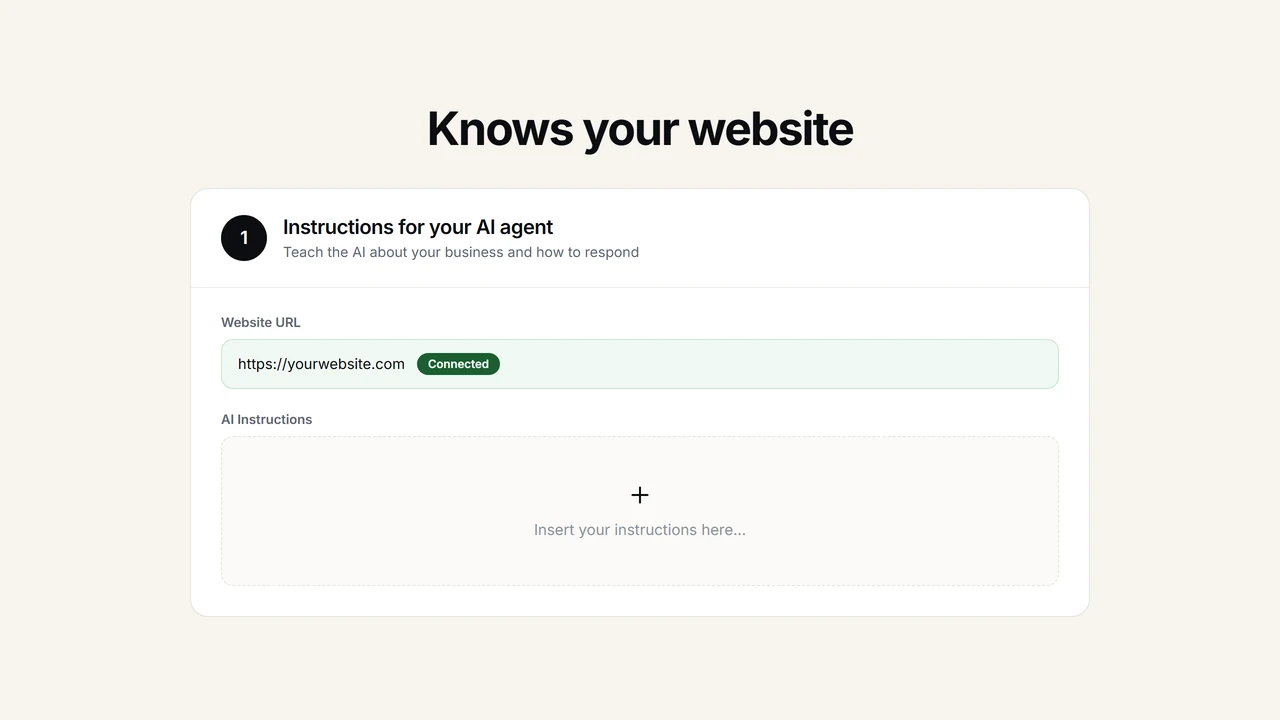
- Reads your site, not your manualsPoint the chatbot at your homepage and it absorbs your hours, pricing, return policy, FAQ, and product pages. You didn't write a knowledge base twice; the site you already maintain is the knowledge base.
- Configured in plain English"Always tell customers we close at 5pm on Sundays." "Offer the 10% welcome discount when someone asks about first orders." Type the rule, save, done. No decision trees, no branching flow diagrams.
Flat monthly pricing. No seat fees. No surprise invoices.
Enterprise chatbot tools are priced for companies with a procurement department. Asyntai isn't. A free tier covers 50 messages a month so you can try it on a real site, paid plans start at $39 per month for 800 messages, and you'll get warning emails long before you hit a cap — never a quiet overage charge at the end of the month.
- Free plan with real capacity50 messages a month, no credit card, one connected site. Enough to prove it works on your actual storefront before you commit a dollar.
- $39/month gets you 800 messagesThat's comfortably more than most small business sites use. If traffic grows, higher tiers are there — but you won't outgrow the starter plan in your first quarter.
- Cap alerts before you hit the limitThe billing system emails you as usage climbs, so a sudden flurry of shoppers never means a silently cut-off chatbot or an unexpected invoice.
Live on your shop before the end of the afternoon
Most small business owners reading this don't want a multi-week rollout; they want something working by tonight. Grab the snippet from your Asyntai dashboard, paste it between your site's <head> tags, and the chatbot is answering questions for real visitors within minutes.
- Create a free Asyntai account and copy the snippet from your dashboard.
- Paste it into your site's header — via your theme editor, a plugin like Insert Headers and Footers, or the native platform integration.
- Enter your website URL so the chatbot can crawl your pages and learn the business.
- Test three or four typical customer questions, tweak the welcome message, and you're running.
<script src="https://asyntai.com/widget.js"
data-id="your-shop-id" async>
</script>
</head>
# Shop owner to live chatbot in one paste.
AI chatbot for small business — common owner questions
Questions that keep coming up from solo founders and two-person shops.
I'm a one-person shop. Can I really run this without a developer?
Yes — that's specifically who it's designed for. There's one tag to paste, and every platform (WordPress, Shopify, Wix, Squarespace, Webflow, custom HTML) has a straightforward place to drop it. If you've ever added a Google Analytics snippet, Facebook Pixel, or any other tracking tag to your site, you've already done the hardest part of installing Asyntai.
How does the pricing actually work for a small business?
Start free with 50 messages per month — plenty to test on a low-traffic site or validate the idea. Paid plans begin at $39 a month for 800 messages, which is generous headroom for most small business sites. If you somehow need more, higher tiers step up from there. No per-seat licensing, no minimum annual commitment, and you can downgrade or cancel any time.
What if I'm not a big writer? Will my chatbot sound bland?
The chatbot reads the copy already on your website, so whatever voice you've built there carries over. On top of that, custom instructions let you nudge the tone — friendly, playful, straight-to-the-point — without writing a style guide. Most small business owners describe the voice they want in two or three sentences and that's enough.
My customers don't all speak English. Does that cost extra?
No extra cost. The widget interface is translated into 36 languages, and the AI replies in whatever language the visitor types in. A Spanish-speaking customer types in Spanish and gets Spanish back; a Polish shopper types in Polish and gets Polish back. There's no separate setup, no language-pack purchase, and no need for a translated version of your site.
Can customers reach a real person if the chatbot can't help?
Yes. The chatbot can capture an email during any conversation — either because the visitor asks for human help or because the AI senses the question has gone beyond what it should answer alone. Those leads land in your Asyntai dashboard with the full transcript, and optionally in your inbox via email notifications, so you can follow up personally.
I run two side businesses. Can one account handle both?
Yes, on paid plans. Free plan is one site, Starter is two, Standard is three, and Pro goes up to ten connected sites. Each site gets its own separate chatbot, so your bakery doesn't accidentally answer questions with advice from your consulting side — the two stay cleanly separate under a single login.
What about logged-in customers — can it recognize them?
On Standard and Pro plans, yes. Your site passes customer info (name, order number, membership level, whatever you want) into a JavaScript object called window.Asyntai.userContext before the widget loads. The chatbot then gives personalized answers — "your last order shipped Tuesday", "your membership renews in 12 days" — without any backend integration or API wiring.
What happens if a month gets too busy and I run over?
Warning emails arrive as you approach the monthly cap, giving time to upgrade if the traffic is sticking around. If the limit is actually reached, the chatbot pauses new replies until the next billing cycle or an upgrade — you never get blindsided by an overage charge, because there isn't one. The cap is a cap, not a meter.
AI chatbot for small business — a practical owner's guide
Running a small business is a balancing act nobody outside one quite gets. You're the founder, the support desk, the shipping clerk, the marketing department, and sometimes the janitor — often inside the same hour. Adding an AI chatbot for small business use sounds appealing in theory, but every owner has the same fear: another tool that eats three weekends to configure and never pays itself back. This page is written specifically against that fear. Everything below assumes you have no developer on call, no training budget, and no patience for software that wants you to watch onboarding videos before it does anything useful.
Start with the honest problem. Most small business websites are working quietly against their owners. A prospective customer lands on the page at 9:40pm, has a question about sizing or delivery or whether you'll be open Sunday, can't find the answer fast enough, and closes the tab. They don't email. They don't come back the next morning. They just vanish, and the owner never knows they were there. Every small business has some percentage of this invisible leakage, and the bigger the site grows, the bigger the leakage in absolute terms. An AI chatbot for small business sites plugs that leak specifically — by being awake and on-topic when the owner can't be.
The reason small business owners historically avoided chatbots is that the early generation of them were terrible. Button-based flows that funneled every visitor through the same five questions. Keyword matchers that panicked the moment a customer phrased things naturally. Expensive enterprise platforms that demanded a dedicated "bot manager" role the business didn't have. The current generation of AI chatbots, built on large language models and trained directly on your own website content, doesn't have those problems — it reads context, answers in natural language, and gets better the more you refine your site rather than some separate training console. That shift is what makes the technology finally viable at the small-business end of the market.
Asyntai's approach to setup is built for owners with no time to produce a knowledge base. You enter your website address in the dashboard and the AI crawls your public pages — products, services, pricing, hours, FAQ, shipping, returns, about. Whatever you've already written for human visitors becomes the chatbot's working knowledge. For the stuff that isn't on your site — a pricing spreadsheet, a client onboarding PDF, a handful of edge-case policies you've never bothered to publish — you can upload files or paste text directly. No manual Q&A pair writing. No dragging nodes around a canvas. The site you already maintain is the material.
Customizing the chatbot's behavior matters more for small businesses than large ones, because small business voices are distinctive. A family-run bakery doesn't want a chatbot that sounds like a bank. A handmade-jewelry store doesn't want a chatbot written by someone's legal team. A two-person consulting shop needs a chatbot that reflects the specific style that got their current clients to trust them. Asyntai lets you write custom instructions in plain English: "keep answers short and warm", "never quote specific wait times without checking", "always offer the 20% first-order discount if someone asks about discounts". The AI applies those rules across every conversation, in every language, without drift.
Multilingual support is something small business owners often assume is a paid enterprise feature somewhere. It isn't, with Asyntai. The widget's interface — the input placeholder, the "Send" button, the online indicator — is localized into 36 languages and switches automatically based on the visitor's browser. The AI itself reads the visitor's message and replies in that same language. For a small business with even occasional tourist traffic, overseas online customers, or a second-generation local audience, this dramatically expands who can actually use the site comfortably. A French tourist asking about your boutique's hours gets French. A Korean buyer asking about international shipping gets Korean. No plugins, no translation invoices, no duplicate content work.
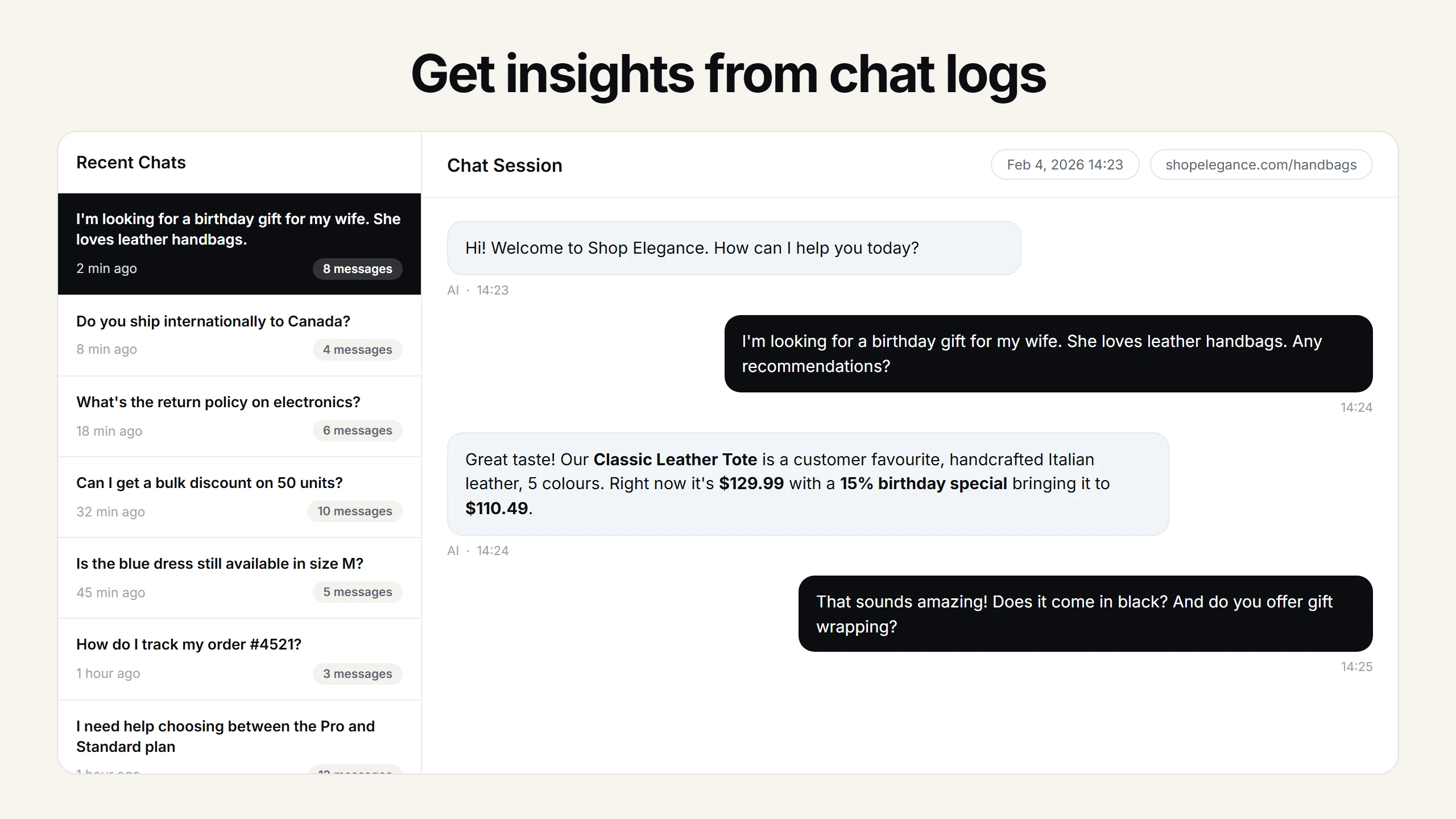
Lead capture is where the chatbot quietly earns itself. Every conversation the AI has is an opportunity to turn an anonymous visitor into a known contact. The chatbot can ask for an email when it senses a follow-up is needed, when the question goes past what it should answer on its own, or when the visitor seems ready to take the next step. Every lead lands in your Asyntai dashboard with the full transcript — what they asked, what was answered, where in your funnel they were stuck. If you flip on email notifications, the same information arrives in your inbox in real time, so you can personally reply within minutes while the interest is still warm. Small businesses win almost entirely on response speed; this is the infrastructure that makes speed feasible without being glued to your phone.
Personalization deserves its own note because it's where small businesses often assume they can't compete with big ones. With Asyntai's User Context feature (included on Standard and Pro plans), your site pushes logged-in customer data into a small JavaScript object — window.Asyntai.userContext — before the widget loads. Whatever you choose to include there becomes available to the chatbot. A returning customer at your online pottery store logs in, opens the chat, and asks "where's my mug?" — the chatbot can respond with the specific tracking status because your site handed that data to it. No backend API setup, no connector configuration, no security review; you control exactly what the chatbot sees, and you can pass more or less at any time.
The economic argument for a small business is almost embarrassingly clear once you run the numbers. A part-time virtual assistant costs more per month than the Pro plan and can't cover 24 hours a day. A full-time support hire costs 50+ times more annually and still needs holidays, sick days, and training. A chatbot platform sold to the enterprise market typically starts around where Asyntai's highest tier ends. What small businesses actually need is a competent answerer that's cheaper than any of those options, doesn't demand a contract, and gets out of the way when the owner wants to handle a conversation personally. That's the slot this product sits in.
A few specific small business categories tend to see returns faster than others. Local services — plumbers, electricians, tutors, salons — recover the "are you open Saturday?" and "do you serve my suburb?" questions that currently go unanswered after hours. Online stores — handmade goods, niche ecommerce, hobby-driven retailers — recover the "is this still in stock?" and "how long will shipping take?" questions that otherwise send shoppers back to search. Coaches and consultants — who live or die by discovery-call bookings — answer "is this right for my situation" objections and push qualified prospects into the scheduling flow. Small B2B SaaS — usually running a WordPress or Webflow marketing site — recover trial signups by answering the pricing and feature questions buyers have before they'll commit. The common thread across all of them: the chatbot handles the repeating questions so the owner can focus on the unrepeating ones.
On the topic of what not to expect, a grounded AI chatbot for small business isn't a replacement for the relationship side of running one. It won't handle a delicate complaint about a missed delivery as well as you would. It won't negotiate a custom quote with finesse. It won't sense when a regular is having a bad week and respond with extra care. What it will do is take the repetitive, well-defined 60-70% of inbound questions off your plate so that the emotionally-charged 30-40% actually gets the attention it deserves. A good owner doesn't lose themselves in their chatbot; they use it to buy back the time they need to be a good owner.
One underrated side effect of running a chatbot is the live diagnostic it gives you of your own website. Every conversation is data about what your site failed to communicate clearly enough on its own. If twenty customers this week asked what your return window is, your returns page is either buried or unclear. If half your chats ask whether you ship internationally, your product pages probably don't mention it. The conversation analytics in the Asyntai dashboard surface these patterns, so over time the chatbot isn't only answering inbound questions — it's quietly showing you which parts of your site need a rewrite and which pages are pulling their weight.
The practical rollout plan for a small business owner reading this is short. Sign up for the free tier. Drop the snippet between the header tags of whichever site you care about most. Let the AI crawl your content. Try it with five or six questions a real customer might ask — be a little mean, use imperfect grammar, ask edge cases. Upload any PDF or document that covers policy the site doesn't already describe. Write two or three custom instructions in plain English about tone, escalation, and anything you'd never want the chatbot to say. Flip on email notifications so leads come to your inbox. Then leave it alone for a week and check the dashboard. You'll have real data about what your customers were asking when you weren't around — and, probably, an uncomfortable sense that you should have done this months ago. For most small businesses, an AI chatbot is now less of an experiment and more of the cheapest upgrade the website has ever had.