AI chat widget that understands what visitors actually ask
Asyntai offers an AI chat widget that reads your website content, understands natural language questions, and answers in plain prose — not scripted buttons. Installs as a single snippet on any site, ready in minutes.
Try the AI chat widget on your website
Enter your site URL and watch the widget answer questions the way a trained team member would
The "AI" in AI chat widget means answers come from your content, not the internet
Generic AI models hallucinate because they're answering from general training data. A well-designed AI chat widget grounds every response in your own website, documents, and instructions — so answers are specific, accurate, and on-brand, not invented.
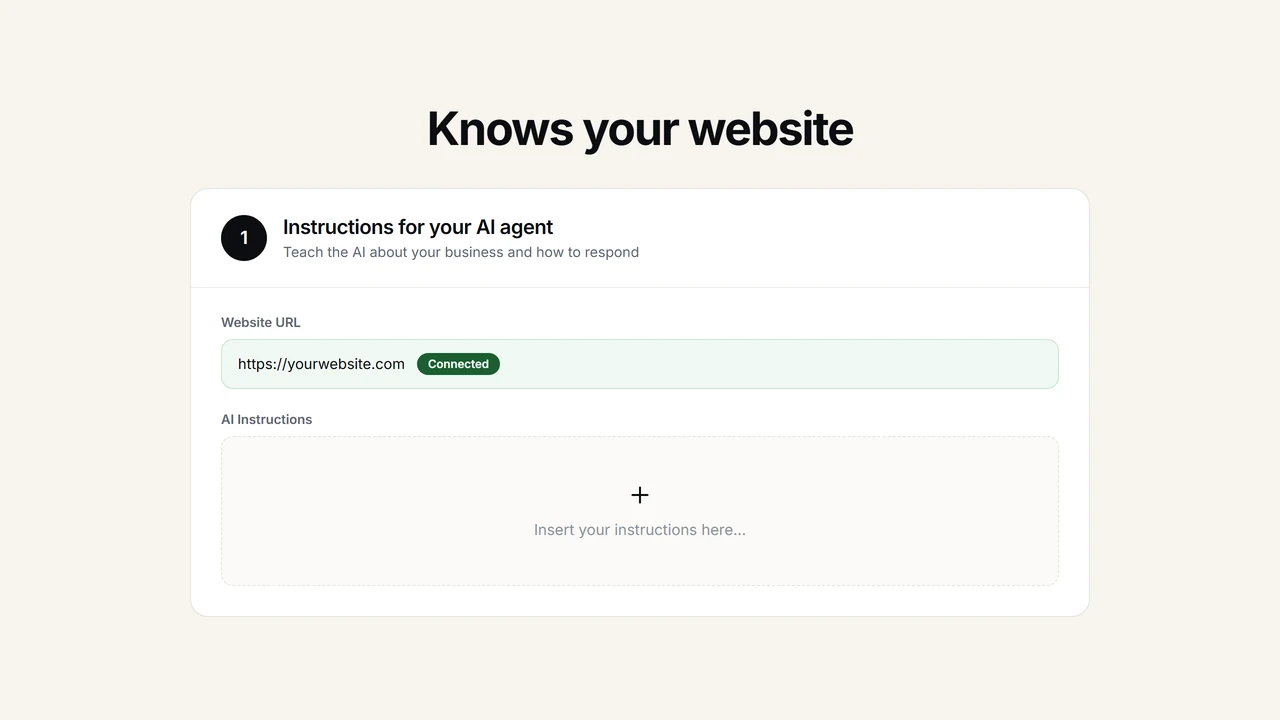
- Reads your published pagesThe AI chat widget crawls your site on signup — services, products, pricing, blog, policies — and pulls from that content when answering, not from its general training data.
- Uses uploaded documents as sourceInternal pricing sheets, SOPs, product specs, onboarding docs — add them as PDFs or text, and the AI uses them exactly like it uses your public pages.
- Custom behavior rules in plain English"Never quote shipping timelines without asking destination." "Always offer a demo when asked about enterprise pricing." The widget follows the rules you write, across every conversation.
Customization that matches any brand, not "chat widget blue"
Every element of the AI chat widget's appearance is configurable — the launcher color, position, avatar, welcome message, input placeholder, tone. Changes preview live in the Asyntai dashboard before going to production.
- Full visual controlPrimary color, launcher corner (left or right), avatar, welcome line, placeholder text — all dialed in through a live-preview dashboard.
- Tone set through instructionsFormal and technical for a B2B SaaS site, warm and casual for a wellness brand, concise for a product store — tone is controlled by a few plain-English rules.
- Mobile behavior you can tuneChoose between a smaller bubble opening or a full conversational overlay on phones — separately from desktop behavior, to match how your visitors actually use the site.
Embed the AI chat widget in one line
The AI chat widget installs exactly like any modern third-party widget — a single script tag in your <head>, same as Google Tag Manager or a Meta Pixel. Works on any CMS or custom site.
- Sign up for a free Asyntai account and copy your snippet.
- Paste it into the
<head>of your site — through your CMS header field, a header plugin, or the template directly. - Point the AI chat widget at your site URL and upload any private documents it should reference.
- Set your colors, write a few plain-English instructions, test a handful of real conversations, and go live.
<script src="https://asyntai.com/widget.js"
data-id="your-site-id" async>
</script>
</head>
# AI chat widget live on every page.
AI chat widget — FAQs
What teams checking an AI chat widget typically confirm before installing.
What makes this an "AI" chat widget versus a regular chat widget?
The AI reads your content and composes answers in natural language — no pre-written flows, no decision trees, no button menus. A regular chat widget either requires a human typing or follows scripted branches. An AI chat widget understands any phrasing of a question and responds based on your actual website, documents, and rules.
Will the widget hallucinate or make things up?
The AI is grounded in your content — the pages you've published and the documents you've uploaded — rather than answering from general knowledge. Custom instructions can also tighten the boundaries: "never answer about competitors," "always say 'I'll check with the team' for pricing over $10k," "only cite what's in the docs." For questions genuinely outside your content, the widget captures the user's email and hands off to your team rather than guessing.
Where does the AI chat widget work?
Any website. Because it's a JavaScript snippet, the widget works the same on WordPress, Shopify, Wix, Squarespace, Webflow, Ghost, HubSpot CMS, custom-built sites, and any platform that allows script tags in the header. Dedicated plugins exist for popular CMSes if you prefer a native install flow.
Can the widget give different answers to logged-in vs anonymous visitors?
Yes, through the User Context feature on Standard and Pro plans. Your site passes logged-in user data — name, account tier, subscription status, recent activity — into a JavaScript object before the widget loads. The AI uses that context to give personalized answers. You control exactly what the widget sees; nothing is pulled from your backend automatically.
Does it handle visitors who speak other languages?
Yes — 36 languages. The widget UI is localized, and the AI detects the visitor's language from their first message. A French visitor gets French answers, a Japanese visitor gets Japanese, a Spanish visitor gets Spanish, all from one install without any translation plugin.
How does the AI chat widget handle escalation to humans?
When the widget can't resolve a question, it captures the visitor's name and email along with the full conversation transcript, and routes the handoff to your Asyntai dashboard and email inbox in real time. Your team picks up the conversation already aware of the context, through whatever email or CRM workflow you already use.
What does the widget cost?
Free tier: 100 messages per month, single site. Paid plans start at $39 per month for 800 messages with two-site support. Higher tiers scale with volume and number of sites. Compared to per-seat live chat pricing, the per-conversation model tends to be far more favorable for teams where most interactions are AI-answered.
Can I run the AI chat widget across multiple sites?
Yes on paid plans. Free: 1 site, Starter: 2, Standard: 3, Pro: up to 10. Each site gets its own indexed widget with its own content, instructions, and branding — useful for portfolios, multi-brand operators, and agencies running the widget on client sites.
AI chat widget — what's actually new and what to look for
Three years ago, "AI chat widget" was a marketing phrase attached to products that were mostly decision trees with a thin layer of natural language processing. You'd type a question, the system would pattern-match it against pre-written intents, and the response would be a prebuilt template from whichever intent scored highest. That approach worked when the visitor's question landed within the intents the team had already written; it collapsed whenever a real user phrased something unexpectedly, which turned out to be most of the time. The AI chat widget category has changed enough since then that the old framing is no longer accurate. A current AI chat widget doesn't match intents or look up templates. It reads your website content directly, composes an answer grounded in what's there, and delivers it in the visitor's own language — all without you building a single flow.
The specific shift matters if you're evaluating tools, because it changes what setup actually requires. Old AI chat widgets needed hours of intent mapping, utterance examples, flow construction, and fallback paths. Teams would spend weeks on configuration before a widget produced useful answers, and the quality decayed every time the site content changed because the intents were linked to old article versions. A modern AI chat widget skips this entirely. You give it your site URL, it reads the content on signup, and the widget is usable immediately. When you update your pricing page, the AI updates along with it — no retraining cycle, no intent re-mapping, no flow maintenance. This change is why AI chat widgets have moved from enterprise-deployment territory to a tool a solo founder can install in an afternoon.
Grounding is the technical concept worth understanding, because it's the thing that separates a trustworthy AI chat widget from one that invents answers. An AI model trained on general internet data knows a lot about a lot of things, but it doesn't know your pricing, your product variants, your return policy, or your specific procedures — and if asked, it will make something plausible-sounding up. A grounded AI chat widget restricts the model to your own content as the source of truth. Asyntai's widget crawls your website and combines that with documents you upload, then answers from the resulting knowledge layer. If a visitor asks something outside that layer, the widget is instructed to say it doesn't have the information rather than guess. Custom rules tighten the boundaries further — "never discuss competitors," "always offer a team handoff for pricing over $10,000," "only cite information from the knowledge base." The grounding is what lets real businesses deploy an AI chat widget without it turning into a reputational hazard.
Customization has become table stakes, but quality varies. The minimum an AI chat widget should offer is primary color, launcher position, avatar, welcome message, and tone — which most widgets cover. What separates better widgets is how configurable the behavior is: whether you can set escalation rules in plain English, whether the tone controls produce actually different outputs, whether mobile behavior can be tuned separately from desktop, whether the widget integrates cleanly with your brand's design system rather than looking like every other widget on the web. Asyntai handles customization through a live-preview dashboard so you can see exactly how the widget will render before committing. Changes take effect immediately; no redeploy, no new version push, no approval cycle.
Mobile behavior is the detail most widget vendors quietly fail on. On desktop, an AI chat widget that opens as a proper pane in the corner is intuitive. On a phone, the same "proper pane" often becomes a full-screen takeover that covers whatever the visitor was reading, causing an immediate bounce. A well-designed widget lets you choose how it behaves on phones separately — open as a smaller dismissible bubble, or a full overlay, depending on your audience. Asyntai defaults to the less intrusive option on mobile because full-screen takeovers tend to measurably increase bounce rate on small screens. For ecommerce sites, landing pages, and content-heavy sites, this detail matters for the measurable conversion outcome.
Multilingual handling is the feature that most often tips the decision for international teams. Most "AI chat widgets" from 2021 and 2022 offered a single language of both UI and responses. Current systems — including Asyntai — handle 36 languages in the UI and detect each visitor's language from their first message. A French visitor to your site gets French replies. A Japanese visitor gets Japanese. A German visitor gets German. You install the widget once and it covers language markets you'd otherwise need to hire dedicated agents for. For content-heavy sites with global SEO reach, this alone often justifies the AI widget layer relative to human-agent alternatives.
Personalization for logged-in users is the feature that takes an AI chat widget from "good at general questions" to "aware of who it's talking to." Asyntai handles this through the User Context feature on Standard and Pro plans. Your site passes logged-in visitor data into a JavaScript object before the widget loads — name, account tier, recent activity, role, whatever relevant context you choose. The AI uses that for personalized responses: a user on the Pro plan gets different answers than a free user asking the same question, because the widget knows the difference. The mechanism is pushed from your site (not pulled through an API), so you control exactly what the widget sees on every visitor session.
The handoff to a human, when needed, is where a lot of AI chat widgets fail the user experience test. A widget that says "sorry, I can't help" and dead-ends the conversation leaves the visitor worse off than if there had been no widget at all. Asyntai captures the user's email and the full conversation transcript when the AI can't fully resolve a question, and routes the handoff to your Asyntai dashboard. Real-time email notifications deliver the same transcript to your team's inbox, so a human picks up the conversation already aware of what was asked and what was answered. The experience from the user's perspective is one continuous thread, even though it moved from AI to human mid-conversation.
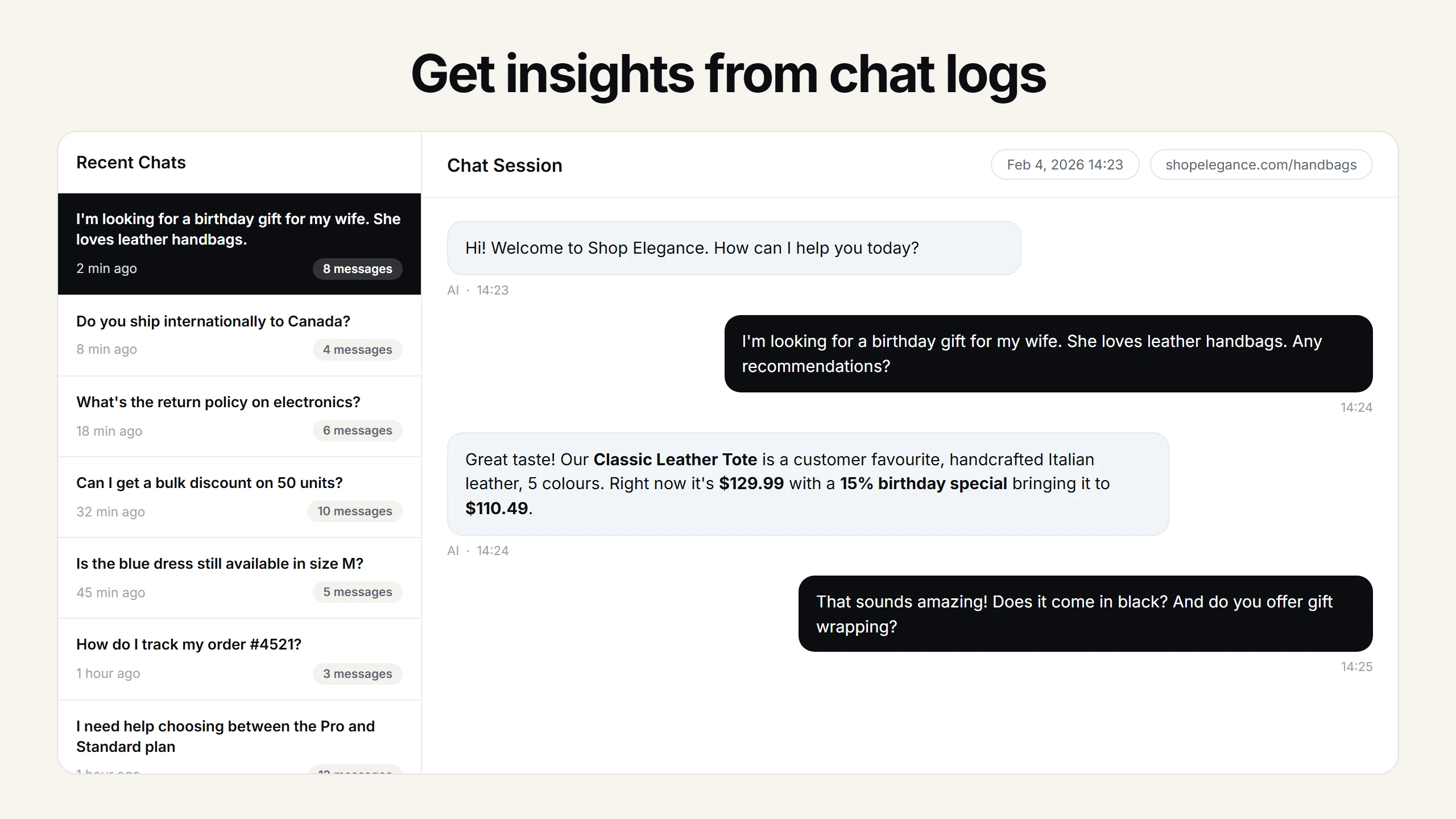
Analytics from an AI chat widget become useful in a different way than analytics from a human-agent live chat. Human chat metrics are about agent performance: response times, tickets handled per hour, customer satisfaction per conversation. AI widget metrics are about content performance: which questions come up most frequently, which pages generate the most chat traffic, which questions the widget resolves confidently versus flags for handoff, what language mix your actual audience uses. The Asyntai dashboard surfaces these patterns, and over a few months they become a prioritized edit list for your website. The widget isn't just answering questions; it's telling you which pages to rewrite to make those questions unnecessary.
Pricing is structured to match the shape of AI-powered chat usage rather than traditional per-seat live chat economics. The free tier covers 50 messages per month, enough for a small site to pilot the widget. Paid plans start at $39 per month for 800 messages, covering most mid-sized sites with healthy traffic. Higher tiers exist for sites with significant chat volume. Site limits scale with the plan (1, 2, 3, 10), relevant for agencies and multi-site operators. Traditional live chat tools charging $40-80 per agent per month become very expensive as your team grows; per-conversation pricing stays predictable as your visitor volume grows. For teams where AI-answered conversations are the majority, this is often the bigger cost difference than any specific feature.
The businesses that see the most value from an AI chat widget are the ones whose visitor traffic includes a lot of content-answerable questions. SaaS companies with active trial flows win on pre-purchase and pricing questions. E-commerce stores win on product, shipping, and return questions. Service businesses win on qualification and booking questions. Consulting and agency sites win on scope and fit questions before a prospect commits to a call. Content sites win on "where do I find X" questions that keep readers engaged instead of bouncing to competitors. Internal helpdesks — IT, HR, facilities — win on the large volume of repetitive access, procedure, and policy questions. Across all of these, the pattern is the same: wherever visitors have questions that can be answered from existing content, the AI chat widget replaces the silence with immediate, relevant responses.
Deploying an AI chat widget doesn't require changing anything else about how your team operates. Drop the snippet into your website's <head> section. Point the AI at your URL. Upload anything internal you want the widget to reference. Set colors and write a handful of instructions. Test five or six real visitor conversations to make sure the voice is right. Go live. Most teams complete the setup in under an hour and spend the following week refining instructions based on real conversations. From there, the widget works quietly — answering the questions visitors used to silently leave with, capturing the leads that would have evaporated, and producing the analytics that tell you which pages on your site need more attention.