An AI chat support tool that works on any website
Asyntai is a plug-in chat support tool for websites: one script tag, pointed at your site URL, and visitors get grounded AI answers pulled from your actual content — without a migration, a platform lock-in, or a rebuild of how your support already works.
Try the support tool on your website
Paste your site address and watch the AI answer the kind of questions your visitors actually send
A support layer that doesn't care how your website was built
Most support software assumes you live inside a specific ecosystem — a CRM, a helpdesk suite, a CMS marketplace. Asyntai is the opposite: a lightweight chat support tool for websites that loads through one snippet, so it behaves the same whether your site is a hand-rolled Next.js app, a WordPress marketing page, a Webflow build, or a twenty-year-old PHP stack nobody wants to touch.
- One snippet, any siteThe tool loads from a single script tag. Static HTML, framework SPAs, CMS builders, subdomains, staging environments — if a page can include JavaScript, the chat support tool runs.
- No platform commitmentNothing to migrate, no existing tooling to rip out. The AI chat layer sits on top of whatever support workflow you already have and complements it instead of replacing it.
- Multi-site from a single accountRun one tool across several web properties — a marketing site, a docs portal, a customer app. Free includes 1 site, Starter 2, Standard 3, Pro up to 10, each with its own knowledge base.
Built around conversations, not a queue your visitors have to join
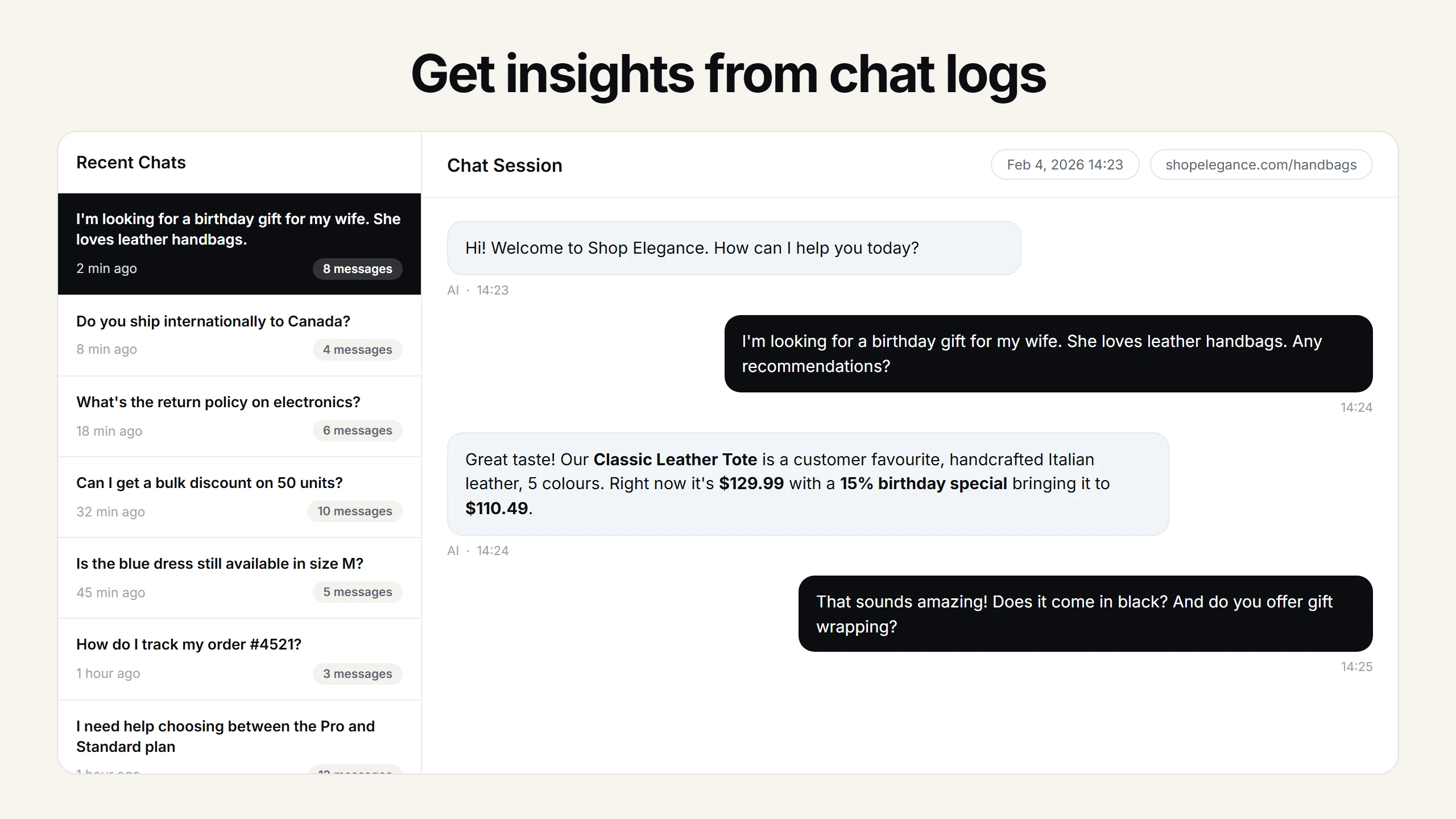
Email tickets assume the visitor is willing to wait. A chat support tool for websites meets them in the moment — at the product page, the pricing table, the checkout, the docs section — with answers grounded in the same content that page is built on. When the conversation genuinely needs a human, the tool captures the handoff cleanly instead of pushing the visitor into a separate form.
- Answers in-page, in secondsVisitors stay where they are. No "submit a ticket and wait", no portal login, no back-and-forth threads — just a threaded chat that responds immediately with content pulled from your own site.
- Lead capture as a fallback, not a gateThe chat doesn't demand an email before answering. It collects name, email, and optionally phone when — and only when — the conversation is heading toward a human follow-up.
- Dashboard plus optional email alertsEvery captured lead and full transcript lives in the Asyntai dashboard; turn on email notifications and the same thread lands in your team's inbox in real time.
Install the support tool the same afternoon you sign up
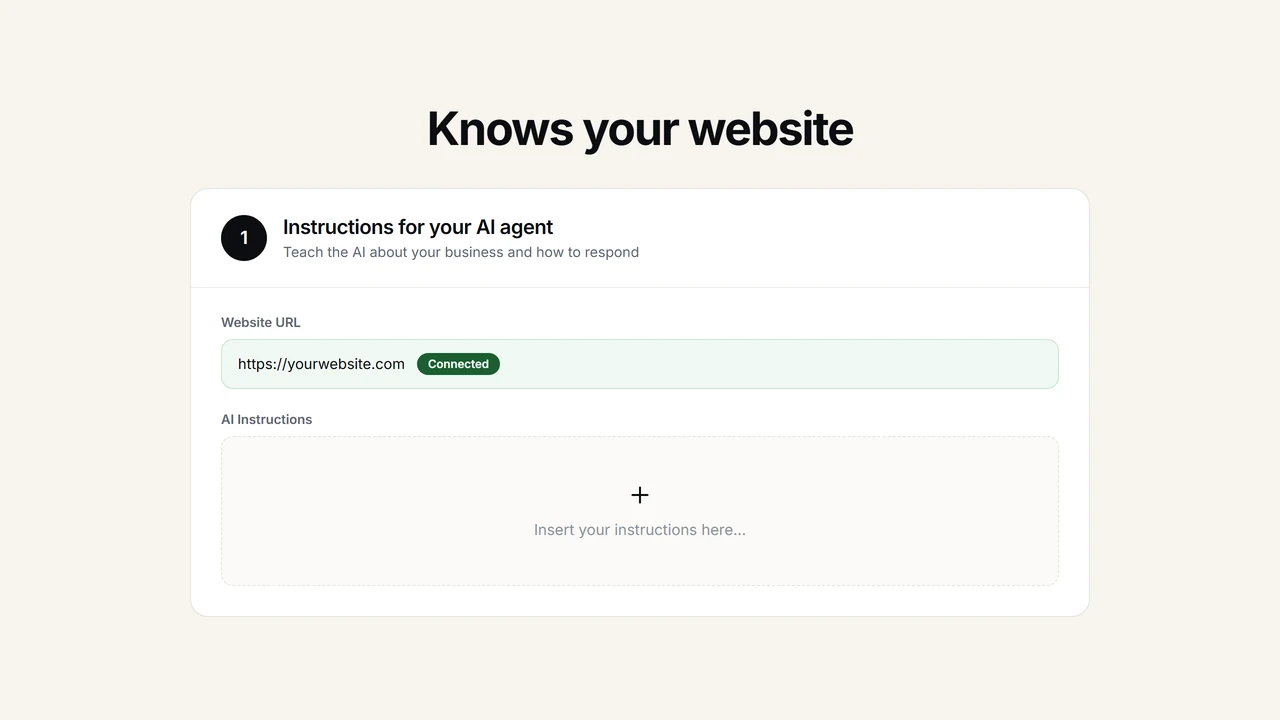
Adding a website support tool shouldn't take a sprint. Asyntai is a one-file install: paste the snippet into your site's head, point the tool at your URL so it crawls your pages, drop in any private PDFs or text notes, and it's live.
- Create a free Asyntai account and grab your unique support script.
- Paste it once into your site's
<head>— through a CMS header field, a header-injection plugin, or directly in your template. - Enter your website address in the dashboard so the tool auto-crawls your pages; upload any PDFs or paste text for content the crawler can't see.
- Add a few plain-language instructions, preview the chat, and flip it live for real visitors.
<script src="https://asyntai.com/widget.js"
data-id="your-site-id" async>
</script>
</head>
# Drop in, reload, done.
AI chat support tool for websites — FAQs
Questions that webmasters, marketing leads, and small support teams ask before dropping the tool into a live site.
Is this really compatible with any website, or are there hidden requirements?
The only real requirement is that the website can embed a JavaScript snippet in its markup. That covers essentially every modern and legacy web stack — custom builds, CMS platforms, site builders, docs generators, even single-page apps. The tool doesn't require server-side changes, a specific hosting provider, or a particular framework. If you can add a single script line to a page template, the support tool works.
What exactly is the AI using to answer questions?
Two sources, both yours. First, the tool crawls pages at the URL you point it at — product pages, help articles, pricing, policies, FAQs — and turns that content into the AI's working knowledge. Second, you can upload PDFs or paste long-form text for anything that isn't crawlable: internal notes, warranty terms, price lists, onboarding guides. The AI answers from the union of those two, so replies are grounded in your actual content rather than a generic model guess.
How is this different from just installing a regular live chat widget?
Traditional live chat waits for a human to type a reply. This tool answers the moment a visitor sends a message, using your documented content, and only pulls in a human when the conversation needs one. For a small team, that means the off-hours, the lunch breaks, and the spike-hour queues all get covered automatically. For a solo founder, it means the website can offer real support without anyone actually sitting at a chat window.
Can visitors interact in languages other than English?
Yes. The widget's interface ships in 36 languages, and the AI detects the language of each message from its first word. A visitor writing in Polish gets a Polish reply, one writing in Thai gets Thai, one writing in Arabic gets Arabic — no configuration, no per-language training, no duplicate content to maintain.
Can the chat support tool see who a logged-in visitor is?
Only if your site explicitly tells it. On Standard and Pro plans, the User Context feature lets your site pass logged-in visitor details — name, account tier, plan status, order number, anything — into a JavaScript object (window.Asyntai.userContext) before the widget loads. The AI then uses that context in its answers. Nothing is pulled server-side; your site decides exactly what the support tool is allowed to see.
What does pricing look like for a typical small website?
There's a free plan with 50 messages a month, which is enough to verify the fit on a low-traffic site. The paid entry point is $39 per month for 800 messages, and higher tiers scale both the message budget and the number of sites you can run. When the usage limit gets close, you'll get email warnings before the chat actually pauses — no silent outages mid-day.
Where do the leads from escalated conversations actually go?
Straight into your Asyntai dashboard, which lists every captured name, email, optional phone, and the full transcript that produced the handoff. If you want the same information delivered actively, switch on email notifications and your inbox becomes the second delivery channel. You can forward those emails into whatever ticketing system or CRM you already use.
Will adding the chat tool change how my existing support workflow works?
No — it layers on top. Your existing email, phone line, or ticketing system keeps doing exactly what it does today. The support tool absorbs the easy questions at the web layer before they reach your queue, and forwards the hard ones to whatever channel your team already watches. It's additive to your current stack, not a replacement for it.
Why a chat support tool belongs on the website itself
Websites were never really designed for support. They were built to sell, to explain, to announce, to convert — and somewhere along the way, a "contact us" link got added to the footer, a form was tacked onto a help page, and the whole burden of answering visitor questions got pushed off into a separate inbox that somebody else on the team would deal with later. That model was fine when web traffic was smaller and expectations were lower. It doesn't fit anymore. A visitor arriving at a modern website expects to get an answer in the same tab they're already sitting in, in the same minute, in the same language they asked in. An AI chat support tool for websites is how that expectation becomes realistic without doubling the size of the support team.
The word "tool" matters here, because it sets the scope honestly. Asyntai isn't a full helpdesk suite with ticket queues, SLA timers, routing rules, and an agent workforce management module. It's a narrower thing: a support layer that lives on the website itself, answers the questions it can answer from your content, and punts the rest to whatever system you already use for harder cases. That narrowness is the point. A tool added to an existing workflow is easier to justify, easier to install, and easier to turn off if it doesn't work than a platform that demands you rebuild your support operation around it.
The chat-based framing also matters. For years, "website support" meant a contact form that asked for an email address and promised a reply within one business day. That model treats the visitor's question as an asynchronous request — go do something else, we'll get back to you. The problem is that most website visitors aren't willing to do something else; they either get an answer in the moment or they bounce. A chat support tool collapses the round trip. The visitor asks, the tool answers, and if the question genuinely needs a human, the tool collects the details and keeps the conversation thread alive until someone picks it up. The visitor never drops into the awkward "I sent a form, now I wait" state that kills so much intent.
A fair question to raise at this point is whether the AI is actually useful, or whether it just produces generic-sounding paragraphs that sort of answer the question but not quite. The answer depends entirely on what the AI is pulling from. Generic model output — answers generated without any of your content attached — is what most people remember from the first wave of website chatbots, and it deserves the bad reputation it earned. Grounded output, where the AI is reading your actual pages and your actual PDFs before composing a reply, is a different product. Asyntai is the second kind. Every answer is drawn from the content you pointed the tool at. Where your content says "30-day returns," the tool says "30-day returns," not "typically around 30 days or so." Where your content says "free ground shipping on orders over $75," the tool repeats that exact number, not a plausible-sounding estimate.
The install process deserves its own note, because it's where most "add support to your website" projects die. Traditional support tooling requires a staging environment, a rollout plan, integration time with whatever backend system owns the customer data, and usually a kickoff meeting where someone asks about SAML. Asyntai's chat support tool for websites skips all of that. The entire install is pasting one script line into the head of your site, entering your site URL into the Asyntai dashboard so the AI can auto-crawl your pages, and uploading a handful of PDFs or text documents if you have content that isn't publicly crawlable. An afternoon is a generous estimate; most sites are live within an hour.
"Any website" is a strong claim, but it holds in practice because the tool is deliberately unopinionated about your stack. If your site is built in WordPress, you paste the snippet into a header plugin. If it's Shopify, you paste it into the theme's header file. If it's Webflow, you paste it into the custom code section in project settings. If it's a static site built from Markdown, you paste it into the template that wraps every page. If it's a single-page app built in React, Vue, Svelte, or anything else, you paste it into the main HTML file the framework renders into. The support tool doesn't care — it just wants a script tag somewhere in your markup. That universality is why teams with mixed stacks — a WordPress marketing site, a custom product dashboard, a docs site built in a static generator — can run one support tool across all of them from a single dashboard.
The multi-site angle ends up being more useful than it sounds in the abstract. A growing business rarely ends up with a single website; it ends up with several — the main brand site, a support docs subdomain, a separate landing page for a campaign, sometimes a separately branded sub-product. Running four different support tools, each with its own login and billing and content to keep in sync, is painful. Running one tool on four sites, each answering from its own URL and its own uploaded documents, is sane. Free supports one site, Starter two, Standard three, and Pro up to ten — enough that a small agency running chat support for client sites can do it from one account without a per-client license.
Personalization is the other place where the "tool" framing earns its keep. Most support platforms expect deep backend access: they want API credentials to your user system, permission to pull order details, a webhook into your billing provider. That kind of integration is a multi-week project on a good day and a political fight on a bad one. Asyntai takes the lighter approach via User Context on Standard and Pro plans. Your site passes whatever logged-in details you want into a window.Asyntai.userContext object before the widget loads — name, plan tier, subscription status, last order — and the AI uses that context to answer personalized questions like "when does my plan renew" or "what's the status of my latest order." Because the data is pushed rather than pulled, you control exactly what the tool sees. It only has access to the fields your own code chose to hand it.
Where the chat support tool sits in the escalation flow is worth naming plainly. The AI handles what it can handle confidently; everything else gets a clean handoff. When a conversation reaches a point where a human follow-up is needed — a refund approval, a custom quote, a sensitive complaint, an edge-case account issue — the tool asks for the visitor's name and email (and optionally phone), captures the full conversation up to that point, and delivers the bundle into the Asyntai dashboard. Turn on email notifications and that same bundle arrives in your team's inbox in real time. From there, whatever you already use — Gmail, Zendesk, Intercom, Help Scout, a shared Slack channel, a sticky note on someone's monitor — picks up the thread. The tool doesn't try to be the system of record. It hands off cleanly and gets out of the way.
Languages are the hidden lever for any website with international visitors. A tool that only speaks English on a site that attracts non-English visitors is actively hurting the conversion of that segment. The Asyntai widget ships its UI in 36 languages, and the underlying AI replies in whatever language the visitor wrote in — detected from the first message, no settings panel to configure. That capability matters disproportionately for businesses whose international traffic is growing but whose support hiring hasn't caught up. A French visitor to a US-based site can get a French answer instantly; a Japanese visitor gets a Japanese answer; a Portuguese visitor gets Portuguese. The tool turns the website into a polyglot support layer without the team needing to hire a polyglot.
Pricing, in the spirit of matching a narrow tool to a narrow budget, stays light. The free plan gives 50 messages a month — enough to install the tool on a low-traffic site and confirm it's actually answering real visitor questions usefully before committing. The paid tier starts at $39 a month for 800 messages, which covers typical visitor chat volume on most small websites. Higher tiers stretch both the message budget and the number of sites you can run the tool on. Before you hit a usage ceiling, email warnings arrive in advance — so a launch day doesn't silently knock the chat offline just when attention is highest.
Use cases for an AI chat support tool for websites tend to cluster. Service businesses drop it on their website to qualify inbound prospects without making them fill out a form first — the tool asks the right questions, captures the lead, and sends it into the pipeline. E-commerce stores use it to answer the shipping and returns and sizing questions that otherwise eat the most live-chat hours. SaaS companies deploy it on their marketing site and their docs portal as a reading layer — visitors ask a natural-language question and get a grounded answer instead of digging through a help center. Local businesses with mostly-informational sites use it to answer hours and location and menu questions at 2am without a human in the loop. Each of these is a narrow use case; the tool works because it doesn't try to be more than a narrow tool.
Common objections are worth answering directly. "Our visitors won't trust an AI chat" is mostly resolved by the tool being grounded in your content — visitors can verify the answer against the page they're already on, and the conversation tone stays specific rather than vague. "We don't want to replace our human support" isn't what this tool does; it's explicitly additive, catching the easy questions so the humans can focus on the harder ones. "We already have a helpdesk" is fine too; the chat support tool lives at the web layer, ahead of the helpdesk, and routes the escalations into it rather than competing with it. "We'll need weeks of engineering time" is the one the snippet-level install genuinely makes untrue — most sites are running the tool the same day they installed it.
Everything up to this point has treated the chat support tool as something bolted onto a website. That framing is accurate today, but it undersells where the role is heading. A website that answers questions well — in real time, in the visitor's language, from the site's own documented content — stops being a static marketing artifact and starts being an interactive one. The pages still convert. The forms still submit. The checkout still checks out. But the support layer underneath them is responsive now, not asynchronous; specific, not generic; multilingual, not English-only; available at 3am, not just during business hours. A chat support tool for websites is how that shift happens incrementally, without a rebuild, and without a multi-quarter project plan. Paste the snippet, crawl the content, switch it on, and the website starts behaving the way visitors already expected it to.