An AI assistant for website visitors — proactive, not passive
Asyntai ships an AI assistant for website owners who want more than a reactive chat box. It greets visitors, anticipates what they're looking for, answers in 36 languages, and installs on anything that accepts a script tag.
See the AI assistant running on your own site
Drop in your URL and preview how the assistant would welcome and guide your actual visitors
Works on any website — not tied to one CMS or builder
A real AI assistant for website deployment shouldn't care whether you're on WordPress, a Webflow landing page, a Wix portfolio, a Ghost blog, a handwritten HTML file, a Django app, or something bespoke your developer built last quarter. The Asyntai assistant is platform-agnostic. One snippet, any stack, identical behavior.
- CMS, builder, or custom — same pathIf the platform lets you inject anything into the page header, the assistant will run there. No adapter plugins to maintain, no platform-specific quirks, no feature-parity gaps between builders.
- Single-page apps and static sitesReact, Vue, Astro, Next.js marketing pages, static Jekyll sites, plain HTML — the snippet loads asynchronously and boots once the page is ready, regardless of how the rest of the site is rendered.
- Staging and production, same snippetKeep the same assistant configuration across your staging environment, preview domains, and live site. What you tested is what your visitors get.
An assistant that opens the conversation, not a box that waits
Most website chat is passive. Visitors ignore the little bubble in the corner because it's asking them to do the work. An AI assistant for website use earns its name by starting helpful conversations at the right moment — with a welcome line tailored to the page, a nudge after a visitor has been reading for a while, or a specific prompt on pages where questions predictably stall.
- Context-aware greetingsDifferent welcome lines per page type — a pricing-page visitor gets a pricing-flavored opener, a blog reader gets something gentler, a returning visitor gets something different from a first-timer.
- Suggested first questionsRather than a blank input box, visitors see a handful of clickable starter prompts pulled from the most common real questions on your site — lowering the barrier from "type something" to "tap one of these."
- Quiet when it needs to beProactive doesn't mean annoying. The assistant respects dismissals, stays out of the way on checkout and form pages, and adjusts its behavior based on how visitors have responded in aggregate.
Add it to your website in the time it takes to pour coffee
Any website that accepts a script tag can run the assistant. Paste the snippet into your <head> — through your CMS header setting, a theme file, a Google Tag Manager container, or directly in your template — and the assistant boots on every page automatically.
- Create a free Asyntai account and grab the snippet assigned to your site.
- Drop it into the header of your website — via your CMS, a tag manager, or a hand-edited template.
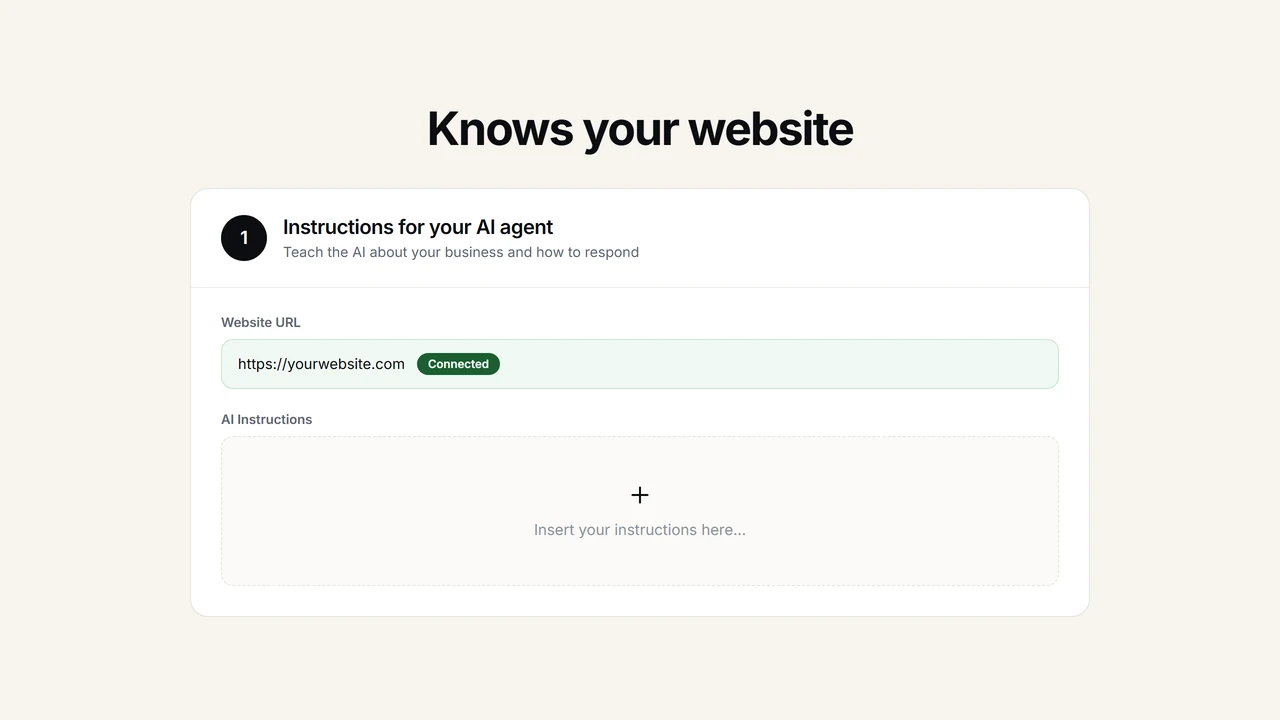
- Feed the assistant your site URL so it learns your content, and add any private PDFs it should know about.
- Review a few sample conversations, pick a launcher color that fits, and publish.
<script src="https://asyntai.com/widget.js"
data-id="your-site-id" async>
</script>
</head>
# Live on every page of the site.
AI assistant for website — common questions
What site owners usually want clarified before rolling it out across their pages.
What kind of websites does this fit?
Nearly any kind. Portfolios, product stores, SaaS marketing sites, service-business pages, documentation hubs, membership sites, course platforms, niche communities, association pages, personal blogs with traffic worth monetizing — if visitors arrive and potentially have questions, the assistant has a job to do. The feature set doesn't change based on industry; only the knowledge base does.
Do I need to be on a specific platform?
No. The assistant is a plain JavaScript snippet, so it's compatible with whatever builds your site — commercial CMS platforms, open-source frameworks, static site generators, JAMstack deployments, even handwritten HTML hosted on a bucket. If the environment permits a script tag somewhere in the page, the assistant runs.
Will installing it slow my pages down?
The snippet loads asynchronously, meaning it doesn't block the rest of your site from rendering. Visitors see your hero, images, and interactive elements on the usual timeline — the assistant finishes initializing in the background and becomes available shortly after. The launcher itself is a small button; the full chat interface only loads if a visitor opens it.
What does the assistant actually know about my website?
When you connect your site, the assistant reads your publicly accessible pages and builds a working memory from them. Anything published — product descriptions, team pages, service details, blog posts, FAQs, terms — becomes part of what it can reference. For internal documents that don't belong on a public URL, upload them as PDFs or paste the text directly, and they join the same knowledge layer.
Is there a limit on how many pages it can learn from?
Practically, no. The crawler handles sites with hundreds or thousands of pages. Very small sites with fewer than a dozen pages work equally well — the assistant simply has less surface area to reference. You can also narrow or widen what gets indexed if you'd rather the assistant ignore certain sections, like a legacy archive or a staging subdomain.
Can the assistant recognize signed-in visitors?
Yes, through User Context on Standard and Pro plans. Before the widget loads, your site pushes information about the current visitor into a lightweight JavaScript object — name, membership tier, order status, anything you want the assistant to know. The AI uses that to give answers relevant to that specific visitor, without needing a backend API hookup. Your website chooses what to share; the assistant only sees what you pass in.
Does it handle visitors from different countries?
Comfortably. The interface is localized into 36 languages, and the AI picks up the visitor's language from the first message they send. A Spanish speaker typing in Spanish gets Spanish replies; a Korean visitor gets Korean; a Czech visitor gets Czech — all from the same single install, without per-language configuration.
What do plans look like in practice?
Free for 50 messages per month on a single website, no card required to start. Paid plans kick off at $39 per month for 800 messages with two connected websites. Higher tiers lift the quota and the site count — Standard allows three, Pro up to ten — which matters if you run multiple web properties or manage sites for other people.
Where do captured visitor details end up?
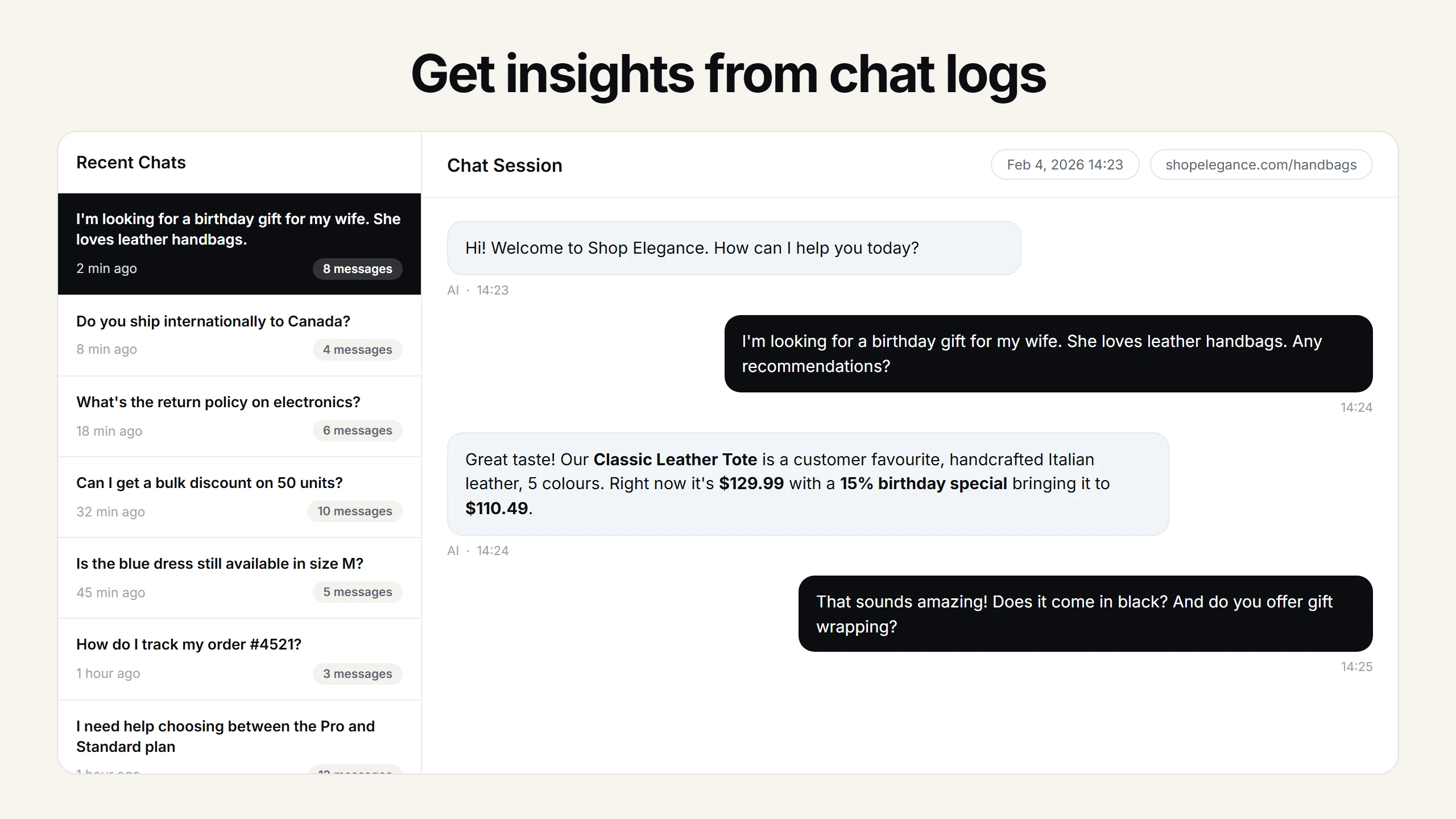
Inside your Asyntai dashboard, complete with the full conversation attached. Turn on email alerts and the same details land in whatever inbox you point them at, in real time — so you can feed them into your existing CRM, spreadsheet, or email workflow without any integration step.
AI assistant for website use — a practical guide
Most websites are built on a quiet assumption: that the visitor will find what they need, work out what to do next, and take action without any help. Sometimes that assumption holds. A visitor with clear intent, landing on a well-designed page, will usually self-serve just fine. But the majority of website traffic is fuzzier than that. Visitors land with half-formed questions, uncertain about whether the thing they're looking at is right for them, unsure where to click, unclear on a specific detail that would tip their decision — and because there's no one to ask, they leave. An AI assistant for website traffic exists to fill that silent gap. Not to replace the site's design, not to paper over bad content, but to answer the specific questions that people would have asked a human if a human had been available.
The phrase "AI assistant for website" deserves unpacking because it gets used loosely. Some people mean a scripted chatbot. Others mean an analytics overlay. A third group means a recommendation engine. What actually delivers value for most website owners is narrower: an AI layer that reads the existing content of the site, understands natural-language visitor questions, answers them in the visitor's own language, captures contact details when intent is high, and hands off clean context to the human owner when a conversation needs escalation. Anything less gimmicky is usually less useful; anything more elaborate usually requires engineering time the site owner doesn't have. The sweet spot is an assistant that does those five things well and stays out of the way otherwise.
Universal applicability is the feature that matters most for website owners who don't want to be locked into one ecosystem. The Asyntai assistant runs identically on whatever built your site. A WordPress blog, a Webflow-designed marketing page, a Ghost publication, a handwritten HTML portfolio hosted on a static bucket, a Django-backed application, a React-rendered SPA — the install is the same script tag, and the behavior is the same across all of them. There's no platform where the feature set shrinks or the integration gets awkward. This matters in practice because websites get rebuilt. A Webflow site today might migrate to a custom Next.js stack next year, and an AI assistant tied too tightly to one builder becomes friction in that transition. A snippet that works everywhere travels with you.
Proactivity, the way a useful assistant demonstrates it, is subtle. The failed version of proactive chat is the one most web users have been trained to dismiss: a pop-up appearing three seconds after page load, a fake agent photo with "Hi, do you have any questions?", a sound effect, a badge demanding attention. That kind of proactivity gets ignored because it's the same noise every site makes. A real AI assistant for website engagement behaves more like a good retail associate: aware of what you're looking at, ready to step in when you linger on a decision, silent otherwise. Asyntai handles this with context-aware greetings that differ by page type, starter-question suggestions pulled from what your actual visitors ask, and sensible defaults that stay quiet during high-focus moments like checkout, signup, and contact forms.
Content-grounding is the bedrock of whether an assistant is actually trustworthy enough to deploy on a website you care about. A generic AI model, asked a specific question about your site, will confidently invent details that sound right. The assistant has to be constrained to your own content — and only your own content — for its responses to be safe to put in front of paying visitors. Asyntai's assistant crawls your public pages, ingests whatever you upload as internal documents, and answers from that combined source. When a visitor asks something outside the knowledge base, the assistant is instructed to collect contact details and hand the question to you rather than guess. This is not a default you want to trust the vendor on; if you're evaluating any tool in the category, test a few edge-case questions deliberately before going live.
Languages turn out to be a bigger lever than most website owners realize until they look at their analytics. Any site with meaningful organic reach ends up with visitors in languages the owner doesn't personally speak. The traditional response is either to ignore those visitors or to run separate translated versions of the site, both of which leak significant potential value. An AI assistant that handles 36 languages in the interface and detects the visitor's language from a single message bridges the gap without duplicated infrastructure. A site can remain monolingual in its published content while its assistant operates fluently across any visitor who shows up — a Portuguese visitor reading an English site still gets Portuguese answers to their questions, without the site having to maintain a Portuguese version.
Logged-in experiences deserve their own consideration for any website with member accounts, subscriptions, or a customer portal. Generic website assistants are designed for anonymous traffic; anything they say to a logged-in user lacks the specificity that makes logged-in experiences valuable in the first place. Asyntai's User Context feature, available on Standard and Pro tiers, solves this elegantly: your website pushes a small JavaScript object with details about the currently logged-in visitor right before the widget loads, and the assistant uses those details to personalize every response for that session. There's no API integration and no credential to rotate. You control, per session, exactly what the assistant can see. For sites with member accounts, this is often the difference between a chat tool that feels useful and one that feels like an afterthought.
Lead capture is where a website assistant quietly earns its keep. Most sites have a contact form tucked somewhere in the footer or behind a "Get in touch" button, and most visitors never fill it out. The friction is usually emotional rather than practical — they don't know what to say in the message field, they're not ready to commit to "contacting sales," they haven't formulated what they want. A conversational assistant lowers that friction dramatically. The visitor asks a question, gets a useful answer, and mid-conversation is offered a way to stay in touch — an email address in case the team can help further, a phone number if they'd like a direct callback. Captured details flow into the Asyntai dashboard with the full chat attached, and optionally into your email inbox in real time, ready to slot into whichever follow-up process you already use.
Analytics from the assistant become a second-order benefit that shows up after a month or two of live traffic. Every conversation reveals what visitors actually want to know — not what you assumed they wanted to know when you wrote the page. Patterns emerge quickly: one FAQ question keeps showing up because your services page doesn't address it clearly; one product detail gets asked repeatedly because it's buried below the fold; one policy is constantly misread because the language is too formal. Rather than guessing at conversion-rate-optimization experiments, you get a prioritized list of the things your own visitors have told you are unclear. The website improves because the assistant's running a continuous, honest user-research interview with every arrival.
Pricing is structured to make the assistant viable at any website size. The free tier covers 50 messages per month on one site, which is plenty for testing or for a very small site's total volume. Paid plans begin at $39 per month for 800 messages and two sites, a combination that covers most small-to-mid-traffic sites comfortably. Higher tiers lift message quotas and expand the site count to three (Standard) or ten (Pro), which is the tier that makes sense for agencies, multi-brand operators, or individuals running portfolios of web properties. Before a billing cycle hits its cap, email warnings go out, so a traffic spike doesn't silently shut off the assistant mid-month. You can start at no cost, watch how the assistant actually performs on your site, and decide whether the paid tier pays itself back.
The category of websites that benefits most is broader than it first looks. Obvious wins: SaaS marketing sites converting trial signups, e-commerce stores answering product questions, service businesses qualifying inbound prospects, professional sites handling initial inquiries. Less obvious but genuine wins: content-heavy blogs where readers have follow-up questions the author can't respond to individually; documentation sites where users get stuck on specific pages; membership sites where new members need onboarding guidance; local-business websites where after-hours visitors currently have no path to an answer; association and nonprofit sites where prospective members want to clarify eligibility. The common factor is simply: visitors arriving with questions that can be answered from existing material. Any website matching that description is a candidate.
Setup, realistically, is the short part. Create an account. Paste the snippet. Let the crawler ingest the site while you handle something else. Write two or three plain-English instructions — "always offer a consultation when a visitor mentions budget," "stay formal in tone," "link to the case-studies page when asked about past work." Test a handful of real conversations as if you were a visitor. Publish. The first month teaches you what your visitors actually ask; the second month is where you fine-tune the instructions; by the third month the assistant operates largely without attention, pulling its weight in the background and showing up in the dashboard whenever a new lead or notable conversation arrives. For any site where visitors outnumber the hours the owner has to answer them, this is one of the cheapest high-leverage additions available.