A 24/7 customer support chatbot that never clocks out
Asyntai answers your customers at 3am, on Boxing Day, during the overnight shift in Tokyo, and while your team is asleep in London. One script tag, 36 languages, zero overtime pay — round-the-clock support coverage without a round-the-clock payroll.
Try the 24/7 chatbot on your own site
Drop in your URL and watch how overnight, weekend, and timezone-mismatch tickets would get handled automatically
The 3am customer gets the same answer as the 3pm one
Most support tickets don't politely wait for office hours. A genuine 24/7 customer support chatbot means the visitor browsing at 2:47am on a Tuesday gets a real answer — not a "we'll reply within 24 hours" autoresponder that sends them to a competitor before breakfast.
- Weekends and holidays includedYour chatbot doesn't recognize Saturdays, Easter Monday, or the week between Christmas and New Year as reasons to stop replying. Coverage is identical on Tuesday afternoon and Sunday midnight.
- No overnight shift to staffHiring humans for graveyard-shift chat is painful: recruitment, premium wages, retention, burnout. The AI handles overnight volume at the same rate as daytime volume — no shift differential.
- Sick days don't degrade serviceFlu season, family emergencies, burnout leaves — whatever thins your human roster doesn't touch chatbot availability. Uptime depends on infrastructure, not on whether someone set an alarm.
Tokyo at breakfast, New York at lunch, London at tea — all live
Running a support team that actually covers every timezone your customers sit in means hiring in at least three regions, managing three sets of payroll, and crossing your fingers that handovers don't leak context. A 24/7 chatbot skips the logistics entirely.
- Simultaneous sessions, not queuedFifty visitors from fifty timezones can all chat at once. There's no "you are 7th in line" apology when morning rush hits Sydney while evening rush hits Madrid.
- Multilingual by defaultCustomers write in their own language and get answers in it. 36 UI languages plus AI that follows whatever tongue the visitor opens with — the timezone and the language problem get solved with the same widget.
- Handoff captures the full contextWhen a case truly needs your human team, the transcript and lead details land in your dashboard (and optionally your email) so the agent who picks it up the next business morning already knows what happened overnight.
Live on your site tonight — not next quarter
Standing up genuine round-the-clock support used to demand a multi-region hiring plan. Asyntai compresses that into a paste-and-train workflow you can finish between coffee and lunch, and your first overnight shift is covered before the sun goes down.
- Create an Asyntai account (100 free messages, no card) and grab your widget snippet.
- Place the snippet inside the
<head>region — via your CMS, a header-injection plugin, or directly in the theme file. - Feed Asyntai your site URL so it ingests your pages, and upload any after-hours procedures your agents usually follow.
- Add plain-English rules for what the bot can and can't commit to overnight, then flip it live.
<script src="https://asyntai.com/widget.js"
data-id="your-site-id" async>
</script>
# Answers at 02:00. Answers at 14:00. Same widget.
24/7 customer support chatbot — questions we get
Things operations leaders and founders ask before swapping their overnight voicemail for an AI chatbot.
What share of our chats actually happen outside 9-to-5?
For most consumer-facing sites, a meaningful chunk of chat volume lands between 7pm and 9am local, plus all day on weekends. If you sell internationally, that share climbs further because foreign daytime is your nighttime. Teams that switch on a 24/7 chatbot and then check their analytics after a fortnight are usually surprised by how much of the traffic was never being captured by their daytime team at all.
Is the overnight version the same quality as the daytime version?
Yes — there's no "after hours mode" that downgrades replies. The same knowledge base, the same escalation rules, the same tone settings apply at 4am and at 4pm. A visitor who chats while your office is dark gets the same depth of answer as one who chats while every seat is filled.
What happens when the chatbot can't answer something at 2am?
The bot collects the visitor's contact details — first name, email, phone if you enable it — stores the full chat thread against your dashboard, and fires an optional email alert the moment the handoff is triggered. Your team picks up the conversation when they're back at their desks, with the overnight context already attached. The visitor knows a human reply is coming, rather than feeling blanked until morning.
Can we restrict what the bot is allowed to promise overnight?
Yes. You write the overnight boundaries as normal-English guardrails in your settings. Teams commonly tell the bot things like "never commit to a delivery date outside posted cutoffs", "don't confirm refunds above $200 without escalating", or "for any complaint about damaged goods, collect details and promise a human reply next business day". Those rules apply around the clock and across every language.
How does 24/7 coverage work with 36 languages?
The two features stack. The widget UI translates into 36 languages, and the AI answers in whatever language the visitor opens the conversation in. So a Spanish speaker messaging during their Tuesday evening (while you're asleep in your timezone) gets a fluent Spanish answer immediately — no language gap on top of the timezone gap.
Can it recognize a logged-in customer during the middle of the night?
If you're on Standard or Pro, yes. Before the widget boots, your own site drops the visitor's details — name, tier, subscription status, last order, whatever you decide to expose — onto window.Asyntai.userContext for the bot to read. That context lets the chatbot tackle account-specific questions at 3am without any overnight engineering rota standing by.
What if traffic spikes overnight and we blow past the message cap?
Warning emails arrive well before the cap is actually hit, so you can upgrade or top up proactively. If the cap is reached, the bot pauses replies until the next cycle or until you increase your plan. Paid plans start at $39/month for 800 messages, and a surprise overnight traffic surge is exactly the scenario the alerts are designed to prevent you sleeping through.
Can we run one chatbot per brand on multi-site businesses?
Yes. The site allowance rises with your tier: Free covers a single property, Starter doubles that, Standard triples it, and Pro reaches ten sites. Each property has its own separately trained knowledge base, its own escalation rules, and its own conversation log, so a portfolio of brands can each have their own overnight persona without leaking content between them.
Why 24/7 coverage is the unfair advantage most support teams skip
If you pull the timestamps on a year of chat traffic and plot them on a clock face, the result surprises almost every support lead who does it for the first time. The daytime bars are tall, as expected. The evening bars are taller than most people predict. The late-night bars exist — smaller, but they exist — and on weekends the whole histogram flattens into a band that looks nothing like the Monday-to-Friday, 9-to-5 shape most support rotas are built around. The gap between when people actually want help and when support is actually staffed is the single most expensive thing on most customer-experience dashboards, and a 24/7 customer support chatbot is the cheapest tool available for closing it.
The financial comparison is worth stating plainly because it reframes the whole project. Paying a human agent to cover a Tuesday 3am shift in your home market costs what it costs: base wage, shift differential, management overhead, recruiter fees, the replacement cost when someone quits after six months of circadian abuse. Paying another human to cover Saturday afternoons costs about the same. Paying a third to cover the bank holidays costs similar again, often more because holiday rates kick in. Stack those up into a genuinely 24/7 rota and you're carrying a payroll that, for most mid-sized teams, exceeds the entire monthly bill of any chat tool on the market by an order of magnitude. Asyntai's $39-per-month starting plan is less than a single overnight shift of an outsourced agent, and it covers every hour of the week rather than one eight-hour slice.
The nuance most articles on overnight support miss is that not every ticket needs a human even during business hours, let alone outside them. The bulk of the chats arriving at 2am are the same kinds of chats arriving at 2pm — shipping status, return policy, password resets, pre-sale pricing, basic account queries, product specs. These are not complex judgment calls. They are questions with answers that already exist on your site somewhere, and the visitor either couldn't find the answer or preferred to ask rather than hunt. A grounded chatbot — answering from your actual content, not a generic web model — answers those the same way your daytime agents would, in seconds, and does it as readily at 3:17am as at 3:17pm.
Where 24/7 coverage gets genuinely strategic is in the timezone problem. Any business with customers in more than one region is silently running a support-quality lottery. If you sell worldwide but staff only in Central European Time, every American buyer has a six-to-nine hour wait from their evening purchase until a human in your office wakes up. Every Australian buyer is waiting the better part of a day. The customer doesn't measure your service quality in "median response time across all tickets" — they measure it in "how long did my specific ticket sit there". For the buyer who gets lucky and messages during your working afternoon, service is excellent. For the buyer who messages during your overnight, service looks broken. A 24/7 chatbot flattens that experience. The Sydney customer and the Madrid customer both get immediate, content-grounded replies, regardless of where your office sits on the globe.
Multilingual coverage compounds the timezone benefit in a way that deserves its own paragraph. Staffing a human team that speaks Spanish, Portuguese, French, German, Japanese, and Korean is already expensive. Staffing that same roster across three shifts to cover 24 hours is, for most companies that aren't in the Fortune 500 bracket, simply not going to happen — you'd need dozens of agents before the first ticket arrived. The Asyntai widget ships with 36 interface languages, and the conversational AI on top of it answers in whichever language each customer happened to write in. A Brazilian customer messaging at their 10pm — which happens to be your 2am — gets a Portuguese answer grounded in your help content, with no scheduled agent anywhere in the world who needed to be awake for it to happen. The two hardest problems in global support, "too many timezones" and "too many languages", turn into the same solved problem under one script tag.
There is a cultural side to this that ops leaders recognize but rarely put into slide decks. Overnight shifts corrode teams. The people willing to take them skew toward the early-career end, tend to burn out quickly, and usually treat the role as a step to something else. Churn runs high, training investment doesn't pay back, and the quality of overnight service drifts downward over the year as you cycle through hires. Shifting the overnight workload to an always-on chatbot — with human escalation for the minority of cases that need it — means your experienced agents spend their energy on the tickets where human judgment genuinely matters, and nobody has to file sick against a 10pm-to-6am rota.
Holidays are the other category where the math bends sharply. Public holidays vary by country, cluster around predictable weeks, and create the situations where support volume is counter-intuitively high — because your customers are at home with time to deal with admin they've been putting off. Stocking a human team during Christmas week means paying holiday rates to a minority of staff while the majority are at home with family. Running a 24/7 chatbot through the same week means you wake up on 27 December to an inbox full of escalations that were already triaged, name-and-email captured, and full conversation transcripts delivered — plus a long tail of simpler questions that never needed a human at all because the bot handled them while you were asleep under a tree.
A reasonable objection is that customers can tell the difference between a bot and a human, and some of them resent the substitution. Both things are partly true, but neither is the whole picture. What customers actually resent is being fobbed off — getting a canned response to a specific question, being trapped in a decision-tree that doesn't match their situation, or being told to open a ticket and wait. A chatbot that reads their natural-language question, pulls the relevant answer from your actual site content, and replies in seconds is faster and more useful than an email autoresponder promising a reply within 24 hours. The survey data that does exist consistently shows customers rate speed-to-answer above channel preference. At 2am, speed-to-answer from a trained AI beats an overnight voicemail any day of the week.
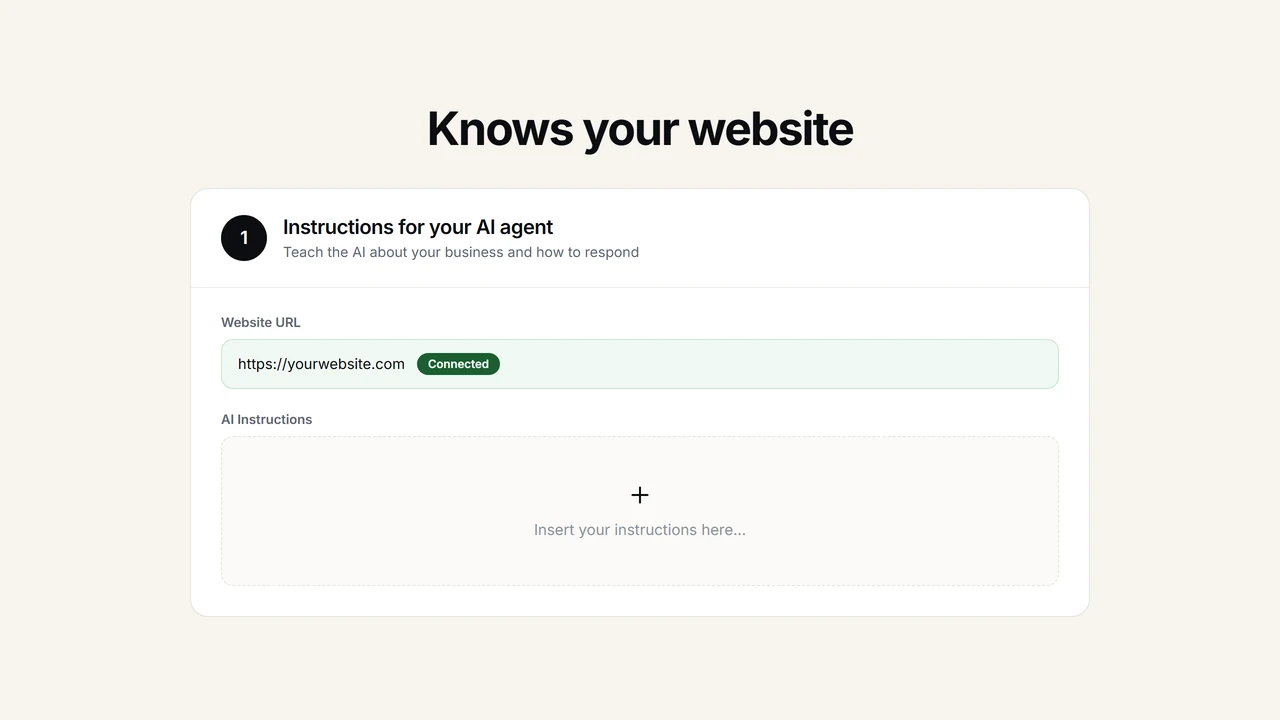
Training the overnight chatbot is the part that disarms teams expecting a six-week project. You don't write scripts. You don't build conversation trees. You point Asyntai at your site URL, let it crawl your help center, FAQs, pricing pages, shipping policies, and product descriptions, and in minutes it has the same working knowledge your tenured agents do. You then upload anything private the public site doesn't carry — the operations handbook for edge cases, the carrier-specific cutoff tables, the warranty scripts your second-line team uses — as PDFs or pasted text. Custom instructions cover the rest: escalation thresholds, tone, promise limits. An afternoon of setup and the bot is ready to cover tonight's overnight, not next quarter's.
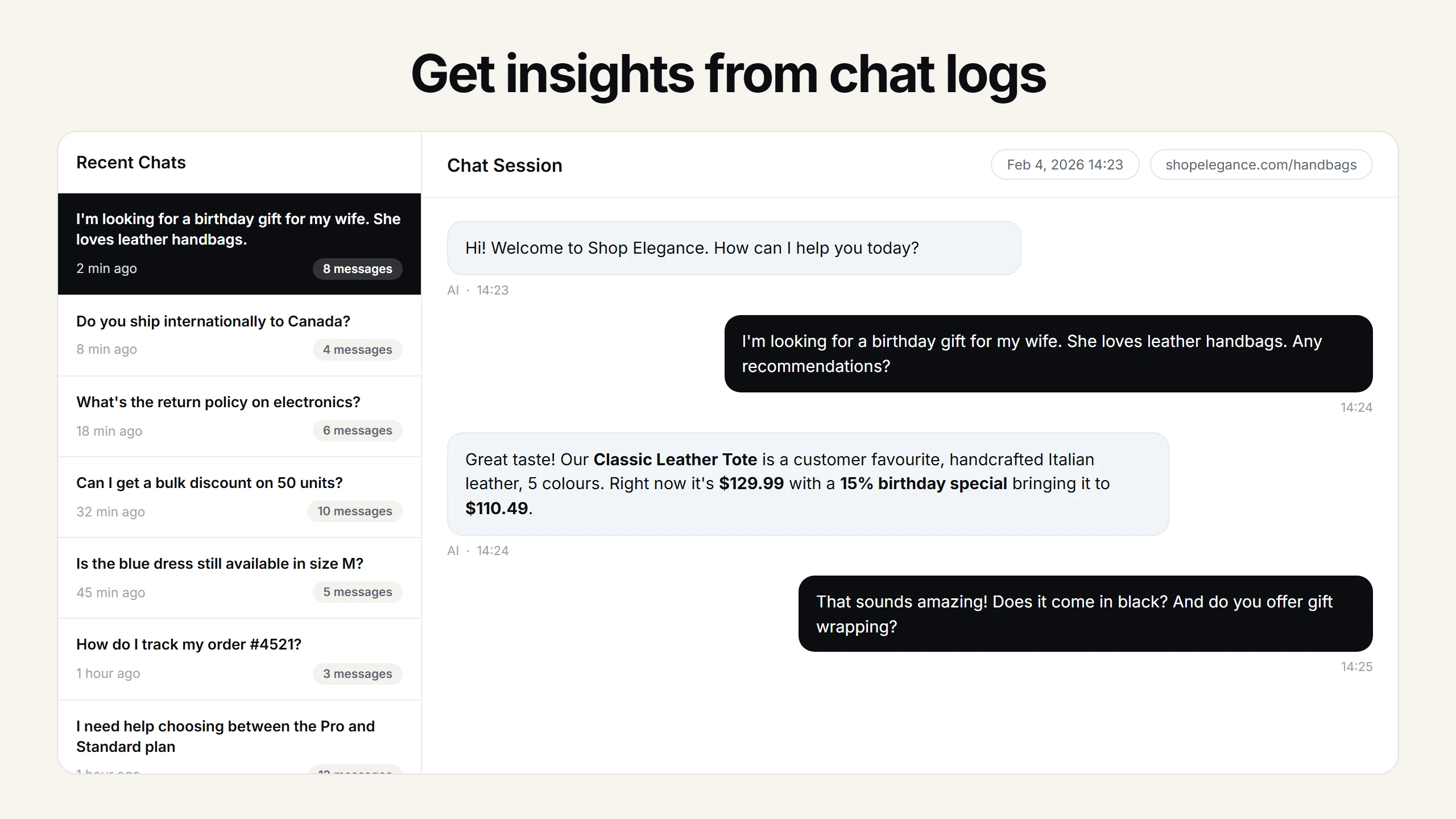
Something worth pointing out about overnight analytics specifically is how valuable the data becomes. Because the bot logs every conversation, and because tagging overnight vs daytime chats is trivial, you end up with a clear view of what your customers ask when nobody is watching. That dataset is a goldmine for product and documentation. Maybe half of the 3am questions are about a single confusing step in your checkout flow — suddenly you know which paragraph of your help center needs a rewrite. Maybe Brazilian customers keep asking the same thing your Portuguese help page doesn't currently answer — suddenly you know which page to translate first. A 24/7 chatbot isn't only a deflection tool; it's the instrument that tells you what your support site is failing to explain, grouped by hour, language, and topic.
Escalation mechanics deserve real attention because they're what separates a 24/7 chatbot that earns trust from one that frustrates people. The rule of thumb Asyntai is built around: the AI should handle what it can clearly handle, should admit what it can't, and should hand off with full context when a human is the right answer. Overnight escalations aren't lost — they're queued with a complete transcript, the visitor's contact details, and any account context passed via User Context. When your team logs in the next morning, they're not starting cold — they're picking up a conversation that already has shape. The visitor meanwhile knows a human follow-up is coming, which is a radically different experience from hitting a silence until someone gets to the inbox.
The pricing tiers are worth mapping to the 24/7 use case explicitly. The Free plan lets you cover one site with 50 messages to see how much overnight volume you're actually getting. Starter at $39/month runs two sites at 800 messages — enough for most small brands to cover both daytime and overnight traffic on a single property, or to split across two brands. Standard adds User Context so your logged-in members can get account-specific overnight answers, plus three sites. Pro scales to ten sites for agencies, multi-brand retailers, and groups running distinct chatbots per property. None of those tiers gate 24/7 coverage — the clock doesn't care about your plan, because the bot was always going to run all the time anyway.
Closing the loop on the business case: a 24/7 customer support chatbot isn't a luxury upgrade for big enterprises. It's the cheapest, fastest way to stop leaking customers during the exact hours when most of your competition is doing the same. Installing Asyntai in the <head> of your site tonight means your overnight is covered by tomorrow's overnight. The chatbot will quietly answer the questions that would have become voicemails, escalate the few that need human judgment, work across every timezone you sell into, switch languages without being asked, and hand you a dashboard full of patterns to act on the next time you rewrite a help page. Round-the-clock support used to mean a round-the-clock payroll. It doesn't have to anymore.